Risks of Representing Yourself in a Personal Injury Case: What to Know Before You Decide
Learn the key risks of representing yourself in a personal injury case, from missed deadlines to undervaluation, before negotiating with insurers alone.
Could handling your claim yourself cost you evidence, compensation, or legal options you don’t know you have? The risks of representing yourself in a personal injury case can go beyond missed paperwork. You may also need to assess your claim’s value, track deadlines, and respond to an insurer while you’re still recovering.
It’s understandable to consider managing a case alone, especially if you’re concerned that attorney fees could outweigh your recovery. But self-representation means taking on the legal, evidence-gathering, and negotiation work yourself, often while dealing with professionals who handle claims every day.
This article explains where a claim can be put at risk, how attorney assistance compares, and what to gather before requesting a case evaluation. You’ll learn why deadlines and court procedures matter, how evidence gaps or claim valuation can affect your options, and what to ask about fees before deciding. An evaluation can help you consider whether professional representation may fit your circumstances. Accident Lawyers Hotline evaluates motor vehicle accident cases and connects injured people with independent personal injury attorneys. It isn’t a law firm and doesn’t directly represent clients.
Key Takeaways
- The risks of representing yourself in a personal injury case include managing legal tasks and negotiations without an attorney’s guidance.
- Organize records of the accident, treatment, and losses to help you assess your options.
- Compare the workload and legal guidance involved in each path, and confirm an attorney’s fee terms before deciding.
- Accident Lawyers Hotline evaluates motor vehicle accident cases and connects injured people with independent personal injury attorneys. An evaluation can help you consider a next step.
Risks of representing yourself in a personal injury case: where problems can begin
Managing an injury and a claim at the same time can feel difficult and uncertain. You may be dealing with treatment, missed work, and insurer calls while trying to understand what happens next. Knowing what self-representation involves can help you identify practical risks before deciding how to proceed.
In a civil claim, representing yourself generally means acting as your own legal representative rather than having an attorney handle the case. This is different from simply speaking with an insurer or submitting information about an insurance claim. The term “pro se” refers to representing yourself in court; Pro se legal representation offers background on the term. A personal injury matter may involve insurance negotiations, a lawsuit, or both. Not every claim requires a lawsuit or an attorney.
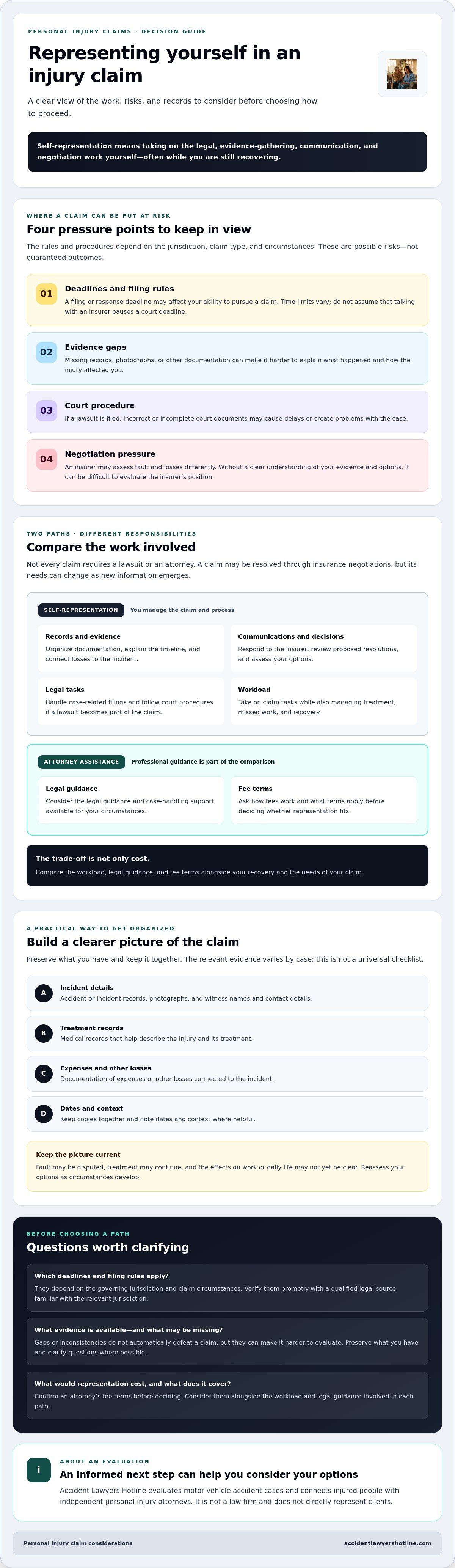
The rules and procedures that apply can vary by state, court, claim type, and case circumstances. The risks of representing yourself in a personal injury case may include:
- Missed deadlines: A filing or response deadline may affect your ability to pursue a claim. Applicable time limits depend on the circumstances and jurisdiction.
- Incomplete evidence: Missing records, photographs, or other documentation can make it harder to support what happened and how the injury affected you.
- Procedural errors: Incorrect or incomplete court documents, if a lawsuit is filed, may cause delays or create problems with your case.
- Negotiation pressure: An insurer may assess fault and losses differently than you do. Without a clear understanding of your evidence and options, it can be difficult to evaluate the insurer’s position.
Self-representation means managing both the facts of the claim and the legal process.
What does representing yourself in a personal injury case involve?
A self-represented claimant handles case-related filings, communications, evidence, and decisions. That can include organizing records, responding to an insurer, reviewing proposed resolutions, and, if a lawsuit becomes part of the claim, following court procedures. Your responsibilities depend on how the matter proceeds. A claim can sometimes be resolved through insurance negotiations without going to court.
Why a seemingly simple injury claim can become complicated
A claim’s needs can change as new information emerges. Fault may be disputed, treatment may continue, or the full effect of an injury on work and daily life may not yet be clear. An insurer’s view of responsibility or losses may also differ from what your records support. A claim that seems straightforward at first may become more involved, so reassess your options as circumstances develop.
How evidence, deadlines, and legal procedure can put a self-represented claim at risk
Once you decide to pursue a claim, administrative tasks can affect how clearly you explain what happened and what you lost. A practical sequence is to preserve records, document losses, communicate carefully, assess your options, and verify the deadlines that apply to your circumstances. The risks of representing yourself in a personal injury case can grow when one of these steps is missed or delayed.
Applicable deadlines and filing rules depend on the governing jurisdiction and claim circumstances. Limitation periods and court requirements aren’t uniform across the country. Check the rules promptly with a qualified legal source, such as a lawyer familiar with the relevant jurisdiction. Don’t assume that a conversation with an insurer pauses a court deadline.
Evidence and documentation a claimant may need to organize
Depending on the claim, useful materials may include accident or incident records, photographs, witness names and contact details, medical records, and documentation of expenses or other losses. Keep copies together and note dates and context where helpful. Organized, consistent records can make it easier to explain the timeline and connect claimed losses to the incident. The relevant evidence varies by case, so this isn’t a universal checklist.
Gaps or inconsistencies don’t automatically defeat a claim, but they can make it harder to evaluate. For example, a missing receipt may make a particular expense harder to document, while differing accounts of an event may raise questions that need clarification. Preserve what you have and avoid guessing when you’re unsure of a detail.
Deadlines, filings, and communication mistakes to watch for
An informal insurance claim and a lawsuit don’t involve the same process. In an insurance discussion, you may exchange information and documents with an insurer. If litigation begins, court procedures may require particular forms, service of documents, and responses by set deadlines. Evidence available through court processes may also differ from what you can gather informally. California Courts, for example, warns that failing to follow court rules can have serious consequences, including dismissal; its guide describes the biggest risk is that you lose. That resource concerns California courts, so it shouldn’t be treated as a guide to every jurisdiction.
Save insurer letters and emails, and keep notes of calls. Review requests carefully, keep your statements accurate, and seek qualified advice before making consequential decisions, such as accepting a resolution or filing court papers. Accident Lawyers Hotline evaluates motor vehicle accident cases and connects injured people with independent personal injury attorneys. If that applies to your situation, a motor vehicle accident case evaluation may help you consider whether to seek legal guidance. Accident Lawyers Hotline isn’t a law firm and doesn’t directly represent clients.
Self-representation vs. hiring a personal injury attorney: compare the trade-offs
Choosing how to handle a claim is a personal decision. Weigh the risks of representing yourself in a personal injury case against the responsibilities, fees, and potential support involved in hiring an attorney. Neither option is automatically right for every claimant.
| Consideration | Handling the claim yourself | Working with an attorney |
|---|---|---|
| Claimant workload | You manage communications, records, decisions, and any court tasks required if a lawsuit is filed. | An attorney may handle many claim tasks, while you provide information and make decisions with their guidance. |
| Legal guidance | You research applicable rules and assess your options independently. | An attorney can explain legal issues and help evaluate evidence, procedure, and settlement options. |
| Process familiarity | You build familiarity as the claim progresses, including with any court requirements. | An attorney brings experience with claim and court processes relevant to the matter. |
| Control over decisions | You direct the claim and make decisions without an attorney advising you. | You remain involved in decisions, with legal advice to help you consider them. |
When handling a claim yourself may feel manageable, and what to assess
Clear facts, limited disagreement about responsibility, and the time and confidence to manage paperwork may make self-handling feel more manageable. These are factors to weigh, not a legal test or a guarantee that self-representation is safe. Reassess if treatment continues, fault becomes disputed, or negotiations grow more involved. A claim can change as new information emerges.
What an attorney may add, and what to ask about fees
An attorney may help assess a claim, identify evidence issues, explain procedure, and negotiate with an insurer. That support doesn’t guarantee a particular result, settlement, or case value. Some personal injury attorneys work on a contingency basis, but fee arrangements and responsibility for case expenses vary. Ask for the terms in writing, including how the fee is calculated, what expenses may arise, and who pays them. For more detail, read this guide to contingency fees.
For a complex vehicle claim, such as one involving a truck, consider what experience and support you want from counsel. This truck accident lawyer selection guide offers questions to consider. Ultimately, weigh the claim’s complexity, the injury’s impact, disputed facts, your available time, and the written fee terms before choosing a path.
When to seek legal help for your injury claim
You don’t need to wait until a problem arises to ask whether legal guidance could help. Consider the injury’s effect on your health and daily life, whether fault is disputed, how complete your records are, whether you understand the deadlines, and how much time and energy you can devote to the claim. These factors can help you decide whether to continue on your own or seek an informed perspective.
- Injury impact: Is treatment ongoing, or are the effects on work and daily activities still unclear?
- Fault: Does the other party or insurer challenge how the incident happened or who was responsible?
- Evidence: Are important records missing, or are you unsure what to preserve?
- Deadlines: Do you know which jurisdiction’s rules apply and when action may be required?
- Capacity: Can you manage communications, records, and decisions while recovering?
Consider seeking legal guidance promptly if a deadline is unclear or approaching, fault is contested, evidence may be difficult to obtain, or you feel pressured to make a consequential decision. These are reasons to ask questions, not a universal rule that every claim requires an attorney. The risks of representing yourself in a personal injury case can be harder to assess without knowing the facts and rules that apply to your claim.
Questions to ask before continuing without representation
Ask which jurisdiction’s rules govern your claim and what deadlines may apply. Find out what information or evidence may matter and how to preserve it. If you’re considering an attorney, ask for the fee agreement and clarify how fees are calculated, which expenses may arise, who is responsible for them, and what communication to expect. Get the terms in writing before deciding.
What to prepare for a case evaluation
A short, organized summary can make an evaluation more useful. Gather what you have, but don’t delay asking for guidance just because a document is missing.
- A brief timeline of the incident and what followed.
- Available accident documents, treatment information, and insurer letters or messages.
- A list of unresolved questions, including concerns about deadlines or claim communications.
The circumstances of an accident can shape which questions are most useful. If you were injured in a motorcycle crash, this motorcycle accident lawyer guide offers related context to consider.
A case evaluation is an opportunity to discuss facts, questions, and possible legal options. An evaluation doesn’t guarantee representation or a particular outcome. To discuss your circumstances, request a motor vehicle accident case evaluation. Accident Lawyers Hotline isn’t a law firm and doesn’t directly represent clients.
Get an informed next step without facing the decision alone
Deciding whether to handle a claim yourself or seek an attorney’s help doesn’t have to happen all at once. Weigh the claim’s complexity, the legal responsibilities involved, the time you can commit, and any attorney’s written fee terms. An evaluation can help you understand possible options without requiring you to decide in advance to hire a lawyer.
What happens when you request a motor vehicle accident case evaluation?
You can share basic information about the accident and your injury so the circumstances can be evaluated. Accident Lawyers Hotline evaluates motor vehicle accident cases and may connect injured people with an independent personal injury attorney suited to the matter. Not every case will necessarily result in a connection, and an evaluation can’t promise representation or a particular outcome.
The platform is not a law firm and does not directly represent clients. If an independent attorney discusses representing you, ask that attorney about the scope of representation, fees, possible case expenses, and what happens next. Attorneys connected through the platform work on a contingency basis, with no fees unless the case is won. Confirm the complete agreement and any responsibility for costs directly with the attorney before signing.
Make your next decision with clear information
Seeking an evaluation doesn’t commit you to hiring an attorney. It gives you an opportunity to discuss what happened, raise concerns, and learn whether legal representation may fit your situation. You can then compare that guidance with the time and effort involved in managing the claim yourself. This can be especially useful if you’re weighing the risks of representing yourself in a personal injury case but are unsure what support would involve.
Before agreeing to representation, read the written fee agreement carefully. Make sure you understand how fees are calculated, how case expenses are handled, and what services the attorney will provide. Ask for clarification on anything that isn’t clear. You should feel informed about the terms before you decide.
If you were injured in a motor vehicle accident and want to discuss possible next steps, request a motor vehicle accident case evaluation. You can use what you learn to make a considered choice about whether to continue on your own or explore working with an independent attorney.
Choose your next step with confidence
The risks of representing yourself in a personal injury case can include missed requirements, evidence gaps, and difficult negotiations. Before deciding, weigh the claim’s complexity, the time you can commit, and the written terms of any attorney agreement. You don’t have to settle the question without first learning what your options may be.
Accident Lawyers Hotline evaluates motor vehicle accident cases nationwide, including car, truck, motorcycle, pedestrian, and bus accidents, and connects injured people with independent attorneys. The platform isn’t a law firm and doesn’t directly represent clients. Connected attorneys work on a contingency basis, with no fees unless the case is won. Confirm the full fee agreement and any responsibility for case expenses directly with the attorney.
If you’d like to discuss your circumstances and possible next steps, request a motor vehicle accident case evaluation. Getting information can help you make a clear, considered decision about what comes next.
Frequently Asked Questions
Is it risky to represent yourself in a personal injury case?
Yes, self-representation can create risks, especially if you’re unfamiliar with claim procedures or court rules. You may need to organize evidence, track deadlines, communicate with an insurer, assess losses, and handle filings if a lawsuit becomes necessary. These responsibilities can be difficult to manage while recovering. The risks of representing yourself in a personal injury case depend on the facts, applicable rules, and your ability to manage each task.
Can I negotiate a personal injury claim without a lawyer?
Yes, you can negotiate directly with an insurer without hiring a lawyer. Before responding to an offer, consider whether you understand the evidence, the losses you’re claiming, and any terms in documents the insurer asks you to sign. Keep communications and records organized, and avoid guessing about facts. If fault is disputed, treatment continues, or you’re unsure about a deadline or offer, consider getting legal guidance before deciding how to proceed.
What happens if I miss a personal injury claim deadline?
Missing a filing deadline may limit or prevent you from pursuing a claim in court, but the consequences depend on the jurisdiction, claim type, and circumstances. Some claims may have different deadlines or requirements, so don’t rely on a general estimate or assume that discussions with an insurer extend the time to file. If you think a deadline may have passed or is approaching, promptly contact a qualified attorney or other reliable legal resource.
Do I need a lawyer for a minor car accident injury claim?
Not necessarily. Whether to hire a lawyer depends on the injury’s effects, the clarity of fault, the evidence, applicable deadlines, and your comfort handling communications and paperwork. A seemingly minor injury may need reassessment if symptoms continue, treatment changes, or the insurer disputes responsibility or losses. You can seek an evaluation to better understand possible options, then decide whether professional representation fits your circumstances. No particular injury level automatically determines the right choice.
How much does a personal injury lawyer cost if they work on contingency?
With a contingency arrangement, the attorney’s fee is tied to the outcome, and attorneys connected through Accident Lawyers Hotline work on a contingency basis with no fees unless the case is won. The specific fee percentage, how it’s calculated, and responsibility for case expenses can vary. Ask the attorney to explain all terms in writing, including what happens to expenses if there’s no recovery. Don’t assume every cost is waived; confirm the agreement before signing.
Can Accident Lawyers Hotline represent me in court?
No. Accident Lawyers Hotline is a case-evaluation and referral platform, not a law firm, and it doesn’t directly represent clients in court. It evaluates motor vehicle accident cases and may connect injured people with independent personal injury or motor vehicle accident attorneys. If an attorney discusses representing you, ask that attorney about the scope of representation, fees, expenses, and next steps. A connection or evaluation doesn’t guarantee that an attorney will take the case or achieve a particular result.
What should I bring to a personal injury case evaluation?
Bring what you have, but don’t postpone an evaluation just because some records are missing. A brief incident timeline, available accident documents or photos, treatment information, expense records, and insurer letters or messages can help explain the situation. Note unresolved questions, especially concerns about deadlines, fault, or claim communications. The relevant materials depend on the case. Be ready to describe what happened, what has changed since, and what you hope to understand about your options.
Were You Injured in an Accident?
Get a free, confidential case evaluation. No upfront fees.
Get Free Case Evaluation