What Is Discovery in a Personal Injury Case? A Clear Guide
Wondering what is discovery in a personal injury case? Learn how evidence is gathered, what to expect, and how to protect your claim in this clear guide.
Questions and document requests in an injury claim are meant to clarify what happened, not catch you off guard. If you’re wondering what is discovery in a personal injury case, it’s the stage when both sides gather and examine evidence related to the accident, your injuries, and the losses you’re claiming. The process can feel intimidating when legal terms are unfamiliar or requests involve private records. Those concerns are understandable, and you don’t have to interpret every request on your own.
This guide explains why discovery happens, what it may involve, and what evidence may be exchanged, from medical records and written answers to digital information such as vehicle data or smartwatch activity. You’ll also find practical ways to preserve and organize relevant records before responding. Discovery procedures and deadlines vary by state and case, so an attorney can explain what a particular request means and help you understand your obligations. A case evaluation may also help you discuss how discovery could apply to your accident claim and, if eligible, connect with an independent personal injury attorney.
Key Takeaways
- Learn what is discovery in a personal injury case and how exchanging information can clarify disputed facts.
- See how the process may move from a court schedule to written requests, depositions, and follow-up.
- Find out what kinds of evidence may help explain the accident, injuries, and related questions.
- Use practical steps to organize materials, track deadlines, and respond carefully without guessing.
- Understand why case-specific legal guidance matters and how a referral platform differs from a law firm.
What Is Discovery in a Personal Injury Case, and Why Does It Matter?
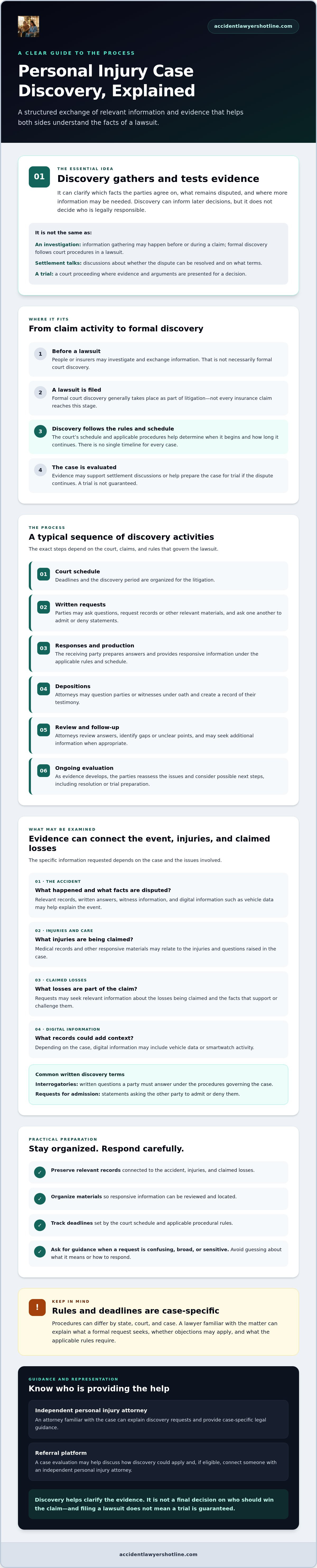
Discovery is the formal exchange of relevant information and evidence between parties in a lawsuit. If you’re asking what is discovery in a personal injury case, think of it as a structured way for each side to learn which facts and materials may support or challenge the claim. The process can help identify what the parties agree on, clarify what remains disputed, and prepare them to discuss resolution or proceed toward trial. For a broad overview of the legal concept, see Discovery (law).
Discovery is different from an investigation. An investigation may involve gathering information before or during a claim, such as locating witnesses or documenting an accident. Formal discovery takes place within a lawsuit and follows the applicable court rules. It is also separate from settlement negotiations, where parties discuss whether they can resolve the dispute and on what terms. A trial is different again: it’s a court proceeding where evidence and arguments are presented for a decision.
Information exchanged during discovery can help each side assess the strengths and uncertainties in the case. It may also show where more information is needed. Discovery doesn’t decide who is legally responsible by itself. Instead, it helps clarify the evidence that may inform later decisions.
When does discovery happen in an injury claim?
Formal court discovery is part of litigation, so it generally follows the filing of a lawsuit. Not every insurance claim reaches this stage. Before a lawsuit, parties or insurers may still investigate and exchange information, but that isn’t necessarily formal discovery under court procedures. After a lawsuit is filed, the court’s schedule and applicable rules help determine when discovery begins and how long it continues. There’s no single timeline for every case.
Does discovery mean the case is going to trial?
No. Discovery can help both sides evaluate the evidence and support settlement discussions. It can also help prepare a case for trial if the dispute continues. Filing a lawsuit doesn’t establish liability or mean a trial is guaranteed. A case may resolve before trial, but the path depends on its facts, the parties’ positions, and applicable procedures.
Discovery gathers and tests evidence; it isn’t a final decision on who should win the claim. The timing, scope, and rules depend on the court, jurisdiction, and circumstances of the case. If a formal request arrives, an attorney familiar with the case can explain what it seeks and how to respond under the applicable rules.
How Discovery Works in a Personal Injury Lawsuit
If you’re trying to understand what is discovery in a personal injury case in practical terms, picture a series of steps rather than a single event. The exact process depends on the court, the claims, and the rules that govern the lawsuit. Federal and state procedures can differ, so deadlines and response requirements aren’t universal. Cornell Law School’s Legal Information Institute offers a helpful legal definition of discovery.
A case may move through these stages:
- Court schedule: The court and parties establish deadlines and organize the litigation, including the discovery period.
- Written requests: Each side may send questions, ask the other party to admit or deny statements, and request relevant records or other materials.
- Responses: The receiving party prepares answers and produces responsive information according to the applicable rules and schedule.
- Depositions: Attorneys may question parties or witnesses under oath and create a record of their testimony.
- Follow-up: Attorneys review responses, identify gaps or unclear answers, and may seek additional information when appropriate.
- Ongoing evaluation: As evidence develops, the parties reassess the issues and consider possible next steps, including resolution or trial preparation.
Deadlines come from the court’s schedule and the procedural rules that apply. If a request seems broad, confusing, or sensitive, don’t assume you should answer it without guidance. An attorney can explain what the request seeks, whether objections may apply, and what you need to do in your specific case.
What are interrogatories and requests for admission?
Interrogatories are written questions that a party must answer under the procedures governing the case. They may ask about the accident, claimed injuries, or other relevant facts. A request for admission presents a statement and asks the other party to admit or deny it. The permitted scope, response format, and deadlines depend on the rules and court orders that apply.
What are requests for production and depositions?
A request for production asks for relevant documents or other materials. Examples may include medical records, accident photographs, or communications. A deposition is recorded testimony given under oath, usually with attorneys present. Before responding to document requests or giving testimony, ask your attorney how to prepare, what objections may apply, and which obligations you must follow in your case.
If you’re still assessing an accident claim, a motor vehicle accident case evaluation may help you discuss how the process could apply and, if eligible, connect with an independent attorney. Accident Lawyers Hotline is a referral platform, not a law firm, and does not provide direct legal representation.
What Evidence Can Discovery Cover in a Personal Injury Case?
Discovery can involve records and information that help explain how an accident happened, what injuries followed, and what losses are claimed. If you’re asking what is discovery in a personal injury case, the evidence exchanged depends on the issues in the lawsuit and the rules that apply. A request doesn’t automatically make every record relevant or admissible. The purpose of discovery is to help parties prepare by learning about evidence, though the cited DOJ overview addresses the process generally, not the specific rules for every injury lawsuit.
| Evidence type | Possible example | Why it may matter |
|---|---|---|
| Medical records | Treatment notes, test results, or follow-up care records | May help explain the injury, treatment, and recovery. |
| Accident photographs | Images of vehicle damage, the scene, or visible injuries | May help show conditions or damage after the collision. |
| Repair information | Vehicle estimates, invoices, or inspection records | May provide details about damage and repairs. |
| Witness accounts | Statements or contact information for people who saw the event | May help clarify what happened and what was observed. |
| Communications and digital records | Relevant messages, vehicle data, or smartwatch activity | May provide context about events, timing, or claimed effects. |
Which documents and records might be requested?
Requests may relate to treatment, the accident, or losses claimed in the case. For example, employment records might matter if missed work or lost income is disputed. Financial records or prior medical records may be relevant to particular issues, but that doesn’t mean every such record must be produced. Don’t send sensitive information informally just because someone asks. Ask an attorney to review the request, its scope, and any privacy or privilege concerns.
Can discovery include social media or electronic records?
It can, if electronic information is relevant and within the permitted scope under the rules governing the case. A post, private account, smartwatch activity log, or vehicle telematics data isn’t automatically discoverable simply because it exists. Relevance and possible objections require case-specific review. Preserve potentially relevant material, and ask your attorney before changing or deleting posts, messages, files, or account data. That can help you respond carefully while protecting your privacy and interests.
How to Prepare for Discovery Without Creating Avoidable Problems
Knowing what is discovery in a personal injury case can make the process feel more manageable, but careful preparation matters too. Start by preserving potentially relevant materials, including paper records, photos, messages, and electronic information. Don’t delete, edit, or conceal anything that could relate to the accident, your injuries, or your claim. If you’re unsure whether something matters, keep it and ask your attorney.
A few simple habits can help you stay organized:
- Keep accident, treatment, and expense records together in a secure place.
- Save copies of discovery requests and the responses you provide.
- Track deadlines and appointments, and confirm any dates you don’t understand.
- Make a list of questions for your attorney rather than guessing at legal answers.
Answer questions truthfully. If you don’t know or remember something, don’t guess. Don’t ignore formal discovery requests, but remember that what you must provide and when depends on the case, the governing rules, and any court orders. Your attorney can explain your obligations and advise you about objections or sensitive information.
How should you prepare for a deposition?
Ask your attorney to explain how the deposition works and what topics may come up. Listen to each question, answer truthfully, and ask for clarification if you don’t understand it. Take time to respond. You don’t need to memorize or script your testimony. Your goal is to give accurate answers in your own words, not to shape the facts.
What should you do when a discovery request arrives?
Note the response deadline and promptly share the full request with your attorney. Gather potentially responsive materials, but don’t alter originals or decide on your own to withhold information. Counsel can review what the request covers, assess privacy concerns or possible objections, and help prepare the required response. If you’re unsure what a term means, ask before responding.
Clear guidance can help you handle discovery requests carefully. A motor vehicle accident case evaluation may help you discuss your claim and, if eligible, connect with an independent personal injury attorney. Accident Lawyers Hotline is a referral platform, not a law firm, and does not provide direct legal representation.
Who Can Guide You Through Personal Injury Discovery?
Discovery requests can raise questions that general information can’t answer. The right response may depend on the wording of a request, the evidence in your claim, and the procedural rules that apply. An attorney familiar with your case can help you understand your options and obligations. This can be especially useful if a request asks for sensitive information or you’re unsure how to prepare for testimony.
Accident Lawyers Hotline is a national referral platform, not a law firm or your attorney. It evaluates eligible motor vehicle accident matters and may connect people with independent personal injury attorneys. The platform doesn’t provide direct legal representation or case-specific legal advice. Only an attorney who knows the facts of your case can advise you about responding to discovery.
What can an attorney help you understand?
An attorney may review what a formal request seeks, explain applicable deadlines, and help identify relevant records. Counsel can also assess possible objections or privacy concerns and help you prepare for a deposition. If you’re discussing representation, ask who would handle your case, how communication will work, and what the fee agreement covers. For more background, read this guide to contingency fees and attorney arrangements. Fee terms vary by attorney, so clarify them directly and ask about any case-related expenses.
What happens during a case evaluation?
An evaluation is an opportunity to discuss the accident, your injuries, records you have, and questions about your claim, including how discovery might apply. Before the conversation, gather basic information and write down what you’re unsure about. You might ask what next steps could involve, what documents may be useful, and whether an attorney referral may be available. An evaluation doesn’t guarantee that an attorney will accept the matter, that representation will follow, or that the claim will have a particular result.
If you’re considering what is discovery in a personal injury case in relation to your own accident, a case evaluation may help you identify questions to raise with an attorney. You can request a car accident case evaluation and discuss whether a connection with an independent attorney may be appropriate.
Take the Next Step With Greater Clarity
Understanding what is discovery in a personal injury case can make a complex legal process easier to approach. Discovery is a formal exchange of relevant information and evidence. It may help clarify disputed facts and prepare the parties for settlement discussions or trial, but it doesn’t decide the claim by itself.
Keep potentially relevant records and digital information, track deadlines, and don’t ignore formal requests. Answer truthfully, avoid guessing, and ask an attorney to explain requests or deposition preparation. Rules and response duties depend on the case, so guidance from an attorney familiar with the facts can help you understand your options.
Accident Lawyers Hotline is a national case evaluation and attorney-referral platform, not a law firm and not your legal representative. It evaluates eligible accident matters and may connect accident victims with independent personal injury attorneys. If you’d like to discuss your car accident claim and possible next steps, request a car accident case evaluation. You can move forward one clear question at a time.
Frequently Asked Questions
What is discovery in a personal injury case?
Discovery is the formal process for exchanging relevant information and evidence after a lawsuit begins. In practical terms, what is discovery in a personal injury case? It’s a way for each side to ask questions, request records, or take testimony using tools allowed by the applicable rules. The process helps clarify disputed facts and prepare the case for possible resolution or trial. Its scope depends on the court and claim.
When does discovery start in a personal injury case?
Formal discovery generally starts after a lawsuit is filed, following the court’s schedule and applicable procedural rules. Before a lawsuit, insurers and parties may investigate or exchange information, but that isn’t necessarily formal court discovery. The order of steps and response dates can vary. If you receive a request or notice, share it with the attorney handling your claim and ask which deadlines apply to your situation.
What happens if you do not respond to discovery requests?
Ignoring a formal discovery request can create legal problems, but the consequences depend on the request, applicable rules, and any court orders. Don’t assume you can set it aside or respond late. Note the deadline and promptly send the request to your attorney. Ask how to respond and whether any concerns need to be raised. If you don’t have counsel, seek qualified legal guidance about the rules that govern your case.
Can discovery include medical records and social media?
Yes, medical records or social media information may be requested if they’re relevant and discoverable under the rules for the case. That doesn’t make every record or private account automatically available. Relevance, privacy, privilege, and the scope of the request may matter. Preserve potentially relevant information, and don’t delete or edit it. Before sharing sensitive records or responding about online activity, ask an attorney to review the request.
Do you have to give a deposition in a personal injury case?
You may have to give a deposition if one is properly requested under the applicable rules or ordered by the court. A deposition is testimony under oath, usually recorded with attorneys present. The requirements depend on your case. If you receive a deposition notice or request, promptly discuss the date and process with your attorney. Ask how to prepare, what topics may be covered, and what to do if a question is unclear.
How long does discovery take in a personal injury case?
There’s no single timeline for discovery in every personal injury case. The schedule may depend on court rules, the number of parties, the evidence involved, ongoing medical treatment, and disputes over requests. A court may set deadlines, and those dates vary by jurisdiction and case. For a useful estimate of your current schedule, ask the attorney handling the matter. Avoid relying on a general timeline to plan your response dates.
Does discovery mean a personal injury case will go to trial?
No, discovery doesn’t mean a personal injury case will go to trial. It helps the parties assess evidence and prepare for possible next steps, including settlement discussions or trial. A case may resolve without trial, but no outcome is guaranteed. Discovery itself isn’t a ruling on fault or compensation. An attorney familiar with the facts can explain how the evidence may affect your claim and what options may be available.
Were You Injured in an Accident?
Get a free, confidential case evaluation. No upfront fees.
Get Free Case Evaluation