Car Accident Back & Neck Injury: 2026 Settlement Guide
Curious about the average settlement for car accident back and neck injury? Our 2026 guide reveals adjuster tactics & how to calculate your claim's true value.
Is the $15,000 the insurance company offered you for your neck pain actually a fair settlement, or is it just the lowest number their software could generate? You're likely dealing with mounting medical bills and the exhausting reality of chronic pain that makes even simple movements difficult. It's frustrating to feel like your physical suffering is being reduced to a line item on a spreadsheet, especially when you're worried a past injury might be used against you. Many victims searching for the average settlement for car accident back and neck injury find that numbers vary wildly, often because a settlement is not a lottery win but a calculated reimbursement of documented losses.
We understand that your injury is not just a legal case; it's a disruption of your life that deserves a fair restoration of balance. This 2026 guide will show you exactly how insurance adjusters use specialized software to calculate payouts and help you determine what your specific claim could be worth. We'll break down realistic dollar ranges for different injury types, from whiplash to herniated discs, and explain how to handle pre-existing conditions. You'll discover clear steps to increase your claim value and gain the validation that your pain is a compensable loss that requires a professional resolution.
Key Takeaways
- Learn why the average settlement for car accident back and neck injury ranges from $10,000 to over $100,000 based on the severity of your specific medical documentation.
- Understand how insurance companies use specialized software to distinguish between soft tissue whiplash and permanent disc injuries when valuing your claim.
- Discover the "Three Pillars" of damage calculation to ensure your medical debt, lost wages, and physical pain are fully accounted for.
- Identify critical mistakes like the "Gap in Treatment" trap that adjusters use to devalue your case before it even begins.
- Find out how a professional case evaluation serves as the essential first step to securing a fair resolution with a no-fee-unless-we-win guarantee.
Understanding the Average Settlement for Car Accident Back and Neck Injury
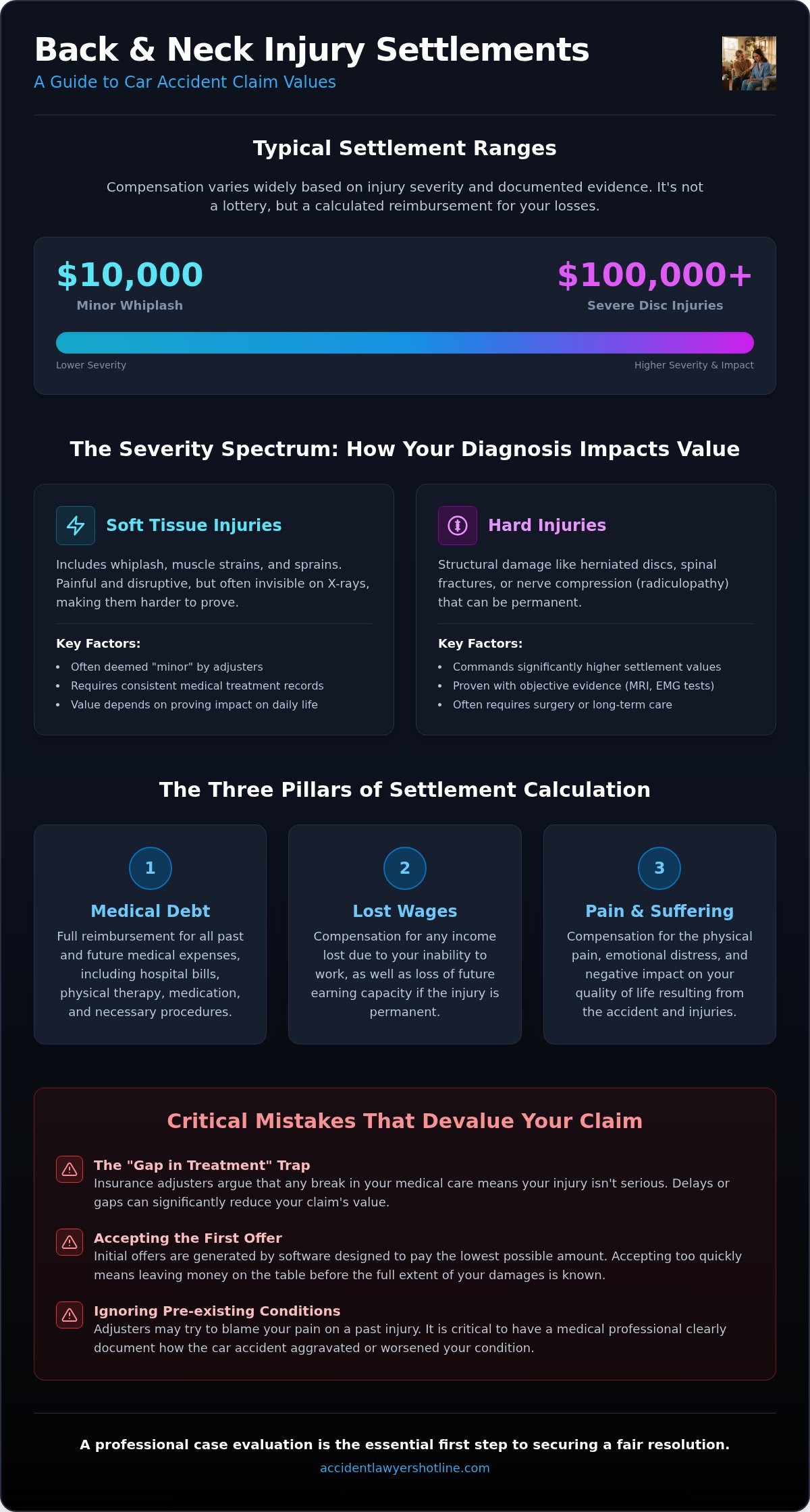
A car accident settlement is the total amount of compensation you receive to cover both economic and non-economic damages. When victims ask about the average settlement for car accident back and neck injury, they often find figures ranging from $10,000 for minor whiplash to over $100,000 for severe disc injuries. These numbers are broad because personal injury claims are highly individualized. Your specific payout depends on the clarity of your medical evidence and the insurance coverage available. It's not just about the pain you feel; it's about how well that pain is documented and presented to the insurance adjuster.
Injuries are generally classified into two categories. Soft tissue injuries, such as whiplash or muscle strains, often result in lower settlements because they can be harder to prove on an MRI or X-ray. Hard injuries, like spinal fractures or herniated discs that require surgery, typically command higher values. While national statistics provide a baseline, they don't account for your unique circumstances or the specific way your life has been disrupted. A professional Case Evaluation is the only reliable way to move past generic averages and understand what your specific claim is worth.
Why One "Average" Figure Doesn’t Exist
The amount of money available for your recovery is often capped by insurance policy limits. A crash involving a driver with a minimum liability policy will look very different from a collision with a commercial truck that carries a high-limit policy. Location also plays a massive role in your final payout. Different jurisdictions view pain and suffering through different lenses; some areas are known for being more sympathetic to victims than others. A settlement is a legal release of liability where you agree to stop further legal action in exchange for a specific amount of compensation.
The Difference Between Settlement and Jury Verdict
Most victims choose to settle their cases out of court rather than going to a full trial. This decision is usually based on the need for certainty. A jury verdict is a gamble; it could result in a massive award or zero compensation. Settlements provide a faster payout and eliminate the stress of a courtroom battle. However, insurance companies often try to offer less because they know you want a quick resolution. Experienced motorcycle accident lawyers and car accident specialists use the threat of a trial to force adjusters to increase their offers. They show the insurance company that they're prepared to fight, which often leads to a more favorable balance in the final agreement.
The Severity Spectrum: How Your Specific Injury Impacts Payouts
Your medical diagnosis is the single most important factor in determining your recovery. While you might feel severe pain, insurance companies focus on objective evidence. They categorize injuries to simplify their math. Understanding where you fall on this spectrum helps clarify why the average settlement for car accident back and neck injury can vary by tens of thousands of dollars. It isn't just about the injury itself; it's about the medical proof you provide to the adjuster.
Most claims start in the soft tissue category. This includes whiplash, strains, and sprains. These injuries are painful and disruptive, but they don't always show up on standard X-rays. NHTSA research on neck and spine injuries highlights the complex forces at play during a collision, yet insurance adjusters often label these as "minor." To get a fair result, you need to prove the injury's impact on your daily life through consistent treatment records.
Disc injuries like herniations or annular tears represent a higher tier of severity. These are structural changes to your spine that can cause permanent damage. If the damage affects your nerves, you might experience radiculopathy, which is radiating pain or numbness in your limbs. Proving these injuries requires advanced diagnostics. MRI scans show disc placement and nerve compression, while EMG testing measures the actual electrical function of your nerves. These tests provide the objective proof adjusters can't ignore, moving your claim from a soft tissue category to a more significant hard injury status.
Whiplash and Soft Tissue Claims
Adjusters frequently undervalue whiplash because they can't see it on a scan. They might suggest your pain should resolve in a few weeks. Typical treatment often involves months of physical therapy or chiropractic care to restore mobility. Don't let them dismiss your struggle. Keep a daily log of your pain levels and physical limitations. This documentation turns your subjective experience into a credible record, which is vital when calculating the average settlement for car accident back and neck injury for your specific situation.
Herniated Discs and Surgical Interventions
If a doctor recommends a microdiscectomy or spinal fusion, your case value changes significantly. Surgery provides clear proof of a permanent injury. These procedures also introduce the "Future Medical Care" pillar of compensation. You aren't just settling for past bills; you're securing funds for long-term health needs. Specialized truck accident lawyers often manage these complex spinal cases because high-speed commercial crashes frequently cause life-altering disc damage. If you're facing surgery, requesting a professional car accident case evaluation is the best way to protect your long-term health and financial stability.
The Three Pillars of Settlement Value Calculation
Your settlement isn't a random number pulled from thin air. It's a methodical calculation built on three specific pillars. This framework helps explain why the average settlement for car accident back and neck injury can range from a few thousand dollars to several hundred thousand. If one pillar is weak, your entire recovery is at risk. You deserve a professional approach that accounts for every single loss you've endured since the crash.
Pillar 1 covers your economic damages. These are the bills you can see and touch. It includes hospital stays, physical therapy, and medication. Even a common Whiplash Injury can lead to thousands in medical expenses. Pillar 2 addresses non-economic damages, often called pain and suffering. Adjusters usually use the Multiplier Method, which multiplies your bills by a number between 1.5 and 5, or the Per Diem method, which assigns a daily dollar value to your pain. Finally, Pillar 3 is the insurance policy limit. This is the maximum amount the insurance company is legally required to pay, regardless of your total losses.
Calculating Economic Losses
To maximize your recovery, you must track every doctor visit, co-pay, and prescription receipt. It isn't enough to say you're hurting; you have to show the financial cost of that hurt. If your injuries prevent you from returning to your career, we look at your lost earning capacity. This accounts for the future wages you'll miss because of your physical limitations. Medical liens must be paid out of the final settlement, so your total award needs to cover these obligations before you receive your portion.
The "Policy Limit" Bottleneck
The most frustrating part of a claim is often the policy limit bottleneck. If your total damages are $100,000 but the at-fault driver only carries a $25,000 policy, you face a significant gap. This is where Underinsured Motorist (UIM) coverage on your own policy becomes vital. It acts as a safety net to cover the difference. Experienced attorneys also search for secondary sources of recovery, such as umbrella policies or corporate liability in commercial cases. Finding these hidden layers of insurance is often the only way to ensure the average settlement for car accident back and neck injury in your case reflects your actual needs.
Critical Mistakes That Devalue Back and Neck Injury Claims
Securing a fair recovery requires more than just proving the other driver was at fault. You must also avoid common traps that insurance adjusters use to slash the value of your claim. Even a strong case can be undermined by a single oversight. Understanding these pitfalls is the best way to ensure the average settlement for car accident back and neck injury in your case isn't unfairly reduced. You've already suffered enough; don't let a procedural error cost you the compensation you need to heal.
The "Gap in Treatment" is one of the most dangerous traps. If you wait more than 14 days to see a doctor, adjusters will argue that your injuries weren't serious or were caused by something else. They also look for any reason to use your own words against you. A recorded statement might seem like a routine request, but it's often a search for inconsistencies. Similarly, social media posts can be weaponized. A single photo of you at a family dinner can be used to claim your "pain and suffering" is exaggerated. Protect your claim value by requesting a car accident case evaluation before speaking with anyone from the insurance company.
Many victims worry that a past injury will ruin their chance at a settlement. This is a common myth. The "Eggshell Skull" doctrine protects you by stating that a defendant is responsible for all damages they cause, even if you were more susceptible to injury. You aren't disqualified just because your back was already fragile. The law requires the at-fault party to take the victim as they find them, meaning they're still liable for the specific harm they caused in the crash.
The Danger of Early Settlement Offers
Insurance companies often reach out with an offer within days of the accident. This initial figure is almost always a lowball offer designed to close the file before you realize the true extent of your injuries. You should never settle until you reach Maximum Medical Improvement (MMI). This is the point where your doctors determine your condition has stabilized as much as it's going to. If you sign a release early, you waive your right to any future compensation, even if you eventually need surgery or long-term care.
Handling Pre-Existing Back or Neck Issues
You can still recover compensation for the "aggravation" of a previous condition. Success in these cases depends on clear medical records that compare your physical status before and after the collision. Your doctors must document how the crash created new symptoms or worsened old ones. A no fee unless we win your case attorney can help bridge this gap by hiring medical experts to prove causation. This professional advocacy ensures that your medical history is used to show the true impact of the crash rather than as an excuse to lower the average settlement for car accident back and neck injury for your claim.
How to Start Your Car Accident Case Evaluation
The path to restoration begins with a clear, methodical plan. You don't have to carry the burden of legal complexity while you're trying to heal. Knowing the average settlement for car accident back and neck injury is a helpful start, but moving from a general range to your specific recovery requires a professional review. Following a few simple steps can shift the weight of the situation from your shoulders to a team of experts. This process is designed to be risk-free and streamlined, allowing you to focus on your health while a professional handles the high-stakes legal work.
Start by gathering your police report and initial medical discharge papers. These documents provide the objective facts needed to build your file. Next, contact a referral service for a professional Case Evaluation. This is the essential first step to knowing the real value of your claim. Once you're connected with a specialized personal injury attorney, they'll work on a contingency basis. Finally, let your legal team manage all communication with insurance adjusters. This protects your privacy and prevents adjusters from using your words against you to devalue your pain.
What Happens During a Case Evaluation?
A professional evaluation is a comprehensive review of your unique situation. The team examines fault and liability to ensure the right party is held accountable for the crash. They also look for every available layer of insurance coverage to avoid the policy limit bottlenecks that often trap unrepresented victims. Experts perform an initial assessment of the severity of your back and neck injuries based on your diagnostic records. Most importantly, they determine if hiring a lawyer will likely increase your net recovery. This transparency ensures the process always works in your best interest.
The Advantage of the Contingency Fee Model
The contingency fee model is designed to provide immediate reassurance and remove barriers to justice. There are zero upfront costs for you. You don't have to worry about hourly fees or retainer payments while you're already facing mounting medical debt. The attorney only gets paid a percentage of the final settlement. This "no fee unless we win" structure means your legal team is fully invested in your success. It removes the financial risk and creates a clear path toward a fair resolution. Get your free car accident case evaluation today to see what your claim is worth.
Secure Your Path to Financial Recovery
You've learned that your recovery isn't just a number on a page. It's a calculated restoration of fairness based on your specific medical evidence and the insurance coverage available. While the average settlement for car accident back and neck injury provides a baseline, your path forward depends on avoiding common traps like treatment gaps and early lowball offers. By focusing on objective diagnostics and clear documentation, you shift the power dynamic back in your favor and ensure your pain is recognized as a compensable loss.
You don't have to face insurance adjusters alone. Our national network of specialized attorneys is ready to provide a fast, professional evaluation of your claim. We operate on a risk-free model, which means there's no fee unless we win your case. This structure ensures you have a formidable advocate in your corner without any upfront financial burden. Start your free car accident case evaluation now and take the first step toward the professional resolution you deserve. You've been through enough; now it's time to focus on your healing while an expert handles the legal burden.
Frequently Asked Questions
How much is a typical settlement for whiplash?
A typical settlement for a whiplash injury generally ranges between $6,000 and $22,000. This amount covers your medical bills, physical therapy costs, and a small portion for pain and suffering. Because whiplash is a soft tissue injury that doesn't always show up on an X-ray, insurance companies often try to minimize these claims. Consistent medical documentation and a clear treatment plan are essential to securing the higher end of this range.
Can I still get a settlement if I had a bad back before the accident?
Yes, you can still recover compensation under the "Eggshell Skull" doctrine. This legal rule protects you by stating that the at-fault driver is responsible for the "aggravation" of your previous condition. You'll need medical records that compare your physical status before the crash to your new limitations. A professional case evaluation helps distinguish your old pain from the new, compensable injuries caused specifically by the collision.
How long does it take to receive a settlement for a neck injury?
Most neck injury cases take several months to over a year to resolve. You shouldn't settle until you reach Maximum Medical Improvement (MMI). This ensures all your medical needs are fully understood before you sign a release. Once your treatment is complete and a demand is sent, negotiations typically last 30 to 90 days. Complex cases involving surgery or litigation will naturally take longer to reach a final resolution.
Do I have to go to court to get a back injury settlement?
No, the vast majority of personal injury cases settle out of court before a trial ever begins. Insurance companies usually prefer the certainty of a settlement over the high costs and risks of a jury verdict. However, having an attorney who is prepared to go to trial often increases the final offer. The threat of litigation forces the adjuster to take your back injury claim more seriously during negotiations.
What if the at-fault driver does not have enough insurance to cover my surgery?
If your surgery costs exceed the at-fault driver's policy limits, you can often turn to your own Underinsured Motorist (UIM) coverage. This acts as a vital safety net to fill the financial gap. Additionally, a legal expert can search for secondary sources of recovery, such as corporate liability or umbrella policies. Finding these hidden layers of insurance is often the only way to cover high-value spinal procedures.
What is the "multiplier method" for pain and suffering?
The multiplier method is a common way to calculate the average settlement for car accident back and neck injury. Adjusters take your total medical bills and multiply them by a number, typically between 1.5 and 5. A higher multiplier is applied to severe injuries like fractures or those requiring surgery. This total represents your non-economic damages, providing a structured way to put a dollar value on your physical pain.
Should I accept the first settlement offer from the insurance company?
You should rarely accept the first offer from an insurance company. These initial figures are almost always "lowball" offers designed to close your file as cheaply as possible. Once you sign a release, you lose the right to ask for more money, even if your pain persists. It's best to wait until your full medical outlook is clear and you've had a professional review of your case's real value.
How does a herniated disc affect my car accident claim value?
A herniated disc significantly increases the average settlement for car accident back and neck injury compared to a simple strain. Because this is a structural injury visible on an MRI, it provides the objective proof adjusters can't easily ignore. If the disc injury requires epidural injections or spinal fusion surgery, the case value rises sharply to account for the increased medical debt and the likelihood of permanent physical limitations.
Were You Injured in an Accident?
Get a free, confidential case evaluation. No upfront fees.
Get Free Case Evaluation