Car Accident Victim Assistance: Your Guide to Support
Need car accident victim assistance? Explore your options for medical care, emotional support, financial aid, and legal claims in our comprehensive guide.
What if the first step after a crash isn’t sorting out every claim, but identifying the help you need right now? In the days that follow, car accident victim assistance may include medical care, emotional support, practical resources, or financial benefits. It’s understandable to feel unsure where to begin, especially when recovery and insurance paperwork compete for your attention.
The right support depends on your needs and circumstances. Victim assistance programs, insurance benefits, and legal claims serve different purposes, and eligibility for public programs varies. Not every collision qualifies for crime-victim compensation. You can work through these options one at a time.
This guide matches common needs with relevant support, explains how assistance programs differ from insurance and legal claims, and outlines practical first steps. It also explains when a case evaluation may help clarify possible legal options. Accident Lawyers Hotline evaluates motor vehicle accident inquiries and connects people with independent personal injury attorneys. A case evaluation is one pathway to legal help, not a substitute for medical care, emotional support, or community resources.
Key Takeaways
- Car accident victim assistance can address emotional, practical, financial-program, or legal needs, depending on your situation.
- Government victim programs, insurance processes, and civil legal claims serve different purposes, and eligibility and deadlines vary.
- Start by identifying your most urgent need, then choose a matching resource and keep related records organized and secure.
- A case evaluation may help clarify questions about a possible civil claim. Accident Lawyers Hotline connects people with independent attorneys and isn’t a law firm.
Car Accident Victim Assistance: What Support Can Help After a Crash?
Needing help after a collision is common. An accident can affect health, emotional well-being, daily responsibilities, and finances at the same time. You may be managing appointments while arranging transportation, keeping up with bills, or helping a family member recover. You don’t need to solve every problem at once. Identify what needs attention first, then look for the type of support that fits.
Car accident victim assistance means support matched to a person’s circumstances. It can be practical, emotional, financial, or related to legal questions. These pathways serve different purposes, and one resource is unlikely to address every need. For a broader overview of services that can follow an accident, see Accident Management Services, which includes areas such as vehicle recovery and damage assessment.
Which needs can car accident victim assistance address?
Post-crash needs may include physical recovery, emotional care, help with daily tasks, or guidance about possible legal questions. Those needs can change over time. Someone may first need medical attention, then help managing transportation or missed responsibilities. Family members and caregivers may also need information or support as they help with recovery.
Post-crash assistance means practical, emotional, financial, or legal support considered in light of a person’s circumstances, not a guaranteed benefit or single service.
Why the right support depends on the circumstances
A collision doesn’t automatically qualify someone for a government crime-victim program. Those programs generally concern victims of crime, so the circumstances of the crash matter. If suspected criminal conduct was involved, a victim program may be relevant, but eligibility and covered expenses depend on the specific program. An ordinary collision may instead point toward insurance, community, or other support routes.
The best starting point also depends on how the crash affected you. An injury may create ongoing care needs. Financial strain may make help with expenses or daily responsibilities more urgent. Emotional effects may call for separate support. Needs can overlap, and a family member may be handling paperwork while the injured person focuses on recovery. No single organization or program should be expected to meet all these needs.
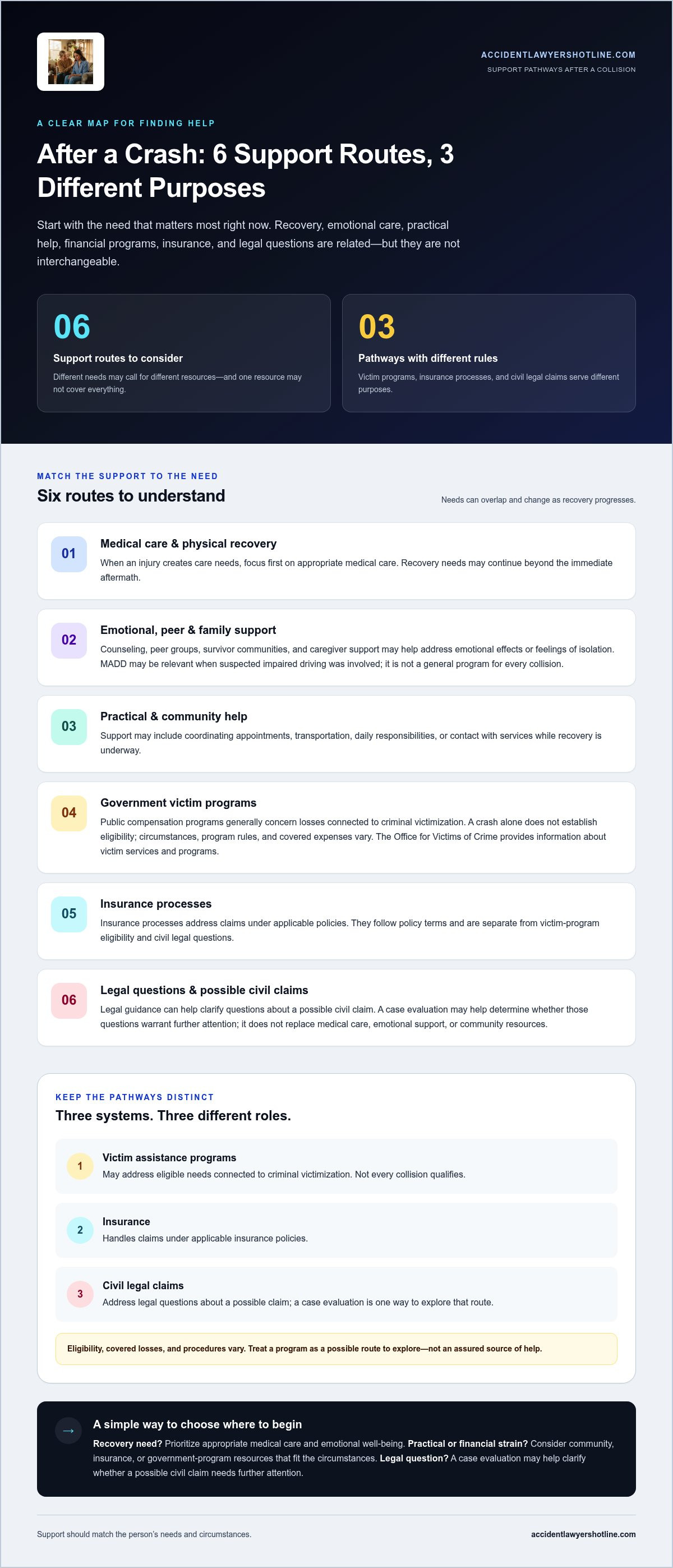
Use this simple map to choose a starting point:
- Recovery needs: Focus first on appropriate medical care and emotional well-being.
- Assistance routes: Consider practical, community, insurance, or government-program resources that match the need and circumstances.
- Legal questions: A case evaluation may help clarify whether questions about a civil claim warrant further attention.
The next sections explain how these support categories differ, how government programs, insurance processes, and civil legal claims work in broad terms, and how to take manageable first steps. Eligibility, covered losses, and procedures vary, so treat any program as a possible route to explore, not an assured source of help.
Types of Car Accident Victim Assistance: Find the Support That Fits
Different needs call for different kinds of help. A peer group may help someone feel less alone, while practical support can make it easier to manage appointments or daily tasks. Financial programs and insurance processes follow their own rules, and legal guidance addresses possible civil claims. These forms of car accident victim assistance may overlap, but they aren’t interchangeable or guaranteed.
Emotional, peer, and family support after a collision
A collision can affect a person’s sense of safety, sleep, mood, or ability to manage daily life. Counseling may offer space to work through those effects. Peer groups and survivor communities can connect people with others who understand recovery firsthand, which may ease feelings of isolation. Loved ones and caregivers may also benefit from support as they help someone recover.
For crashes involving suspected impaired driving, Mothers Against Drunk Driving (MADD) may be a relevant resource. Its focus is impaired-driving incidents, so it isn’t a general program for every collision. If you or someone else is in immediate danger, contact emergency services. For an urgent emotional or mental health crisis, reach out to an appropriate crisis service.
Practical, financial, and legal support are different pathways
Practical help can mean coordinating appointments, transportation, daily responsibilities, or contact with services during recovery. Financial-program assistance is different: public compensation programs have specific eligibility rules and may apply to losses connected to criminal victimization. The Office for Victims of Crime provides information about victim services and programs, but a crash alone doesn’t establish eligibility.
Insurance processes address claims under applicable policies. Legal guidance, by contrast, can help someone understand questions about a possible civil claim. It doesn’t replace counseling, practical support, or a government benefit. A case evaluation can be one way to explore legal questions. Accident Lawyers Hotline connects people with independent personal injury attorneys and doesn’t provide direct legal representation. To explore that route, you can request a motor vehicle accident case evaluation.
Use this table to match a need with a possible starting point. Availability and eligibility vary by program and individual circumstances.
| Need | Possible resource | What to keep in mind |
|---|---|---|
| Emotional support | Counseling, peer group, or survivor community | Access and fit vary; loved ones may need support too. |
| Recovery logistics | Family, caregiver, or community support | Help may focus on appointments, transportation, or daily tasks. |
| Eligible crime-related losses | Government victim assistance or compensation program | Eligibility, covered expenses, and application steps vary. |
| Insurance or legal questions | Insurer or independent attorney referral | Policies, claim circumstances, and legal options differ. |
Choose the route that fits the problem in front of you. You can pursue emotional, practical, financial, and legal support separately rather than expecting one resource to handle every part of recovery.
Government Benefits, Insurance, and Legal Claims: How the Pathways Differ
These routes can all relate to crash losses, but they aren’t one shared compensation system. A government crime-victim program, an insurance claim, and a civil legal claim have different purposes, decision-makers, and requirements. Understanding the distinctions can help you identify relevant car accident victim assistance without assuming that one application covers every expense.
| Pathway | What it generally addresses | What to verify |
|---|---|---|
| Government crime-victim programs | Potential services or compensation for people who meet program rules related to victimization | Whether the circumstances qualify, covered losses, documentation, application steps, and deadlines |
| Insurance processes | Claims under applicable auto or other insurance policies | Relevant coverage, policy requirements, claim procedures, and reporting timelines |
| Civil legal claims | Questions about seeking recovery through a legal claim | Whether a claim may apply, the process, and deadlines in the relevant jurisdiction |
Eligibility, covered losses, procedures, and deadlines vary by program and jurisdiction. The table is a general guide, not a determination of eligibility or a prediction of benefits, claim value, or outcome. Use current guidance from the relevant official agency, insurance policy, or qualified legal resource to understand the applicable requirements.
When crime-victim assistance or compensation may be relevant
Some government programs may apply when a crash involves criminal conduct, subject to the rules where the incident occurred. A traffic collision by itself doesn’t establish eligibility. The U.S. Department of Justice’s Office for Victims of Crime (OVC) provides information that can help people locate victim services and state or territory compensation contacts. The Victims of Crime Act (VOCA) supports assistance programs through grants, but it doesn’t create an automatic payment for every crash survivor.
Use official program guidance to review current eligibility, covered expenses, required records, and application steps. OVC information can help you find the appropriate program; it doesn’t decide whether an individual qualifies. If criminal conduct may have been involved, the program’s rules will determine whether the incident qualifies.
How insurance and civil legal questions differ from victim programs
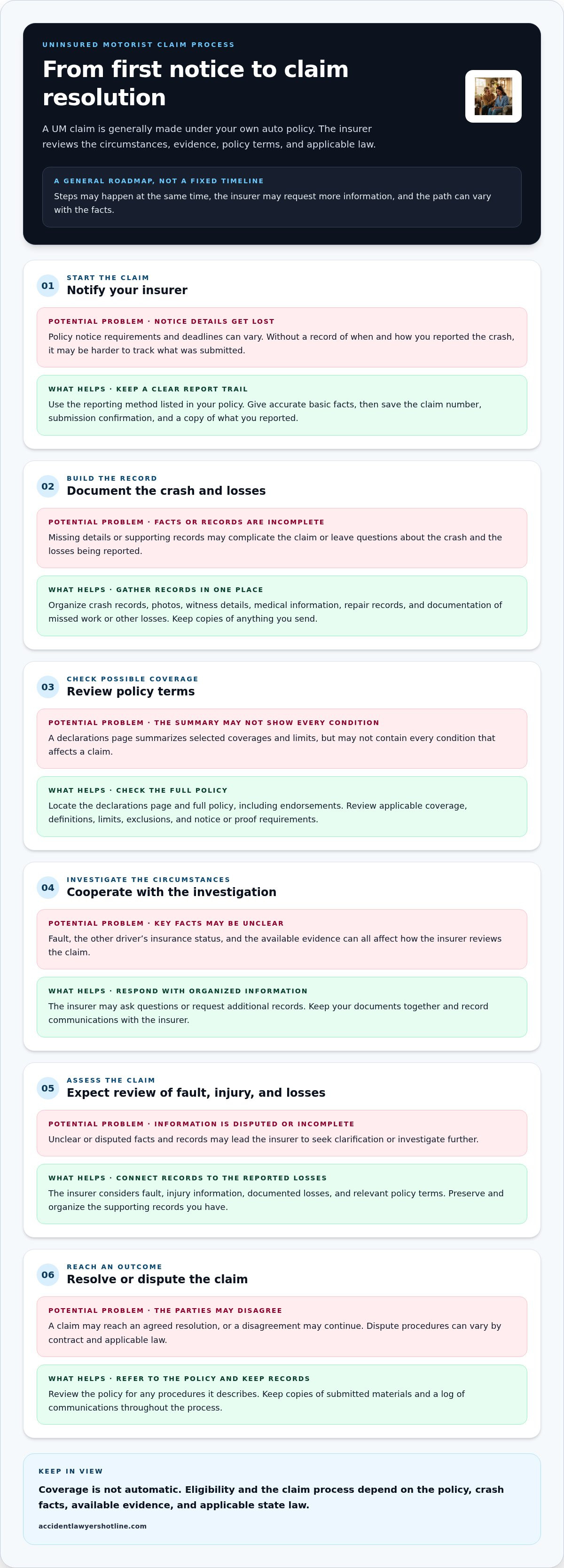
Insurance claims are handled under applicable policies and their procedures. A civil legal claim is a separate process that may raise questions about responsibility and recovery. Neither should be confused with crime-victim compensation, which follows its own program criteria. Depending on the circumstances, you may need to explore more than one route, but one route doesn’t guarantee eligibility or payment through another.
If you’re trying to understand what a civil claim evaluation covers, this car accident attorney case evaluation guide explains that pathway. Accident Lawyers Hotline evaluates motor vehicle accident inquiries and connects people with independent personal injury attorneys. It doesn’t provide direct legal representation. Official program and policy information can help you understand separate benefit or claim requirements.
How to Find Car Accident Victim Assistance: A Practical First-Step Plan
It can be hard to know where to start when several needs arise at once. Use this sequence to make the search for car accident victim assistance more manageable. If someone faces immediate danger or urgent medical needs, contact emergency services first. The steps below can wait until it’s safe to focus on them.
- Identify the need. Name the most pressing concern, such as recovery logistics, emotional support, financial-program eligibility, or a legal question.
- Select a resource type. Match the need to a relevant support route rather than expecting one organization to handle everything.
- Gather key records. Keep accident, medical, expense, and communication records together in a secure place.
- Follow up. Note whom you contacted, what they requested, and any next steps or dates they provided.
Needs can overlap, so you may explore more than one route at a time. For example, you might look for recovery support while separately reviewing an insurer’s process or a public program’s eligibility rules. Keep a simple log of calls, emails, submitted documents, and responses. It can help you track what’s been handled without relying on memory during a stressful period.
Prepare a clear summary before contacting a resource
Write down the crash date, what you know about how it happened, injuries or treatment to date, and the questions you want answered. Keep copies of relevant records, such as reports, medical documents, receipts, and messages, but don’t delay care or urgent help while gathering paperwork. Share sensitive personal information only through appropriate, trusted channels.
For each contact, record the organization, date, person or department you reached, and any requested follow-up. If a family member or caregiver is helping, agree on where records are stored and who will handle responses. A brief, consistent summary can make conversations easier and reduce the need to retell details from memory.
Use national directories and specialist organizations appropriately
The Office for Victims of Crime (OVC) provides a directory to help locate victim programs. Treat it as a starting point, not a ruling on eligibility: requirements and available assistance vary. MADD may be relevant to survivors and loved ones affected by an impaired-driving crash, but its focus is specialized. Neither resource applies to every collision or every need.
Before reaching out, review whether the organization’s focus matches your situation and use its official guidance for current instructions. If you’re unsure which kind of support to seek, write down the question and the outcome you need, such as understanding a program or finding peer support. For immediate safety or urgent medical concerns, contact emergency services rather than waiting for a directory or organization to respond.
If a legal question is one part of your recovery needs, Accident Lawyers Hotline evaluates motor vehicle accident inquiries and connects people with independent personal injury attorneys. It isn’t a law firm and doesn’t provide direct legal representation. You can Explore a case evaluation as one possible step, separate from medical, emotional, or community support.
When a Car Accident Case Evaluation Can Connect You With Legal Help
Legal help is one possible part of car accident victim assistance. If you have questions about a potential civil claim, a case evaluation may offer a way to discuss the collision and understand what legal questions could be relevant. It’s separate from medical care, emotional support, insurance processes, and government programs. An evaluation doesn’t guarantee that you qualify for a claim, will be offered representation, or will receive compensation.
What a case evaluation can clarify
An evaluation may consider the crash circumstances, injuries, available records, and the questions you want answered. You might be unsure which documents matter or whether your situation raises civil claim questions. Sharing what you know can help frame the discussion, but missing records or unanswered details don’t establish what the outcome will be. A case-specific review is needed to assess the particular circumstances.
Accident Lawyers Hotline is a referral platform, not a law firm. It evaluates motor vehicle accident inquiries and connects people with independent personal injury attorneys. The platform doesn’t provide direct legal representation. If an attorney connection is made, the attorney’s assessment, decision about representation, and agreement with you are separate from the platform’s role.
What happens when you request a legal connection
The process begins with sharing basic information about the accident and your questions. Accident Lawyers Hotline uses motor vehicle accident inquiries to connect people with independent attorneys. The evaluation is a starting point for exploring legal assistance, not a promise of a particular attorney, representation, or result. You can also review this contingency fee guide to understand the term and the questions an attorney agreement may address.
Referred attorneys operate on a contingency basis, meaning no fees unless the case is won. That general description doesn’t replace the specific agreement: fee terms and representation details depend on the attorney and the agreement you enter. Review those terms directly with the attorney before deciding whether to proceed. Don’t assume that every attorney uses identical terms.
If you’re considering legal help, share basic information about the crash and your questions for a case evaluation. It’s one option for exploring possible civil claim issues, alongside the recovery and other support you may need. There’s no guaranteed outcome, and the evaluation doesn’t replace medical, emotional, or community assistance.
Choose One Next Step That Feels Manageable
Recovery doesn’t require you to resolve every question today. Choose the next step that would bring the most clarity, whether that’s arranging support for a current need or writing down a legal question you want answered. A focused step can make car accident victim assistance feel more manageable without taking attention away from your health and well-being.
If you’re considering whether a civil claim may be an option, a case evaluation can help you raise questions about your circumstances. It can’t guarantee representation or a particular result, but it may help you decide what to explore next.
Request a car accident case evaluation if you’re ready to discuss your situation. Take things one step at a time, at a pace that works for you.
Frequently Asked Questions
Is car accident victim assistance available after every crash?
Support options may be available after many kinds of crashes, but access depends on the resource. A peer community or educational material may be open to a broad audience, while a public compensation program may require specific circumstances and evidence. Insurance and civil legal matters have their own rules. Start with the need you’re trying to address, then review the relevant organization’s current requirements. Seek urgent medical or safety help before handling forms.
Can I get victim compensation after a car accident?
Possibly, but a collision alone doesn’t establish eligibility. Some government programs are intended for people affected by qualifying crimes, and their rules differ. If you suspect criminal conduct was involved, review the official program guidance for the place where the crash occurred. For example, look for whether the program accepts your type of incident and what documents it requests. Don’t treat a general description of benefits as confirmation that your circumstances qualify.
How much financial help can a car accident victim receive?
There’s no single amount that applies to every person or program. Any assistance depends on eligibility, which expenses a program covers, required documentation, and the circumstances of the case. Insurance claims and civil legal claims are separate processes, and neither guarantees payment. Rather than rely on a broad online estimate, list the expenses you’re asking about and review the specific program or policy. For legal claim questions, an attorney can discuss the individual circumstances.
What happens if I cannot afford a lawyer after a car accident?
Some personal injury attorneys work on a contingency basis, with their fee tied to a successful case rather than paid upfront. Accident Lawyers Hotline evaluates motor vehicle accident inquiries and connects people with independent attorneys who operate on that basis. This doesn’t guarantee representation or a result. Before entering an agreement, review the attorney’s specific fee terms, including how the agreement defines a successful case.
Can family members get support after someone is injured in a crash?
Yes, some survivor organizations and support services include relatives, caregivers, or other loved ones. A family member might seek a peer connection while helping coordinate daily responsibilities, or review whether a resource supports people affected indirectly by the crash. Services vary. When looking into an organization, explain your relationship to the injured person and what kind of help you’re seeking. If the crash involved suspected impaired driving, note that circumstance when reviewing specialized resources.
Do I need a police report to ask for car accident victim assistance?
Not always. A peer group or educational resource may not ask for a police report, while an insurer, public program, or legal process may request records relevant to its review. If you don’t have a copy, review the organization’s instructions for acceptable alternatives and how to obtain the document if needed. Keep any records you already have together, but don’t postpone medical care or emotional support while collecting paperwork.
Is a victim assistance organization the same as a car accident law firm?
No. A victim assistance organization may focus on emotional support, information, advocacy, or referrals. A law firm provides legal representation through an attorney-client agreement. Accident Lawyers Hotline is a referral platform that evaluates accident inquiries and connects people with independent attorneys; it doesn’t directly represent clients. Knowing the role of each resource helps you direct your request appropriately, such as seeking peer connection for emotional support or an attorney referral for a civil claim question.
Were You Injured in an Accident?
Get a free, confidential case evaluation. No upfront fees.
Get Free Case Evaluation