T-Bone Accident Settlement Examples: What Affects a Claim
Explore t-bone accident settlement examples and learn the key factors that affect payout amounts, from injury proof to fault rules and insurance limits.
Could two people in nearly identical T-bone crashes receive very different settlement offers? Yes. The t-bone accident settlement examples you find online often leave out the facts that explain why a claim resolved as it did.
It’s understandable to look for a number that helps you plan. But a settlement isn’t determined by the crash type alone, and an early offer may arrive before you know the full impact of your injuries. Fault, medical evidence, documented losses, and available insurance coverage can all shape a claim.
This article explains what examples can and can’t tell you. You’ll see how injuries, evidence, fault, and insurance may affect a claim, and which records can help clarify your circumstances. You’ll also learn why no example can predict your result, especially when injuries are still developing or responsibility is disputed.
To get a clearer picture, organize your medical records, bills, wage-loss information, crash photos, witness details, and insurance documents. An individual case evaluation can help you discuss the facts generic examples can’t resolve and connect with an independent attorney who can provide legal assistance.
Key Takeaways
- Use t-bone accident settlement examples to understand how claims may differ, not to predict your own result.
- Separate evidence about how the crash happened from records showing your injuries, treatment, and financial losses.
- Consider how fault rules and available insurance may affect recovery, since both can vary by situation and state.
- Preserve crash, medical, wage-loss, and insurance records, and prioritize care guided by qualified clinicians.
- An individual case evaluation can review your account and available records, then connect you with an independent attorney.
What T-Bone Accident Settlement Examples Can, and Cannot, Tell You
A T-bone collision is a side-impact crash, typically named for the shape formed when one vehicle strikes another from the side. The term describes how the vehicles collide, not how serious the injuries are or who is legally responsible. For an overview of side impacts, see Side collision (T-bone accident).
A settlement is a negotiated resolution of a claim. Published t-bone accident settlement examples can illustrate how claims differ, but only if you can see the relevant facts and understand what the reported result includes. A figure without that context offers little guidance.
Why published T-bone settlement figures need context
Two side-impact crashes may look similar but involve very different claims. Compare injury severity, treatment, recovery outlook, evidence about liability, and available insurance coverage. For example, a documented fracture requiring ongoing care raises different questions from symptoms that resolve after limited treatment. That contrast doesn’t establish what either claim is worth. It shows why the underlying records matter.
Public case results may leave out confidential settlement terms, fees, liens, disputed facts, or how the parties reached an agreement. A dramatic result involving catastrophic injuries shouldn’t be a benchmark for a different crash with different injuries and evidence. Treat examples as illustrations, not promises or reliable predictions.
Settlement, verdict, and take-home recovery are different
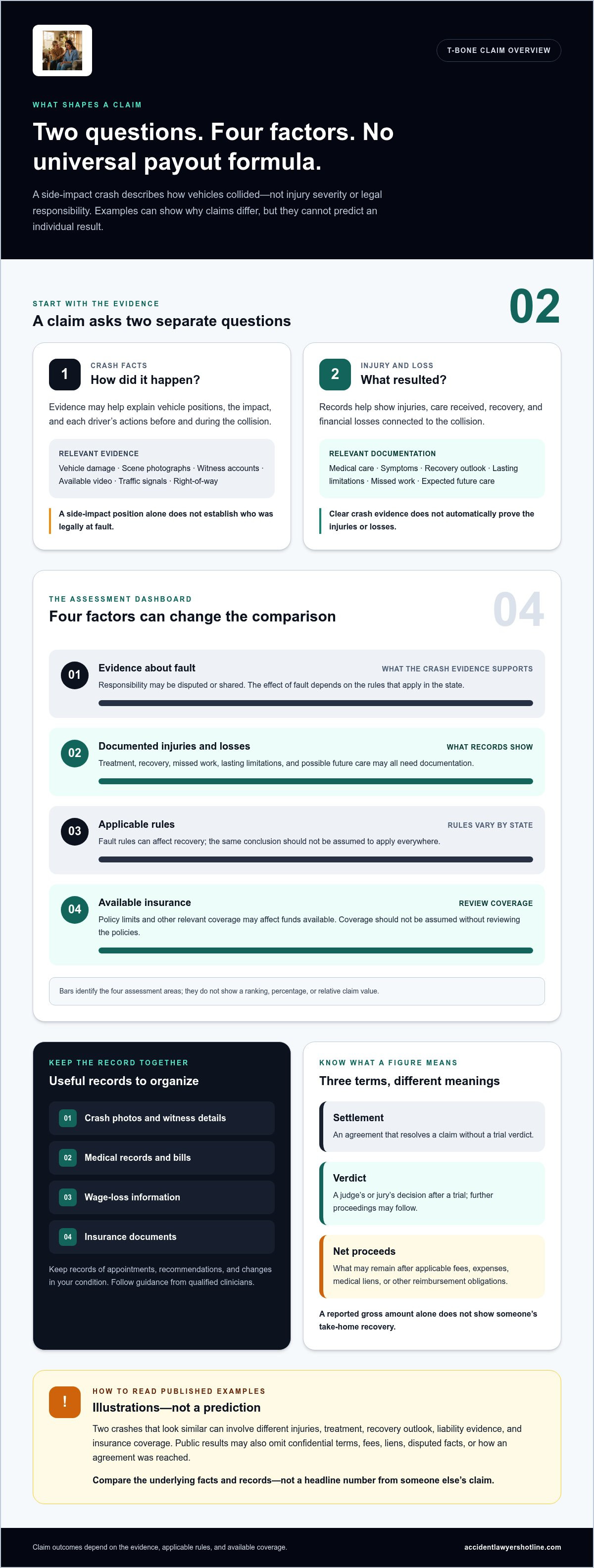
A settlement is an agreement that resolves a claim without a trial verdict. A verdict is a decision made by a judge or jury after a trial. A verdict may be followed by further proceedings, so the amount reported in a case result may not reflect what a claimant ultimately receives.
Also distinguish a gross settlement or award from net proceeds. The gross amount is the total before applicable deductions and obligations. Depending on the claim and agreements involved, fees, case expenses, medical liens, or other reimbursement obligations may affect the amount left for the claimant. The specific terms matter, so a headline figure alone can’t tell you someone’s take-home recovery.
No example or hypothetical can predict an individual claim’s value. Your circumstances depend on the available evidence, injury documentation, applicable fault rules, insurance, and other case-specific facts. A careful review can put those pieces into context instead of relying on a number from someone else’s claim.
Which T-Bone Crash Facts Can Change a Settlement Outcome?
A claim involves two separate questions: what the evidence shows about how the crash happened, and what records show about resulting injuries and losses. Strong proof on one point doesn’t automatically establish the other. For example, photos may clearly show damage to a vehicle’s side, while medical records still need to connect the injuries and treatment to the collision.
How fault and side-impact evidence may matter
Vehicle damage, scene photographs, witness accounts, and available video may help explain where the vehicles were and how the impact occurred. But a side-impact position alone doesn’t establish who was legally at fault. The investigation may need to consider traffic signals, right-of-way, and each driver’s actions before and during the collision.
These details can affect whether responsibility is disputed or shared. The legal effect of fault depends on the rules that apply in the state, so don’t assume the same conclusion follows everywhere. For general highway-safety information and resources, consult the National Highway Traffic Safety Administration (NHTSA) data.
How injuries, losses, and insurance shape the comparison
Medical records help show the care received, symptoms reported, and course of recovery. Gaps in treatment or disagreements about whether later care relates to the crash may complicate an assessment. That doesn’t mean a claim has no value. It means the records and reasons for any gaps may need careful review. Follow qualified clinicians’ advice and keep records of appointments, recommendations, and changes in your condition.
Other relevant information may include lasting limitations, missed work, and expected future care. These losses need documentation, and whether they are covered or recoverable depends on the circumstances and applicable rules. Insurance also matters. The at-fault driver’s policy limits and any other relevant coverage may affect the funds available, but coverage should not be assumed without reviewing the policies.
In short, a T-bone claim’s potential recovery depends on evidence of fault, documented injuries and losses, applicable rules, and available insurance, not on a single universal formula.
That’s why t-bone accident settlement examples can explain relevant factors but can’t replace a review of your records and coverage. An individual case evaluation can help organize those questions and connect you with an independent attorney for legal assistance. Start an individual accident case evaluation to discuss the facts of your crash.
Three T-Bone Accident Examples Compared Without Promising a Payout
The following scenarios are hypothetical, not reports of actual claims or settlement results. They show how evidence, medical documentation, coverage, and unanswered questions can change a claim assessment, even when each crash involves a vehicle struck from the side.
| Hypothetical scenario | Liability evidence | Injury documentation | Coverage questions | Unresolved issues |
|---|---|---|---|---|
| Clearer fault evidence | Scene photos and a witness account support one driver’s version. | Prompt evaluation and treatment records document an injury and follow-up care. | Which policies apply, and what are their limits? | How long will recovery take? Is any driver’s conduct disputed? |
| Disputed responsibility | Drivers give conflicting accounts; no clear video is initially available. | Records document reported symptoms and treatment. | What coverage is available if responsibility is shared? | Could witnesses, vehicle damage, video, or signal records clarify the crash? |
| Evolving medical picture | Initial evidence describes the impact, but some details remain uncertain. | Symptoms continue, and clinicians are still assessing treatment needs and prognosis. | Do applicable policies cover the documented losses, and what limits apply? | What lasting effects or future care needs will medical records support? |
Example one: Clearer fault evidence with documented injuries
Imagine a driver is struck while crossing an intersection. Photographs show the damage, a witness describes the other vehicle entering the intersection, and medical records document an evaluation and follow-up treatment. Together, those facts may help assess liability and the claimed injury. They don’t resolve every question. Coverage, recovery duration, and any disputed conduct still matter.
Example two: Disputed fault or shared-responsibility questions
In another hypothetical, both drivers say they had the right of way, and the available scene evidence is incomplete. A nearby camera, witness account, vehicle damage pattern, or traffic-signal records might help clarify what happened. If responsibility is shared, the effect on recovery depends on the state’s applicable fault rules. It can’t be determined from the collision shape alone.
Example three: Serious symptoms with an evolving medical picture
A person feels pain after the crash, receives an initial evaluation, and later reports continuing symptoms. Their clinicians may recommend further assessment or treatment. As the medical picture develops, records may clarify the injury, prognosis, and any lasting limitations. Necessary care should follow qualified clinicians’ advice. This example offers no basis to predict a settlement.
These t-bone accident settlement examples show why similar crash shapes don’t guarantee similar claim assessments. The facts, records, insurance, and state rules can differ. None of these hypotheticals establishes a likely outcome or payout for an individual claim.
How to Build a Stronger T-Bone Claim Record Before Comparing Examples
Before using t-bone accident settlement examples as a point of comparison, gather records that explain your crash, injuries, and losses. You don’t need to reconstruct everything at once. Start with what you have, keep it organized, and avoid filling gaps with guesses.
Preserve records that explain the collision
- Save existing crash evidence: Keep scene and vehicle photographs, witness names and contact details, incident documents, and relevant insurer correspondence together.
- Write down what you remember: Note the date, location, direction of travel, sequence of events, and what you observed. Separate direct memories from details you’re unsure about.
- Keep vehicle documents: Save available repair estimates, invoices, and inspection records. These may help document damage, though damage alone doesn’t establish fault.
- Retain communications: Keep copies of letters, emails, and claim documents, along with the dates of calls and the names of people you spoke with.
Records made close to the time of the crash can help clarify disputed details by preserving what was observed, documented, and communicated before memories fade.
Track injuries, treatment, and practical losses
- Collect medical records, treatment instructions, appointment dates, and bills or other expense documents as they become available.
- Keep accurate records of missed work, such as schedules, pay information, or employer documentation. Don’t estimate lost time or income if you can verify it.
- Note changes in symptoms and activity limits, then share them with your healthcare professionals. Prioritize medical attention and follow qualified clinicians’ advice.
- Keep records that show how an injury affects routine tasks, but describe your experience accurately and avoid exaggerating or minimizing it.
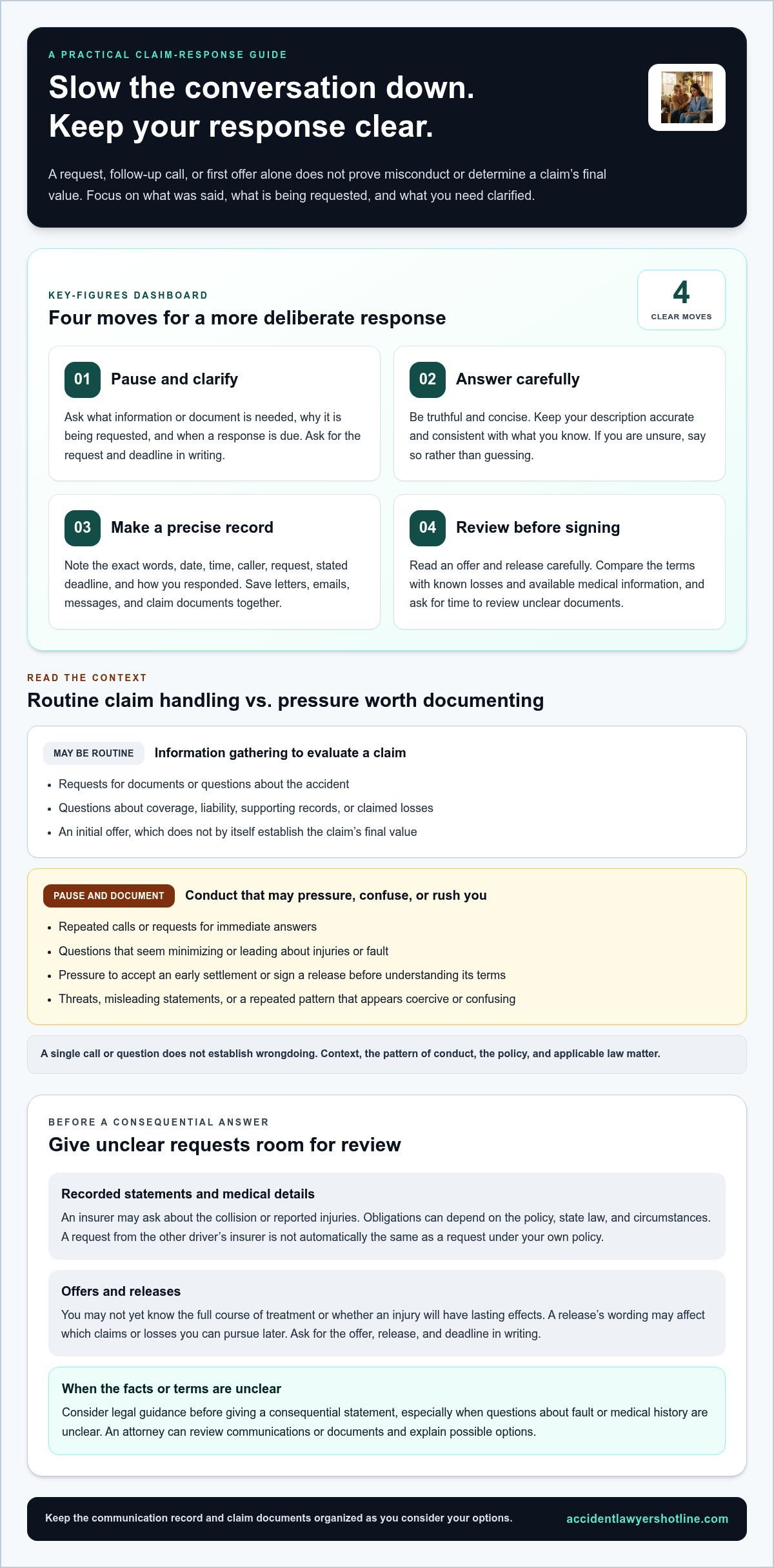
Insurer questions, recorded statements, and proposed settlement documents can have consequences for a claim. Read requests carefully, keep copies of what you provide, and avoid signing a settlement document you don’t understand. The effect of a statement or document depends on the circumstances and applicable law. If you’re unsure what a request means, an individual case evaluation can help you discuss the available information with an independent attorney.
Organized records won’t guarantee a particular result. They can make it easier to see what evidence exists, what remains unclear, and how your situation differs from examples online. Request an individual accident case evaluation to discuss your records and connect with an independent attorney.
What Happens During a T-Bone Accident Case Evaluation?
A case evaluation gives you a chance to discuss the details behind your crash, not just compare your situation with examples online. It can consider your account of the collision, available records, current injuries and treatment, and relevant insurance information. The goal is to understand what is known, what remains unclear, and what questions may need further review. An evaluation does not guarantee a settlement or a particular result.
Accident Lawyers Hotline is a case-evaluation and referral platform that connects people with independent attorneys who provide legal assistance. It does not directly represent you. The attorneys it connects you with offer contingency-based representation, meaning there are no fees unless the case is won. Ask the attorney to explain the terms of the agreement before deciding whether to proceed.
Information to prepare for an individual evaluation
You don’t need a perfect file to start a conversation. A short, accurate summary can make the discussion clearer. Gather what you have, and mark anything you’re uncertain about rather than filling in missing details.
- Collision timeline: Note where and when the crash happened, what you remember about the sequence, and any details that are disputed or unclear.
- Available records: Collect photos, incident documents, witness information, medical records, and documents about vehicle damage.
- Treatment update: Summarize care received so far, current symptoms, and any follow-up or recommendations from qualified clinicians.
- Insurance contact: Keep insurer correspondence and documents you’ve received. An offer or request is one piece of information, not a complete assessment of claim value.
- Open questions: List concerns about fault, available coverage, ongoing injuries, lost income, or possible next steps.
Getting connected with independent legal help
An individual attorney can review facts that general t-bone accident settlement examples can’t resolve, including how evidence, injuries, and coverage apply to your circumstances. If you’re considering a contingency arrangement, read a guide to understanding contingency fees and discuss the specific agreement with the attorney. The terms can vary.
When you’re ready, start a national case evaluation to discuss your account and available records. Accident Lawyers Hotline connects motor vehicle accident victims with independent attorneys who can provide legal assistance.
Take the Next Step With a Clearer Picture
t-bone accident settlement examples can show how fault evidence, injury documentation, and available insurance may shape different claims. They can’t predict your result. A side-impact crash’s appearance alone doesn’t answer who was responsible or what losses are supported. Your records and circumstances matter.
Keep your collision documents, treatment information, and notes about losses together. Then consider an individual case evaluation to discuss the facts generic examples can’t resolve. Accident Lawyers Hotline is a national case-evaluation and referral platform that connects motor vehicle accident victims with independent attorneys experienced in accident cases. The attorneys it connects you with offer contingency-based representation, meaning there are no fees unless the case is won.
Start a T-bone accident case evaluation to discuss your situation and connect with an independent attorney. You don’t have to make sense of every detail alone. A thoughtful review can help you identify questions and consider your next steps with greater confidence.
Frequently Asked Questions
What is a typical settlement for a T-bone accident?
There’s no dependable typical amount that applies to every T-bone accident. Injury severity, treatment, recovery outlook, evidence of fault, and available insurance can all change a claim assessment. Published t-bone accident settlement examples may also omit important details, such as disputed facts or settlement terms. Use examples to understand which factors matter, not as a prediction of what your claim should settle for.
How much is a T-bone accident settlement worth?
A T-bone settlement’s value depends on the documented losses and facts of the individual claim. Relevant details may include medical care, missed work, lasting limitations, evidence about responsibility, and available insurance coverage. State law may also affect recovery. No online figure can account for all those details. An individual case evaluation can help you discuss your records and identify questions that generic examples can’t answer.
Can I recover compensation if I was partly at fault in a T-bone crash?
Possibly, but the effect of shared fault depends on the law that applies to your claim. Some states reduce a person’s recovery based on their share of responsibility, while other rules may limit whether recovery is allowed at all. For example, Texas and California use different comparative-fault approaches. The crash position alone doesn’t determine fault. Discuss the evidence and applicable state rules with an independent attorney.
What evidence helps prove fault in a T-bone accident?
Useful evidence may include photographs of the scene and vehicle damage, witness accounts, available traffic or vehicle video, and incident records. Information about traffic signals, right-of-way, and each driver’s actions may also help clarify what happened. Preserve what you have, including repair or inspection documents, and separate what you remember from what you’re unsure about. A side-impact position by itself doesn’t establish legal fault.
How long does it take to settle a T-bone accident claim?
There’s no fixed timeline for resolving a T-bone claim. The process may depend on how quickly fault can be assessed, whether injuries and treatment needs are clear, how much evidence is available, and whether the parties dispute liability or losses. Insurance communications and negotiations can also affect timing. A case evaluation can help identify what information is available and what questions may still need review, but it can’t guarantee a resolution date.
What injuries are common in side-impact crashes?
Side-impact crashes can cause a range of injuries, from soft-tissue pain and bruising to fractures, head injuries, or spinal injuries. The actual harm depends on the collision and the person involved, so the crash type alone can’t establish injury severity. Seek medical attention after a crash and follow qualified clinicians’ advice. Keep records of symptoms, evaluations, and treatment, and share changes in your condition with your healthcare professionals.
Should I accept an insurance settlement before finishing treatment?
Don’t decide based only on an early offer or a case example. Before accepting, understand what the settlement document says it resolves and whether it may affect later claims related to the crash. If treatment is ongoing or your recovery outlook is unclear, the full impact of your injuries may not yet be documented. The consequences depend on the agreement and applicable law, so consider discussing the offer with an independent attorney before signing.
Were You Injured in an Accident?
Get a free, confidential case evaluation. No upfront fees.
Get Free Case Evaluation