Burn Injury Settlement From a Car Accident: What Affects Value
See what shapes a burn injury settlement from a car accident: burn extent, medical costs, scarring, lost income, future treatment, and pain and suffering.
The degree of a burn matters, but it doesn’t determine a settlement by itself. Reported U.S. burn injury settlements range from $10,000 to $10,000,000+, and a burn injury settlement from a car accident can depend on how severe the burns are, how much of the body they affect, and what care the person needs.
It’s understandable to focus first on whether a burn is first-, second-, or third-degree. First-degree burns affect the outer skin layer, second-degree burns can blister, and third-degree burns damage deeper tissue. The area affected, lasting scars, and impact on daily life also help show the extent of the injury.
This article explains how burn severity, treatment, rehabilitation, medical expenses, lost income, and pain and suffering can affect settlement value. It also covers how car fires, friction, and other crash-related causes can lead to burns, and why documenting future care needs matters when assessing a claim.
Key Takeaways
- Burn depth and the size of the injured area help show the injury’s seriousness, while scarring and lasting effects can also influence value.
- Keep the full picture of harm in view: a claim may include treatment and rehabilitation needs, lost income, and non-economic damages.
- Crash-related burns can result from fire, friction, or vehicle-related hazards, so how the injury occurred matters when assessing responsibility.
- Future care needs, including reconstructive treatment and therapy, can shape a claim alongside bills and income losses already incurred.
- A careful case evaluation can connect the medical impact and crash circumstances to the damages being claimed.
Burn severity and the size of the injured area
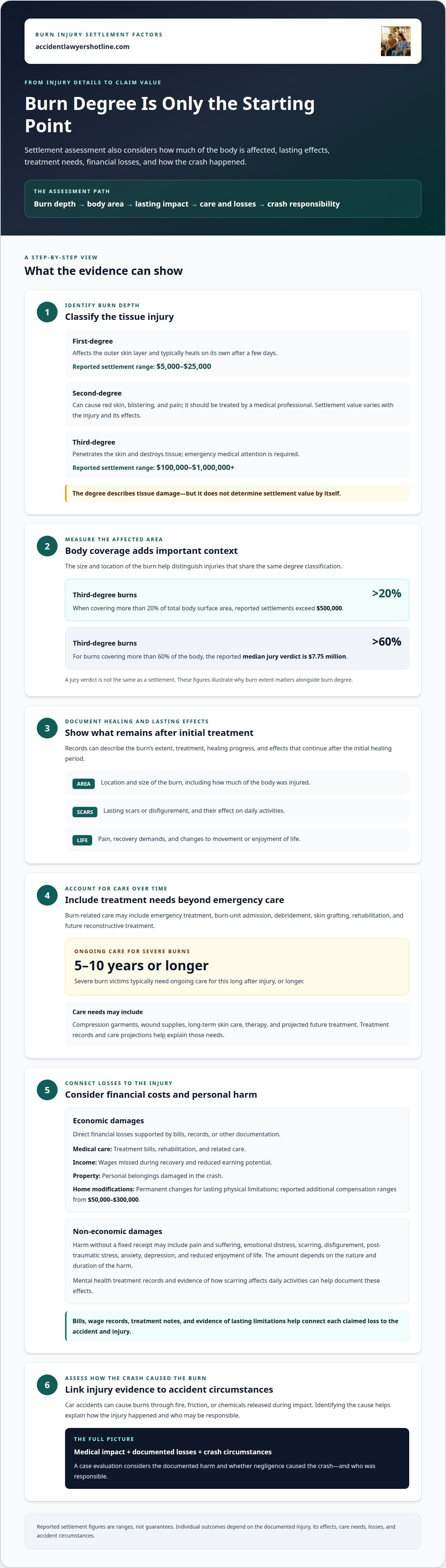
Burn classification describes tissue damage, but it doesn’t determine settlement value on its own. The degree, affected body area, healing process, and ongoing care help document the injury’s impact. A first-degree burn affects the outer skin layer and typically heals on its own after a few days. That differs from deeper burns that need professional treatment or emergency care.
Reported first-degree burn injury settlements range from $5,000 to $25,000. A first-degree burn may still cause pain and disrupt daily activities, but its documented healing course helps distinguish it from more severe injuries. The degree is one part of the assessment. The location and size of the burn, treatment received, and effects that continue after initial healing also help describe the loss.
A second-degree burn can cause red skin, blistering, and pain, and should be treated by a medical professional. Settlement values for second-degree burns can vary depending on the injury and its effects. The classification alone doesn’t capture how much of the body was injured or what treatment followed. Records can show the burn’s extent, care provided, and healing progress. Those details give a clearer picture than the degree label alone.
A third-degree burn penetrates the skin and destroys tissue, and requires emergency medical attention. Reported third-degree burn injury settlements range from $100,000 to $1,000,000+. The wide range reflects how much the injury’s full impact can vary. The size of the burned area, lasting effects, and continuing treatment needs all matter. A severe injury involving a large area can call for a different assessment than a smaller burn.
Body area adds important context. Third-degree burns covering more than 20% of total body surface area are reported to result in settlements exceeding $500,000. For third-degree burns covering more than 60% of the body, the median jury verdict is $7.75 million. A jury verdict is not the same as a settlement, but these figures show why the extent of injury matters alongside its degree.
Long-term treatment can extend beyond emergency care. Severe burn victims typically need ongoing care for 5-10 years after injury or longer. A claim may include compression garments, wound supplies, and long-term skin care. Treatment records and care projections help explain how the burn continues to affect daily needs. A personal injury assessment also considers whether negligence caused the crash and who was responsible. The injured person deserves consideration of the documented harm, not just a label for the burn’s degree.
Economic and non-economic damages
A burn injury claim can include economic and non-economic damages. Economic damages are direct financial losses, such as medical bills, lost wages, and property damage. Non-economic damages address harm without a fixed receipt, including pain, emotional distress, and reduced enjoyment of life. Separating these categories helps show the injury’s full impact instead of relying on a single total.
Medical treatment can create substantial expenses. A claim may include emergency care, burn-unit admission, debridement, and skin grafting. Records and bills for each treatment help explain which costs relate to the injury. An attorney can organize those expenses alongside other documented financial losses.
Economic damages can also include lost wages, reduced earning potential, physical therapy, and home modifications. If a severe burn limits movement, the injured person may need therapy or changes to the home. Permanent home modifications for burn victims typically receive additional compensation ranging from $50,000 to $300,000. Property damage may also be included, such as belongings damaged in the crash. Each item should connect clearly to the injury or accident.
- Medical expenses: Treatment bills, rehabilitation, and related care.
- Income losses: Wages missed during recovery and reduced earning capacity.
- Property damage: Losses to personal belongings connected to the crash.
- Home modifications: Changes needed to accommodate lasting physical limitations.
Non-economic damages address the human impact of a burn. Pain and suffering, scarring, disfigurement, post-traumatic stress, anxiety, depression, and loss of enjoyment of life may be considered. These damages don’t have a fixed price like a hospital bill. Mental health treatment records, or evidence showing how scarring affects daily activities, can help document that impact. The amount depends on the nature and duration of the harm.
Economic and non-economic losses together describe the compensation sought. A bill may show the cost of a graft, while treatment notes explain pain and recovery demands. Wage records can establish missed income, while evidence of lasting limitations can show effects beyond the paycheck. An attorney assessing a claim considers documented expenses alongside personal harm. Clear records help connect each claimed loss to the accident and injury.
For help organizing the financial and personal effects of a burn injury, request a case evaluation to discuss which damages may apply.
Burn injuries caused by car accidents
Car crashes can cause burns through fire, friction, or chemicals released during impact. Identifying the cause can help explain how the injury happened and who may be responsible.
There is no single filing deadline for every state. Kansas generally allows two years, Missouri generally allows five years, and California generally allows two years from the injury date; California claims against government entities generally have six months.
Evidence for a Burn Injury Claim
Evidence for a burn injury claim connects the crash, the burn, and the resulting losses to the responsible party. Prompt medical care creates records of the injury and treatment. Photographs of the burns, crash scene, vehicle, or hazard can document conditions close to the event. Preserving a defective part or other relevant item may help explain how the burn occurred.
Crash reports, witness accounts, treatment records, and photographs can each support a different part of the claim. For example, a vehicle fire may raise questions about the crash sequence, while medical records document the burn and its effects. A lawyer may work with doctors, engineers, or safety experts to assess the injury and its cause. Together, this evidence can help establish negligence and show the extent of the harm.
Insurance Coverage for Burn Injuries
Coverage depends on the crash circumstances, the responsible party, and the terms of the applicable policies. A claim may involve the at-fault driver’s auto liability coverage or coverage under the injured person’s own auto policy. The policy language and collision facts determine which coverage may apply.
Burns involving a defective vehicle part can raise additional questions about responsibility beyond the drivers. Available coverage may depend on who caused the crash, what caused the fire, and which policies apply. A car accident lawyer can assess how the injury mechanism relates to the claim and identify relevant coverage issues. Policy limits and exclusions can affect the amount available.
Car accidents can cause thermal burns when a vehicle catches fire. Friction burns can occur when skin scrapes against a rough surface, combining heat injury with abrasion. Airbag chemicals or a fuel tank defect may also contribute to burns. Identifying the mechanism helps distinguish an impact injury from a fire-related or equipment-related injury.
The cause can shape the liability investigation. If a collision triggers a fire, the evidence may focus on the crash and its aftermath. If a defective component contributed, investigators may examine the part and how it functioned. A lawyer may work with engineers or safety experts to assess these questions. The key is linking the specific cause to the injury and resulting losses, not assuming every vehicle fire proves negligence.
Burn injuries can affect people beyond the driver. A passenger may suffer friction burns against a surface or burns from a fire after impact. Each claim depends on the person’s injuries, the crash circumstances, and the evidence of responsibility. Those details help explain the suffering and losses the injured person seeks to recover.
How do burn severity, body area, and scarring affect car accident settlement value?
Settlement value reflects more than the burn’s degree. The affected body area, lasting scars, treatment needs, and impact on daily life all matter. Reported figures vary widely between cases, so a range cannot predict what an individual claim will recover.
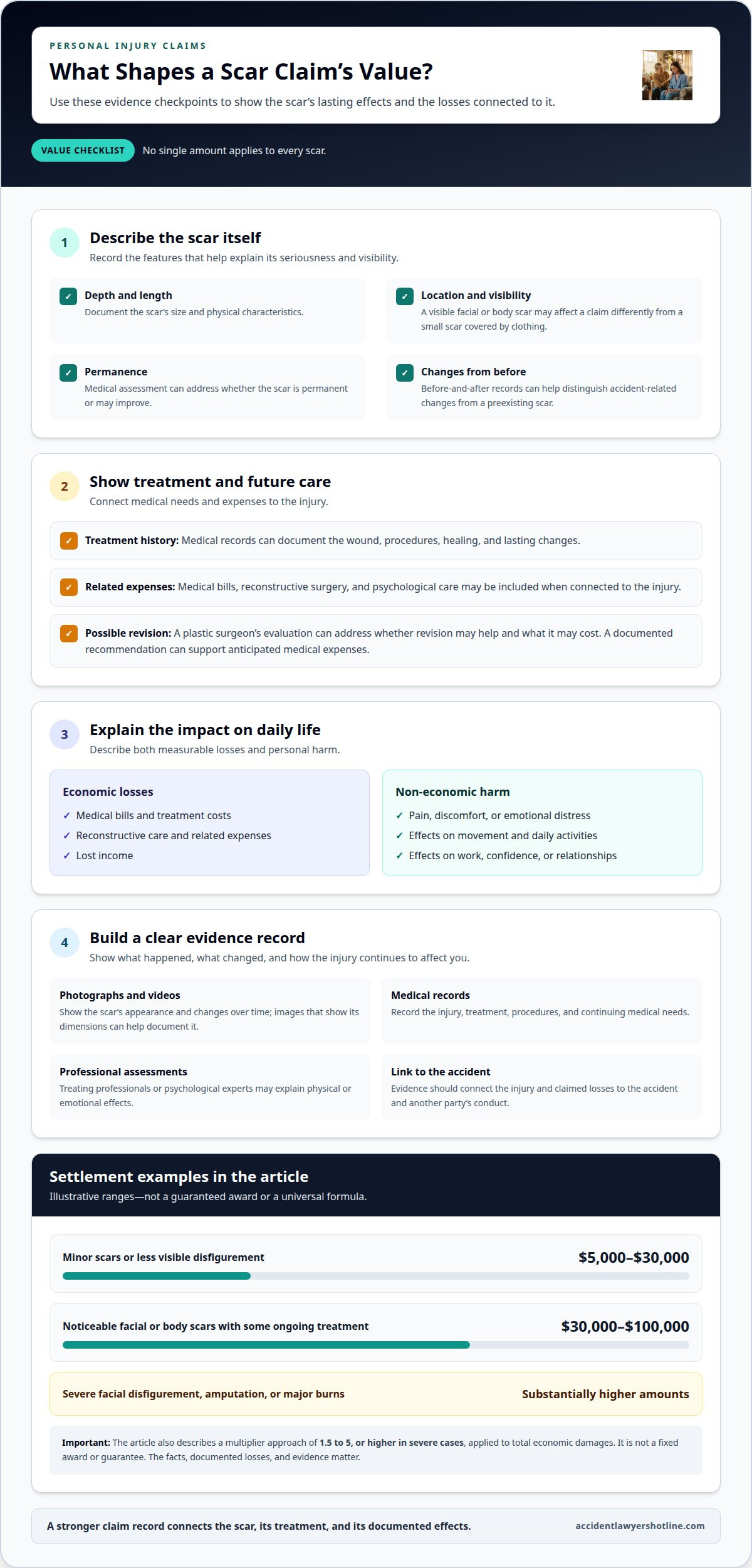
Scarring can change how an injury affects a person’s life. Reported settlements for minimal scarring range from $10,000 to $50,000, while moderate scarring ranges from $50,000 to $250,000. Severe facial scarring settlements range from $250,000 to $1,500,000. Facial and neck scarring can result in settlements 2-3 times higher than equivalent burns elsewhere, reflecting visibility and personal impact.
Body area also matters. Third-degree burns covering more than 20% of total body surface area are reported to result in settlements exceeding $500,000. For third-degree burns covering more than 60% of the body, the median jury verdict is $7.75 million. A jury verdict differs from a settlement, but both figures illustrate how extensive injuries can involve greater losses and care needs.
Individual cases show why burn degree alone doesn’t establish value. Different injuries, evidence, and circumstances make direct comparisons unreliable.
Other outcomes provide context, not a formula. The body area and case details differ, so these results shouldn’t be treated as fixed benchmarks.
Fourth-degree burns have reported settlement ranges of $500,000 to $10,000,000+. The upper range reflects the potential scope of severe injury, not a standard award. To assess a claim, the evidence needs to show the affected area, scar location, treatment, and lasting limits. Photographs and medical records can document changes over time, while care records may show continuing needs. For example, a scar affecting hand movement can have different daily consequences from a scar that does not restrict function. Those distinctions help explain why the injury’s actual effects matter alongside its classification.
How are medical bills, future treatment, and lost wages calculated in a burn injury settlement?
A claim combines losses already incurred with projected future care and income losses. Severe burn medical bills can reach hundreds of thousands of dollars. Calculating a burn injury settlement from car accident-related injuries means separating past expenses from future needs, then connecting each loss to the injury and its effects.
Past medical expenses are gathered from treatment records and bills. These may include emergency care, burn-unit admission, debridement, skin grafting, and infection treatment. Organizing charges by provider and treatment helps show what care the burn required and how the total developed.
Future care requires more than adding current bills. A claim may account for reconstructive procedures, scar-revision surgeries, wound supplies, and long-term skin care. Physical and occupational therapy may address contractures or lost range of motion. Each projected need should connect to the injury’s documented effects, such as restricted movement that requires continued therapy.
A life care plan can organize expected services, equipment, and treatment over time. Cases with detailed future-care projections can increase final compensation by 30-50% compared with cases without them. The plan helps explain why current treatment costs may not represent the full financial impact. For a young child with severe burns, projected lifetime care needs may span 60-70+ years.
Income losses can include wages missed during recovery and diminished earning capacity when lasting limitations affect work. The calculation considers how the injury changes a person’s ability to perform their job. For example, restricted hand movement may interfere with tasks requiring grip or dexterity. Employment and income records can help establish past losses, while medical evidence can explain limitations affecting future work.
Rehabilitation can affect both expenses and earning capacity. A person with contractures may need ongoing physical or occupational therapy to address movement limits. If those limits affect job duties, the claim may include lost income or reduced earning potential. Treatment plans and work records help connect these losses rather than present them as unrelated expenses. A burn injury settlement from car accident-related harm should account for documented future limitations as well as past costs.
- Past costs: Bills for treatment already received and related medical care.
- Future care: Projected treatment, therapy, supplies, and reconstructive needs.
- Income losses: Wages missed and reduced capacity to earn.
A careful calculation distinguishes documented costs from projected needs and explains the basis for each. To discuss how medical records, future care, and income losses fit together, request a burn injury case evaluation.
Accident Lawyers Hotline
Accident Lawyers Hotline offers case evaluations for people injured in motor vehicle crashes. If burns followed a collision, an evaluation can help connect the crash circumstances, medical records, treatment needs, and financial losses. Accident Lawyers Hotline connects individuals with personal injury and motor vehicle accident attorneys who provide legal assistance. The attorneys work on a contingency basis, meaning there are no fees unless the case is won.
A case evaluation can be a useful next step when you need help assessing how evidence of the burn and crash relates to potential compensation. Accident Lawyers Hotline also offers evaluations for truck, motorcycle, and pedestrian accident cases.
Contact Accident Lawyers Hotline to discuss a case evaluation.
Take the Next Step With a Clearer Claim
A burn injury settlement from a car accident should reflect the documented impact, not just the immediate aftermath. Before deciding whether to resolve a claim, consider whether the available information accounts for ongoing care, work limitations, and changes to everyday life. A claim assessment can help identify supported losses, unanswered questions, and how the crash evidence connects to the injury. That gives you a more grounded basis for considering your next move.
You don’t have to sort through the process alone. Accident Lawyers Hotline can connect you with legal assistance to evaluate a motor vehicle injury claim and discuss the factors that may shape it. A case evaluation can help you understand how the collision facts and the effects of your burns fit together, so you can decide how to proceed with greater clarity.
Contact Accident Lawyers Hotline to discuss your situation and take a considered next step.
Frequently Asked Questions
Can 2nd-Degree Burns Result in Million-Dollar Verdicts?
Yes. The result shows how extensive burns and lasting facial scarring can factor into a verdict. It does not establish a standard value for other claims. The affected body area, lasting effects, evidence, and crash circumstances all shape an individual case.
Does my psychological treatment count toward the claim?
Psychological treatment can be relevant when it addresses effects connected to the burn, such as post-traumatic stress, anxiety, or depression. For example, records from a mental health professional can document symptoms, treatment, and their impact on daily life. This evidence can help explain emotional harm alongside physical injuries. The connection between the crash, the burn, and the need for treatment matters when presenting this part of a claim.
How Can a Personal Injury Attorney Help?
A personal injury attorney can assess how crash evidence, medical information, and documented losses support a claim. For example, an attorney may coordinate records that explain the cause of a vehicle fire and the resulting injuries. Accident Lawyers Hotline provides case evaluations and connects accident victims with independent personal injury and motor vehicle accident attorneys. The attorney can then provide legal assistance based on the facts and needs of the case.
How Do Burns Happen in Car Accidents?
Burns in car accidents can result from flames after a crash, skin scraping against a rough surface, or chemicals released by an airbag. A fuel tank defect may also contribute to a fire or burn injury. For example, friction burns can combine heat damage with abrasion. Identifying the mechanism helps explain how the burn occurred and whether the crash circumstances or a vehicle component contributed.
How Does Fault Affect What You Recover?
Fault can reduce or prevent recovery under some state rules. In Texas, modified comparative fault allows recovery based on the percentage the injured person was not responsible; a person more than 50% at fault cannot recover. In the provided example, a Texas victim found 20% responsible receives $8,000 from a $10,000 settlement. Rules differ by state, so the relevant location and facts matter.
Should I settle before my reconstructive surgeries are finished?
Before agreeing to resolve a claim, account for planned reconstructive or scar-revision surgery and related rehabilitation. For example, a treatment plan may identify additional procedures after the initial burn care. Future needs may also include physical or occupational therapy for movement limitations. Medical projections help show the expected scope of care, rather than relying only on expenses already incurred. Consider the full treatment picture before deciding whether a proposed resolution addresses it.
What Steps Can an Attorney Take to Help You Get Compensated, and What Forms of Compensation May Be Available?
An attorney can assess responsibility, organize evidence, and connect documented losses to the crash. Compensation may include medical expenses, future care, lost wages, reduced earning capacity, and property damage. A claim may also account for pain, emotional distress, scarring, or loss of enjoyment of life. For example, treatment records and income documents can support different parts of the claim and help explain how the injury affects daily needs.
What is the average settlement for burn injuries from a car accident?
There is no single figure that describes every car-accident burn claim. The reported national median recovery across burn injury cases is $366,313, but that figure is not specific to car accidents. Individual outcomes depend on injury extent, treatment, lasting effects, financial losses, and responsibility for the crash. A case assessment should distinguish broad burn-injury figures from evidence tied to the particular collision and injuries.
Were You Injured in an Accident?
Get a free, confidential case evaluation. No upfront fees.
Get Free Case Evaluation