Permanent Scarring Claims: What Affects Their Value
Learn what affects a permanent scarring or disfigurement claim, from scar location and permanence to treatment, daily-life impact, evidence, and related losses.
A scar’s value in a personal injury claim depends on more than its appearance. A permanent scarring or disfigurement claim may account for the scar’s location, severity, permanence, treatment needs, and effect on daily life, along with related losses such as medical expenses, lost income, and pain and suffering.
It’s understandable to want a clear dollar figure, especially when an injury has changed your appearance or affected how you feel day to day. But no single amount applies to every scar. A visible mark, a serious burn, and a scar that limits movement can affect a claim differently, and the strength of the evidence matters.
This article explains what scarring and disfigurement mean, how they may affect a personal injury claim, and what can influence its value. It also covers how photographs, medical records, treatment details, and evidence of the scar’s impact can show what happened and how the injury continues to affect you.
Key Takeaways
- Understand how a lasting change in appearance may qualify as scarring or disfigurement and affect a personal injury claim.
- Learn which economic and non-economic losses may be considered, and why settlement values depend on the facts of the injury.
- See how clear photographs, including images that show a scar’s dimensions, can help document its appearance over time.
- Identify how scar location, severity, permanence, and effects on daily life may influence claim value.
- Discover how medical assessments, treatment records, and expert testimony can help connect the injury to the harm claimed.
What Is Scarring and Disfigurement?
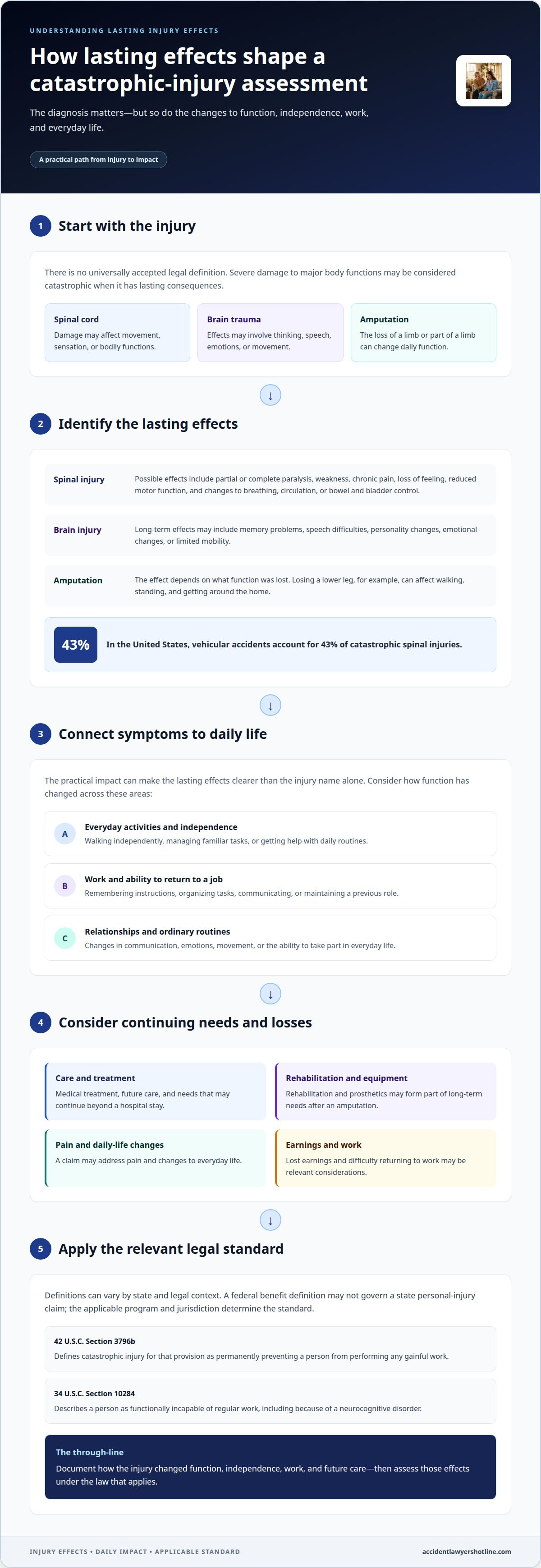
A scar forms when damage reaches the dermis and the body produces collagen fibers during healing. Disfigurement describes lasting, medically significant harm to appearance, such as a scar, burn, missing limb, or differently shaped body part. A preexisting scar doesn’t automatically prevent a claim. Before-and-after records can help show what the accident changed. Shared fault may affect recovery under applicable state law, so the evidence must connect the injury and claimed harm to the other party’s negligence.
The injury’s cause and healing process help explain its effects. A vehicle accident may cause deep lacerations, facial injuries, burns, or crush injuries. Severe burns may require skin grafts, which can leave differences in skin color and texture. A visible scar shows that a wound has healed, but not how much the injury has affected someone’s life. Treatment records can document the wound, procedures, and lasting changes.
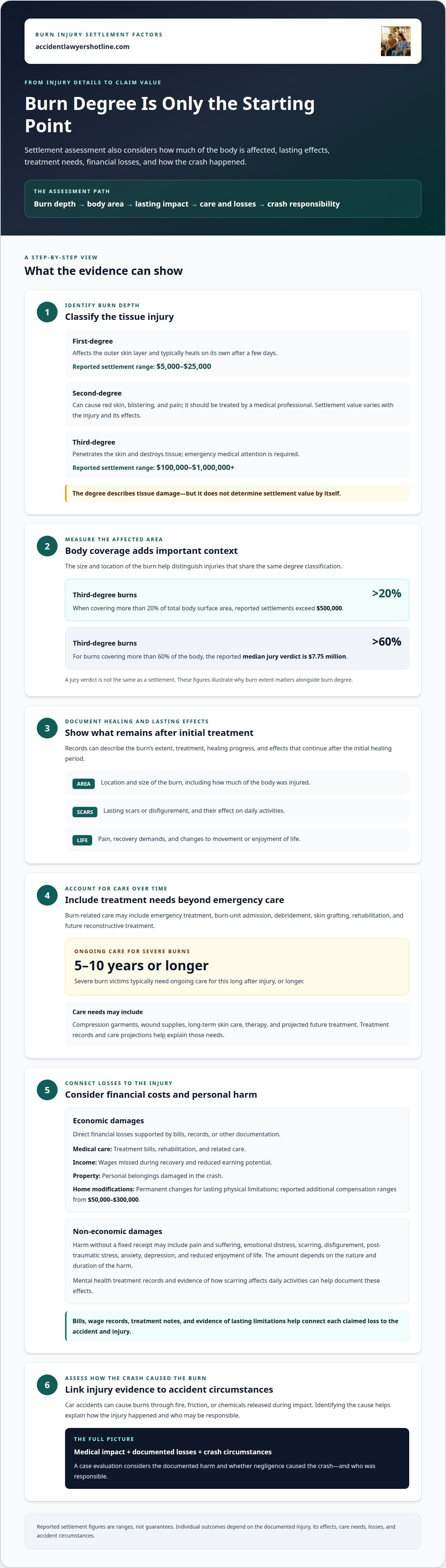
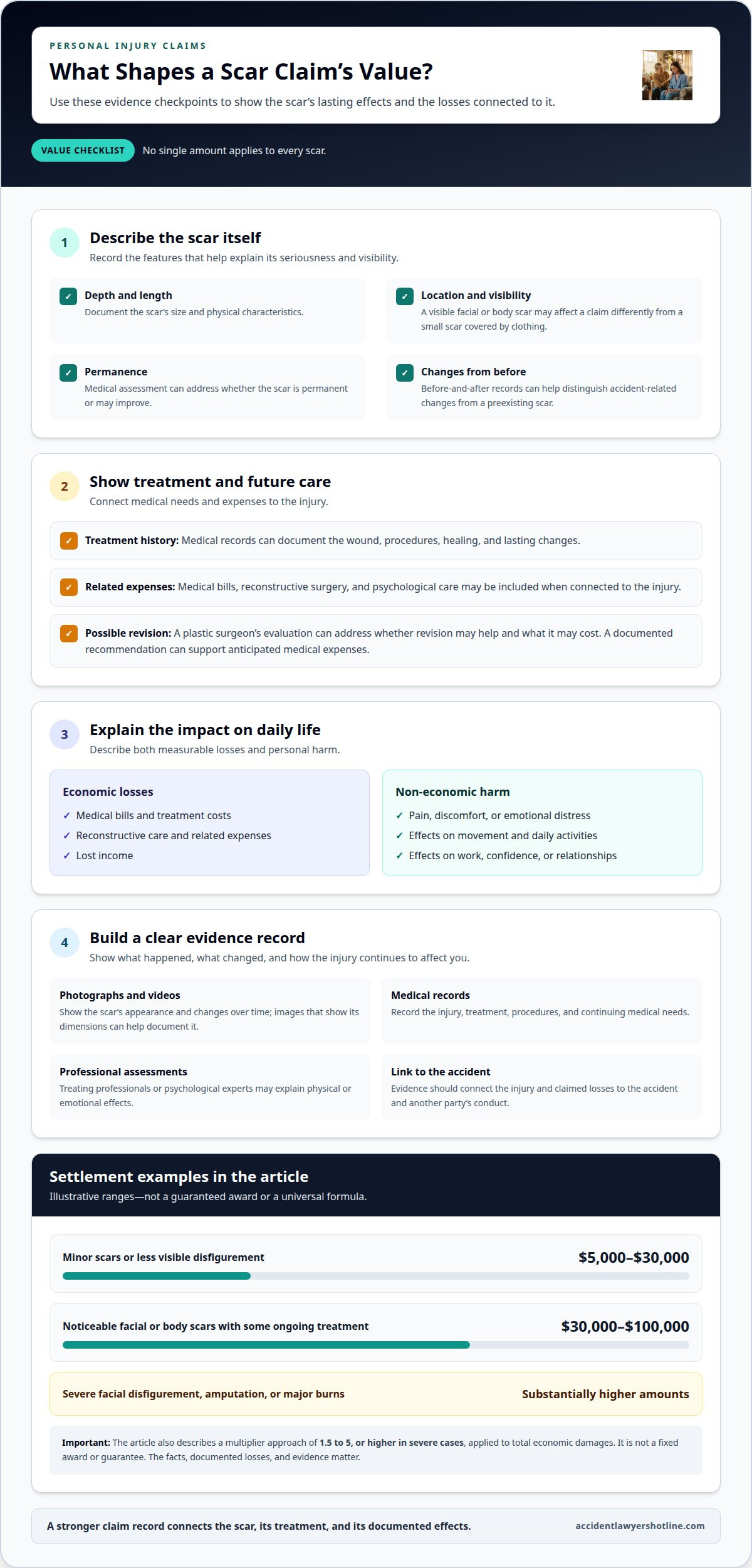
Compensation for accident-related scars may include medical expenses, reconstructive surgery, psychological care, lost income, and pain and suffering. The amount depends on the losses connected to the injury and the evidence supporting them. Claims involving minor scars or less visible disfigurement may settle for $5,000 to $30,000. Claims involving noticeable facial or body scars and some ongoing treatment may settle for $30,000 to $100,000. Severe facial disfigurement, amputation, or major burns may involve substantially higher amounts.
Workers’ compensation benefits follow different rules from injury claims against a negligent party. Alabama workers’ compensation law allows compensation for serious disfigurement not covered by another scheduled injury for a period set by the court, up to 100 weeks. According to the South Carolina Legislature, state workers’ compensation law allows up to fifty weeks of benefits for serious permanent disfigurement of the face, head, neck, or another area normally exposed in employment. These examples show why the injury’s setting and location matter.
Missouri law also provides a route to seek injury-related compensation when negligence caused the harm. Missouri § 537.765 is cited as allowing an injury victim to pursue compensation for injury-related losses when another party’s negligence caused the injury. For example, a person injured in a crash may document scar treatment alongside other accident losses. The claim still needs evidence connecting the injury to the accident and the responsible party’s conduct.
Several details shape compensation: the scar’s depth and length, location and visibility, whether it is permanent, and its effects on movement, work, relationships, or daily activities. A facial burn requiring grafts involves different evidence from a small scar covered by clothing. An injury lawyer can assess how medical records, treatment needs, and documented changes support the claimed losses. Clear evidence of any earlier scar also helps distinguish the accident’s effects from preexisting conditions.
Can Scarring Affect a Personal Injury Claim?
Yes. A scar may support damages for financial losses and personal harm. A permanent scarring or disfigurement claim can include evidence of how the injury occurred and how it affects the person afterward.
Economic and Non-Economic Damages
Economic damages cover measurable losses, while non-economic damages address personal harm such as pain and suffering. In a scarring case, medical bills and lost income may support economic damages; discomfort, emotional distress, and changes to daily life may support non-economic damages.
For example, a burn that requires treatment can lead to doctor bills and reconstructive care, while a visible facial scar may affect confidence or relationships. Separating these categories helps show how one injury can create both financial costs and lasting personal effects.
Evidence of Liability and Damages
Evidence of liability connects the accident to another party’s conduct; evidence of damages shows the injury’s consequences. Medical records can document treatment, while photographs and videos can show the scar’s appearance. Testimony from treating professionals or psychological experts may help explain the injury’s physical or emotional effects.
There is no single nationwide filing deadline for a scarring claim. The applicable deadline depends on the state and claim type, including whether the case involves personal injury or workers’ compensation. Identifying the governing state and claim category is an essential early step, because missing a deadline can affect your ability to pursue compensation.
Calculating Permanent Scar Compensation
There is no universal formula for calculating compensation for permanent scars. A settlement may account for documented economic losses and non-economic harm, including pain, emotional distress, and the scar’s impact on daily life.
One settlement approach multiplies total economic damages by a factor between 1.5 and 5, or higher in severe cases. This multiplier method is not a fixed award or a guarantee. For a permanent scarring or disfigurement claim, the scar’s visibility, permanence, treatment needs, and effect on work or relationships help explain the non-economic damages sought.
Future Scar Revision Costs
Future scar revision or reconstructive surgery costs may be included when they relate to the injury and are supported by evidence. A plastic surgeon’s scar revision evaluation can assess whether a scar is permanent, whether it may improve, and the cost of revision.
That assessment helps distinguish completed treatment from anticipated care. For instance, a documented recommendation for revision can explain why additional medical expenses may be part of the claim. A personal injury lawyer’s evaluation can help organize evidence of liability, current losses, and projected treatment costs.
How an attorney can document scars with professional photography
After an injury, give the attorney the accident details, medical records, treatment history, and any photographs or videos already taken. Explain when the wound appeared, how it healed, and whether an earlier scar or condition affects the same area.
A scar develops as the body repairs damage to the dermis by forming new collagen fibers. Professional photographs can preserve a clear record of its appearance and severity. An attorney can organize the images alongside medical records, connecting the visible injury with its treatment and the personal injury claim.
Useful photographs show both the scar’s location and its details. A wider view can place a facial scar in context; a closer view can capture its edges, texture, and color. A ruler in the image can show its dimensions. Consistent lighting and clear focus make comparisons more meaningful across photographs taken at different stages.
Photographs and videos can document how a scar changes during healing or after treatment. An attorney can arrange the images by date and relate them to medical visits, procedures, or a doctor’s assessment. This timeline helps explain changes in appearance and the treatment that followed, rather than presenting isolated images without context.
Dog bites and animal attacks can cause deep puncture wounds or ragged lacerations. Wounds on the face, throat, or scalp can leave visible scars and may be difficult to reconstruct. In a dog-bite case, photographs can record the wound’s location and appearance, while medical records describe treatment and any infection-related tissue loss.
An attorney can use an organized photo record to explain the evidence to insurance companies. Images are more useful when paired with the date, body location, and related treatment record. For example, a photograph of a facial scar alongside a reconstructive surgeon’s assessment can show both its appearance and the medical context.
Documentation should also reflect the victim’s ability to work and manage daily activities. If a scar limits movement or causes sensitivity, medical notes and a clear description of the affected task can add context to the images. Together, photographs, videos, and expert testimony can show the injury’s visible and practical effects.
Factors affecting the value of a scar claim
A scar claim’s value reflects more than appearance. Severity, visibility, permanence, and effects on work or relationships can all shape the assessment.
Factors Affecting Settlement Amounts
Settlement amounts reflect the injury’s physical effects, personal consequences, and the evidence connecting them to the accident. Relevant factors include scar severity, the injured person’s age and gender, effects on career and lifestyle, relationships, and jurisdiction. These details help explain why two people with similar-looking scars may present different claims.
For example, a scar that limits someone’s work duties may create different documented losses from one that causes no work-related changes. An attorney can connect the medical record with evidence of career disruption, altered activities, or relationship effects. A claim is stronger when it explains these specific consequences rather than relying only on a general description of distress.
Severity and Visibility
Courts and juries may consider a scar’s permanence, appearance, location, and effect on daily life when assessing its severity. A visible scar on the face or neck may be viewed as more harmful than one on the stomach or back. Location matters because it can affect how often others see the scar and how it influences ordinary social or work situations.
Depth and length also help describe the injury’s physical extent. Medical assessments can explain whether the scar is permanent or may improve, while photographs show its appearance. A plastic surgeon’s evaluation may address likely improvement and revision needs. Together, these details give the decision-maker a clearer basis for assessing the scar’s severity and effects.
Settlements and Jury Awards
Settlements and jury awards are different outcomes, so past examples do not create a fixed comparison for an individual case. Settlement amounts reflect negotiations and the evidence presented; jury awards depend on the case presented to jurors. High-profile verdicts and settlements for permanent disfigurement or catastrophic scarring have exceeded $1 million, but that figure does not predict another claim’s result.
The injury’s circumstances and supporting evidence remain central to how a claim is assessed. An attorney can explain how medical findings, documented effects on daily life, and jurisdiction relate to the case’s specific facts.
Visibility is only one part of the assessment. A scar on the face may draw attention, while a scar elsewhere may still affect movement, clothing choices, or familiar tasks. Evidence should connect each claimed effect to the injury. For instance, medical notes can describe restricted movement, while testimony can explain changes to work or relationships.
Jurisdiction can also affect the legal context for compensation. In South Carolina, the Legislature allows up to fifty weeks of workers’ compensation benefits for serious permanent disfigurement on the face, head, neck, or another area normally exposed in employment. That rule applies to workers’ compensation, not every personal injury claim. The claim type and documented impact help determine which factors matter.
How an attorney can prove a scarring and disfigurement claim
A strong claim connects three points: another party’s negligence, the accident, and the lasting injury. An attorney builds that connection with evidence showing what happened, how the wound developed, and how it changed the victim’s appearance or ability. In a car accident case, crash records and medical notes should provide a consistent account of the injury.
Liability evidence explains why another party bears responsibility. For example, witness accounts, incident records, and photographs of the accident scene can help establish how the event occurred. The attorney then connects those details to the injury. The central question is whether the other party’s negligence directly caused the claimed scarring or disfigurement.
Medical records help establish that connection over time. Emergency care notes can document the original wound, while later records describe treatment and healing. If the victim had an earlier scar in the same area, records and dated photographs can help distinguish its prior appearance from changes after the accident. A clear timeline reduces confusion about which injury caused each claimed effect.
Photographs and videos provide visual evidence of the scar’s appearance and progression. An attorney can organize them by date and pair each image with the related medical visit or treatment. Professional photographs can show the scar’s dimensions, and a ruler in the image provides scale. This record helps explain the injury’s physical development, not just its final appearance.
Expert testimony can explain medical issues that images alone cannot resolve. A reconstructive surgeon can assess whether a scar is permanent, whether it may improve, and the cost of revision. Burn experts can explain injury severity and treatment. Psychological experts can address emotional effects. Each expert’s evidence should relate to a specific issue in the claim, such as permanence, care needs, or distress.
Proof of damages must show how the injury affects the victim, not only how it looks. Medical bills and treatment records document financial losses. Testimony can describe pain and suffering, emotional distress, or changes to work and relationships. For example, a record of reduced movement combined with an account of difficulty performing a regular task gives the injury’s effects concrete context.
Insurance discussions depend on a coherent presentation of liability, causation, and damages. An attorney can organize the evidence so each record supports a specific part of the claim: accident documentation for liability, medical evidence for causation, and treatment records or personal testimony for losses. Contradictions between dates, records, and descriptions can make the injury harder to evaluate.
If an accident caused lasting scarring, request a case evaluation to discuss how the available evidence can support your claim.
Accident Lawyers Hotline
Accident Lawyers Hotline helps people injured in accidents explore how their injuries may fit a personal injury claim. If scarring followed a car, truck, motorcycle, or pedestrian accident, a case evaluation can help clarify the evidence and losses involved. Accident Lawyers Hotline offers evaluations for these accident types and connects individuals with personal injury attorneys who provide legal assistance.
Consider reaching out when you need help understanding how medical records, photographs, and the accident circumstances relate to your claim. You can contact Accident Lawyers Hotline to discuss a case evaluation.
Take the Next Step Toward a Clearer Claim
A lasting scar can affect how you feel, work, and move through daily life. The next step is to turn your concerns into a clear account of what happened and how the injury continues to affect you. A permanent scarring or disfigurement claim should reflect your circumstances, not assumptions based only on appearance.
Accident Lawyers Hotline offers Car Accident Case Evaluation, Truck Accident Case Evaluation, and Motorcycle Accident Case Evaluation. These evaluations can help you discuss an accident-related injury and understand how to move forward with legal assistance. You don’t need every detail organized before seeking guidance.
If you’re ready to talk through your situation, contact Accident Lawyers Hotline today. Taking that step can help you approach what comes next with greater clarity and support.
Frequently Asked Questions
Can a Temporary Injury Still Matter?
Yes. An injury can matter even if its effects later improve or the scar fades. For example, a wound may require treatment, cause pain during healing, or temporarily limit work or ordinary activities. These effects can be documented as they occur. A temporary condition does not establish permanent disfigurement, but records of the healing period can help explain the injury’s full impact.
Does permanent scarring remove Ohio’s damages cap?
Not automatically. Under Ohio Revised Code § 2315.18, a permanent and substantial physical deformity can qualify for an exception to the ordinary statutory limit on noneconomic damages. The scar must meet that legal threshold; permanence alone does not establish it. Medical evidence describing the lasting physical change can help show whether the injury fits the exception.
Does the Location of a Scar Matter?
Yes. Location can affect how often a scar is seen and whether it interferes with movement or routine tasks. A scar near a joint, for example, may restrict a particular motion, while one on an exposed area may draw attention in daily interactions. Evidence should describe the specific effect, such as difficulty turning the neck or wearing required work clothing.
How Can a Personal Injury Attorney Help?
A personal injury attorney can organize the claim around the accident, the injury, and its consequences. For example, the attorney may compare medical records with accident documentation, identify gaps in the timeline, and present treatment or work-related losses to the insurer. This helps distinguish documented effects from assumptions and gives the claim a clearer factual foundation.
How Does Michigan Law Treat Permanent Scarring?
A Michigan scarring case should be evaluated under the rules that apply to the underlying injury claim. The scar’s treatment, lasting effects, and connection to the accident are relevant evidence, but a scar does not by itself establish a particular payment. A Michigan personal injury attorney can assess the applicable law and how the facts fit the claim.
How Much Is a Permanent Scar Worth?
There is no fixed value for a permanent scar. Its significance may differ based on its appearance, location, lasting effects, and impact on daily activities. A small mark with little practical impact presents different evidence from a scar that restricts movement or changes appearance in a way that affects work or relationships.
How much will I be compensated?
Your compensation depends on the losses supported by the claim, not simply on the presence of a scar. Medical expenses, income losses, and pain and suffering may each require different supporting records. For example, treatment bills document past care, while a medical assessment can explain continuing needs. Keep the claim focused on losses connected to the injury.
Is scarring considered pain and suffering in Ohio?
A scar may be relevant to noneconomic damages, which can include pain and suffering and the personal effects of an injury. In Ohio, a permanent and substantial physical deformity may qualify for an exception to the ordinary statutory limit on noneconomic damages under Ohio Revised Code § 2315.18. The scar’s physical and emotional effects should be documented clearly.
Were You Injured in an Accident?
Get a free, confidential case evaluation. No upfront fees.
Get Free Case Evaluation