Common Mistakes After a Car Accident: A 2026 Guide to Protecting Your Rights
Avoid common mistakes after a car accident that cost you money. Our 2026 guide shows how to handle insurers and protect your rights to fair compensation.
The insurance company starts building a case against you the moment your vehicle stops moving. It's natural to feel overwhelmed by the sudden weight of medical debt or terrified that one wrong word to an adjuster will ruin your future. Many drivers unintentionally commit common mistakes after a car accident that strip away their right to fair compensation before they even realize what happened.
You deserve to feel protected and informed during this crisis. This 2026 guide provides a clear list of critical errors to avoid, from missing the strict 14 day medical treatment windows found in some states to the hidden dangers of your own social media activity. We'll show you how to handle insurance calls with confidence and how a professional case evaluation can restore the balance of fairness. You'll discover how to access specialized legal support through a referral service that operates on a contingency basis. This approach ensures you can focus on your recovery while a dedicated advocate handles the heavy lifting. Our guide clarifies the path forward, showing you how to secure professional help with the peace of mind that there's no fee unless they win your case.
Key Takeaways
- Learn why failing to secure an official accident report or 360-degree scene photography can immediately weaken your legal position.
- Understand the specific communication traps insurance adjusters use to devalue your claim during the first "how are you feeling" phone call.
- Identify the common mistakes after a car accident regarding medical care, such as skipping follow-up appointments or delaying your initial evaluation.
- Discover how the 2026 digital landscape makes your social media activity and dashcam footage critical factors in proving liability.
- See why navigating complex statutes of limitations alone is a high-risk gamble and how a specialized referral service connects you with expert advocates.
Immediate Scene Mistakes That Can Sabotage Your Claim
The adrenaline of a crash often triggers a "fight or flight" response. This makes it easy to overlook technical details that determine the outcome of your future legal case. One of the most common mistakes after a car accident is failing to treat the scene as a critical evidence site. You must stay calm and follow a specific protocol to protect your rights.
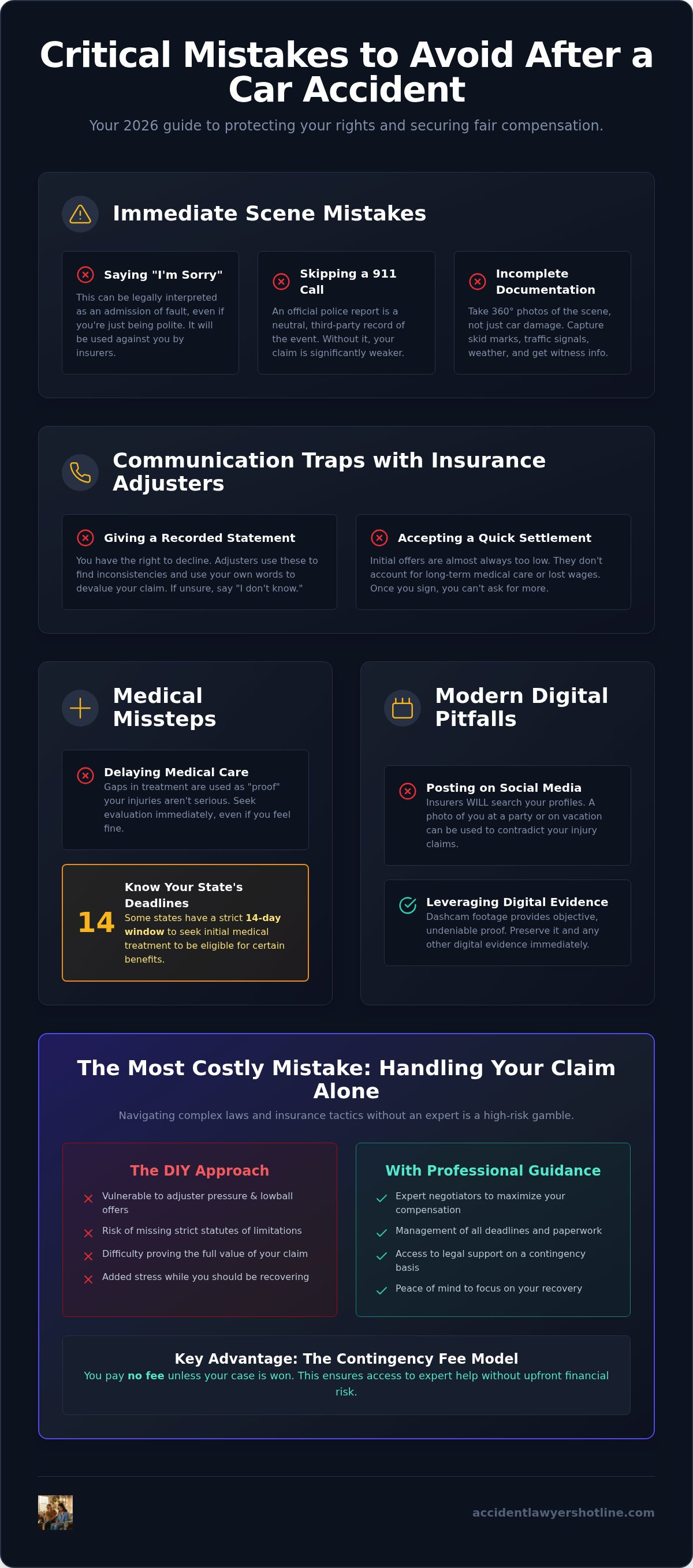
Always call 911 immediately. Even if the other driver suggests "handling it privately," don't agree. An official police report provides a neutral, third-party account of the event. If law enforcement is unable to respond due to the minor nature of the crash, you should still visit a local station to file a self-report. This creates a paper trail that insurance companies cannot easily dismiss. Never leave the scene without the other driver's full name, phone number, insurance company, and policy number. Leaving prematurely can be classified as a hit-and-run, which complicates your claim and potentially leads to criminal charges.
The 'I'm Sorry' Trap: Why Politeness Costs Money
Politeness is a natural reaction, but saying "I'm sorry" can be legally interpreted as an admission of liability. You might just mean you're sorry the event happened, but an insurance adjuster will use it to argue you were at fault. Focus on being cooperative and checking for injuries. Provide your license and insurance details, but don't discuss who caused the crash or how fast you were going. Remember, fault is a legal determination made by experts after reviewing all evidence, not a personal one you should decide on the shoulder of a road.
Incomplete Scene Documentation
Many people only take a few photos of the dented bumpers. This is a mistake. To build a strong case, you need a 360-degree view of the entire area. Start by understanding traffic collisions from a broad perspective; this includes capturing the surrounding environment. Avoiding these common mistakes after a car accident ensures you have the visual proof needed to back your claim.
- Document the road: Take photos of skid marks or the absence of them.
- Check the infrastructure: Capture the status of traffic signals or obscured stop signs.
- Note the environment: Record the weather conditions and any road debris.
- Secure witnesses: Get the contact information of any bystanders before they leave.
Witnesses often vanish once the initial shock wears off. Their statements are vital for verifying your version of events. By documenting everything immediately, you shift the burden of proof away from your memory and onto objective facts.
Communication Errors: Dealing with Insurance Adjusters
Insurance adjusters are trained negotiators. Their primary goal is to minimize the company's financial liability. One of the most common mistakes after a car accident is viewing the adjuster as a helpful advocate. They aren't. They're looking for reasons to reduce your payout. While you must follow specific steps to take after a car accident to remain compliant with your policy, you aren't required to hand over every detail of your life to the other driver's insurer.
The Danger of the Recorded Statement
Adjusters often call within hours of the crash. They'll ask for a recorded statement "just to get the facts straight." Don't do it. You have the right to decline a recorded statement until you've received professional guidance. They use these recordings to find inconsistencies. If you say you're "fine" on Tuesday but your neck starts hurting on Thursday, they'll use your own words to claim you're exaggerating. Avoiding these common mistakes after a car accident ensures your words aren't twisted into a denial of coverage. If you aren't 100% certain about a detail like speed or distance, say "I don't know." A guess is a trap that creates a permanent record against you.
Premature Settlement Acceptance
Insurers often dangle a "quick" check in front of victims who are stressed by medical bills. This is a tactic to get you to sign a release of all claims. Once you sign, you can't go back for more money, even if you discover a herniated disc weeks later. Initial offers rarely cover the full scope of long-term rehabilitation or lost wages. It's vital to understand the value of your case before agreeing to anything. You can learn more about how to protect your interests in our no fee unless we win your case attorney guide. This resource explains how professional advocacy works without upfront costs.
Another risk involves signing medical authorization forms. These forms often give the insurance company access to your entire medical history, not just records related to the crash. They'll search for "pre-existing conditions" to blame for your current pain. Only provide records specifically related to the accident. If you're feeling pressured by an adjuster, requesting a professional Car Accident Case Evaluation can help you determine the best way to respond without risking your claim.
Medical Missteps: Why Skipping the Doctor Is a Legal Failure
Adrenaline is a powerful mask. In the moments following a crash, your body's "fight or flight" response can hide significant pain from soft tissue damage, internal bleeding, or concussions. One of the most dangerous common mistakes after a car accident is assuming you're uninjured just because you aren't bleeding. If you don't seek a medical evaluation immediately, you're not just risking your health; you're handing the insurance company a tool to dismantle your claim. They'll argue that if you didn't need a doctor right away, you weren't actually hurt.
The 'Gap in Treatment' Defense
Insurance adjusters look for any "gap" in your medical history to devalue your case. If you wait several days or even weeks to see a professional, the defense will claim your injuries resulted from an unrelated event that happened after the crash. Following the correct steps to take after a car accident means visiting an urgent care or emergency room within 72 hours. In some states, like Florida, the law is even stricter; you must seek treatment within 14 days to access your Personal Injury Protection (PIP) benefits. A certified medical record serves as objective legal evidence that links your physical trauma directly to the collision. Without this contemporaneous documentation, your word against theirs is rarely enough to secure a settlement.
Inconsistency in Medical Reporting
Your medical records must tell a consistent story. When you speak to a physician, you must mention every symptom, however minor it seems at the time. A "dull ache" in your shoulder today could become a debilitating injury next month. If that ache isn't in your initial report, the insurance company will fight to exclude it from your compensation. This is especially critical in specialized cases, such as a motorcycle accident, where the lack of vehicle protection often leads to complex, latent injuries that require immediate specialist attention.
Failing to follow your doctor's prescribed treatment plan is another major error. If you miss physical therapy appointments or stop treatment as soon as you feel "mostly" better, you trigger the "failure to mitigate" defense. The insurer will argue that your ongoing pain is your own fault because you didn't follow medical advice. To protect your claim, you must:
- Attend every scheduled appointment: Consistency proves the severity of your injury.
- Follow all restrictions: If the doctor says don't lift heavy objects, don't do it.
- Report new symptoms: Keep your physician updated as your condition evolves.
Avoiding these common mistakes after a car accident ensures that your medical file remains a strong, unshakeable foundation for your legal recovery.
Modern Pitfalls: Social Media and Digital Evidence in 2026
Evidence in 2026 has evolved far beyond physical vehicle damage. In the current legal environment, your digital footprint is often the primary target for insurance defense teams. One of the most damaging common mistakes after a car accident is failing to realize that your online life is an open book for investigators. They aren't just looking at the crash; they're looking for any reason to prove you aren't as injured as you claim.
Social Media: The Insurance Company's Best Friend
Insurance adjusters are paid to find inconsistencies. They spend significant time monitoring the social media profiles of claimants. If you've filed a claim for "pain and suffering" but post a photo of yourself smiling at a family BBQ, they'll use that image to argue your quality of life hasn't suffered. It doesn't matter if you were in pain the entire time; the image creates a narrative that works against you. Many victims think "private" settings protect them, but this is a dangerous assumption. Legal teams can often subpoena your digital data, including deleted posts and private messages. The safest rule of thumb is simple: if you wouldn't say it in front of a judge, don't post it online. Avoid discussing the accident or your recovery in public forums or comment sections entirely.
Securing Digital Proof
While your social media can hurt you, other digital tools can be your strongest allies if handled correctly. Dashcam usage in US litigation has reached record highs in 2026, providing objective proof of liability. However, this footage is volatile. Most dashcams use SD cards that overwrite old data on a loop. If you don't secure that card immediately after the collision, the most vital evidence in your case could be lost forever. Similarly, smart-watch data is increasingly used to track heart rate and physical activity levels. This data can provide scientific proof of your physical limitations during recovery.
Commercial collisions involve even more complex digital layers. If you were involved in a crash with a semi, you'll need a truck accident lawyer who knows how to preserve Electronic Logging Device (ELD) data. These "black boxes" prove if a driver was speeding or violating federal rest requirements. Many common mistakes after a car accident involve ignoring this technical data until it's too late. Modern vehicles also record braking pressure and steering input in the seconds before impact. Preserving this information is critical to building an unshakeable case. If you're worried about losing this vital proof, a professional Car Accident Case Evaluation can help you identify and secure every piece of digital evidence before it vanishes.
Why DIY-ing Your Claim Is the Most Costly Mistake
Attempting to handle a legal claim alone is one of the most common mistakes after a car accident. Many victims believe they're saving money by avoiding professional fees. In reality, they often leave a significant portion of their potential settlement on the table. The legal system is built on rigid deadlines and complex liability rules that are difficult to navigate without specialized training. Insurance companies know this. They use your lack of legal experience to push for lower payouts.
Statutes of limitations vary significantly across the country in 2026. For example, California and Texas maintain a strict two-year window for filing, while Maine allows up to six years. Missing a single filing deadline by one day can permanently bar you from seeking any recovery. Beyond the clock, identifying every liable party is rarely simple. It isn't always just the other driver. A vehicle manufacturer, a government entity, or even a driver's employer could be legally responsible for the crash. A professional evaluation ensures every responsible party is identified and held accountable.
The Advantage of Professional Matching
A specialized referral service acts as your bridge to the right advocate. Unlike a local generalist who handles multiple types of law, our referral platform connects you with a professional specifically suited for your unique accident type. Whether you were involved in a bus, pedestrian, or motorcycle incident, matching your case with a specialized attorney increases your chances of a successful outcome. A free evaluation serves as a vital audit of your situation. It identifies any common mistakes after a car accident you've already made and provides a clear strategy to move forward with confidence.
The 'No Fee' Safety Net
Financial anxiety shouldn't prevent you from seeking the justice you deserve. The contingency fee model removes all upfront barriers to professional help. You don't pay a single cent unless your case is won. This safety net ensures that high-quality advocacy is accessible to everyone, regardless of their current medical debt. Professional advocates understand that an insurance company's "final offer" is usually just a starting point for negotiations. They have the resources to fight for a settlement that covers your long-term needs, not just your immediate bills. Taking the first step is easy and risk-free. You don't have to carry this burden alone.
Get your free car accident case evaluation now and protect your future today.
Take Control of Your Legal Recovery
You shouldn't have to navigate the complex legal landscape of 2026 alone. Protecting your rights starts with avoiding the common mistakes after a car accident that often devalue legitimate claims. By securing 360-degree scene documentation and declining recorded statements until you have professional guidance, you've already taken the first steps toward a fair resolution. Your health and your financial security are the top priorities during this challenging time.
Our referral platform is designed to bridge the gap between your moment of crisis and a successful settlement. We connect you with a national network of specialized attorneys who understand the intricacies of modern vehicle data and insurance tactics. You can move forward with confidence knowing that our service provides access to a "No Fee Unless We Win" model. This ensures that expert advocacy is available to you without any upfront financial risk.
Don't let medical debt or insurance pressure dictate your future. Take the next step toward justice right now. Get Your Free Case Evaluation with Accident Lawyers Hotline Today and access 24/7 support from experts who prioritize your recovery. You have the strength to rebuild; we have the tools to help you do it.
Frequently Asked Questions
Is it too late to file a claim if I didn't call the police at the scene?
No, it isn't necessarily too late, but it creates a significant hurdle. You should immediately visit a local police station to file a self-report. This creates a formal record of the event. While an on-scene report is the gold standard, a self-report still provides a paper trail for insurance adjusters. Failing to document the crash at all is one of the common mistakes after a car accident that you can still partially correct by acting now.
What if I already gave a recorded statement to the insurance adjuster?
You can't undo the recording, but you can stop providing further statements. Contact a professional referral service immediately to evaluate the impact of your words. A specialized attorney can help clarify inconsistencies or provide context for your previous answers. It's vital to move forward with expert guidance to prevent the adjuster from using that recording as a reason to deny your future medical compensation or downplay the severity of your physical trauma.
Can I still seek medical attention a week after the accident?
Yes, you should see a doctor immediately, even if a week has passed. While insurance companies often use a 72-hour window as a benchmark, many injuries like whiplash or internal trauma have delayed symptoms. Seeking care now is better than waiting longer. A medical evaluation provides the necessary link between the crash and your physical condition. This documentation is critical for securing the settlement you deserve and protecting your long-term health.
How do I know if the settlement offer is fair or too low?
Initial offers are almost always lower than the true value of your case. Insurers aim to settle quickly before the full extent of your injuries is known. A fair offer must cover current medical bills, future rehabilitation, and lost wages. A specialized case evaluation is the only way to accurately audit these numbers. Professional advocates use their expertise to ensure you don't sign away your rights for an insufficient amount that ignores long-term costs.
What happens if the other driver's insurance company says I was at fault?
An insurance company's determination of fault is not a final legal verdict. They often use high-pressure tactics to make you accept liability. You have the right to challenge their findings with evidence like dashcam footage, witness statements, or black box data. Connecting with a personal injury attorney through a referral platform allows you to build a defense that protects your rights. This process shifts the burden of proof from you to a capable expert.
Do I have to pay for a case evaluation if I'm not sure I have a case?
No, you don't have to pay for an initial evaluation. Our referral service provides free case evaluations to help you understand your legal standing. This removes the financial barrier to entry and allows you to get professional feedback without risk. If you decide to move forward, the attorneys in our national network operate on a contingency basis. This means there is no fee unless they win your case, providing you with immediate reassurance.
How long do I have to file a lawsuit after a car accident in 2026?
Deadlines vary by state, generally ranging from one to six years. In 2026, California and Texas have a strict two-year statute of limitations. Florida also maintains a two-year limit for most accidents. However, claims against government entities often have much shorter notice periods, sometimes as little as 60 days. Missing these deadlines is among the most common mistakes after a car accident, so checking your local requirements with a professional immediately is an essential step.
Will my social media posts really affect my personal injury claim?
Yes, social media activity is a primary target for insurance investigators. Even an innocent photo of a family gathering can be used to argue that your injuries aren't severe. Adjusters look for any evidence that contradicts your "pain and suffering" claims. Your safest path is to set all profiles to private and avoid posting anything about your recovery until your matter is resolved. Professional advocates can help you navigate these modern digital pitfalls effectively.
Were You Injured in an Accident?
Get a free, confidential case evaluation. No upfront fees.
Get Free Case Evaluation