Common Truck Driver Errors Causing Accidents: Causes, Evidence, and Legal Rights
Learn the common truck driver errors causing accidents, how to secure crucial black box evidence, and protect your legal rights after a severe collision.
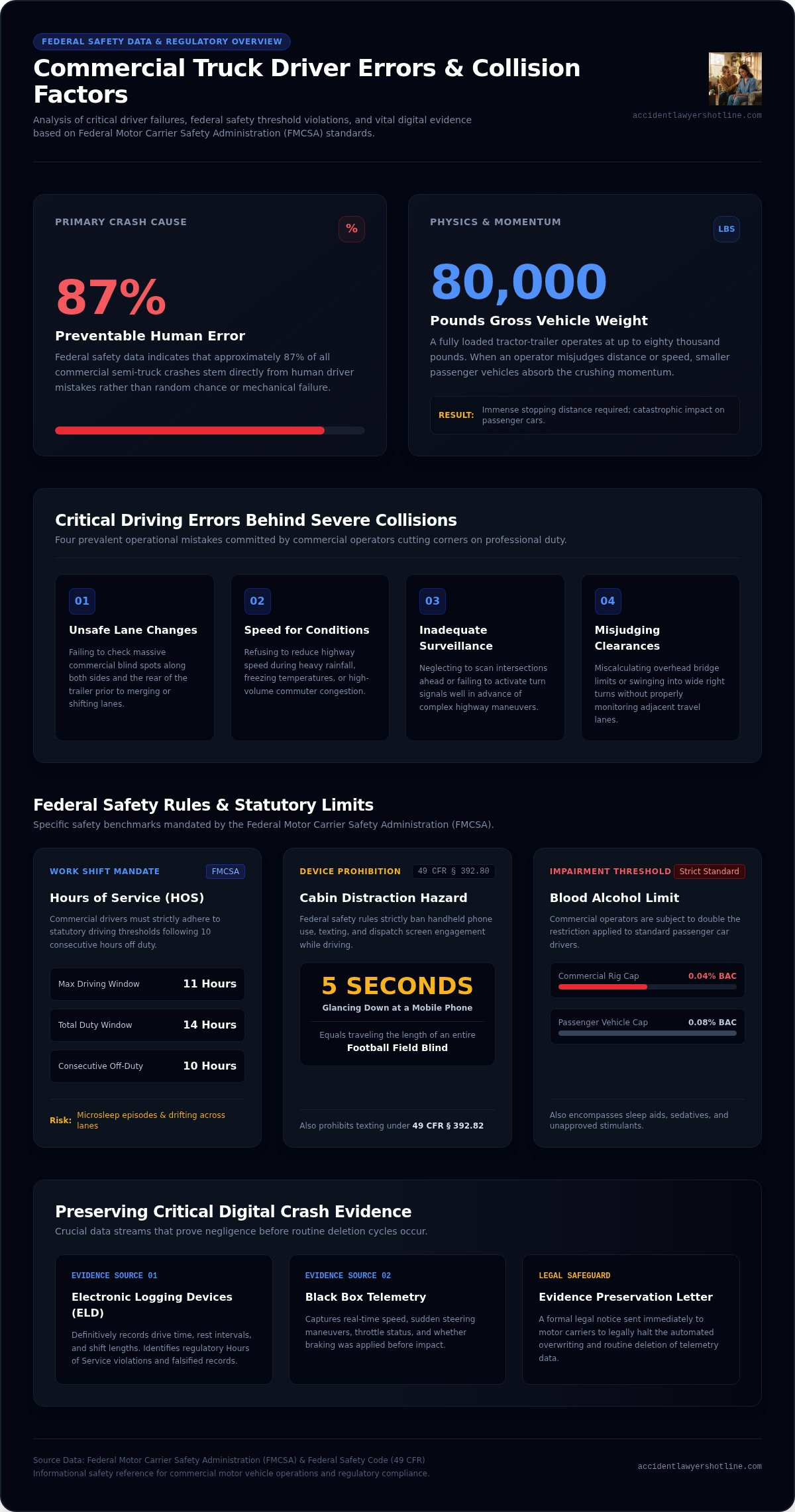
Federal safety data reveals an alarming truth: an estimated 87% of commercial motor vehicle crashes stem directly from preventable human mistakes rather than random chance. When an eighty-thousand-pound tractor-trailer collides with a passenger car, identifying the common truck driver errors causing accidents is the vital first step toward uncovering the truth. You shouldn't have to bear the physical and financial fallout of a commercial driver's reckless shortcuts.
If you're dealing with catastrophic injuries, mounting hospital bills, and pressure from aggressive insurance adjusters, feeling overwhelmed is completely understandable. You deserve immediate clarity and accountability. In this guide, you'll discover how driver fatigue, excessive speed, and federal safety rule violations trigger devastating wrecks, and how electronic logging devices can definitively prove negligence. We will also outline how black box evidence protects your legal rights, showing you the clear path toward securing a professional, no-obligation truck accident case evaluation.
Key Takeaways
- Identify the common truck driver errors causing accidents, including chronic driver exhaustion, mobile phone distractions, and federal safety rule violations.
- Understand the physical reality of commercial braking limits and why tailgating or traveling too fast for conditions eliminates a truck driver's reaction window.
- Learn why sending a formal evidence preservation letter immediately protects vital black box telemetry and electronic logs from routine deletion.
- Uncover the corporate tactics motor carriers use to deflect fault onto passenger vehicle drivers across complex multi-party claims.
- Discover the essential steps to secure a confidential truck accident case evaluation and connect with vetted legal advocates operating on contingency.
What Are the Most Common Truck Driver Errors Causing Accidents?
When an eighty-thousand-pound commercial vehicle collides with a standard passenger car, the physical destruction is catastrophic. Modern principles of road traffic safety emphasize that safe transit requires systemic vigilance, yet commercial operators repeatedly disregard baseline operational safety. Data from the Federal Motor Carrier Safety Administration (FMCSA) indicates that human error causes roughly 87% of all commercial semi-truck collisions. Understanding the common truck driver errors causing accidents allows injured victims to cut through carrier excuses, identify actionable negligence, and assert their legal rights effectively.
Critical Driving Errors Behind Severe Commercial Collisions
Operating a massive commercial rig demands constant precision. When drivers cut corners, devastating wrecks inevitably follow. The most frequent operational failures include:
- Unsafe lane changes: Failing to account for massive blind spots along the sides and rear of the trailer before merging.
- Driving too fast for conditions: Refusing to reduce highway speed during heavy rainfall, freezing conditions, or heavy commuter traffic.
- Inadequate surveillance: Neglecting to scan intersections or failing to activate turn signals well in advance of complex maneuvers.
- Misjudging clearances: Miscalculating overhead bridge clearances or executing wide right turns without monitoring adjacent vehicle lanes.
Each of these mistakes represents a clear failure of professional duty. Recognizing these behaviors helps establish immediate accountability against careless drivers.
Why Operational Mistakes by Truck Operators Trigger Catastrophic Crashes
Physics explains why commercial driving mistakes produce horrific outcomes. A loaded tractor-trailer requires immense physical space to slow down or alter course. When an operator misjudges distance or speed, nearby passenger cars absorb the crushing momentum. The weight disparity is severe; passenger vehicle occupants suffer the brunt of the trauma, leading to extensive hospital stays, traumatic brain injuries, and permanent disabilities. Addressing these common truck driver errors causing accidents requires holding motor carriers accountable for putting negligent drivers on the road.
Driver Fatigue, Distraction, and Violations of Federal Safety Standards
Commercial drivers operate under demanding schedules, but corporate delivery deadlines never justify compromising public safety. When an operator pushes past physical limits or glances at a screen, their truck becomes an uncontrollable hazard. Severe exhaustion mimics blood alcohol intoxication, slowing reaction times and distorting distance judgment. In fact, regulatory breaches rank among the most prevalent common truck driver errors causing accidents, often establishing clear legal proof of negligence per se against both the driver and the motor carrier.
Hours of Service Violations and Extreme Operator Fatigue
Federal Motor Carrier Safety Administration (FMCSA) regulations strictly govern commercial work shifts. Drivers are generally restricted to eleven hours of driving within a fourteen-hour window following ten consecutive hours off duty. Despite these mandates, freight schedules tempt operators to cheat their electronic logging devices (ELDs). The result is devastating: a driver experiences a split-second microsleep episode, drifting across lanes without applying the brakes before impact.
In-Cab Distractions and Mobile Device Use Behind the Wheel
Federal rules (49 CFR § 392.80 and § 392.82) strictly ban handheld phone use and texting by commercial motor vehicle operators. Looking down at a phone for five seconds at highway speeds means traveling the entire length of a football field blind. Fleet dispatch screens and route navigation systems create cognitive distractions that pull vital attention away from moving traffic.
Impairment, Prescription Medication, and Substance Misuse
Commercial drivers must adhere to a strict 0.04% blood alcohol concentration cap, which is half the legal limit for passenger car motorists. Beyond alcohol, impairment frequently involves unapproved stimulants taken to counteract exhaustion, or prescription medications that cause severe drowsiness:
- Over-the-counter sleep aids that delay morning reaction speeds.
- Prescription sedatives or muscle relaxants that cloud split-second decision-making.
- Illicit stimulants that trigger aggressive driving, erratic lane shifts, and sudden perceptual crashes.
Understanding these violations is critical when establishing liability after a collision. If you suspect commercial driver exhaustion or phone distraction caused your crash, requesting a confidential truck accident case evaluation helps you determine whether federal safety laws were breached.
Speeding, Inadequate Following Distance, and Navigational Blunders
Braking physics govern how commercial vehicles behave under sudden highway stress. A standard passenger car traveling at highway speeds can stop in about three hundred feet. A fully loaded tractor-trailer moving at 65 mph requires approximately 525 feet to halt. As documented in the federal Large Truck Crash Causation Study, traveling too fast for conditions represents one of the top contributing factors in severe wrecks. Ignoring these basic physical limitations remains one of the primary common truck driver errors causing accidents on American roadways.
Excessive Speed for Heavy Traffic and Adverse Road Conditions
Posted speed limits assume dry pavement and clear visibility. When rain, sleet, or heavy traffic develops, commercial operators must reduce their speed accordingly. High velocity compromises tire traction and magnifies centrifugal force on curved exit ramps. If a driver takes a curve too fast, the trailer's center of gravity shifts violently, initiating a catastrophic rollover or jackknife slide across crowded travel lanes.
Tailgating, Misjudged Stopping Distances, and Brake Failure Dynamics
Following too closely leaves commercial operators without an escape route. Federal safety guidelines recommend maintaining at least one second of following space for every ten feet of vehicle length at lower speeds, adding extra buffer at highway velocity. Tailgating eliminates this margin. When a truck driver stomps on the brakes during sudden highway slowdowns, extreme friction generates thermal brake fade. Overheated brakes fail to grip, transforming the truck into an unguided battering ram.
Unsafe Lane Changes and Blind Spot Navigation Failures
Every commercial rig has four massive blind spots, known across the industry as "No-Zones":
- Directly in front of the cab, extending roughly twenty feet forward.
- Along the driver's side beneath the window.
- Along the entire passenger side, extending across three lanes of traffic.
- Directly behind the trailer, where the operator has zero rear-view mirror visibility.
Failing to verify these zones before merging crushes passenger cars against roadside guardrails. Such careless lane departures illustrate how preventable driver mistakes destroy lives in an instant.
Preserving Evidence When Truck Driver Negligence Harms You
Commercial motor carriers routinely dispatch rapid-response defense teams to the collision scene within hours. Their primary goal is simple: control the narrative and limit corporate financial exposure. Proving the common truck driver errors causing accidents requires acting quickly before critical digital proof disappears. Federal regulations only require motor carriers to retain certain operational logs for six months. Without prompt formal intervention, vital telemetry can be legally overwritten or erased during routine system resets.
Gathering Essential Crash Data and Commercial Telematics
Modern commercial trucks act as rolling data centers. Extracting this objective digital information provides undisputed proof of operational blunders:
- Event Data Recorders (EDRs): Truck black boxes record crucial metrics seconds before impact, such as vehicle speed, throttle position, steering angle, and braking force.
- Dashcam systems: Dual-facing cameras record external traffic interactions and document in-cab driver behaviors like texting or falling asleep.
- GPS and fleet tracking: Satellite records track exact travel routes, verifying whether drivers exceeded speed limits to meet unrealistic dispatch deadlines.
Securing Electronic Logging Devices (ELD) and Driver Inspection Records
Tamper-resistant electronic logging devices reveal direct Hours of Service violations. In addition, driver qualification files uncover prior traffic infractions, poor safety ratings, and missing medical certifications. Pre-trip inspection reports can prove whether the operator knowingly drove with worn brake pads or defective steering components.
Documenting the Scene and Protecting Your Physical Recovery
What steps should you take to protect your recovery? Photograph everything at the scene if you can do so safely, including vehicle resting positions, skid marks, and highway conditions. Seek immediate medical attention to document crash-related trauma. Crucially, refuse to provide recorded statements to the trucking company's insurance claims adjusters without dedicated guidance.
A formal spoliation letter legally obligates the motor carrier to preserve all physical evidence, onboard data, and maintenance records. Connecting with a knowledgeable truck accident lawyer through a contingency arrangement ensures that technical experts secure this evidence before it is lost. To hold negligent trucking companies accountable without any upfront legal fees, request a free, confidential case evaluation through Accident Lawyers Hotline today.
Navigating Commercial Truck Crash Claims and Next Steps
Filing an insurance claim after a heavy vehicle collision rarely resembles a typical two-car insurance settlement. Commercial motor carriers operate within layered corporate entities backed by multi-million-dollar insurance policies. Multiple commercial stakeholders share potential fault, including freight brokers, maintenance contractors, trailer leasing entities, and parent logistics corporations. While the common truck driver errors causing accidents often trigger the initial impact, commercial defense teams fight aggressively to shield these corporate entities from financial responsibility.
Overcoming Motor Carrier Defense Tactics and Shared Fault Claims
Defense adjusters routinely deploy aggressive strategies to diminish your claim. They often allege that passenger vehicles lingered in blind spots, made sudden lane maneuvers, or braked abruptly. Under comparative negligence laws across most jurisdictions, assigning even partial blame to the injured driver drastically reduces total financial compensation. Overcoming these deflections requires objective evidence. Crash reconstruction specialists use EDR telemetry, brake heat patterns, and crush damage analysis to prove the commercial operator's fault and dismantle fabricated defense narratives.
The Role of Independent Evaluation in Truck Injury Cases
How do you cut through corporate deflection and secure justice? Securing a structured evaluation of your incident uncovers actionable regulatory violations and identifies all liable corporate policies. Injured victims should never have to risk their household savings to demand fair treatment. Partnering with a vetted no fee unless we win your case attorney removes financial barriers completely, ensuring you pay zero upfront costs for legal advocacy.
Accident Lawyers Hotline serves as a dedicated nationwide evaluation platform connecting crash victims with seasoned motor vehicle accident attorneys. The service operates strictly as an independent matching resource rather than a direct law firm. You can take the first step toward restoring financial stability by requesting a confidential free case evaluation to protect your rights.
Take Decisive Action to Protect Your Recovery
Catastrophic collisions don't happen by chance. When operators violate federal rest mandates, speed through adverse weather, or focus on mobile devices, their choices cause life-altering harm. Identifying the common truck driver errors causing accidents is essential to dismantling insurer deflections and demanding full accountability. Because vital black box telemetry and electronic logs face strict corporate deletion timelines, waiting to assert your rights only benefits the trucking company.
You don't have to carry this heavy burden alone. Accident Lawyers Hotline connects you with a nationwide network of dedicated motor vehicle accident attorneys operating on contingency. You face zero upfront legal costs, meaning there's no fee unless your case is won. A thorough review uncovers hidden logbook violations, fleet safety breaches, and corporate liability so you can focus on physical healing. Take the first step toward restoring fairness and financial peace of mind. Claim your free, confidential truck accident case evaluation today.
Frequently Asked Questions
What is the single most common truck driver error causing highway accidents?
Traveling too fast for conditions is the single most frequent operational error. Excessive speed contributes to roughly 25% of all large truck crashes. Commercial rigs require substantial stopping distance, so high speeds prevent drivers from reacting to sudden slowdowns. Along with fatigue and distraction, speeding stands out among common truck driver errors causing accidents that lead to devastating multi-vehicle collisions.
How does driver fatigue contribute to commercial semi-truck collisions?
Driver fatigue severely impairs cognitive function and slows physical reaction times similarly to alcohol impairment. Exhaustion degrades decision-making and narrows visual perception. Fatigued operators often experience split-second microsleep episodes, causing them to drift across highway lanes without touching the brakes. Tight freight deadlines tempt drivers to push past federal rest limits, transforming commercial exhaustion into a major danger for passenger vehicles.
Can a trucking company be held liable for an individual driver's negligence?
Yes, trucking companies are routinely held liable for driver mistakes under the doctrine of vicarious liability. If the driver was operating within the scope of their employment, the motor carrier shares legal fault. Companies also face direct negligence claims for poor hiring practices, inadequate safety training, deferred vehicle maintenance, or pressuring operators to violate federal Hours of Service limits to meet unrealistic freight schedules.
What happens if a truck's electronic logbook data is deleted after an accident?
If a trucking company destroys or overwrites electronic logging data after receiving a formal preservation letter, courts can penalize them for spoliation of evidence. Judges can issue sanctions, strike down corporate defenses, or instruct juries to presume the missing electronic logs proved the driver's negligence. Acting quickly to issue a spoliation demand prevents critical digital records from vanishing through routine six-month deletion cycles.
How much longer does it take a commercial truck to stop compared to a car?
A fully loaded tractor-trailer traveling at 65 mph takes approximately 525 feet to come to a complete stop. In comparison, a passenger car traveling at the same speed requires roughly 300 feet. That extra 225 feet equals nearly three-quarters of a football field. This massive disparity makes following too closely and speeding particularly lethal commercial errors during sudden highway slowdowns.
Is it worth pursuing a legal claim if the truck driver claims I was in their blind spot?
Yes. Commercial drivers have a strict legal duty to clear blind spots and merge only when safe. Trucking insurers routinely blame passenger vehicles to avoid payouts, but that excuse rarely holds up. Blind spot crashes often stem from common truck driver errors causing accidents, such as failing to signal or speeding. A dedicated case evaluation helps uncover dashcam and telemetry proof to refute corporate deflection.
Were You Injured in an Accident?
Get a free, confidential case evaluation. No upfront fees.
Get Free Case Evaluation