Long-Term Disability After a Car Accident: How Much Could You Get
Learn how long-term disability after a car accident is calculated, with SSDI and SSI amounts, eligibility rules, insurance benefits, and injury claim options.
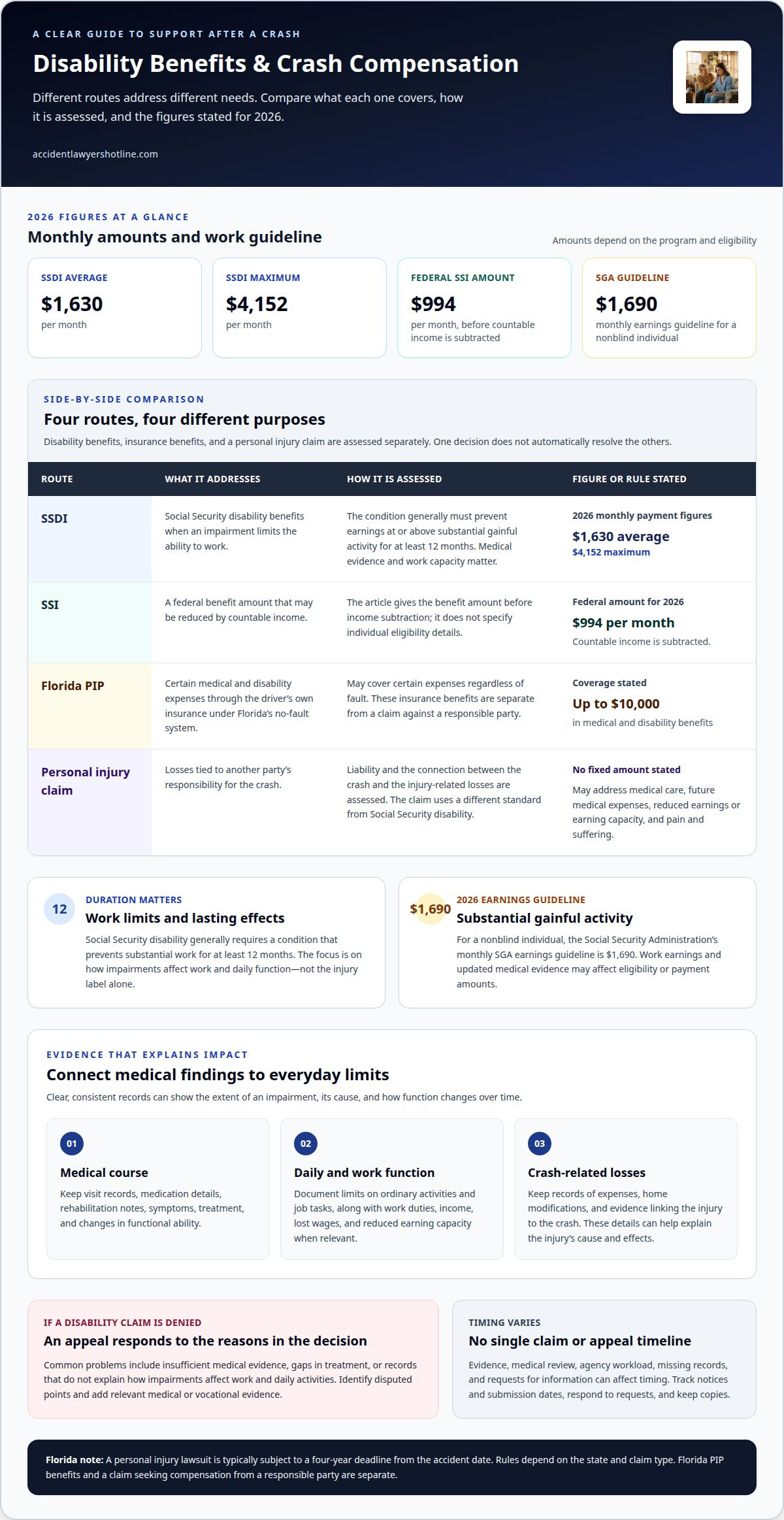
There’s no fixed amount for long-term disability after a car accident. The benefit depends on the program and your eligibility: in 2026, the average monthly SSDI payment is $1,630, and the maximum monthly payment is $4,152. The federal SSI benefit amount for 2026 is $994 per month before countable income is subtracted, according to the Social Security Administration.
When an injury disrupts your income and future plans, it’s understandable to want a clear figure. Disability benefits are separate from compensation through a personal injury claim, and each is assessed differently. This article explains how SSDI, SSI, and disability insurance payments are determined, and how an injury’s lasting effects can shape eligibility.
You’ll also learn how impairment, work capacity, and responsibility for the crash may affect a legal claim for losses such as medical care and reduced earnings. Understanding these factors can help you identify which forms of support may apply and what to consider before deciding whether to settle.
Key Takeaways
- Social Security disability eligibility generally depends on whether your condition prevents substantial work for at least 12 months.
- A lasting impairment can affect daily activities, work capacity, and the support or care you may need over time.
- Medical records and evidence linking the injury to the crash can help establish the extent and cause of your limitations.
- A personal injury claim may address losses such as future medical expenses, reduced earning capacity, and pain and suffering.
- A case evaluation can help clarify liability and how your injury-related losses may fit into a legal claim.
What if I Get a Permanent Disability After a Car Accident?
A lasting impairment can change how you move, think, work, and manage daily tasks. With long-term disability after a car accident, key questions include which functions remain limited, how long those limitations are expected to last, and what support or compensation may apply. Medical findings and consistent records help explain the effects.
Spinal cord injuries can disrupt communication between the brain and body. Damage may cause partial or complete paralysis, limited mobility, or reduced independence. The impact depends on the injury’s location and severity. For example, someone with paralysis may need a wheelchair, home modifications, or ongoing rehabilitation. A traumatic brain injury can also cause lasting cognitive impairment, memory loss, or neurological problems that affect work and everyday decisions.
Other injuries can limit function, too. A fracture may heal with treatment, but a complex leg fracture can remain disabling if someone still needs a walker or cane after a year. Burns may affect movement or require ongoing care, while whiplash and other soft-tissue injuries can cause persistent pain and restricted mobility. Medical records should describe symptoms, treatment, functional limits, and their effects on ordinary activities.
Some injuries lead to temporary disability during recovery; others create lasting restrictions. A treating physician may describe maximum medical improvement when the condition has stabilized and further treatment is not expected to improve it. That does not necessarily mean care ends: ongoing treatment may help maintain stability or manage chronic pain. For 2026, the Social Security Administration sets the monthly substantial gainful activity earnings guideline for a nonblind individual at $1,690. The Social Security Administration states the federal SSI benefit amount for 2026 is $994 per month before subtracting countable income.
Returning to work or improving medically can affect disability payments, depending on the benefit program and policy terms. Work earnings and updated medical evidence may change eligibility or payment amounts. Keep records of job duties, income, treatment, and changes in your functional abilities.
Deadlines and rules depend on the state and claim type. In Florida, a personal injury lawsuit is typically subject to a four-year deadline from the accident date; Florida’s no-fault system may also cover certain expenses through a driver’s own insurance, regardless of fault. Florida Personal Injury Protection covers up to $10,000 in medical and disability benefits. These insurance benefits are separate from a claim seeking compensation from a responsible party.
Can I Get Social Security Disability After a Serious Car Wreck?
Potentially, if lasting impairments prevent substantial work and meet Social Security’s disability criteria. The Social Security Administration generally requires the condition to prevent earnings at or above substantial gainful activity for at least 12 months.
Whiplash and Chronic Neck Pain Claims
Whiplash is a neck injury that can cause persistent pain, stiffness, or restricted movement after a collision. For a disability claim, the central issue is how symptoms limit function over time, not the injury label alone. Medical records can describe pain, mobility, treatment, and effects on work tasks such as lifting, turning, or sitting for extended periods.
Records for Insurance and Disability Claims
Claim records organize evidence of injuries, treatment, expenses, and limits on daily function. Keep medical visits, medication details, rehabilitation notes, and work-related records together. Include home modifications, out-of-pocket expenses, lost wages, and reduced earning capacity when relevant. A dated record of symptoms and activities can show how impairments changed after the crash.
Denied Claims and Appeals
An appeal asks the reviewing agency to reconsider a denied disability claim in light of the reasons stated in the decision. Common problems include insufficient medical evidence, gaps in treatment, or records that don’t explain how impairments affect work and daily activities. Read the denial carefully, identify each disputed point, and add relevant medical or vocational evidence. An attorney can help assess how the decision relates to a separate personal injury claim.
Claim and Appeal Timelines
The time needed for a claim or appeal varies with the evidence, medical review, and agency workload. Missing records or requests for additional information can add steps, so there’s no reliable timeline for every case. Track notices and submission dates, respond to requests, and keep copies to make delays or missing documents easier to identify.
A serious crash can lead to several separate claims. Social Security disability focuses on work capacity and medical eligibility. An insurance claim may address crash-related expenses, while a personal injury claim concerns losses tied to another party’s responsibility. These processes may involve overlapping records, but they apply different standards. One decision does not automatically resolve the others.
Vision or hearing impairments may affect a disability claim when they limit work or everyday function. Document specific difficulties, such as trouble reading instructions or hearing workplace communication, and connect them to medical findings. If several impairments exist, explain their combined effects on concentration, mobility, communication, and reliable work. Clear evidence shows the practical impact beyond a diagnosis.
Legal representation and compensation
Disability benefits and compensation from an at-fault driver address different losses. The type of claim, available insurance, and evidence of reduced work capacity shape what may be recovered.
Seeking Legal Representation
Legal representation means having an attorney assess liability, insurance, and losses tied to the collision. A lawyer can organize medical and wage evidence, communicate with insurers, and evaluate whether a personal injury claim includes future care or reduced earning capacity. This can matter when brain injuries or other lasting impairments affect someone’s ability to work, but their full financial impact is still developing.
Compensation Beyond PIP
Compensation beyond Personal Injury Protection may come through a claim against a responsible party. In Florida, PIP covers up to $10,000 in medical and disability benefits. A personal injury claim may seek damages for expenses and losses beyond that coverage, including future medical care, lost wages, loss of earning capacity, and pain and suffering. Evidence should connect each claimed loss to the crash and resulting injury.
Insurance Coverage and Disability Benefits
Car insurance, PIP, and uninsured motorist coverage are separate from Social Security disability benefits. Florida’s no-fault system allows a driver’s own insurance to cover certain expenses regardless of who caused the crash. Uninsured motorist coverage may provide another avenue under the applicable policy. Review how each policy addresses the injury and loss, and keep claim records separate from Social Security documents.
SSDI eligibility focuses on medical limitations, work history, and income rules. It does not determine who caused the collision or establish the value of a personal injury claim. A person may pursue disability benefits while also seeking compensation related to the crash, but each claim uses different criteria and evidence. Medical records can support both claims, while wage documents help show lost income and impaired work capacity.
Workers’ compensation is a separate system for job-related injuries, not a substitute for an auto insurance or personal injury claim. A crash during work duties may raise questions about more than one claim. Social Security disability and workers’ compensation also have distinct eligibility rules. Keep notices, benefit statements, medical records, and wage information organized so the facts for each claim remain clear.
For example, a driver with a lasting brain injury may need to document treatment, missed work, and changes in job duties. An attorney can assess whether the available evidence supports a liability claim and whether future expenses are included. Reviewing coverage alongside disability benefits helps identify which losses each source may address, without treating one payment as a complete measure of the injury.
Definition and types of long-term impairment
A permanent impairment is a lasting limitation in a body part’s motion or function that may not improve with time or treatment. This describes an injury’s lasting effect, not automatic eligibility for Social Security disability. A stable diagnosis alone doesn’t show how the condition affects work, self-care, communication, or other daily activities.
Physical impairments can involve movement, sensation, or ongoing pain. A spinal injury may limit walking or sitting, while chronic pain can make routine tasks difficult to sustain. Someone may manage one activity but struggle with several tasks over a workday. For disability evaluations, the practical question is how these limits affect functioning, including the ability to perform and maintain work.
Traumatic brain injuries can cause cognitive impairments, memory loss, and long-term neurological issues. For example, difficulty remembering instructions may affect someone’s ability to complete tasks reliably. Mental impairments matter, too. Anxiety, depression, or post-traumatic stress disorder after a serious crash can affect relationships, work, and quality of life. Relevant evidence describes actual limitations, rather than relying only on a diagnostic label.
Social Security disability evaluations consider residual functional capacity, or RFC. RFC means the most a person can still do despite physical and mental impairments. The Social Security Administration uses a five-step review process and assesses the combined effects of disabilities on day-to-day functioning. Several conditions may therefore matter together. For example, pain, limited mobility, and difficulty concentrating may create greater work restrictions in combination.
Age and work experience can also affect how Social Security evaluates a person’s ability to adjust to other work. A 58-year-old construction worker with limited transferable skills may be assessed differently from a 28-year-old with substantial computer experience. This comparison illustrates why the same diagnosis can have different practical effects across work histories and abilities.
A lasting impairment can affect a person’s ability to perform major life activities. A limitation might involve walking, communicating, or completing routine tasks. Medical records can connect a diagnosis to those effects. Treatment notes, functional assessments, and descriptions of daily limitations provide context for how an injury changes someone’s life over time.
Keep the distinction clear: permanence describes an impairment’s lasting nature, while disability programs apply their own eligibility standards. Someone with a permanent limitation may still need to show how it affects work capacity and daily functioning. For example, records showing restricted mobility and difficulty completing job tasks explain more than a diagnosis alone. This functional picture helps clarify what support or benefits may be relevant.
Determining liability and causation
A serious injury claim must connect the crash, the responsible party’s conduct, and the resulting impairment. For long-term disability after a car accident, evidence needs to explain both who caused the collision and how it led to lasting limits.
Liability concerns responsibility for the crash. Causation concerns the link between the crash and an injury or impairment. These questions overlap, but they require different evidence. A collision report may describe the scene and vehicles involved, while medical records document symptoms, diagnoses, and treatment. Together, those records help clarify what happened and what followed.
A careful investigation can organize evidence about the collision and the injury timeline. Relevant materials may include photographs, witness accounts, vehicle damage, medical records, and work information. For example, photographs of vehicle damage can help explain the force and direction of impact. Treatment notes can then show when symptoms appeared, what clinicians observed, and how the condition affected movement or daily activities.
Medical causation requires more than showing that an injury exists. Evidence must connect the condition to the crash and explain its effects. A physician’s examination, imaging, treatment history, and functional assessments can help establish that connection. For traumatic brain injuries, records might address changes in memory, concentration, or communication. For a spinal injury, they might document reduced motion, weakness, or mobility limits.
Expert testimony may help explain complex medical or crash-related evidence. An expert can interpret how an impact relates to an injury or how a severe impairment affects function. The value lies in clear reasoning tied to records and observations. For instance, a consistent treatment timeline can help explain why symptoms persisted after the collision rather than appearing only during a later dispute.
Complications can arise when symptoms develop over time, treatment is interrupted, or earlier health issues also affect function. Useful records distinguish the person’s condition before the crash from changes afterward. Medical notes, prior functional information, and a clear symptom timeline can help clarify the difference. Document anxiety or other psychological effects, too, when they follow the collision and affect daily life.
The evidence should tell one coherent story: the collision occurred, specific conduct caused it, medical findings connect the injuries to that event, and the resulting limitations affect work or daily activities. Missing links can make responsibility or the extent of loss harder to establish. A personal injury lawyer can assess how the evidence supports liability and causation. Request a personal injury case evaluation to discuss the evidence and injury-related losses.
Accident Lawyers Hotline
Accident Lawyers Hotline provides case evaluations to help you understand how crash-related injuries, evidence, and liability may affect a personal injury claim. Consider an evaluation when lasting limitations, reduced income, or future care needs make it difficult to assess potential losses on your own. It can help clarify questions to consider as you weigh insurance and legal options.
Whether the crash involved a car, truck, motorcycle, or pedestrian accident, an evaluation can help organize the issues specific to your case. Social Security disability benefits and personal injury compensation follow different rules, so understanding how they relate can help you make informed decisions. To discuss your situation, contact Accident Lawyers Hotline.
Take the Next Step Toward Clarity
Living with lasting effects after a crash can make decisions about work, treatment, and financial support harder to manage. You don’t need to resolve every question at once. A focused review of how the injury affects your daily life and what evidence supports your claim can help identify the next issues to address.
Accident Lawyers Hotline provides case evaluations for car, truck, and motorcycle accidents. An evaluation can help you consider how the crash, injury-related losses, and available evidence may shape a personal injury claim. This can be useful when weighing how a legal claim relates to disability benefits or future needs.
For long-term disability after a car accident, a clear understanding of your options can help you make your next decision with greater confidence. Contact Accident Lawyers Hotline to discuss your situation. Taking one informed step can help you move forward with greater purpose.
Frequently Asked Questions
How Much Money Can I Get in Disability Benefits?
The amount depends on the benefit program and your eligibility. SSDI payments are based on your work record, while SSI considers countable income and financial resources. Private disability insurance follows the policy’s terms and may calculate payments using prior wages. These benefits are separate from personal injury compensation, which may account for crash-related losses such as medical expenses or reduced earning capacity.
Do I Qualify for Disability If I Have Constant Neck Pain Due to Whiplash?
Possibly, if medical evidence shows a lasting neck or spinal impairment that limits your ability to function and work. A whiplash claim should document symptoms, examinations, treatment, and effects on tasks such as turning your head or sitting. Imaging may help show an injury. Continue treatment and explain persistent symptoms to your clinicians so your records reflect how the condition affects daily activities.
What If Your Disability Claim Is Denied?
A denial doesn’t necessarily end your claim. Read the decision notice, identify the stated reason, and gather evidence that addresses it, such as updated treatment records or details about work-related limits. Follow the appeal instructions and deadlines in the notice. If the decision says the medical evidence is insufficient, focus on records describing specific functional problems, not just the diagnosis or pain level.
Can I Get Disability for Broken Bones Sustained in a Car Crash?
Yes, a fracture can support a disability claim if its effects meet the program’s requirements. Broken bones expected to heal within six months are unlikely to meet Social Security’s medical requirements. A complicated fracture with lasting mobility limits may require a different assessment. Records describing surgeries, rehabilitation, walking ability, and job-task restrictions can show whether the injury continues to affect functioning.
Do I Have to Be Completely Unable to Work?
No. Social Security evaluates what work you can still perform, including your residual functional capacity, rather than asking only whether you can do your former job. Your physical and mental limits, work history, skills, and ability to adjust to other work may matter. For example, restrictions on lifting or concentrating could affect which tasks remain possible, even if you can still manage some daily activities.
Does It Matter Whether Someone Else Caused the Car Wreck?
Fault generally doesn’t determine eligibility for Social Security disability benefits, which focus on medical limitations and work capacity. Responsibility for the collision matters to a separate personal injury claim. Evidence such as witness accounts, vehicle damage, and medical records can help connect the crash to your injuries and losses. Keep the disability application and injury claim organized as separate processes with distinct standards.
Injured in a car accident, now what?
Get medical attention promptly, even if symptoms seem manageable, and follow your clinicians’ treatment recommendations. Record each visit, medications, rehabilitation, and changes in your ability to work or manage daily tasks. Save wage records and receipts for accident-related expenses. Before considering an insurance settlement, understand the full effects of your injuries, since an early settlement may not account for ongoing needs.
What injuries from a car accident can cause long-term disability?
Spinal cord injuries, traumatic brain injuries, severe fractures, and lasting soft-tissue injuries can cause persistent limitations. Internal injuries may also be life-threatening if not treated promptly. The lasting impact depends on the impairment, not just the injury’s name. For example, a brain injury may affect memory and concentration, while a spinal injury can limit movement. Mental health conditions after a crash may also disrupt work and daily life.
Were You Injured in an Accident?
Get a free, confidential case evaluation. No upfront fees.
Get Free Case Evaluation