Hit and Run Pedestrian Accident: What to Do in 2026
In a hit and run pedestrian accident what to do is vital. Follow our 48-hour guide for crucial medical and legal steps to secure your recovery and justice.
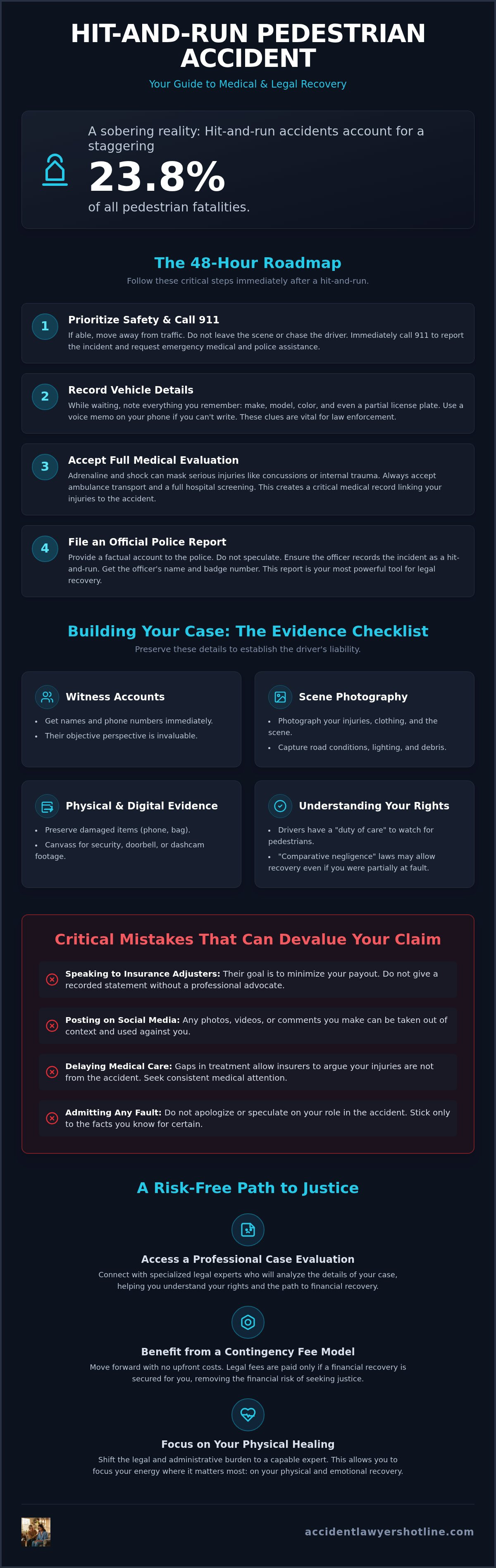
In 2024, hit-and-run accidents accounted for a staggering 23.8% of all pedestrian fatalities. When a driver leaves the scene, they leave you to face mounting medical costs and physical pain on your own. It's natural to feel a sense of injustice and fear that the driver will never be caught. You deserve a professional advocate to help you navigate this crisis. Knowing exactly a hit and run pedestrian accident what to do can protect your health and your right to a fair recovery.
This article outlines the critical medical and legal steps you must take immediately to secure your future. We provide a clear 48-hour roadmap to demystify the legal process and ensure no vital evidence is lost. You'll learn how to access a professional case evaluation and explore financial security through a contingency fee model. By shifting the burden to a capable expert, you can focus entirely on your physical healing. We're here to help you move from a moment of chaos to a structured, professional resolution.
Key Takeaways
- Ensure your immediate safety and secure vital medical aid by following a prioritized 48-hour roadmap designed for high-stress situations.
- Master exactly a hit and run pedestrian accident what to do regarding evidence collection to ensure the driver’s liability is properly documented even if they fled.
- Protect the value of your claim by identifying critical mistakes, such as speaking to insurance adjusters or posting on social media without a professional advocate.
- Navigate the complexities of comparative negligence and driver duty of care to better understand your legal rights and path to financial recovery.
- Access a risk-free path to justice through a professional case evaluation that connects you with specialized legal experts on a contingency fee basis.
Immediate Actions After a Pedestrian Hit and Run
The seconds following a collision are chaotic and terrifying. Your priority is survival. If your injuries allow, move to a safe area away from active traffic immediately. Do not attempt to chase the driver or leave the scene yourself. Instead, call 911 to report the incident and request emergency medical aid. Knowing a hit and run pedestrian accident what to do in the first five minutes can save your life and your legal claim. While you wait for responders, try to write down every detail you remember about the vehicle. Focus on the make, model, color, and even a partial license plate number. If you cannot write, use your phone to record a voice memo of your immediate recollections. These small clues are often the only way law enforcement can track down a fleeing vehicle.
Understanding Hit and Run Laws is essential, but your immediate focus must be on your health. When you are determining a hit and run pedestrian accident what to do, calling for help is the single most important step. It creates an official record of the time and location of the crash. This record is the starting point for any future investigation into the driver's identity.
The Danger of Adrenaline and Shock
You might feel surprisingly calm or even painless right after the impact. This is a biological trap. Adrenaline and shock frequently mask serious internal trauma, concussions, or soft tissue damage. Don't decline medical help just because you feel "fine" in the moment. When first responders arrive, mention every point of discomfort, no matter how minor it seems. Accept the ambulance transport to the hospital for a full medical screening. A medical record created at the scene serves as critical evidence that links your injuries directly to the accident. This documentation prevents insurance companies from arguing that your injuries were pre-existing or happened at a later date. It shifts the burden of proof in your favor from the very beginning.
Filing an Official Police Report
When the police arrive, request a formal report. Ask for the responding officer’s name and badge number so you can follow up later. Providing a factual account is vital for a future pedestrian accident case evaluation. Stick to the facts you know for certain. Don't speculate on the driver’s speed or their intentions. Ensure the officer explicitly records that the incident was a hit and run. This report is your most powerful tool for legal recovery. It serves as an official, third-party account of the crime and helps your advocate build a stronger case for compensation. Without this report, proving the accident occurred exactly as you described becomes much more difficult.
Essential Evidence When the Driver Flees the Scene
Evidence speaks when a fleeing driver won't. If you are physically capable, identify witnesses before they leave the area. People often want to help but may have busy schedules. Ask for their names and phone numbers immediately. Their perspective provides an objective account that insurance companies cannot easily dismiss. Recording a quick video of their statement on your phone is a smart move. When you're determining a hit and run pedestrian accident what to do, these first-hand accounts are invaluable for proving what happened.
Capture the scene visually. Photograph your injuries and your clothing exactly as they are. Take wide shots of the intersection and close-ups of specific road conditions. According to Pedestrian Safety Statistics, environmental factors like poor lighting often play a role in these tragedies. Don't forget to preserve your personal property. A shattered mobile device or a torn bag serves as tangible proof of the impact's severity. If you need help organizing these details, a pedestrian accident case evaluation can provide the clarity you need to move forward.
Strategic Scene Documentation
Focus your camera on the ground. Skid marks and scattered debris are silent witnesses to the driver's speed and reaction time. Note the exact time of the collision. Record the weather and lighting conditions. Was it raining? Was a streetlamp out? These details help reconstruct the event and prove the driver’s liability. Damaged personal property isn't just a loss; it's a measurement of force. Keep every item you were carrying in a secure place. They are physical evidence that your advocate will use to demonstrate the reality of the crash.
Canvassing for Digital Evidence
Search for a digital trail. Modern streets are lined with security cameras and doorbell systems. Visit nearby businesses and ask if their exterior surveillance might have captured the vehicle. Don't stop there. Ask witnesses if they have dashcam footage. A driver several cars back might have recorded the fleeing vehicle’s license plate. This digital evidence is often the most reliable way to identify a hit and run driver. It's a critical part of knowing a hit and run pedestrian accident what to do to ensure justice is served. Acting quickly is essential, as many systems overwrite footage within 48 to 72 hours.
Understanding Pedestrian Rights and Driver Liability
Every driver on the road owes you a legal "duty of care." This means they're required to remain vigilant and take reasonable steps to avoid a collision. When a driver flees the scene, they've violated both the law and this fundamental responsibility. You might worry that being hit while crossing outside a designated crosswalk ends your chance for recovery. This isn't true. Drivers must still exercise caution to avoid pedestrians regardless of where they're walking. If you're unsure about your rights, knowing a hit and run pedestrian accident what to do starts with understanding that the law is designed to protect victims, not fleeing drivers.
One of the most important tools for your recovery is Uninsured Motorist (UM) coverage. Many people don't realize that their own auto insurance can provide compensation even when they're walking. As of 2026, at least 22 states and the District of Columbia require drivers to carry this coverage. If the driver who hit you is never identified, your UM policy acts as the "missing" driver's insurance. It can cover your medical bills, lost wages, and pain. This makes your own policy a critical safety net during a crisis.
The National Framework for Driver Negligence
The legal expectation for drivers is clear: they must be alert at all times. Distracted driving is a primary factor in many collisions. In 2024, 21.7% of pedestrian fatalities involved a distracted driver. Whether they were looking at a phone or a navigation screen, that negligence is the foundation of your claim. A professional pedestrian accident case evaluation can help identify these failures in judgment. Following NHTSA pedestrian safety guidelines is helpful for prevention, but once an accident happens, the focus shifts to proving the driver's breach of duty. We help you connect with experts who know how to document these violations effectively.
Comparative Fault and Your Recovery
You may feel guilty or think you're partially at fault for the accident. In complex urban crossing scenarios, liability isn't always black and white. However, being partially responsible doesn't automatically end your claim. Most jurisdictions use a system of comparative negligence. This means your compensation is adjusted based on your level of responsibility, but you can still recover significant damages. Specialized attorneys use accident reconstruction and witness data to calculate liability fairly. You shouldn't guess your level of fault on your own. Only a legal professional should determine your level of fault after a thorough review of the evidence. This ensures you don't walk away from the compensation you're entitled to receive.
Critical Mistakes That Can Devalue Your Injury Claim
In the high-stress moments following a collision, your instincts might lead you toward costly errors. Many victims feel a natural urge to apologize to bystanders or say "I'm sorry" to responding officers. While this is a common reaction to shock, insurance companies often twist these words into an admission of fault. Refrain from admitting any liability or speculating on the cause of the crash. Your recovery depends on facts, not emotional reactions. Knowing a hit and run pedestrian accident what to do includes maintaining a controlled silence about the details of the event until you have professional support.
Patience is a requirement for a fair settlement. Do not accept an early settlement offer from an insurance carrier. These initial offers are typically "low-ball" amounts designed to close the file before the true cost of your medical care is known. You must reach maximum medical improvement before discussing numbers. This is the point where your doctors determine that your condition has stabilized as much as possible. If you settle too early, you lose the right to seek additional funds if your injuries require surgery or long-term therapy later. If you're feeling pressured by a carrier, a pedestrian accident case evaluation can help you determine the real value of your claim.
Managing Insurance Company Tactics
Insurance adjusters are trained to minimize the company's financial exposure. They'll often call you shortly after the accident, acting concerned and helpful. Their goal is to secure a recorded statement before you've had time to process the trauma. They look for inconsistencies or casual remarks that suggest your injuries are less severe than they truly are. Never provide a recorded statement without an advocate present. Refer all insurance inquiries to your legal representative to ensure your words aren't used against you. You can secure this level of protection regardless of your current finances by working with a No Fee Unless We Win Your Case Attorney: Understanding Contingency Fees in 2026.
The Risk of Social Media Discovery
Your digital life is a goldmine for defense attorneys. A simple post "checking in" at a local park or a photo of you smiling at a family dinner can be used to argue that your physical pain is exaggerated. We advise a total digital blackout regarding the accident and your recovery until the case is fully resolved. Don't assume your privacy settings will protect you. Social media content is frequently subpoenaed and used as evidence in personal injury cases. Even a post from a friend that tags you can create complications. Protect your right to compensation by staying offline during this sensitive time.
Starting Your Recovery with a Professional Case Evaluation
You don't have to carry the legal burden of a collision while you're trying to heal. After a traumatic event, the path forward often feels blocked by confusing paperwork and aggressive insurance adjusters. Our national referral service acts as a bridge between your current crisis and a professional resolution. We specialize in helping victims understand a hit and run pedestrian accident what to do by providing immediate access to expert guidance. This process shifts the high-stakes pressure from your shoulders to a seasoned advocate who knows how to fight for fairness.
Financial fear shouldn't stop you from seeking justice. We connect you with attorneys who operate on a "No Fee Unless We Win" model. This means you don't pay any upfront costs or hourly rates for your legal representation. Your attorney only receives a percentage of the final settlement if they successfully recover compensation for you. It's a risk-free way to ensure you have elite professional support without draining your savings. A professional evaluation is the best way to determine a hit and run pedestrian accident what to do to protect your long-term financial security.
How the Case Evaluation Process Works
The evaluation process is streamlined and confidential. To begin, you'll need to provide basic information about the crash. This includes the date of the incident, the police report number, and the dates of your medical treatments. Having these documents ready helps your advocate assess the strength of your claim quickly. This initial review is a vital, risk-free way to understand your claim’s potential value. Acting immediately is essential. Evidence like security camera footage is often deleted within 48 to 72 hours, and statutes of limitations create strict deadlines for filing claims. In many states, you may have only two or three years to act, but claims against certain entities require notice in as little as 30 days.
The Benefit of Specialized Legal Matching
Not all personal injury cases follow the same rules. A generalist might miss the nuances of a hit and run where the driver is unidentified. Whether you need a pedestrian expert or a motorcycle accident lawyer, specialized matching ensures your advocate understands the specific liability rules of your crash. Our hotline matches victims with attorneys based on their specific case needs and the severity of their injuries. This tailored approach increases your chances of a successful outcome. Don't let the driver's disappearance be the end of your story. Get Your Free Pedestrian Accident Case Evaluation Now and take the first step toward the recovery you deserve.
Secure Your Path to Recovery and Justice
The aftermath of a collision is a time for healing, not for battling insurance companies alone. By prioritizing immediate medical care and securing a formal police report, you establish the evidence needed to protect your future. We've explored how digital trails and witness accounts can bring a fleeing driver to justice. Understanding a hit and run pedestrian accident what to do is the first step in restoring the balance of fairness in your life. You've already taken a significant step by educating yourself on your rights and the common pitfalls to avoid.
Our national referral service provides a bridge to expert advocacy. We offer free, confidential, and risk-free case evaluations to help you understand your legal standing without any upfront costs. We connect you with specialized personal injury advocates who offer No Fee Unless We Win Your Case services. This ensures that high-quality legal help is accessible to everyone, regardless of their current financial situation. Don't let uncertainty delay your progress. Get Your Free Pedestrian Accident Case Evaluation Now and let a professional advocate take charge of the complexities. You have the strength to recover, and we are here to support you every step of the way.
Frequently Asked Questions
What happens if I was hit by a car while jaywalking?
You can still seek compensation even if you weren't in a crosswalk. Jaywalking doesn't automatically cancel a driver's legal duty of care. Drivers must remain vigilant for all pedestrians at all times. Most states use a system of comparative negligence to determine fault. This means you can often recover damages even if you're partially responsible for the accident. A professional evaluation helps clarify how liability applies to your specific situation.
Who pays for my medical bills if the driver fled the scene (hit and run)?
Your own auto insurance policy is typically the first source of payment. Coverage like Uninsured Motorist (UM) or Personal Injury Protection (PIP) often applies even when you're walking. These policies are designed to act as a safety net when the at-fault driver is unknown. Knowing a hit and run pedestrian accident what to do involves reviewing your policy limits immediately. If the driver is eventually identified, their insurance becomes responsible for your costs.
How much is my pedestrian accident case worth?
The value of your case depends on the severity of your injuries and your total medical expenses. There's no fixed settlement amount because every situation is unique. Factors like lost wages, future care needs, and the impact on your daily mobility all play a role. An attorney calculates these variables to build a comprehensive claim for you. We connect you with experts who can assess these specific factors during a free, confidential evaluation.
How long do I have to file a claim after being hit by a car?
Deadlines vary by state, but many provide a window of two to three years. However, if a government vehicle was involved, you might have as little as 30 to 90 days to file a notice. Waiting too long can permanently prevent you from recovering any compensation. It's vital to act quickly to preserve time-sensitive evidence like security camera footage. A specialized advocate can identify the exact legal deadlines that apply to your case.
Can I still recover damages if I didn’t go to the hospital immediately?
Yes, you can still file a claim, but any delay makes the process more difficult. Insurance companies often use a gap in treatment to argue that your injuries aren't serious. They might even claim your pain was caused by a different event. You should seek a medical screening as soon as possible to link your injuries directly to the crash. Medical records created shortly after the impact are the strongest evidence for your recovery.
What if the driver’s insurance company calls me before I have a lawyer?
You should politely decline to provide any recorded statement and end the call. Their adjusters are trained to find reasons to devalue your claim using your own words. Don't speculate on the cause of the accident or the extent of your physical recovery. Refer all insurance inquiries to your legal representative once you've secured one. Protecting your rights means avoiding early conversations that could unintentionally suggest you were at fault.
Is there a fee for a pedestrian accident case evaluation?
No, the evaluation provided by Accident Lawyers Hotline is completely free and risk-free. We provide this service to help victims understand their legal options without any financial pressure. We match you with specialized attorneys based on the unique details of your crash. There's never any obligation to hire a lawyer after your evaluation is complete. It's a simple, confidential way to get professional direction when you need it most.
What is the "No Fee Unless We Win" policy?
This is a contingency fee model that ensures you pay nothing out of pocket for legal help. Your attorney only receives a pre-agreed percentage of the final settlement if they successfully win your case. If they don't recover money for you, you don't owe them any legal fees. This allows you to access high-level professional advocacy regardless of your current savings. It's a risk-free path to justice that keeps the focus on your physical healing.
Were You Injured in an Accident?
Get a free, confidential case evaluation. No upfront fees.
Get Free Case Evaluation