How a Lawyer Negotiates a Car Accident Settlement: The Expert Process in 2026
Learn how a lawyer negotiates a car accident settlement in 2026. Discover expert tactics to counter lowball offers and maximize your claim's true value.
Did you know that initial insurance offers in 2026 are frequently 40% lower than the actual value of your claim? It’s a staggering gap that often leaves families struggling with unpaid medical bills and lost wages. You likely feel like the system is designed to keep you in the dark while adjusters use data-driven models to minimize your recovery. It’s natural to feel anxious about being cheated when you’re already at your limit. Understanding how a lawyer negotiates a car accident settlement is the first step toward restoring the balance of power.
We believe you deserve a fair recovery that covers every long-term cost, not just the immediate bills. As a national referral service, we connect you with professionals who understand these high-stakes battles. This article reveals the tactical steps expert attorneys use to counter insurance company lowballs and maximize your settlement value. We’ll walk through the expert process of gathering bulletproof evidence, timing the demand letter for maximum impact, and handling the complex insurance regulations of 2026. You can find peace of mind knowing there’s a clear, professional path to the resolution you need.
Key Takeaways
- Learn why the initial insurance offer is often a "lowball" tactic designed to protect corporate profits rather than cover your actual costs.
- Discover how to build a "demand package" that serves as a fortress of evidence, making it difficult for adjusters to dispute your medical needs.
- Understand the professional math behind your claim, including the Multiplier Method used to calculate the true value of pain and suffering.
- Gain insight into the iterative "negotiation dance" and how a lawyer negotiates a car accident settlement to reach the adjuster's maximum payout limit.
- Find out how a professional case evaluation can uncover hidden value in your claim while shifting the legal burden away from your family.
The Insurance Adjuster's Strategy: Why Negotiation is Necessary
Insurance adjusters often present themselves as helpful facilitators during a crisis. In reality, their primary role is to serve as a cost-cutter for the corporation. They are trained to protect the company’s bottom line by minimizing payouts. Understanding how a lawyer negotiates a car accident settlement is essential because it reveals the tactics used to keep your payout low. This creates a fundamental conflict of interest between your need for recovery and their need for profit.
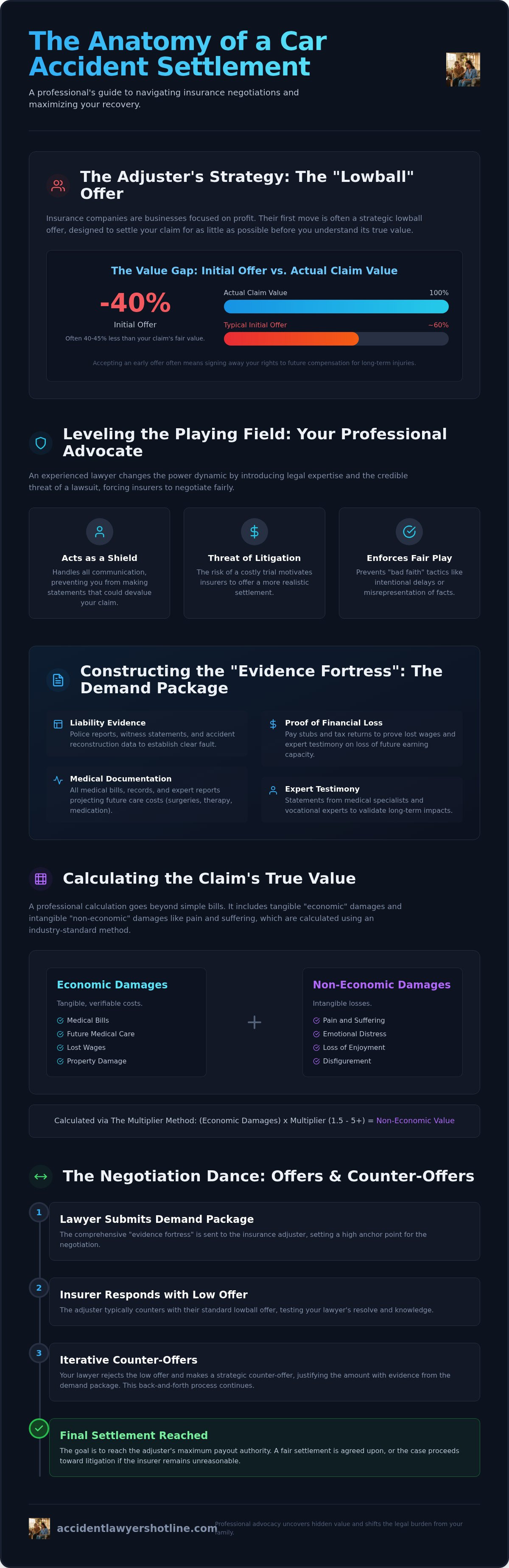
The "lowball offer" is a standard opening move. Industry benchmarks from 2024 and 2025 indicate that initial offers are frequently 40% to 45% lower than the actual value of the damages. These offers aren't accidental; they are strategic. By offering a quick, smaller sum, the insurer hopes to settle the case before you understand the full scope of your medical needs or legal rights. They rely on your financial stress to secure a cheap resolution.
The Goal of the First Offer
When you receive that first check, it usually comes with a catch. You must sign a release of liability. This document permanently ends your right to seek further compensation. If you discover a hidden spinal injury or need surgery six months from now, you cannot go back for more money. Accepting "quick cash" for immediate bills often leaves victims footing the bill for long-term care themselves. Additionally, adjusters use early, recorded statements to find inconsistencies. A simple "I'm okay" spoken in shock can be used later to argue your injuries aren't serious. They want you to commit to a story before you have reached maximum medical improvement.
Why Professional Advocacy Levels the Playing Field
Hiring an expert changes the power dynamic instantly. When you have representation, the insurance company can no longer rely on your lack of legal knowledge. The most significant lever an attorney holds is the credible threat of litigation. Insurers know that a Settlement (litigation) is a way to avoid the high costs and unpredictability of a trial. This threat alone often forces them to bring a more realistic number to the table.
A no fee unless we win your case attorney also acts as a shield for your family. They handle all communication, preventing you from making self-incriminating statements that could devalue your claim. Their presence signals to the insurer that you are prepared to fight for a fair outcome. Finally, they ensure the insurer plays by the rules. In legal terms, "bad faith" occurs when an insurance company intentionally avoids its contractual obligations by misrepresenting facts, delaying payments without cause, or refusing to conduct a fair investigation. Having an advocate means the insurer can no longer use stall tactics to wear you down financially. This is a core part of how a lawyer negotiates a car accident settlement effectively.
The Demand Package: Constructing the Evidence Fortress
The demand letter serves as the opening move in any professional negotiation. It isn't just a simple request for payment. Instead, it is a formal document that outlines the facts of the crash, the legal liability of the other party, and the total damages you've suffered. This package must be airtight to be effective. A lawyer compiles police reports, witness statements, and accident reconstruction data to leave no room for the insurer to argue fault. By presenting a complete "evidence fortress," the attorney shifts the burden of proof back to the insurance adjuster.
Beyond physical damage, the package includes proof of financial loss. This includes "lost wages" for time already missed and "loss of future earning capacity" if your injuries prevent you from returning to your previous career. This is a critical component of how a lawyer negotiates a car accident settlement because it quantifies the long-term economic impact that a simple medical bill doesn't show. Proving these losses requires pay stubs, tax returns, and often testimony from vocational experts.
Medical Evidence and Expert Testimony
Expert attorneys use specialist reports to project long-term care costs. This is vital when injuries require future surgeries, medication, or physical therapy. Insurance companies often request an "Independent Medical Examination" (IME). These are rarely independent; they are conducted by doctors paid by the insurer to find reasons to deny your claim. A lawyer counters these by providing their own expert testimony that links the specific crash mechanism to the physical trauma documented. This prevents the insurer from claiming your condition was pre-existing. If you're unsure if your documentation is sufficient, a car accident case evaluation can help identify the gaps in your evidence.
Documenting Life Impact (Non-Economic Damages)
Non-economic damages are often the hardest to prove but carry significant value. Lawyers often encourage clients to keep "pain and suffering" journals. These daily records document how the injury affects your routine, sleep, and mental health. Quantifying the loss of enjoyment of life or loss of consortium requires specialized knowledge of how courts value these claims. Permanent scarring or disability significantly increases claim value because the impact is lifelong. A professional knows how to translate these human experiences into a persuasive legal argument. This documentation is central to how a lawyer negotiates a car accident settlement to ensure you aren't treated as just another claim number.
The Negotiation Dance: Navigating Offers and Counter-Offers
The first offer from an insurance company is rarely their final word. It is the beginning of an iterative process often called the "negotiation dance." Professional attorneys don't just accept or reject; they counter with hard data. This back-and-forth movement continues until both sides reach a middle ground. A lawyer's goal is to ensure that this ground remains as close as possible to the true value of your damages. Understanding how a lawyer negotiates a car accident settlement means recognizing that every counter-offer is a strategic step to test the adjuster’s resolve.
Experienced lawyers are skilled at identifying an adjuster's "authority limit." This is the maximum amount the adjuster is allowed to pay without seeking approval from a supervisor. By analyzing the speed and size of the adjuster's concessions, an attorney can sense when the company is nearing its ceiling. Additionally, the lawyer evaluates the "policy limits" of the at-fault driver. For example, many jurisdictions require a minimum level of bodily injury coverage per person. If your medical bills exceed these minimums, your attorney will search for additional coverage, such as underinsured motorist policies, to maximize your recovery.
Responding to Liability Disputes
Insurers frequently use "comparative negligence" to reduce the amount they owe you. They might argue you were 20% at fault for the crash to cut the payout by 20%. In many jurisdictions that apply a modified comparative fault system, being found more than 50% at fault can entirely bar your claim. Lawyers shut down these arguments by using dashcam footage, direct witness testimony, and legal precedent from past cases. This evidence proves the other driver’s liability and prevents the insurer from unfairly shifting the blame onto you.
The Timing of the Counter-Offer
Timing is just as important as the dollar amount. A lawyer will often wait until you reach Maximum Medical Improvement (MMI) before making a final counter-offer. This is the point where your condition has stabilized and your future medical needs are clear. Settling before MMI is a significant risk. You cannot reopen a case if you discover you need surgery months later. Your attorney balances this need for patience with the reality of legal deadlines. The statute of limitations acts as a ticking clock that can extinguish your right to recover if negotiations drag on too long. This careful timing is a hallmark of how a lawyer negotiates a car accident settlement to protect your financial security.
Calculating Settlement Value: The Professional Methodology
Determining the true value of a claim requires more than just adding up hospital receipts. Lawyers categorize your losses into special damages and general damages. Special damages are the easy part. They include fixed costs like medical bills, car repairs, and lost wages. General damages are far more complex. These cover intangible losses such as physical pain, emotional distress, and the loss of a normal life. This distinction is where how a lawyer negotiates a car accident settlement becomes a data-driven battle. Without a professional calculation, you risk leaving thousands of dollars on the table.
The math matters because insurance companies use software to undervalue your human experience. National reports show the average car accident settlement in 2026 is approximately $30,416, but this number varies wildly based on how damages are calculated. Attorneys use proven methodologies to ensure the insurer's software doesn't dictate your future. They also factor in the "Per Diem" approach. This assigns a specific daily dollar amount to your suffering from the day of the crash until you reach maximum recovery. This method provides a logical, day-by-day justification for your compensation.
The Multiplier Method Explained
The most common tool in a lawyer's arsenal is the multiplier method. This starts with your total economic damages. An attorney then applies a "severity score," typically ranging from 1.5 to 5. If you suffered a minor soft-tissue injury, the multiplier might be on the lower end. However, factors like surgery, permanent scarring, or a lifelong disability push that multiplier to 4 or 5. Insurers fight aggressively to keep this score as low as possible. They often argue that your injuries don't justify a high multiplier to protect their profits. A seasoned expert knows how to present medical evidence that makes a high multiplier undeniable.
Accounting for Future Financial Losses
A fair settlement must look forward, not just backward. In 2026, settlement values are trending 2% to 4% higher than previous years due to rising medical costs and inflation. Your attorney must account for these increases when projecting the cost of future surgeries or long-term therapy. If your injuries prevent you from returning to your previous career, they calculate your "lost earning capacity." This involves more than just your current salary; it includes lost raises, retirement contributions, and benefits.
Vocational experts are often brought in to prove how your injuries limit your career path. They also estimate the costs of necessary home modifications or specialized medical equipment you may need years from now. If you want to ensure your claim reflects these long-term realities, you should start with a car accident case evaluation. This professional review identifies the hidden value in your claim before you talk to an adjuster. Understanding these calculations is a vital part of how a lawyer negotiates a car accident settlement to secure your financial restoration.
Securing Professional Advocacy: Your Next Steps
Knowing how a lawyer negotiates a car accident settlement gives you a significant advantage. However, applying these tactics on your own while recovering from injuries is nearly impossible. Professional advocacy ensures that the burden of proof, calculation, and communication shifts from your shoulders to an expert facilitator. This protection allows you to focus on your recovery while a specialist builds your evidence fortress. A referral service like Accident Lawyers Hotline simplifies this transition by connecting you with experienced personal injury specialists nationwide.
The process begins with a thorough review of your claim. A case evaluation identifies the "hidden value" that insurance adjusters often overlook. This might include future medical inflation or the specific ways an injury impacts your unique career path. By uncovering these details early, you set a higher floor for the negotiation dance. It is a risk-free way to understand your options without the pressure of an immediate legal commitment. This initial step is vital for restoring a sense of security.
The Advantage of the Contingency Model
Financial stress is often the biggest barrier to seeking justice. Many victims worry they cannot afford a high-quality no fee unless we win your case attorney. The contingency model removes this barrier entirely. You don't pay any upfront costs or hourly rates. Instead, the attorney's fee is a percentage of the final settlement. This structure aligns your interests perfectly with your legal team. They only get paid if you win, which motivates them to maximize your recovery amount. It democratizes the legal system, ensuring everyone has access to formidable representation regardless of their current bank balance.
Start Your Free Case Evaluation Today
Taking the first step is simple and direct. You only need to provide basic information about the accident and your injuries to begin the evaluation process. During your first conversation with a specialist, expect a calm and supportive environment. They will listen to your story, review the facts of the crash, and explain the potential path forward. This initial talk is designed to provide clarity in a moment of uncertainty. There is no obligation to proceed, and the consultation is strictly confidential. Understanding how a lawyer negotiates a car accident settlement ensures you aren't misled by the first offer you receive. You deserve to know the true value of your claim before an insurance company tries to settle for less. Get your free car accident case evaluation now to protect your financial future and restore fairness to your situation.
Restoring Fairness to Your Recovery
You've learned that the path to a fair settlement isn't a simple request for payment. It's a calculated process that involves countering corporate lowball offers with an airtight evidence fortress. Understanding how a lawyer negotiates a car accident settlement in 2026 allows you to see past the insurance company's cost-cutting tactics. From identifying the adjuster's authority limit to calculating the true impact of future medical inflation, every tactical step is designed to restore the balance of power to your side.
You don't have to carry this burden alone. Our national referral service connects you with specialized advocates for car, truck, and motorcycle accidents. These experts operate on a contingency model, meaning there are no fees unless your case is won. Taking action today ensures your rights are protected by a seasoned professional who understands the high stakes of your recovery. We are available for national case evaluations throughout 2026 to help you move forward with confidence. Peace of mind is within reach.
Start your free national car accident case evaluation today
Frequently Asked Questions
How long does it typically take for a lawyer to negotiate a settlement?
Negotiation timelines vary based on your medical recovery and the insurance company's cooperation. Most cases take between four and twelve months to resolve once your attorney sends the initial demand letter. If your injuries are severe, the process may take longer because your legal team must wait until you reach Maximum Medical Improvement. This ensures all future medical costs are included in the final payout. Rushing the process often results in a lower settlement.
Can I negotiate with the insurance company myself without a lawyer?
You have the legal right to negotiate directly with an insurance adjuster. However, individuals without representation often receive significantly lower offers. Adjusters use specialized software and data models to justify "lowball" settlements that don't reflect the true cost of your trauma. A professional knows how a lawyer negotiates a car accident settlement to counter these corporate tactics. They identify the adjuster's authority limits and use legal leverage that an unrepresented person simply doesn't possess.
What percentage of a settlement do car accident lawyers usually take?
Most personal injury attorneys operate on a contingency fee basis. This means they receive a percentage of the final settlement rather than charging you an upfront hourly rate. You don't have to worry about out-of-pocket legal costs while you are focused on your recovery. The specific percentage is determined before the case begins and is only paid if your claim is successful. This model ensures your legal team is fully motivated to secure the highest possible amount.
What happens if the insurance company refuses to negotiate a fair amount?
If an insurance company refuses to offer a fair amount, your attorney may recommend filing a formal lawsuit. This move shifts the case into the "discovery" phase, where both sides must share evidence and testimony under oath. Often, the increased pressure and costs of litigation force the insurer to return to the table with a more realistic offer. Your legal team will guide you through mediation or arbitration before deciding if a full court trial is necessary.
Will my case have to go to court if we can't reach a settlement?
It's highly unlikely your case will end up in a courtroom. National statistics indicate that about 95% of personal injury claims are resolved through a settlement before a trial ever begins. While your attorney prepares every case as if it might go to court, the goal is always to reach a fair agreement through mediation or direct negotiation. A trial is a last resort used only when an insurance company remains completely unreasonable regarding your damages.
How much is my car accident claim actually worth?
Your claim's value depends on your specific medical bills, lost wages, and the impact on your quality of life. In 2026, the national average settlement is reported to be $30,416, but individual results vary significantly. Factors like permanent scarring, the need for future surgery, and the degree of the other driver's fault all influence the final number. A professional case evaluation is the most accurate way to identify the hidden value and long-term costs of your accident.
What is the 'demand letter' and why is it so important?
The demand letter is the formal document that officially starts the negotiation process. It outlines the facts of the crash, proves the other driver’s liability, and details your medical and financial losses. This letter is crucial because it sets the "floor" for all future discussions. A well-crafted demand package includes expert testimony and accident reconstruction data, making it difficult for the insurer to dispute your claim. It forces the adjuster to respond to hard evidence.
Can I still get a settlement if I was partially at fault for the accident?
You can still recover compensation in most states even if you were partially responsible for the crash. Most jurisdictions use "comparative fault" rules, which reduce your settlement by your percentage of fault. For example, if you are 20% at fault, your total payout is reduced by 20%. Understanding how a lawyer negotiates a car accident settlement involves using evidence like dashcam footage to minimize the fault assigned to you. This ensures you aren't unfairly barred from recovery.
Were You Injured in an Accident?
Get a free, confidential case evaluation. No upfront fees.
Get Free Case Evaluation