How Are Personal Injury Settlements Paid Out? Complete 2026 Guide
Wondering how are personal injury settlements paid out? Discover the step-by-step disbursement process, medical lien deductions, and timeline in this guide.
Reaching an agreement with an insurance adjuster feels like crossing the finish line, but receiving your compensation is an orderly legal accounting sequence, not an overnight wire transfer. If you find yourself asking how are personal injury settlements paid out after weeks of silence, that waiting period can trigger immense frustration.
You've endured painful physical recovery and stressful negotiations. Now, watching the calendar while worrying about unexpected medical liens, attorney fees, and processing delays creates unnecessary stress. You deserve complete clarity regarding where every single dollar goes and how much money will ultimately land in your hands.
This guide explains the exact step-by-step process of how settlement funds are processed, deducted, and distributed. We walk through the chronological stages from signing your liability release to final disbursement, reveal how outstanding healthcare bills are settled, and help you evaluate whether a lump-sum payout or a structured annuity best protects your long-term financial security.
Key Takeaways
- Review the chronological stages of how are personal injury settlements paid out, tracing your funds from insurer draft issuance to attorney trust account clearance.
- Compare the immediate liquidity of a lump-sum distribution against the guaranteed, tax-free security of a structured settlement annuity.
- Identify every deduction taken from your gross recovery, including legal contingency fees, case expenses, and statutory medical liens.
- Learn why insurance bureaucracy creates processing delays and how statutory payment deadlines protect your rights.
- Understand how skilled personal injury lawyers aggressively negotiate healthcare subrogation claims to maximize your final net payout.
The Settlement Payout Process: From Agreement to Trust Account
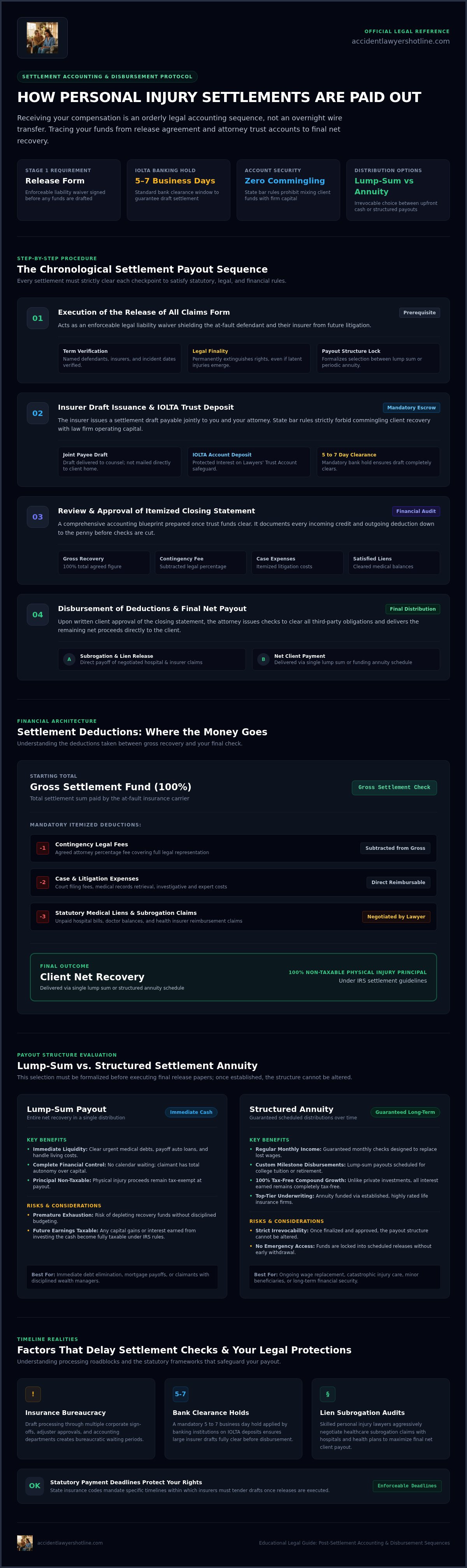
Reaching an oral agreement is a major victory, but it doesn't immediately put cash into your wallet. The post-settlement phase is a strictly monitored legal process designed to protect your financial recovery. Understanding how are personal injury settlements paid out requires looking past the negotiation table into the bank accounts and legal workflows that handle your money. Once terms are finalized, the transfer follows an exact sequence to guarantee that all legal and financial obligations clear properly.
Signing the Release of All Claims Form
Before an insurance company issues a check, you must execute a Release of All Claims form. This document acts as an enforceable liability waiver that shields the at-fault party and their insurer from any future lawsuits stemming from the accident.
- Review the terms closely: Confirm that all named defendants, insurance companies, and incident dates are accurate.
- Understand finality: Signing permanently extinguishes your legal right to pursue additional compensation, even if latent physical injuries emerge down the road.
- Confirm payment structures: Ensure the paperwork accurately reflects your chosen payout method, whether that involves an upfront cash sum or periodic structured settlements.
The Role of the IOLTA Attorney Trust Account
Insurance carriers do not mail settlement drafts directly to your home. Instead, they issue a draft payable jointly to you and your legal representative. State bar disciplinary rules mandate that your lawyer deposit this payment directly into an Interest on Lawyers' Trust Account (IOLTA). Attorneys cannot commingle client funds with general law firm operating capital. The banking institution applies a standard clearance hold, usually lasting 5 to 7 business days. This window ensures the insurer's draft clears completely before anyone touches the funds, protecting all parties from bounced checks or accounting discrepancies.
Reviewing the Settlement Closing Statement
The closing statement acts as your complete financial blueprint, showing every incoming credit and outgoing debit across the lifespan of your case. Your legal counsel prepares this itemized document once trust funds clear. It accounts for the gross settlement figure, subtracted contingency legal fees, litigation expenses, and satisfied medical liens. You must review, approve, and sign this document before anyone cuts checks. This final accounting review clarifies exactly how are personal injury settlements paid out down to the penny, leaving zero ambiguity about your net recovery.
Lump-Sum vs. Structured Settlement: Choosing Your Distribution Method
Deciding how to receive your funds is just as critical as negotiating the final dollar figure. When evaluating how are personal injury settlements paid out, you must choose between taking a single lump-sum distribution or arranging a structured settlement. You must formalize this decision before executing your final agreement, because once established, the payout structure cannot be altered.
Benefits and Drawbacks of Lump-Sum Settlements
A lump-sum distribution delivers your entire net recovery in a single transfer. This approach offers immediate liquidity to clear urgent debts, pay off auto loans, or cover ongoing living expenses while you heal. You retain complete control over your money without waiting on a calendar. However, sudden wealth presents real risks. Without disciplined budgeting, claimants can exhaust their funds prematurely. While physical injury proceeds remain non-taxable, any future capital gains or interest earned from investing that cash become fully taxable under IRS guidelines on settlement taxability.
How Structured Settlement Annuities Work
Structured settlements provide scheduled, guaranteed payments distributed over months, years, or decades. The defense insurer funds an annuity contract issued by an established, highly rated life insurance company. You can customize the distribution schedule based on your personal needs:
- Regular income: Receive guaranteed monthly payments to replace lost wages.
- Milestone payouts: Schedule larger lump-sum disbursements for college tuition or retirement targets.
- Tax-free compound growth: Unlike private investments, all interest earned within a qualified structured settlement remains 100% tax-free under federal law.
- Asset protection: Fixed schedules shield vulnerable accident victims from predatory borrowing requests by acquaintances or relatives.
Comparing Payout Options for Catastrophic Motor Vehicle Injuries
Severe collisions often inflict permanent trauma that demands decades of ongoing physical therapy, surgical revisions, and home modifications. A lump-sum check might look substantial today, yet it can disappear quickly against compounding healthcare inflation. Conversely, structured settlements ensure dependable financial security for life. They can also fund a Special Needs Trust, allowing an injured individual to receive settlement income without losing eligibility for vital government assistance benefits. Discussing your options during a motor vehicle accident case evaluation gives you the clarity needed to choose a distribution path that protects your long-term independence.
Settlement Deductions Explained: Legal Fees, Medical Liens, and Taxes
Gross recovery numbers in legal headlines rarely match the final amount deposited into your personal checking account. When exploring how are personal injury settlements paid out, understanding every required deduction is vital. Before any net proceeds reach your hands, multiple third parties hold legal rights to repayment from that gross figure. An orderly financial accounting resolves these obligations directly from the attorney's trust account.
Contingency Fees and Legal Case Costs
Most injury claimants partner with legal counsel under a contingency model. Choosing a no fee unless we win your case attorney guarantees that you owe zero upfront representation fees. Instead, legal representation is deducted as a pre-agreed percentage of the gross settlement recovery once the case resolves favorably.
Case costs are accounted for separately from attorney fees. These represent out-of-pocket expenses advanced by the law firm during the claims process, such as:
- Fees for acquiring certified medical records and billing histories
- Expert witness analysis, crash reconstruction, and deposition costs
- Court filing fees and formal process server expenses
Resolving Medical Liens and Subrogation Demands
Health insurance providers, Medicare, Medicaid, and hospital systems often assert legal claims called medical liens against your recovery. These entities claim statutory subrogation rights to recover money spent treating your accident-related injuries. Private doctors treating you under Letters of Protection (LOPs) must also be paid from the settlement proceeds.
Experienced personal injury attorneys do not simply pay these demands at face value. They aggressively negotiate outstanding balances downward using statutory common fund rules and hospital reduction statutes. Lowering these healthcare claims directly puts more cash into your final distribution. Resolving them fully is non-negotiable; ignoring verified statutory liens creates serious legal liability for both you and your legal team.
Taxes on Personal Injury Settlements: What the IRS Mandates
Taxes play a decisive role in calculating your true take-home pay. According to official IRS guidelines on settlement taxability, compensatory damages awarded for observable physical injuries or sickness are excluded from gross income under IRC Section 104(a)(2). You owe zero federal or state income tax on money received for bodily harm, physical pain, and accident-related medical expenses.
Certain components remain fully taxable, however. Punitive damages awarded to punish extreme recklessness are taxable as ordinary income. Any pre-judgment or post-judgment interest applied to your payout is also taxable. Understanding these distinctions clarifies how are personal injury settlements paid out and ensures you prepare accurately for tax season.
Factors That Delay Settlement Checks and How to Speed Up Distribution
Waiting for your compensation check after reaching an oral deal can test anyone's patience. The standard timeline from a signed agreement to money in hand usually spans 4 to 8 weeks. Unforeseen administrative roadblocks can stretch that window considerably. Knowing what causes these slowdowns demystifies how are personal injury settlements paid out and empowers you to keep your case moving forward.
Administrative and Insurer Processing Obstacles
Insurance carriers move slowly when releasing corporate funds. Once your signed release reaches defense counsel, it often passes through multiple managerial approval tiers before the claims department issues a payment draft. Internal auditing reviews, postal delivery lags, and high check volumes contribute to standard delays. Even minor clerical errors, like a misspelled middle name or an incorrect vehicle registration entry on the liability release, can prompt the carrier's automated systems to reject the paperwork and freeze check disbursement until revised forms arrive.
The Impact of Medicare and Medicaid Subrogation Audits
Statutory healthcare audits represent one of the most substantial causes of prolonged delay. When public healthcare programs cover injury treatments, federal and state rules require formal verification of paid amounts:
- Medicare conditional demand notices: CMS administrative contractors must calculate and issue a final conditional payment demand letter before an attorney can disburse proceeds.
- Lengthy bureaucratic processing: Securing a final demand from CMS can require 65 to 120 days if not managed through digital portal workflows.
- Segregated escrow solutions: When audit delays drag on, your lawyer can hold a dedicated reserve in trust to satisfy the potential lien while safely disbursing the undisputed balance directly to you.
Steps Claimants Can Take to Accelerate Payouts
You play an active role in keeping this process on schedule. Reviewing and notarizing your Release of All Claims document the exact day you receive it prevents avoidable friction. Forward all health insurance explanation-of-benefits statements, private health coverage cards, and physician invoices to your legal team early. Prompt documentation allows paralegals to open lien negotiations months before the defense ever issues a settlement draft.
If you suffered injuries in a crash and need an advocate to streamline this entire payout lifecycle, connect with a car accident lawyer for a free case evaluation today.
Protecting Your Payout: Securing Legal Representation for Fair Settlement Recovery
Negotiating an accident claim without professional guidance leaves you vulnerable to insurer pressure tactics. Adjusters frequently capitalize on financial vulnerability after a collision, offering fast, undervalued settlement checks before long-term medical costs are fully known. Realizing how are personal injury settlements paid out reveals that winning fair compensation requires more than accepting the first offer. It demands building a rock-solid claim and asserting your rights against institutional defendants.
How Experienced Attorneys Maximize Your Final Net Recovery
Securing legal representation shifts the balance of power back to you. Experienced personal injury attorneys understand how insurers value bodily injury claims, building cases that capture every dollar of your damages:
- Quantifying economic damages: Account for past healthcare bills, anticipated lifelong medical expenses, prescription costs, and diminished earning capacity.
- Documenting non-economic harm: Quantify physical pain, chronic suffering, loss of enjoyment of life, and emotional distress caused by the trauma.
- Leveraging courtroom readiness: Show carriers that you are prepared to file a formal lawsuit if they refuse to negotiate in good faith.
Evaluating Complex Multi-Vehicle and Commercial Collisions
Crashes involving tractor-trailers, municipal buses, or rideshare vehicles introduce corporate defendants with deep legal teams. These claims involve layered commercial liability policies and overlapping corporate liabilities. Proving fault requires immediate actions like preserving black box telematics data, reviewing electronic logging devices, and assessing driver qualification files. Skilled car accident attorneys manage these complex moving parts while preparing the ground for eventual payout disbursal, shielding you from corporate defense teams designed to minimize your recovery.
Take the First Step Toward Your Accident Recovery
Accident Lawyers Hotline connects motor vehicle accident victims directly with experienced motor vehicle accident lawyers nationwide. A professional case evaluation acts as a risk-free starting point, providing clear legal insight into the merits of your claim. Participating lawyers operate on a contingency fee basis with no upfront costs, meaning they collect no legal fees unless they secure a recovery for your case.
Do not let corporate claims departments dictate the value of your physical recovery or confuse your understanding of how are personal injury settlements paid out. Contact Accident Lawyers Hotline today to schedule your free, confidential case evaluation and take control of your financial future.
Take Control of Your Settlement and Future Financial Recovery
Understanding how are personal injury settlements paid out transforms an anxious waiting game into a transparent, manageable legal process. From mandatory trust account clearance holds to aggressive healthcare lien reductions, every stage protects your funds before final disbursement. Whether you select immediate lump-sum liquidity or structured annuity stability, knowing the financial mechanics behind your recovery puts you firmly in control.
You don't have to face aggressive insurance carriers or complex lien audits alone. Accident Lawyers Hotline connects victims of auto, truck, motorcycle, and pedestrian accidents with dedicated personal injury attorneys across the country. With zero upfront expenses and contingency representation, you pay nothing unless your lawyer wins your case. Take decisive action to protect your long-term security. Connect with an experienced accident attorney for a free case evaluation today, and take the first step toward the full, fair recovery you deserve.
Frequently Asked Questions
How long does it take to get a check after settling a personal injury case?
Most claimants receive their net funds within 4 to 8 weeks after reaching an oral settlement agreement. This timeline accounts for drafting and executing the liability release, waiting on the insurer's corporate draft, and completing a standard 5 to 7 business day bank clearance hold. If your case involves complex public healthcare lien audits from Medicare or Medicaid, finalizing the distribution can take several months.
Do I have to pay taxes on my personal injury settlement money?
You generally do not pay federal or state income taxes on compensatory damages awarded for physical personal injuries. Under IRS rules, compensation for bodily injury, ongoing physical therapy, and accident-related emotional trauma is non-taxable. Punitive damages and accrued interest remain fully taxable as ordinary income. If you claimed itemized tax deductions for your medical expenses in prior years, you may face tax recapture obligations on that portion.
What happens if there are unpaid medical bills when my settlement is paid?
Unpaid medical bills and statutory healthcare liens are satisfied directly out of your gross settlement proceeds before net funds are released. Treating doctors, private health plans, and public agencies hold enforceable legal claims against the recovery funds. Your attorney audits every bill and negotiates reductions to minimize what you owe. Once all verified debts are paid, the remaining balance is transferred directly to your personal account.
Can I choose between a lump-sum check and monthly structured settlement payments?
Yes, you can choose between a lump-sum distribution and structured annuity payments, but you must establish this choice before signing your final release. This decision forms a core step in how are personal injury settlements paid out. A lump sum offers immediate capital for urgent debts, while structured settlements provide recurring, guaranteed income. For severe injuries requiring lifelong treatment, structured options protect government benefits and ensure tax-free growth.
Why does my lawyer deposit the settlement check into a trust account first?
State bar rules strictly require lawyers to deposit third-party settlement checks directly into an Interest on Lawyers' Trust Account (IOLTA). Legal ethics prohibit attorneys from commingling client recovery money with ordinary law firm operational accounts. The draft must clear the paying bank completely, which typically takes 5 to 7 business days. This holding window protects everyone involved from counterfeit drafts, bank errors, or bounced settlement checks.
What percentage do personal injury attorneys typically take from a settlement payout?
Personal injury attorneys working on a contingency fee basis typically collect between 33.33% and 40% of the gross recovery. Pre-lawsuit settlements resolved through direct negotiation usually adhere to a one-third (33.33%) rate. If a formal lawsuit must be filed, or if the case requires courtroom discovery and trial proceedings, fees often adjust to 40%. You pay zero upfront costs, and fees are collected only after recovery is secured.
Can health insurance demand their money back from my personal injury settlement?
Yes, health insurance providers can demand reimbursement for accident treatments under contractual subrogation clauses and statutory lien rights. When an insurer covers hospital bills resulting from another driver's negligence, they maintain a legal claim against your compensation. Knowing how are personal injury settlements paid out ensures you aren't blindsided by these claims. An experienced attorney routinely challenges inflated charges and negotiates these liens downward to maximize your recovery.
Were You Injured in an Accident?
Get a free, confidential case evaluation. No upfront fees.
Get Free Case Evaluation