How to Choose the Best Car Accident Lawyer for Your Case
Learn how to find a good lawyer after a car accident. Use our practical checklist to compare legal fees, case experience, and communication for your claim.
What if the lawyer making the boldest promises isn’t the right fit for your case? If you’re recovering from a crash, handling insurance calls, and trying to decide how to find a good lawyer after a car accident, it’s understandable to feel unsure about what matters most. Look beyond advertising. Consider whether the lawyer’s experience fits your situation, whether you can communicate clearly, and whether you understand the fee terms.
This guide offers a practical checklist for comparing lawyers. Use it to ask who would handle your case, how you would receive updates, and how attorney fees and case expenses are addressed. You’ll also learn why experience with claims like yours matters and what clear, responsive communication looks like.
Accident Lawyers Hotline evaluates motor vehicle accident cases and connects people with independent attorneys suited to their legal needs. A case evaluation gives you a way to discuss your circumstances and potential next steps.
Key Takeaways
- To decide how to find a good lawyer after a car accident, consider whether the lawyer’s experience matches your accident, injuries, and legal needs.
- Verify the lawyer’s bar admission and review public disciplinary information through the appropriate state bar authority.
- Use a consultation to compare how clearly lawyers explain your options, who will handle your case, and what happens next.
- Read the written fee agreement carefully to understand how attorney fees are calculated and how case expenses are handled.
- Accident Lawyers Hotline evaluates accident cases and connects people with independent attorneys. The platform does not provide direct legal representation.
How to find a good lawyer after a car accident: start with the right fit
Choosing legal help can feel like one more difficult task when you’re managing pain, appointments, repairs, and insurance calls. You don’t have to decide everything at once. Start by identifying what makes your situation specific, then use an initial conversation to find out whether a lawyer’s experience and approach match your needs.
A good car accident lawyer has relevant experience and communicates clearly. The right fit depends on the crash, your injuries, the questions in dispute, and the working relationship you want. A lawyer who handles personal injury cases generally may have a broad practice, so ask about their direct experience with motor vehicle accident claims like yours. This personal injury lawyer overview explains the wider field and the types of cases it can involve.
The 2026 car accident attorney case-evaluation guide explains what an evaluation can help you discuss. Use an evaluation to organize the facts and explore potential legal needs, not as a guarantee that a claim will succeed.
Why car accident experience should match your situation
Relevant experience can help a lawyer recognize the types of evidence and questions that may matter. Consider the seriousness of your injuries, whether the drivers disagree about what happened, and whether other people or organizations were involved. A straightforward collision and a crash with disputed facts may require different investigation and case-handling approaches. No particular case history guarantees a result.
The type of crash matters, too. A truck collision may involve questions about a commercial vehicle or its operation. Motorcycle, pedestrian, and bus crashes can raise different issues involving visibility, road use, passengers, or responsibility. Ask how the lawyer has handled claims resembling yours. A useful answer should address the details you shared, rather than rely on broad claims about experience.
What a first conversation should help you understand
Use the conversation to find out whether the lawyer understands your concerns and can explain a reasonable way to evaluate them. Briefly describe the crash, any injuries or treatment, and what you’re unsure about, such as who was responsible. You don’t need every document in hand to have a useful discussion.
Pay attention to how the lawyer responds. Are your questions answered in plain language? Do they explain what information could help assess the situation and who would follow up? Do you feel comfortable raising concerns? These are practical signs of whether the working relationship may suit you. An initial discussion is not a promise of a particular outcome, and a preliminary view may change as more facts become available. For broader recovery resources, explore this car accident victim assistance guide.
If you’re unsure how to find a good lawyer after a car accident, focus on fit rather than big promises. Accident Lawyers Hotline evaluates accident cases and connects people with independent attorneys suited to their legal needs. The platform is a referral service, not a law firm, and does not provide direct legal representation.
How to assess a car accident lawyer’s experience and qualifications
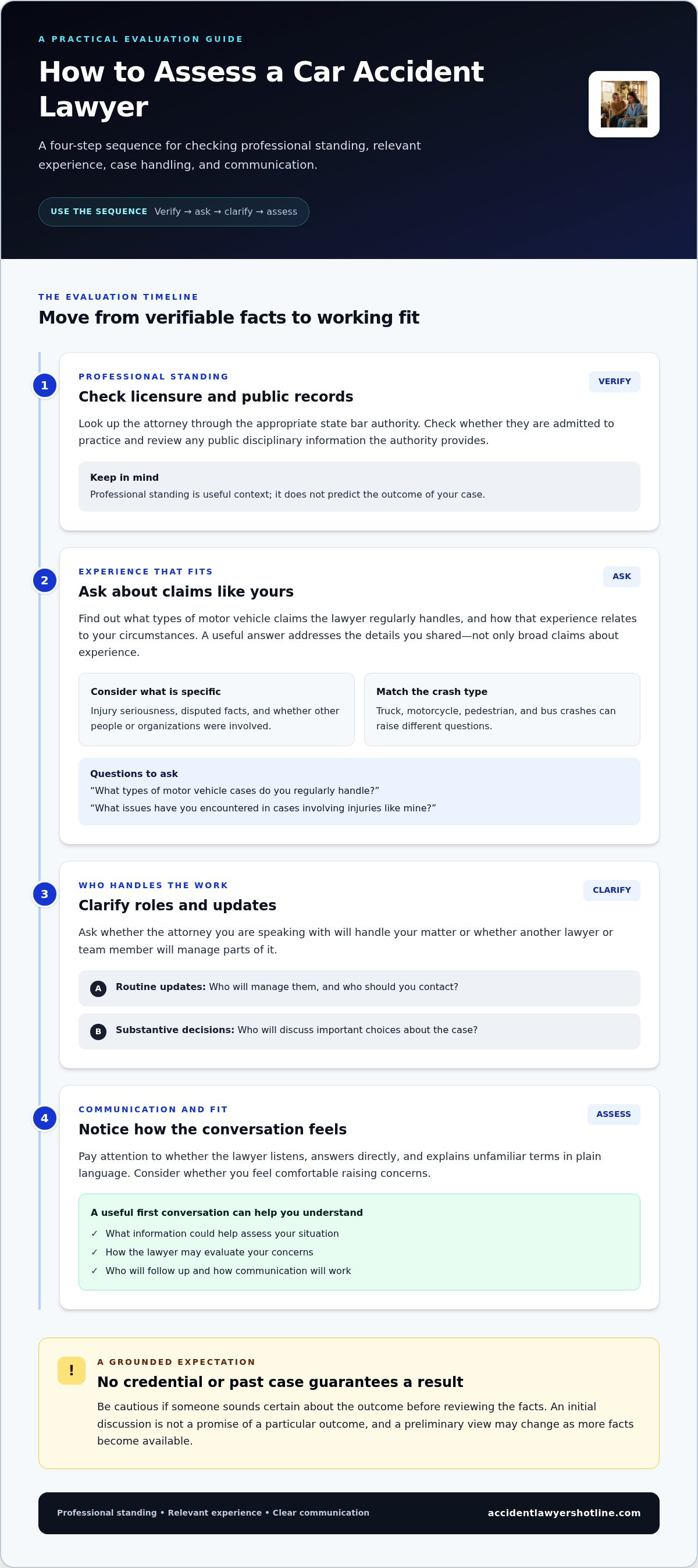
A lawyer’s background can help you judge whether they’re prepared to discuss your situation, but it shouldn’t come down to a list of titles or polished claims. Use a simple sequence: verify professional standing, ask about relevant experience, clarify who will handle the work, and assess whether the communication is clear and direct. That keeps your evaluation grounded in details you can check and answers you can understand.
- Check licensure. Look up the attorney through the appropriate state bar authority and review the available information about their professional standing.
- Ask about relevant cases. Find out what types of motor vehicle claims they regularly handle and how that experience relates to your circumstances.
- Clarify who does the work. Ask who will manage routine updates and who will discuss substantive decisions about the case.
- Assess communication. Notice whether the lawyer listens, answers directly, and explains unfamiliar terms in plain language.
Verifiable qualifications describe a lawyer’s professional standing. They don’t predict the outcome of your case. Licensure and relevant experience offer useful context, but no credential or past case can guarantee a particular result. Be cautious if someone sounds certain about the outcome before reviewing the facts.
Questions that reveal relevant case experience
Ask questions that invite a specific explanation without requesting confidential information about other clients. For example: “What types of motor vehicle cases do you regularly handle?” or “What issues have you encountered in cases involving injuries like mine?” You can also ask what steps might be needed to understand disputed facts. An initial conversation may not support a firm prediction.
Clarify the working arrangement, too. Will the attorney you’re speaking with handle your matter, or will another lawyer or team member manage parts of it? Who should you contact for routine updates, and who will explain important decisions? Clear answers help you set expectations and decide whether the proposed approach suits your needs.
How to verify a lawyer’s professional standing
Use the relevant state bar’s directory to check whether the attorney is admitted to practice and review any public disciplinary information the authority provides. Search the lawyer’s full name carefully, since similar names can cause confusion. If you discuss a potential attorney-client relationship, make sure you know which attorney would represent you and review the written agreement before deciding.
Advertisements, rankings, and testimonials may offer background, but they don’t replace your own evaluation. They may not tell you who will handle your case or how the lawyer will communicate with you. Compare what you can verify with what the attorney tells you directly. Note whether the answers are specific, consistent, and understandable.
Accident Lawyers Hotline evaluates motor vehicle accident cases and connects people with independent attorneys suited to their legal needs. It’s a referral platform, not a law firm, and it does not provide direct legal representation. You can explore a car accident case evaluation to discuss your circumstances and potential legal needs.
How to compare lawyers during a car accident consultation
A consultation lets you compare how lawyers approach your questions, not just how confidently they speak. Take brief notes after each conversation. Focus on whether the answers are clear, direct, and connected to the details you shared. Comparing the same points from each conversation can make it easier to see which approach feels practical.
| What to compare | What to listen for |
|---|---|
| Relevant experience | Does the lawyer explain how their experience relates to your type of crash and the issues you described? |
| Explanations | Are options and uncertainties explained in plain language, without rushing past your questions? |
| Responsiveness | Do you know who your main point of contact will be and how updates are shared? |
| Next steps | Does the lawyer explain what information may be needed and what could happen after the discussion? |
| Fee clarity | Are fees and possible case expenses addressed clearly, with details to review in a written agreement? |
Confidence alone isn’t proof of strong representation. A dramatic promise or certain prediction may sound reassuring, but no lawyer can guarantee a particular outcome based only on an initial conversation. Look for a thoughtful explanation of what is known, what remains unclear, and what information could help assess the situation.
Questions to ask before deciding who to hire
Keep your questions focused on how the working relationship would function. Ask: “Who will be my main point of contact, and how will I receive updates?” “What information would help you assess my situation and explain possible next steps?” “How will you involve me in decisions that need my input?” Specific answers help you understand what communication may look like after the consultation.
You can prepare without assembling a perfect file. Write down the basic crash details, the injuries or treatment you’ve experienced, and the questions you don’t want to forget. If you’re still handling immediate post-crash tasks, the step-by-step guide to what to do after a car accident covers practical actions to consider.
Warning signs that deserve a closer look
Pause if someone guarantees a result, pressures you to decide immediately, or avoids straightforward questions. Notice, too, if it’s unclear who would handle your matter or how you’d get updates. One unsatisfying answer doesn’t tell the whole story, but repeated evasiveness makes it harder to make an informed choice. Give yourself time to compare what you heard rather than deciding under pressure.
If a case evaluation would help you discuss your circumstances and potential legal needs, you can request a car accident case evaluation through Accident Lawyers Hotline. The platform evaluates cases and connects people with independent attorneys. It isn’t a law firm and does not provide direct legal representation.
How to compare contingency fees, costs, and representation terms
Fee arrangements can sound similar while treating expenses differently. Before deciding, distinguish the attorney’s fee from other costs that may arise while a claim is handled. A contingency fee is calculated under an agreement, often based on a recovery if one is obtained. Case expenses may include charges for records, filing, or expert assistance. Whether expenses are deducted from a recovery or remain your responsibility depends on the written terms.
The signed attorney-client agreement governs the fee arrangement, including how the attorney’s fee is calculated, which expenses may be charged, when payment may be due, and what responsibilities apply if the case does not succeed. Don’t rely on a verbal summary alone. Read the document before signing and ask for a plain-language explanation of any provision you don’t understand.
What a contingency-fee agreement should explain
Review the fee calculation closely. Check what amount the percentage or other calculation applies to, when the fee may be owed, and whether the agreement describes different terms at different stages of a case. Then look for a separate explanation of expenses. Ask whether costs are deducted from a recovery, billed separately, or handled another way, including if the case doesn’t result in a recovery. Terms can vary, so compare the actual agreements rather than assuming they are identical.
Before signing, make sure you can explain the basic arrangement in your own words: how the attorney is paid, which expenses may arise, and who may be responsible for them. If a phrase is unclear, ask for clarification in writing. A guide to no-fee-unless-we-win arrangements can also help you identify questions to raise about contingency terms.
How to understand the scope of representation
The agreement should identify the attorney or firm representing you and describe the work covered. Check whether it addresses communication, decisions that require your input, and how either side may end the representation. If a lawyer has discussed handling a specific claim or stage, make sure the written scope reflects what you understood. Ask what happens to outstanding expenses or fees if the relationship ends.
These details are part of how to find a good lawyer after a car accident. Clear terms help you understand the financial arrangement and what representation involves before you commit. Take time to compare documents and ask questions while you can still resolve anything that is unclear.
The platform isn’t a law firm and does not provide direct legal representation. To discuss your circumstances and potential legal needs, request a car accident case evaluation. Any attorney’s specific fee and representation terms are set out in the written agreement you review with that attorney.
How Accident Lawyers Hotline can connect you with a car accident lawyer
Finding legal help can start with a conversation about what happened. The distinction matters: Accident Lawyers Hotline is a referral platform, not a law firm, and it doesn’t represent clients or provide legal services directly. Any legal representation comes from an independent attorney.
The process is straightforward:
- Share basic accident details. Describe the crash and the questions or concerns you have.
- Receive a case evaluation. Discuss the circumstances and potential legal needs.
- Discuss a possible attorney connection. If a connection is appropriate, you can speak with an independent attorney about representation and next steps.
An evaluation can help turn uncertainty into a more focused conversation. It doesn’t guarantee that you qualify for a claim, that an attorney-client relationship will begin, or that you’ll obtain a particular result. It’s a practical way to explore questions and potential legal support as you consider how to find a good lawyer after a car accident.
What information to have ready for a case evaluation
Share what you know. Helpful details may include when and how the crash occurred, the vehicles or people involved, injuries or treatment, insurance information, and your preferred contact details. You don’t need every document or answer before starting. If information is missing, explain what you know so far and what remains uncertain.
Prioritize urgent medical care. An online article or case evaluation isn’t a substitute for medical attention or legal advice tailored to your circumstances. An evaluation can help clarify questions to raise with an attorney, such as what information may matter and what possible next steps to discuss.
What happens after a potential attorney connection
If you’re connected with an attorney, that attorney is independent and provides any legal representation. Accident Lawyers Hotline does not become your lawyer or manage your legal matter. Take time to discuss whether the attorney’s approach fits your needs, how communication will work, and what services the representation covers.
Connected attorneys offer contingency-fee arrangements, meaning no attorney fees unless the case is won. The written agreement controls the specific terms, including how fees are calculated and how expenses are handled. Review it with the attorney and ask about anything that isn’t clear before signing.
Requesting an evaluation is a manageable step toward informed guidance. Share the details you have, discuss your questions, and consider any potential attorney connection at your own pace. Request a car accident case evaluation to start a conversation about your circumstances and possible legal needs.
Take the next step with confidence
You don’t have to resolve every question before moving forward. A focused conversation can help you organize what you know, explain what remains uncertain, and decide what guidance you need next. If you’re still weighing how to find a good lawyer after a car accident, take it one step at a time. Asking for an evaluation doesn’t commit you to a particular legal decision.
When you’re ready, share the details you have and the questions you want answered. Use the conversation to get a clearer sense of your options and consider a path forward that feels right for you. Request a car accident case evaluation to start that discussion.
Recovery and legal decisions can take time. Move at a manageable pace, with a clearer understanding of what to consider next.
Frequently Asked Questions
How soon after a car accident should I contact a lawyer?
Consider seeking legal guidance as soon as practical, especially if you’re injured, fault is disputed, or an insurer asks you to make decisions quickly. Deadlines and claim rules vary by state and situation, so don’t assume you have unlimited time. Prioritize medical care first. If you’re wondering how to find a good lawyer after a car accident, an early conversation can help you identify questions to ask without committing you to representation.
Can I change lawyers after hiring one for a car accident claim?
You may be able to change lawyers, but review your signed agreement before taking action. It may explain how to end the relationship and address fees or expenses already incurred. Ask the current and prospective attorneys how they would manage case files, deadlines, and communication during a transition. Don’t simply stop responding or assume a new lawyer can take over immediately. Clarify the practical and financial details first.
Do I need a lawyer if the insurance company has already contacted me?
Not necessarily, but an insurer’s call doesn’t mean you have to make an immediate decision about representation or settlement. Be accurate and avoid guessing about details you don’t remember. Before signing a release or accepting an offer, make sure you understand what it covers and whether it may affect future claims. If injuries, disputed facts, or confusing paperwork complicate matters, consider getting advice tailored to your situation.
Can I hire a car accident lawyer if I was partly at fault?
Possibly. Being partly responsible doesn’t automatically answer whether you have a claim, because fault rules and their effects vary by state. The details matter, including what each person did and what evidence is available. Be candid about facts that may reflect on your role, such as a traffic signal or lane change. An attorney can discuss how applicable rules may affect your situation, but no preliminary conversation guarantees a result.
What should I bring to a car accident lawyer consultation?
Bring or note what you have, but don’t delay a conversation because your records aren’t complete. Useful items may include the crash report, photos, witness contact details, insurer letters, repair estimates, and medical records or bills. Write down the accident timeline and your questions, too. If you don’t have a document, explain that. A clear account of what happened and what you’re unsure about can help focus the discussion.
Does a contingency-fee lawyer charge upfront fees?
A contingency arrangement generally means the attorney’s fee is tied to the case outcome rather than paid as an upfront attorney fee. However, other case expenses may be handled separately, and terms differ between agreements. Read the written agreement for the fee calculation, expenses, and any payment responsibilities if there’s no recovery. Ask the attorney to explain unclear terms before signing, and don’t assume “contingency” means every possible cost is covered.
Is Accident Lawyers Hotline a law firm?
No. Accident Lawyers Hotline is a referral platform that evaluates accident cases and connects people with independent attorneys. It doesn’t provide legal representation. The attorneys, not the platform, provide any legal services and explain their representation terms directly. Connected attorneys offer contingency-fee arrangements, but the written agreement sets the specific terms. An evaluation can help you discuss your circumstances and potential legal needs without promising eligibility or a particular outcome.
Were You Injured in an Accident?
Get a free, confidential case evaluation. No upfront fees.
Get Free Case Evaluation