How to File a Diminished Value Claim After a Car Accident
Unlike a car accident bodily injury claim, diminished value covers vehicle loss. Learn how to gather records, assess resale value, and file your claim today.
What if your car looks repaired, but its accident history still lowers what buyers may pay? That loss can remain even after the bodywork is complete. A car accident bodily injury claim concerns harm to a person, while a diminished value claim focuses on a vehicle’s possible reduction in market value. They are separate losses, and evidence for one does not automatically establish the other.
It’s understandable to question an insurer’s valuation or denial, especially when you’re unsure which records could support your position. Whether a diminished value claim is available depends on the circumstances and applicable law, but organized documentation can help you assess the issue and respond to the insurer’s reasoning.
This guide explains what diminished value means, how it differs from injury damages, and what evidence may help show a vehicle’s pre-crash and post-repair value. You’ll find practical steps for organizing repair records, photos, appraisals, and insurer communications, as well as ways to respond if a valuation is disputed. The goal is to help you make informed next-step decisions without assuming that every claim qualifies or will succeed.
Key Takeaways
- A diminished value claim concerns a vehicle’s possible loss in resale value after a crash, not bodily injury damages.
- Inherent, repair-related, and immediate diminished value describe different kinds of potential loss. The label alone does not establish eligibility.
- Organize records of your vehicle’s pre-crash condition, the collision, repairs, and post-repair state to help document a possible loss.
- If an insurer disputes your valuation, compare its reasoning with the available evidence and applicable policy terms. Completed repairs do not automatically resolve every value-loss question.
- A car accident bodily injury claim involves harm to a person, while diminished value concerns property loss. Keep the records separate when preparing for a case evaluation or legal guidance.
What Is a Diminished Value Claim After a Car Accident?
A diminished value claim seeks compensation for a possible reduction in a vehicle’s resale value after it has been damaged in a crash and repaired. Even if repairs restore the car’s appearance and function, its accident history may affect what a buyer is willing to pay. Diminished value describes that potential difference in market value. Whether it supports a claim depends on the facts and applicable law.
A vehicle-value claim concerns property loss. It is separate from a car accident bodily injury claim, which addresses losses connected to a person’s physical injuries. The same collision can raise both issues, but each involves different evidence and questions. Whether diminished value can be pursued or recovered may depend on the circumstances of the crash, insurance coverage, and state law.
How Is Diminished Value Different From Repair Costs?
Repair costs pay to fix damage. Diminished value concerns a possible loss in market value that remains after repairs. A repair invoice shows what work was done and what it cost, but it does not establish a specific reduction in resale value. Completed repairs do not automatically prove that value loss remains or rule it out. The vehicle’s condition and relevant market evidence matter.
Is a Bodily Injury Claim the Same as a Vehicle Value Claim?
No. Bodily injury damages relate to harm a person suffered, while vehicle-value damages relate to potential financial loss involving the car. Depending on the circumstances, injury-related losses may include medical expenses, missed work, or other effects of physical harm. Vehicle damage and injuries can arise from one crash, but resolving one issue does not automatically resolve the other.
Keeping the distinction clear helps you identify which information is relevant. For a vehicle-value question, records about the car, its repairs, and its market value may matter. For a car accident bodily injury claim, the focus is on the person’s injuries and related losses. Insurers may handle these matters under different coverage or claim processes, so review the applicable policy terms and circumstances rather than assuming one decision settles every issue.
In short, repair costs cover the work needed to fix a damaged vehicle; diminished value concerns a possible loss in what that repaired vehicle could sell for. Neither the fact of a repair nor the amount on an invoice alone determines whether that separate market loss can be established.
What Types of Diminished Value May Apply After a Collision?
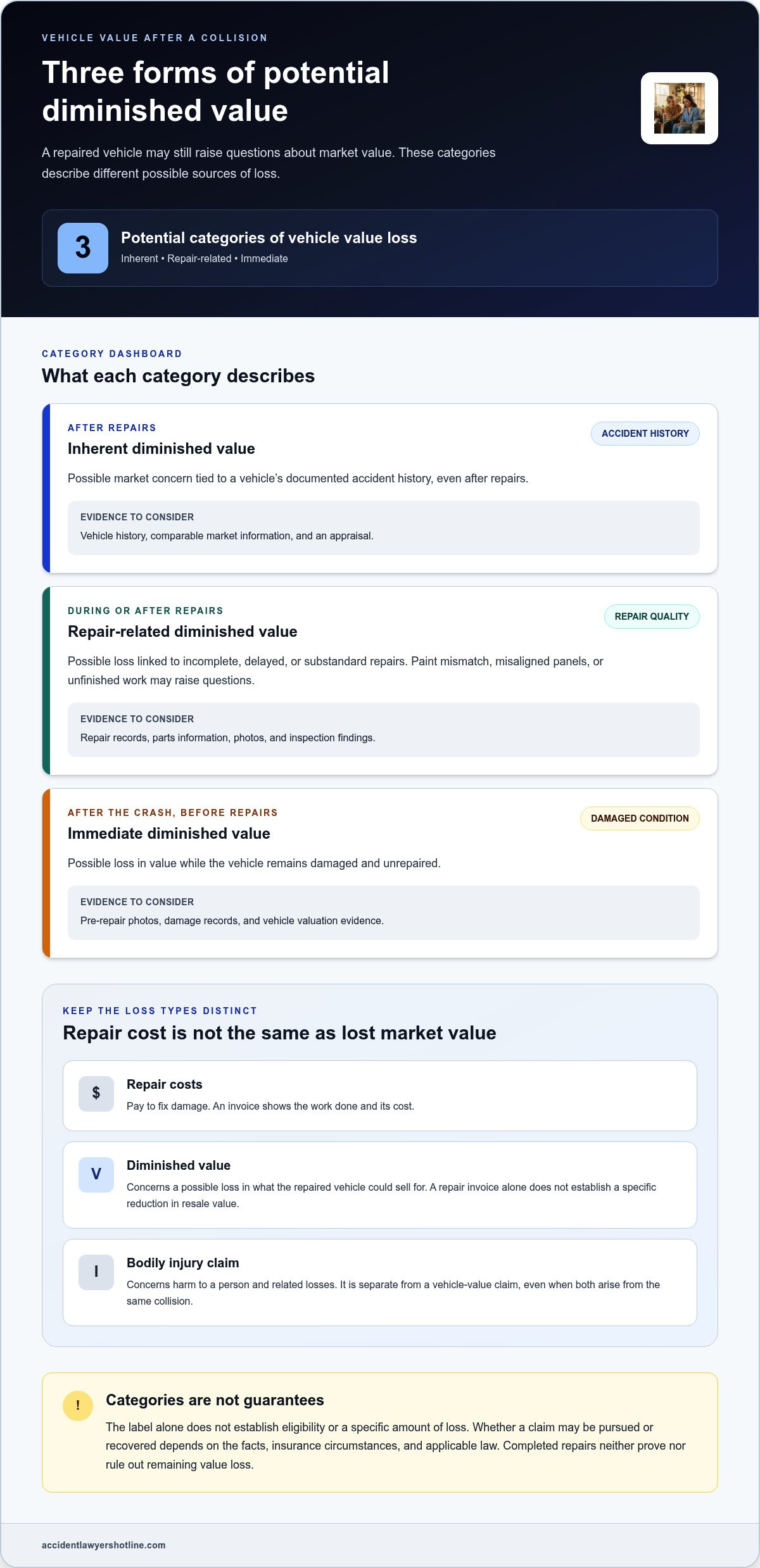
Diminished value is often discussed in three categories: inherent, repair-related, and immediate. These terms describe different ways a vehicle’s value might be affected, but they are not guaranteed claim entitlements. Which category matters, and whether a loss may be recoverable, depends on the facts, insurance circumstances, and governing law.
This comparison can help you identify the kind of value question you may be facing. The evidence listed is a starting point, not proof by itself. For a consumer overview of claim considerations, see this guide on how to file a diminished value claim.
| Category | Timing | What it describes | Evidence to consider |
|---|---|---|---|
| Inherent | After repairs | Possible market concern tied to the vehicle’s accident history | Vehicle history, comparable market information, and an appraisal |
| Repair-related | During or after repairs | Possible loss linked to incomplete, delayed, or substandard repairs | Repair records, parts information, photos, and inspection findings |
| Immediate | After the crash, before repairs | Possible loss in value in the damaged, unrepaired condition | Pre-repair photos, damage records, and vehicle valuation evidence |
What Does Inherent Diminished Value Mean?
Inherent diminished value describes a possible reduction in market appeal because a vehicle has a documented accident history, even after repairs. Buyers may view that history differently, and valuation sources may weigh it differently too. The vehicle’s age, condition, damage, and repair history can shape the assessment. Calling a loss “inherent” does not establish that a specific amount was lost or that the loss is legally recoverable.
How Do Repair-Related and Immediate Value Loss Differ?
Repair-related diminished value concerns the quality or completeness of the work. Visible paint mismatch, misaligned panels, or incomplete repairs may raise questions beyond the fact that the vehicle was in a crash. Immediate diminished value refers to a potential loss measured while the car remains damaged and before repairs. Its relevance can depend on the claim and local law, so do not assume that every jurisdiction recognizes or handles these categories the same way.
There is no single calculation formula that controls every claim. Assess an insurer’s estimate or valuation method against the vehicle’s actual condition and supporting evidence. If you’re also pursuing a car accident bodily injury claim, keep injury issues distinct from questions about your vehicle. A car accident case evaluation can help you discuss whether your circumstances merit legal review. Accident Lawyers Hotline connects people with independent attorneys and does not provide direct legal representation.
How Can You Document a Diminished Value Claim?
Build a clear record of the vehicle’s condition before the crash, the damage it sustained, and its condition after repairs. A complete file helps explain why you believe the vehicle’s market value changed. No single photo, invoice, or appraisal guarantees that an insurer will accept a claim or that compensation will be available.
The key comparison is the vehicle’s value before the crash versus its value after repairs. Keep documents together and arrange them in date order so the vehicle’s history and the claimed loss are easier to review.
Which Records Can Help Show the Vehicle’s Condition and History?
Start with evidence of the car’s pre-crash condition, then add records of the collision and repair process. Save original files when possible, and note dates and sources so the record remains clear.
- Before the crash: Gather photos, maintenance records, ownership details, mileage information, and anything that helps describe the vehicle’s prior condition.
- At the time of the crash: Keep the crash report, photographs of the damage, and relevant insurer communications.
- During repairs: Save the repair estimate, parts information, invoices, and records of work performed.
- After repairs: Take current photos and document any unresolved defect or repair concern. Describe what you observed without assuming it caused a specific market-value loss.
Keep copies of messages and letters from the insurer, including its valuation or explanation of a decision. If you’re also handling a car accident bodily injury claim, organize injury-related records separately from vehicle documentation. The claims concern different kinds of loss, and separate files make each issue easier to assess.
What Should a Diminished Value Appraisal Explain?
A useful appraisal should identify the vehicle’s make, model, year, mileage, condition, and accident details. It should explain the valuation method, sources, and assumptions, and show how those inputs support its conclusion. Check whether the report accounts for the vehicle’s pre-crash condition and post-repair state. If information is missing or an assumption seems inaccurate, note the specific issue for follow-up.
An independent appraisal can offer an informed estimate, but it is not a binding decision on the claim’s value. Compare its reasoning with the repair records, photos, and other available market information. Look for a transparent estimate with a clear basis, rather than relying on a number without supporting details.
What Should You Do If the Insurer Disputes Your Diminished Value Claim?
Completed repairs do not automatically settle every question about a vehicle’s value. Repairs address physical damage; a diminished value dispute concerns whether the repaired vehicle may still be worth less in the market. Review the insurer’s position against the facts you have documented and the applicable policy terms. Coverage, claim procedures, and deadlines vary, so do not assume one rule or timeline applies everywhere.
How Can You Respond to a Low Valuation or Denial?
Start by asking the insurer to explain its valuation or denial in writing. Compare the explanation with your vehicle records, repair documents, photos, and any appraisal. Look for specific differences, such as an incorrect mileage figure, an overlooked repair issue, or assumptions that do not match the vehicle’s condition.
Keep your response concise and factual. Identify the point you dispute, explain why, and attach the records that support your position. If you have an independent valuation, include its reasoning and sources, not only its final estimate. Avoid unsupported figures, threats, or casual statements about who caused the crash. Keep copies of everything you send and receive.
What If the Other Driver or Insurer Disputes Responsibility?
Responsibility can affect a third-party claim, so a disagreement about fault may complicate a vehicle-value issue. Preserve relevant crash evidence, reports, photos, and insurer communications. Describe what you know without making assumptions or presenting disputed fault as settled. State rules can affect how responsibility and potential recovery are assessed, so jurisdiction-specific questions call for careful review.
If you’re also pursuing a car accident bodily injury claim, keep injury-related records and communications separate from the vehicle-value file. The claims concern different losses, and a decision about one does not necessarily resolve the other. Track insurer requests and correspondence, and verify deadlines that may apply to your circumstances rather than relying on a general timeline.
If fault, coverage, or valuation remains disputed, an evaluation can help you discuss whether your circumstances merit legal review. Learn about a car accident case evaluation. Accident Lawyers Hotline connects people with independent attorneys and does not provide direct legal representation.
When Should You Seek Legal Guidance About a Diminished Value Claim?
Legal guidance may be useful when fault is disputed, insurance coverage is complex, the insurer’s valuation differs substantially from yours, or vehicle damage overlaps with injuries from the crash. These issues can affect how a claim is assessed, and relevant rules may vary by state. A case evaluation can help you discuss whether your circumstances merit further legal review, without assuming that a claim will qualify or succeed.
You do not need a perfect file to prepare. Gather what you have and make a short list of what remains unclear. Separate vehicle-value records from documents related to a car accident bodily injury claim so the different losses are easier to explain.
What Information Should You Prepare for a Case Evaluation?
Be ready to summarize when and how the collision happened, what vehicle was involved, what repairs were completed, and how the insurer responded. Note any disagreement about responsibility or coverage, and mention injury-related concerns if they overlap with the insurance issues.
Useful records may include repair estimates and invoices, crash and vehicle photographs, valuation documents, and relevant messages or letters from the insurer. Organize them by date if that helps tell the story clearly. Protect your personal information and share only details needed to discuss the matter.
How Does an Attorney Referral and Contingency Arrangement Work?
Accident Lawyers Hotline evaluates motor vehicle accident cases and connects people with independent attorneys who handle relevant legal matters. The platform is a referral service, not a law firm, and does not provide direct legal representation. If you’re connected with an attorney, that attorney can explain whether they may handle your matter and discuss the terms of a potential attorney-client agreement.
Referred attorneys may work on a contingency basis, meaning there are no fees unless the case is won. The fee arrangement and its terms depend on the agreement between you and the attorney. Read that agreement carefully and ask the attorney to explain anything you do not understand. For a general overview, see understanding contingency fees.
If a disputed valuation, coverage question, or overlapping injury claim leaves you unsure about what to do next, gather the records and questions you have prepared for a case evaluation. A clear conversation can help you understand whether further legal review may be appropriate.
Take the Next Step With a Clearer Picture
A diminished value claim focuses on a vehicle’s possible market loss, separate from repair costs and any car accident bodily injury claim. Your records can help tell the story: document the car’s condition, the collision, completed repairs, and the basis for your value estimate. If an insurer disputes the claim, compare its reasoning with the evidence and applicable policy terms. Eligibility and available options depend on the circumstances and governing law.
Accident Lawyers Hotline evaluates car accident matters and connects consumers with independent attorneys. Referred attorneys may work on a contingency basis, meaning there are no fees unless the case is won, subject to the terms of the attorney-client agreement. If you’d like to discuss whether your circumstances merit legal review, request a car accident case evaluation.
Frequently Asked Questions
Can I make a diminished value claim if my car has been repaired?
Possibly. Repairs do not automatically eliminate a potential loss in market value, because the vehicle’s accident history may still affect resale interest. But completed repairs alone also do not prove that the vehicle lost a particular amount. Keep the repair estimate, final invoice, parts information, and photos, then consider how the car’s condition and market value compare before the crash and after repairs. Claim availability depends on the facts and applicable rules.
How is diminished value calculated after a car accident?
There is no single calculation method that controls every claim. An assessment may compare the vehicle’s estimated pre-crash value with its post-repair market value, considering details such as its age, mileage, condition, damage, and repair history. Insurers may use their own valuation methods, while an independent appraisal may offer a separate estimate. Review the method, sources, and assumptions behind any figure rather than treating a formula as universally accepted.
Can I file a diminished value claim if I was at fault?
It depends on the insurance coverage and law that apply. Diminished value claims are often pursued against the at-fault driver’s insurer, while a claim under your own policy may depend on its terms and state rules. Do not assume your policy covers this type of loss or that fault alone answers every coverage question. Review the policy language and get jurisdiction-specific guidance before relying on a particular claim route.
Is a diminished value claim part of a bodily injury claim?
No. A diminished value claim concerns possible loss in a vehicle’s market value. A car accident bodily injury claim concerns losses connected to a person’s physical injuries, such as medical care or effects on daily activities. Both issues may arise from the same collision, but they involve different evidence and damages. A decision about vehicle value does not automatically resolve an injury claim, or the other way around.
What evidence do I need for a diminished value claim?
Gather records that show the vehicle’s condition before the crash, the collision damage, the repairs, and its post-repair condition. Useful documents may include dated photos, maintenance records, a crash report, repair estimates and invoices, parts details, insurer communications, and a reasoned appraisal. An appraisal should identify the vehicle and explain its valuation method, sources, and assumptions. No single document guarantees that a claim will be accepted or recovered.
How long do I have to file a diminished value claim?
The time limit depends on state law and the type of claim, so there is not one nationwide deadline to rely on. Insurance notice requirements and legal filing deadlines may also differ. Contact the insurer promptly, keep a record of relevant dates and communications, and seek legal guidance to verify the rules that apply to your circumstances. Do not assume that repair completion, ongoing negotiations, or an insurer’s review pauses a legal deadline.
Were You Injured in an Accident?
Get a free, confidential case evaluation. No upfront fees.
Get Free Case Evaluation