How to Get a Police Report for a Car Accident (2026)
Learn how to get a police report for a car accident in 2026. This step-by-step guide helps you secure the evidence needed to prove fault and win your claim.
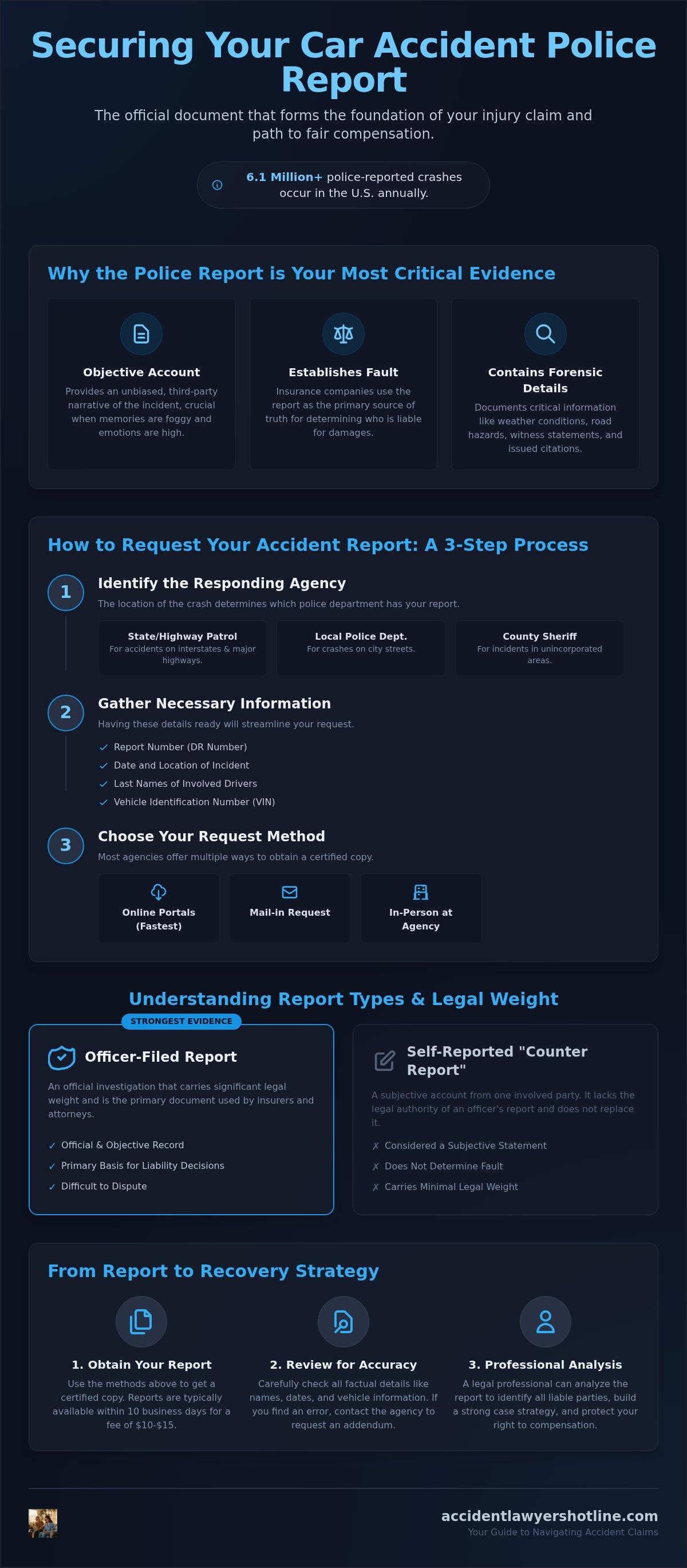
Your car accident claim lives or dies based on a single document you likely don't have yet. With over 6.1 million police-reported crashes occurring annually, the official accident report is the foundation for any successful injury claim. You might feel confused about which agency handled your crash or anxious about the time it takes to receive a copy. Learning how to get a police report for a car accident is the most critical step you can take to move from a state of uncertainty to a position of strength. We understand the stress of this moment. Our goal is to shift the burden of this complex process from your shoulders to a professional framework.
This guide provides a clear, step by step path to securing the evidence you need. We'll walk you through the 2026 digital filing requirements and explain how to obtain a physical or electronic copy of your report. You'll discover how to use these official details to prove fault and protect your right to fair compensation. Whether you're worried about costs or potential errors in the officer's notes, we have the answers you need. Follow this roadmap to gain the clarity and confidence required to move your case forward today.
Key Takeaways
- Discover why the police report is the most influential piece of evidence for establishing fault and liability in your injury claim.
- Follow our step-by-step instructions on how to get a police report for a car accident through online portals, mail-in requests, or local agencies.
- Learn how to identify and correct factual errors in your report to ensure your official record is accurate and reliable.
- Understand the critical difference in legal weight between an officer-led investigation and a driver-submitted counter report.
- Find out how a professional analysis of your accident report can uncover hidden liable parties and strengthen your case evaluation.
Why the Police Report Is the Foundation of Your Accident Claim
The police report is more than just a piece of paper; it's the anchor for your entire recovery. After a crash, your memory might be foggy. Emotions run high. The responding officer provides an objective, third-party account of what actually happened. Insurance companies treat this document as the primary source of truth for determining fault. While you're focusing on healing, adjusters are already scanning this report to decide who is liable for your damages. Knowing how to get a police report for a car accident ensures you have the evidence needed to challenge an unfair denial. Without it, your claim quickly turns into a frustrating battle of words that can stall your progress for months.
Learning how to get a police report for a car accident is vital because this record contains forensic details you might have missed. It documents weather conditions, road hazards, and issued citations. In complex cases, officers may use principles of Traffic collision reconstruction to determine vehicle speeds and impact angles. This scientific approach removes the guesswork from your claim. It also captures witness statements while the events are fresh, providing a layer of evidence that is difficult for the other driver to dispute later.
How the Report Impacts Your Case Evaluation
Attorneys rely on the police narrative to identify all responsible parties immediately. This is especially true in multi-vehicle crashes where liability isn't obvious. A clear report can also speed up the process of getting your medical bills covered by establishing a direct link between the crash and your injuries. When you speak with a car accident attorney, the police report is almost always the first document they will request. It provides the factual foundation needed to build a strategy for your recovery and ensures no critical details are overlooked during the initial review.
The Role of the Driver’s Privacy Protection Act (DPPA)
You might worry about your personal information becoming public. The Driver’s Privacy Protection Act (DPPA) is a federal law that keeps your private data secure. It restricts who can access motor vehicle records, ensuring your address and insurance details aren't available to just anyone. Only authorized parties can request a full report. This typically includes the drivers involved, their legal representatives, and insurance companies. Your privacy is protected throughout this process. You can seek the justice you deserve without fearing that your personal information is being shared with unauthorized third parties.
The 3 Main Ways to Request Your Accident Report Online or by Mail
Securing your documentation shouldn't be a source of stress. The first step in learning how to get a police report for a car accident is identifying which agency responded to the scene. If the crash occurred on an interstate or a major highway, a state level agency likely handled the investigation. Accidents on city streets fall under local police jurisdiction, while those in unincorporated areas are managed by the County Sheriff. Once you know the agency, gather your specific details: the date of the incident, the exact location, and your Report Number, often called a DR Number. If you didn't receive a number at the scene, you'll need the last names of the drivers involved and the Vehicle Identification Number (VIN) for at least one car.
Timing is critical for your recovery. It can take up to ten business days after an accident for the official report to become available in national databases. Once the report is ready, you must pay an administrative fee to obtain a certified copy. These fees typically range between $10 and $15, though some jurisdictions may include additional convenience charges for digital processing. Sharing this report with a professional during a free case evaluation can help you understand your next legal steps and ensure your rights are protected from the start.
Using Online Accident Report Portals
Digital retrieval is the fastest way to move your claim forward. Many agencies now use national databases to manage records and fulfill requests. These platforms allow for immediate downloads, which is essential for rapid evidence gathering. To find your report online, you will generally need a checklist of information: the last name of an involved party, the date of the incident, and either the report number or the VIN. This streamlined process removes the need for physical travel and provides a digital copy you can easily email to your insurance adjuster. Using these portals ensures you have the most critical piece of evidence in hand without unnecessary delays.
Requesting by Mail or In-Person
While digital options are common, some situations still require traditional methods. Mail-in requests are often mandatory for complex cases involving fatalities or criminal arrests. You should be prepared for stricter requirements, such as notarized request forms to verify your identity before the agency releases sensitive motor vehicle records. If you choose to go in person, you may have the opportunity to speak directly with a records clerk. This can be helpful if you need clarification on specific codes or notations within the document. Keep in mind that many regions are phasing out paper requests in favor of mandatory electronic submissions for all accident related legal documents. Always check the specific agency's current rules before sending a payment through the mail.
Officer-Filed Reports vs. Self-Reported "Counter Reports"
Not all accident reports carry the same legal weight. An officer-filed report is an official, third-party investigation conducted by a trained professional. In contrast, a "counter report" is a form submitted by the drivers themselves. Insurance adjusters prioritize the officer's account because it is unbiased and forensic. If you are wondering why an officer didn't respond to your call, it is often due to minor property damage or the crash occurring on private property like a parking lot. During high-volume periods, such as severe weather events, police may only respond to accidents involving injuries. Regardless of the officer's presence, you must understand how to get a police report for a car accident to satisfy your legal and insurance requirements.
Self-reported forms are not "investigated" by the state. They serve as a formal notice of claim rather than a verified record of events. While these reports establish that an accident occurred, they don't provide the same evidentiary strength as an officer's narrative. You still have a legal necessity to file these documents to comply with local "Duty to Report" laws. If you fail to file a report when property damage exceeds specific thresholds, you could face penalties or a denial of your insurance claim. Learning how to get a police report for a car accident ensures you follow the correct protocol even when the police are not physically present.
When an Officer Is Present at the Scene
When an officer investigates the scene, they create a comprehensive record that insurance companies treat as the definitive account. This process typically takes five to ten business days before the report is finalized and uploaded to a digital database. The most valuable part of this document is the "Officer’s Opinion" section. This is where the responding officer identifies the primary cause of the crash and notes any violations of traffic law. If the officer issues a citation to the other driver for speeding or failing to yield, it provides powerful evidence for your recovery strategy. This official narrative removes the "he-said, she-said" element that often stalls injury claims.
Filing a Counter Report When Police Do Not Respond
If law enforcement does not attend the scene, the responsibility for documentation shifts to you. Most jurisdictions require a written report for any crash resulting in injury or property damage exceeding $1,000. To make your self-report as accurate as possible, you must collect detailed field notes at the scene. Take clear photos of vehicle positions, road signs, and any visible damage. Gather contact information from any witnesses who saw the impact. Validating this self-reported data can be a complex task for an individual. A motorcycle accident lawyer can help you review your notes to ensure they align with the physical evidence. They provide the professional analysis needed to turn your personal account into a credible foundation for your case evaluation.
What to Do if Your Police Report Is Inaccurate or Delayed
Discovering an error on your official accident record can feel like a devastating blow to your claim. Typos happen. Common mistakes range from simple misspellings of names to significant factual errors regarding the crash location or insurance details. You must understand the difference between factual errors and judgment calls to address them effectively. Factual errors involve objective data, such as an incorrect date or a misspelled street name. These are generally straightforward to fix. Judgment calls, however, involve the officer's opinion on fault or vehicle speed. These are much harder to change because they represent the officer's professional conclusion at the scene. While you focus on how to get a police report for a car accident, you must also be ready to act if the final document doesn't reflect reality.
How to Request a Correction
If you spot a mistake, your first step is to contact the reporting officer directly. Use the badge number found on your initial paperwork to reach out to their precinct. When you call, remain professional and clear. Present concrete evidence for the correction, such as time-stamped photos of the scene, dashcam footage, or medical records that clarify the extent of your injuries. The officer may not be able to delete the original information, but they can file a Supplemental Report. A Supplemental Report is an addendum that does not erase the original but adds clarifying facts to the permanent record. This ensures that anyone reviewing your file sees the corrected information alongside the initial notes.
Handling Significant Delays in Report Release
Waiting for your documentation can be one of the most frustrating parts of the recovery process. Some large agencies have administrative backlogs that result in a 45-day wait or longer. Delays also occur when there is an ongoing criminal investigation or if the crash involved a fatality. Remember that a delay does not mean your case is weak; it often means the officer is conducting a more thorough investigation. You don't have to put your life on hold while the records clerk processes your request. If you're struggling with mounting costs, connect with an attorney who can use a Letter of Protection to manage your medical providers. This allows you to receive the care you need while the official evidence is finalized. Keeping your claim moving forward ensures that you aren't penalized for administrative bottlenecks beyond your control.
Turning Your Police Report Into a Recovery Strategy
Securing the official record is a major milestone. However, simply knowing how to get a police report for a car accident is only the first phase of your recovery. The report is raw data. To turn it into a successful claim, you need a professional analysis that looks beyond the surface. While the officer notes the immediate cause of the crash, a deeper review can identify hidden liable parties. This might include a trucking company that forced a driver to exceed legal hours or a manufacturer responsible for a defective part. A comprehensive case evaluation ensures that every avenue for compensation is explored, shifting the burden of investigation from you to a seasoned expert.
This is where the "calm in the storm" approach becomes essential. You don't have to navigate the high-stakes world of legal liability alone. By connecting with a no fee unless we win your case attorney, you gain an advocate who understands the nuances of the 2026 legal landscape. They handle the aggressive tactics of insurance adjusters, allowing you to focus entirely on your physical and emotional healing. This partnership restores the balance of power, ensuring that a professional facilitator is fighting for your fairness every step of the way.
Why You Should Not Send the Report to Insurance Immediately
It's tempting to send your report to the insurance company the moment you receive it. You should resist this urge. Insurance adjusters are trained to find ways to twist the narrative against you. They look for any ambiguity in the officer's notes to reduce their payout. Having a legal professional review the document first allows you to identify potential pitfalls before they become permanent obstacles. This preparation is especially vital before you agree to a recorded statement. An expert review helps you understand exactly what the report says and what it implies, protecting you from accidentally admitting fault in a confusing situation.
Get a Professional Case Evaluation Today
The referral process is designed to be seamless and risk-free. There are no upfront costs and no obligations. You shouldn't have to worry about the financial burden of seeking help while you're already dealing with the aftermath of a crash. Having an advocate manage the paperwork and the complex communications provides immediate emotional relief. It replaces your anxiety with a clear, methodical path forward. Don't let the critical details of your accident report go to waste. Start your free national accident case evaluation now and take the first step toward a professional resolution.
Secure Your Evidence and Reclaim Your Peace of Mind
You now have a clear roadmap for how to get a police report for a car accident and why this document is essential for your recovery. Whether you choose a digital download or an in-person request, this record provides the objective proof needed to challenge insurance denials. It removes the "he-said, she-said" roadblocks that often stall injury claims. By identifying errors early and understanding the weight of an officer's narrative, you've taken the most important step in protecting your legal rights. You don't have to carry the weight of this process alone.
Our national network of experienced accident attorneys is ready to provide a free, confidential case evaluation available 24/7. We operate on a contingency basis; there is no fee unless we win your case. Let our experts handle the insurance adjusters while you focus on your physical healing. Start Your Free Car Accident Case Evaluation Today and move forward with the confidence that your future is protected. You've been through enough. It's time to let a professional advocate restore the fairness you deserve.
Frequently Asked Questions
How long does it take for a police report to be ready after a car accident?
Most official reports are available within 5 to 10 business days. This timeline can fluctuate based on the administrative workload of the responding agency or the complexity of the crash investigation. In cases involving severe injuries or ongoing criminal inquiries, the release might be delayed by 45 days or more. If you are learning how to get a police report for a car accident, checking the agency’s digital portal is the most efficient way to track the document's status.
Can I get a police report for a car accident if the police weren’t called?
No, an official police report only exists if an officer investigated the scene. However, you can still file a self-reported "counter report" with the state or local authorities. This is often a legal requirement if property damage exceeds a specific monetary threshold or if any party was injured. While this document is not a forensic investigation, it serves as a formal notification of your claim and establishes a timeline for your insurance provider.
How much does it cost to get a copy of a police report?
Administrative fees for accident reports typically range from $10 to $20 depending on the jurisdiction. While requesting a copy in person at a local precinct may be less expensive, online portals often include convenience fees for immediate digital access. These costs are standard and are used to maintain the security and integrity of motor vehicle records. Always confirm the current fee with the specific agency to ensure your payment is processed correctly and your report is released.
Is a police report required to file an insurance claim?
It is not strictly required to open a claim, but it is essential for proving liability. Without an objective record, your recovery depends on your word against the other driver's account. Insurance adjusters prioritize the officer’s report because it provides a neutral foundation for determining fault. Securing this document early helps you avoid unnecessary delays and protects you from an unfair denial based on missing or contradictory evidence from the scene.
What if the police report says the accident was my fault but it wasn’t?
You can challenge the officer’s findings, but you must have concrete evidence to support your claim. Factual errors regarding the date or location can be corrected through a Supplemental Report. Contesting an officer’s "judgment call" on fault requires more substantial proof, such as dashcam footage or independent witness statements. A professional case evaluation can help you determine if the officer’s conclusion was flawed and if there is a viable path to correcting the record.
Can I get a police report online for free?
Official, certified accident reports are rarely provided for free. Most law enforcement agencies charge a fee to cover the costs of record management and data protection. While some third-party websites may promise free reports, they often provide incomplete data or use your information for marketing purposes. It is safer and more reliable to pay the required administrative fee through an official government portal to ensure you receive an admissible document for your injury claim.
Who is allowed to see my car accident police report?
Access to full accident reports is restricted to protect your privacy under federal law. Only involved drivers, their legal representatives, and insurance companies are typically authorized to view the unredacted document. This ensures that your personal information, including your address and insurance details, remains secure. When you connect with a professional for a case evaluation, they will use their authorized status to review the report and identify all parties who may be liable for your damages.
What is a "Report Number" and where do I find it?
A Report Number is a unique identifier assigned to your crash by the responding agency. You can find this number on the exchange of information slip or the receipt provided by the officer at the scene. If you misplaced this slip, you can retrieve the number by contacting the records department of the local police or sheriff’s office. You will need to provide the date, time, and exact location of the accident to help the clerk locate your file.
Were You Injured in an Accident?
Get a free, confidential case evaluation. No upfront fees.
Get Free Case Evaluation