Law Firms for Car Accident Victims: Expert Selection Guide
Find law firms that specialize in car accident victims with our expert guide. Compare experience, legal fees, and case evaluations to choose the best attorney.
The biggest law firm isn’t automatically the right fit after a crash. What matters is whether its experience matches the details of your accident, injuries, and claim. Finding law firms that specialize in car accident victims can feel difficult when many firms describe themselves as personal injury practices. You may also be unsure what information to share or what fees to expect.
It’s reasonable to want clear answers before discussing a stressful situation. Relevant experience means more than a slogan: it includes familiarity with car accident claims and the ability to assess how your circumstances may shape the next steps. A case evaluation can help clarify that fit. Accident Lawyers Hotline evaluates motor vehicle accident situations and connects potential clients with experienced independent attorneys. The platform facilitates referrals; it doesn’t provide legal representation.
This guide explains what to look for in car accident experience, what typically happens during an evaluation and referral, and what information can help start the conversation. You’ll also learn how partner attorneys’ contingency arrangements work and why the attorney agreement matters for understanding fees and case costs. The goal is to help you take an informed next step without pressure or unrealistic promises.
Key Takeaways
- Judge experience by how well it fits your accident and claim, not by a firm’s slogans, size, or headline recovery totals.
- Use a focused checklist to compare case experience, communication, fee explanations, and who would provide legal representation.
- Organize the crash, contact, insurance, and injury information you have to make a case evaluation more useful.
- A referral platform can connect car accident victims with independent attorneys, but a referral doesn’t promise representation or a particular result.
- Partner attorneys work on a contingency basis. Review the attorney agreement for the specific fee and case-cost terms.
What Does It Mean for a Law Firm to Specialize in Car Accident Victims?
A firm may list car accidents among several practice areas, but that label alone doesn’t show how closely its experience fits your situation. Meaningful specialization combines relevant experience with knowledge of motor vehicle injury claims and the issues those claims can raise. The useful question isn’t how many services a firm advertises. It’s whether the firm’s approach reflects the facts and needs of your case.
A car accident practice focuses on injury claims arising from vehicle collisions, while a general personal injury practice may handle a wider range of harm-related claims. Both fall within the broader field of personal injury law, but a broad practice-area list doesn’t establish case-specific experience.
How car accident legal work differs from general injury representation
Car accident claims often require a close look at how the collision happened, what injuries followed, how insurance applies, and what evidence may help explain the events. Relevant documentation might include a crash report, photographs, medical records, witness details, and communications with insurers. Which information matters, and how a claim proceeds, can vary with the collision, the injuries, and applicable state law.
For example, photographs and a clear account of a rear-end crash may leave different questions from a multi-vehicle collision where accounts of events conflict. A firm with experience in vehicle claims can identify which details need attention rather than treating every injury matter as though it follows the same steps. That doesn’t guarantee a particular outcome. It can help make the process easier to understand by organizing questions, evidence, and possible next steps.
What specialization should mean to an injured person
Look for evidence of a relevant focus, not just polished advertising. Experience should show up in how an attorney or case-evaluation process discusses the collision, your reported injuries, insurance information, and available documents. Clear explanations matter too. You should be able to tell what is known, what remains uncertain, and what information could help assess your circumstances.
- Relevant focus: The discussion addresses motor vehicle claims, not only personal injury in general.
- Case-specific questions: The evaluation considers the collision details and your reported injuries instead of relying on a generic pitch.
- Clear communication: Explanations use plain language and distinguish known facts from open questions.
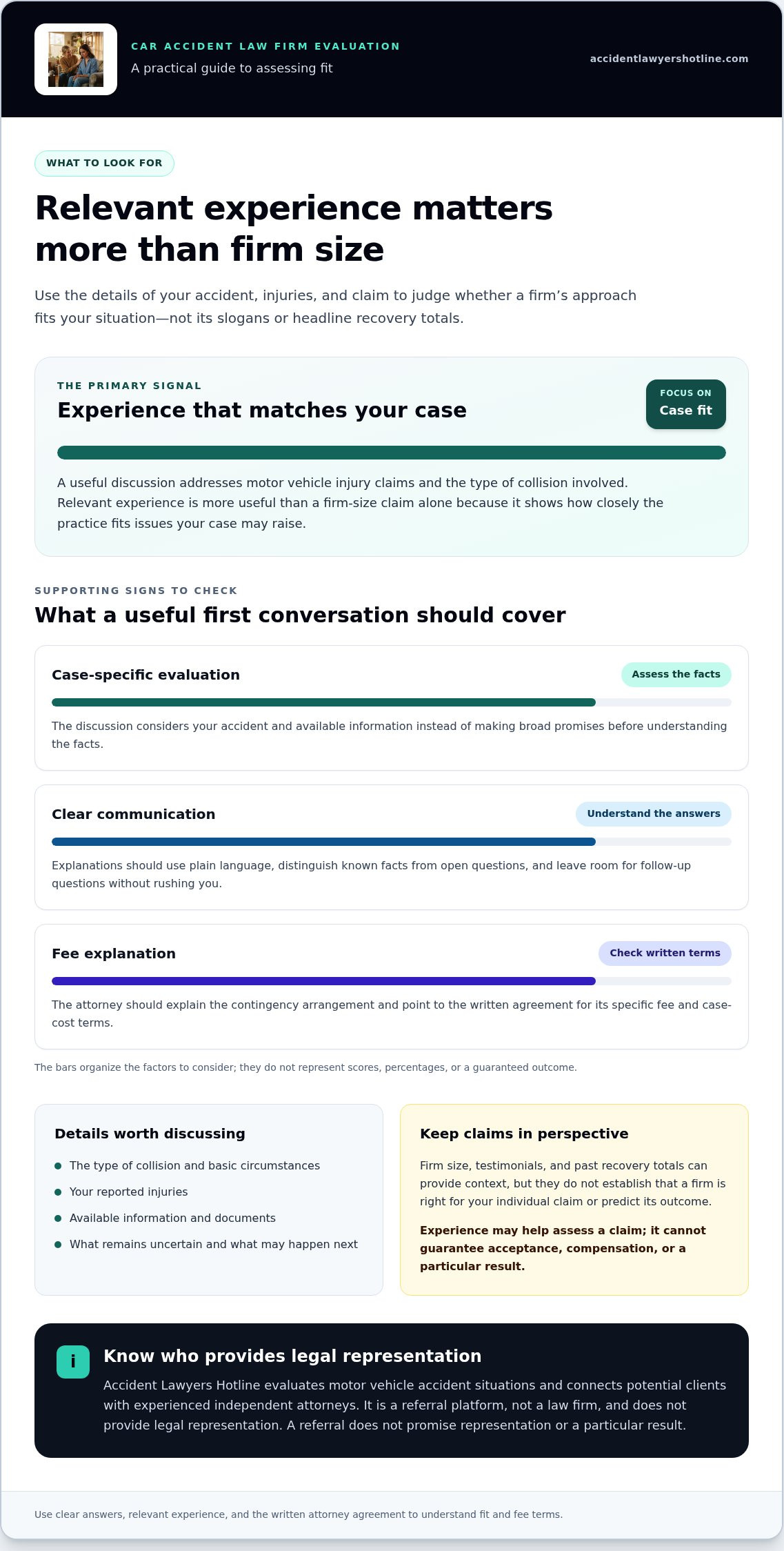
Firm size, testimonials, and past recovery totals can provide context, but they don’t establish that a firm is right for your individual claim or predict its outcome. Focus on whether the experience and explanations relate to your situation. A car accident attorney case evaluation guide can help you understand what a first discussion may cover. Accident Lawyers Hotline evaluates motor vehicle accident situations and connects potential clients with experienced independent attorneys. It is a referral platform, not a law firm, and does not provide legal representation.
Which Signs Show a Firm Understands Car Accident Cases?
A useful first conversation should help you understand whether an attorney’s experience and approach fit your accident, not leave you with a sales pitch. Notice which questions the attorney asks and whether the answers address your circumstances. These signs can help you assess law firms that specialize in car accident victims without treating marketing claims as proof of a particular outcome.
Relevant experience is more useful than a firm-size claim alone because it shows how closely the practice fits the issues your case may raise. Use this checklist to focus the discussion:
- Relevant matters: The attorney can explain experience with motor vehicle injury claims and the type of collision involved.
- Clear communication: Answers are in plain language, and you can ask follow-up questions without being rushed.
- Fee explanation: The attorney explains the contingency arrangement and points to the written agreement for its specific terms.
- Case-specific evaluation: The discussion considers your accident and available information rather than making broad promises before understanding the facts.
Experience, communication, and case fit
A focused discussion should connect the type of accident you experienced with the attorney’s relevant practice. You can describe the vehicles involved, the basic circumstances, and the injuries you know about. Listen for a response that addresses those details and explains what remains uncertain. Experience may help an attorney assess a claim, but it can’t guarantee acceptance, compensation, or any particular result.
You should leave with a better understanding of who would represent you if you choose to proceed, what the next step may involve, and what decisions are yours to make. If an explanation feels vague, ask for it in simpler terms. Clear expectations can help you make an informed choice during an already demanding time.
Credentials, reviews, and results: what they can and cannot show
Credentials can offer context about an attorney’s background, while reviews may describe other clients’ experiences. Neither tells you exactly how your own matter will be handled. Consider details relevant to your needs, but treat promotional claims and testimonials as one part of the picture, not as a prediction.
Reported recoveries also need context. Outcomes can depend on the facts, injuries, available evidence, insurance, and applicable law. A large total or an individual success story doesn’t establish what your claim is worth or whether your circumstances are comparable. Ask how the attorney’s experience relates to your situation, and look for an honest discussion of uncertainties rather than a promised result.
Before agreeing to representation, make sure you understand the written fee terms and who will handle your legal matter. Accident Lawyers Hotline provides a case evaluation and connects potential clients with experienced independent attorneys. It is a referral platform, not a law firm, and it doesn’t directly represent clients. You can request a car accident case evaluation to discuss your situation.
How to Compare Car Accident Law Firms Without Relying on Slogans
Compare the process and the people involved, not just marketing claims. A large firm, a long list of practice areas, or a prominent recovery figure doesn’t tell you who would represent you or whether their experience fits your accident. The same is true of referral support: its role should be clear from the start.
Use this framework to compare direct law-firm representation with a referral platform:
| What to compare | Direct law-firm representation | Referral platform |
|---|---|---|
| Relevant experience | Ask how the firm’s motor vehicle claim experience relates to your accident. | The platform evaluates the situation and connects potential clients with experienced independent attorneys. |
| Communication | Notice whether the firm explains its approach and next steps in plain language. | Look for a clear explanation of the evaluation and referral process, including who provides legal advice. |
| Fee structure | The firm explains its fee arrangement in its written agreement. | Partner attorneys work on a contingency basis, with no attorney fees unless the case is won. Review the attorney agreement for specific terms and conditions. |
| Who represents you | The law firm’s attorneys provide legal representation to their clients. | Accident Lawyers Hotline is a referral platform, not a law firm. It doesn’t represent clients; independent attorneys provide representation if they take on a matter. |
Direct law-firm representation versus referral support
With direct representation, you engage a law firm to handle your legal matter. A referral platform has a different role. Accident Lawyers Hotline evaluates motor vehicle accident situations and connects potential clients with independent attorneys, including car accident lawyers. The platform itself doesn’t provide legal representation. Understanding that distinction makes it clear who evaluates your situation, who may later represent you, and where an attorney-client relationship would be formed.
Understanding contingency-fee language
A contingency-based fee generally means the attorney’s fee depends on the case being won, rather than being charged as an upfront hourly fee. Partner attorneys operate on a no-fees-unless-the-case-is-won basis. That phrase alone doesn’t explain every agreement term. Read the written agreement carefully, including its conditions and how it describes fees or other case-related obligations, before deciding whether to proceed.
As you compare law firms that specialize in car accident victims, use the same questions for each discussion: What experience relates to this type of collision? Who would handle the matter? What does the written fee agreement say? A useful conversation stays grounded in your circumstances rather than promising a result or relying on firm size as proof of fit. A case evaluation can be a practical starting point for understanding whether a connection with an independent attorney may suit your situation.
What to Prepare for a Car Accident Case Evaluation
You don’t need a complete file to start a useful conversation. A few organized notes can help explain what happened, what you know about your injuries, and what information may still be missing. If you’re still looking for documents, share what you have and be clear about what you’re unsure of.
Information that can help explain the situation
Gather what’s readily available, but don’t worry about making it perfect. A simple folder or notes page can keep the essentials together:
- Crash basics: Note the date, general location, type of collision, and a brief account of what happened.
- People and vehicles: List the other involved parties and any contact details you have. Include vehicle or insurer details if they’re available.
- Insurance information: Record known policy or claim details and any communications with an insurer.
- Injury information: Note the injuries you’ve experienced, care you’ve received, and any records you already have.
- Supporting material: Keep relevant photos, correspondence, and available records together so you can refer to them during the discussion.
Separate what you know from what you’re trying to remember. For example, mark a date as approximate if you can’t recall it exactly. Don’t guess to fill gaps. A straightforward account helps the person evaluating your situation distinguish confirmed details from those that may need clarification.
If you’re looking for immediate post-crash steps rather than evaluation preparation, this step-by-step guide to what to do after a car accident covers actions to consider after a collision.
Questions to clarify during the legal connection process
Preparing questions can make it easier to understand what happens after an evaluation. This is useful if you’re comparing law firms that specialize in car accident victims or considering a referral. Ask who would provide legal representation, how you would communicate with that attorney, and what the next step would be if a connection is made.
Before signing an attorney agreement, ask for a plain-language explanation of the contingency-fee terms and any conditions described in the document. Partner attorneys work on a no-fees-unless-the-case-is-won basis, but the written agreement explains the specific terms that apply. Take time to understand it before deciding whether to proceed.
You can also ask what information would be useful to provide next. Accident Lawyers Hotline evaluates motor vehicle accident situations and connects potential clients with independent attorneys when appropriate. It’s a referral platform, not a law firm, and doesn’t provide legal representation. For broader practical resources, explore car accident victim assistance options. When you’re ready to share the information you have, start a car accident case evaluation.
How Accident Lawyers Hotline Connects Car Accident Victims With Legal Help
Accident Lawyers Hotline is a referral platform, not a law firm. It evaluates motor vehicle accident situations and connects potential clients with experienced independent attorneys when appropriate. The platform doesn’t provide legal representation, and a referral doesn’t guarantee that an attorney will accept a case or that it will have a particular outcome.
The process is straightforward:
- Share accident information. Describe the collision and your situation using the details you have available.
- Receive a case evaluation. The information helps assess the situation and the type of legal help that may be relevant.
- Connect with an independent attorney when appropriate. If a connection is made, that attorney can discuss potential representation and next steps with you.
Request a car accident case evaluation to begin.
What the evaluation and referral process is designed to do
An evaluation is an initial way to explain what happened and consider your potential legal needs. It can help identify whether a connection with an independent attorney may be appropriate based on the information shared. The platform facilitates that connection; it doesn’t provide legal advice or represent you. Whether an attorney accepts a matter and what happens next depend on the circumstances and the attorney’s assessment.
This distinction matters if you’re searching for law firms that specialize in car accident victims. A referral platform is not itself one of those firms. If an independent attorney agrees to represent you, that attorney provides legal assistance under a separate attorney-client relationship. Partner attorneys work on a contingency basis, meaning no attorney fees unless the case is won. Review the attorney’s written agreement for the specific terms and conditions before signing.
A clear next step after a car accident
You can share the information you’re comfortable providing, even if you’re still sorting through details. Explain what you know and identify anything you’re uncertain about. The evaluation is a starting point for understanding possible legal needs, not a promise of representation, compensation, or a successful result.
If you choose to proceed with an attorney connection, the independent attorney can explain their role and discuss the agreement that would govern representation. Take the time you need to understand those terms and decide whether to move forward. An evaluation is not a commitment to legal representation.
Accident Lawyers Hotline helps clarify the first step by evaluating car accident situations and facilitating connections with independent attorneys. Request a car accident case evaluation to share your accident information.
Take the Next Step at Your Own Pace
Choosing legal support doesn’t have to mean deciding everything at once. Start by getting a clearer view of your options, then take time to consider what feels right for your circumstances. A useful next step gives you better information without added pressure.
If you’re considering law firms that specialize in car accident victims, an initial evaluation can help you discuss your situation and explore a possible connection with an independent attorney. Share the details you have and ask questions before making decisions about representation.
Request a car accident case evaluation when you’re ready.
Frequently Asked Questions
How long do I have to file a car accident lawsuit?
The filing deadline depends on the jurisdiction and details of your claim, so there isn’t one universal time limit. Different rules may apply based on factors such as the parties involved or the type of claim. Because waiting can affect your options, seek prompt guidance from an attorney who can assess the relevant facts and deadlines. Don’t rely on a general online estimate to determine your filing date.
Can I seek legal help if I may have been partly responsible for the crash?
Yes, you can ask for legal guidance even if you think you may have contributed to the crash. Fault rules vary by jurisdiction, and the facts may be more complex than they first appear. An attorney would need to review the available evidence and circumstances before assessing how responsibility could affect a claim. Law firms that specialize in car accident victims can evaluate the specific situation, but no outcome can be assumed in advance.
Will my car accident case have to go to court?
Not necessarily. Some disputes resolve through discussions or other processes without a trial, while others may proceed further if key issues remain unresolved. The path can depend on matters such as disputed responsibility, the available evidence, and the parties’ positions. No one can guarantee at the outset whether a case will settle or go to court. An attorney can explain possible paths as the facts develop.
Can I speak with an attorney before my medical treatment is complete?
Yes, you can seek legal guidance while treatment is ongoing. You don’t need to wait until you’ve finished care to ask how the claim process may relate to your situation. Continue following appropriate medical advice, and keep records of appointments, symptoms, and treatment as they become available. An attorney can discuss what is known so far and explain what additional information may be useful later.
Can a passenger seek legal help after a car accident?
Yes, a passenger may seek guidance about possible claims after a crash. Relevant questions can include how the collision happened, who may have been responsible, what injuries occurred, and what insurance coverage may apply. The answers depend on the facts and applicable law, so a passenger’s situation needs individual review. Keep relevant contact details, photos, and medical records, and describe clearly what you know and what remains uncertain.
What if the other driver was uninsured?
You may still have questions about possible ways to address your losses, but available options depend on the coverage involved, policy terms, and applicable state law. For example, your own policy may contain provisions that are relevant, but an attorney would need to review the actual documents and circumstances. Gather insurance information for the vehicles involved and any policy papers you have. Don’t assume coverage applies until the details are assessed.
What should I do if I am unsure whether my injuries are related to the crash?
Seek appropriate medical care and describe your symptoms honestly, including when they began and how they change. Keep notes about symptoms and retain available records, such as visit summaries or treatment instructions. Don’t try to diagnose the cause yourself. Whether an injury is connected to a collision can involve medical evidence and other facts, while legal questions depend on applicable law. An attorney can review those issues without replacing medical advice.
Were You Injured in an Accident?
Get a free, confidential case evaluation. No upfront fees.
Get Free Case Evaluation