MedPay Coverage for Car Accidents: What It Pays and How It Works
Understand how MedPay coverage for car accidents works, what medical bills it pays, how it compares to PIP, and how to file your claim after a crash today.
What if medical bills arrive before anyone decides who caused the crash? MedPay coverage for car accidents may help pay eligible medical expenses sooner, regardless of fault, but the policy’s terms and applicable state rules determine how it works. That can matter when deductibles, copays, or treatment bills are due while an insurance claim is still under review.
It’s understandable to wonder who the coverage protects, which expenses qualify, and whether you might have to repay benefits later. MedPay generally focuses on accident-related medical costs. PIP may cover a broader range of expenses, health insurance follows its own terms, and liability coverage depends on fault and available coverage.
This article explains what MedPay may pay for, how it compares with other insurance, and which policy documents and medical bills to gather after a crash. If questions about fault or your legal options remain, Accident Lawyers Hotline provides case evaluations and can connect you with an independent attorney for legal assistance.
Key Takeaways
- MedPay coverage for car accidents may help pay eligible medical bills, subject to your policy and applicable state rules.
- Check the policy wording to see which accident-related expenses and people may qualify.
- MedPay differs from PIP, health insurance, and liability coverage in what it may cover and how benefits are determined.
- Gather policy details, bills, receipts, and provider records to help organize a claim.
- A case evaluation may help you discuss legal questions when injuries, bills, coverage, or responsibility are unclear.
What Is MedPay Coverage for Car Accidents?
MedPay, short for medical payments coverage, is an auto insurance benefit that may pay certain accident-related medical expenses for covered people, regardless of who caused the crash. It is subject to the policy and applicable state rules, so it is not a promise that every bill will be paid. The policy’s terms and available limit determine the scope of coverage.
MedPay is first-party medical coverage, meaning it may help pay eligible expenses for people covered by the policy. Liability coverage works differently: it may pay for injuries or damage the insured driver is legally responsible for causing to someone else. A MedPay claim and a liability claim can follow separate rules, so one does not automatically settle or replace the other.
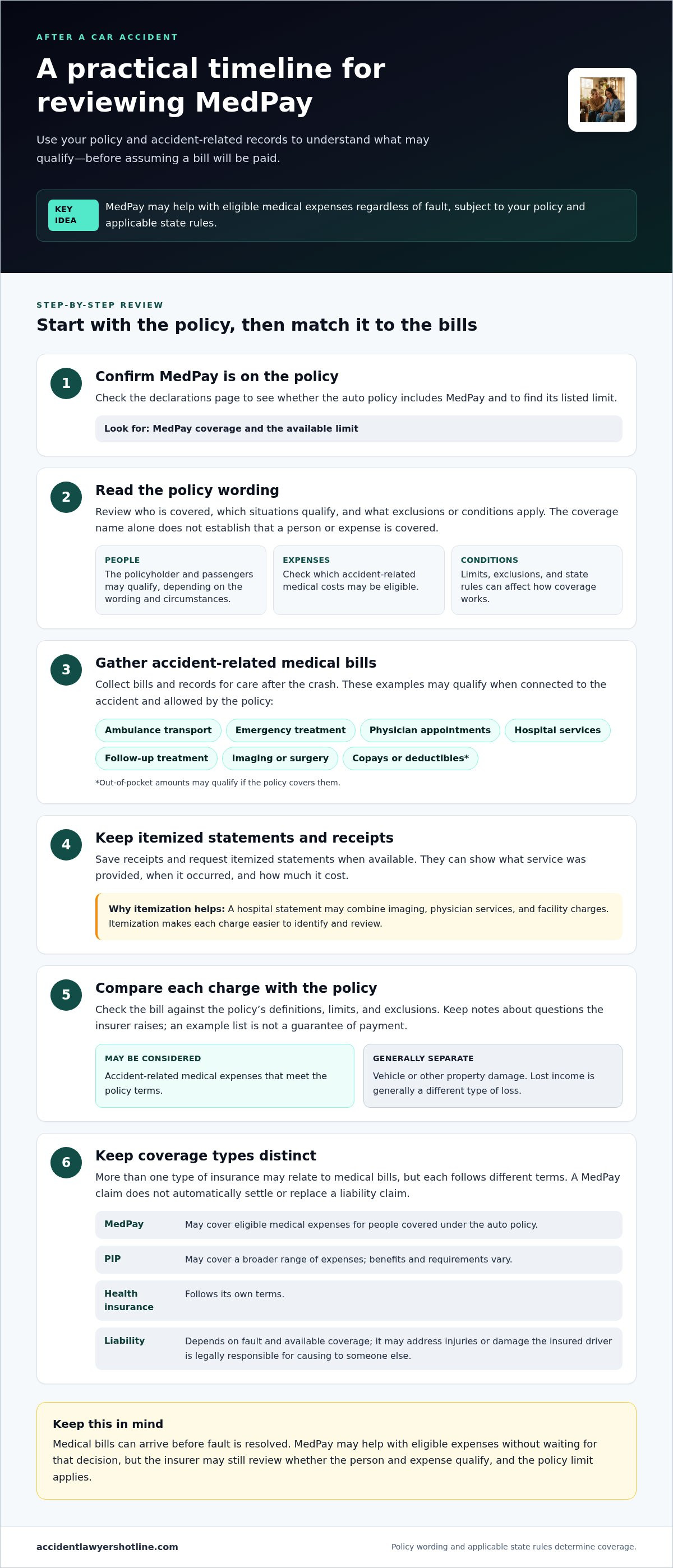
Check both the declarations page and the policy wording. The declarations page can show whether the policy includes MedPay and list its limit. The policy explains who is covered, which situations qualify, and what exclusions or conditions apply. Availability and terms differ by state and policy, so don’t rely on the coverage name alone.
Who may be covered by MedPay after a crash?
The policyholder may qualify for benefits, and passengers may also be covered, depending on the policy language and the circumstances of the crash. Some policies define additional covered people or situations. For example, if an insured driver and a passenger are injured in a collision, the policy may cover eligible medical expenses for both. The policy’s definitions and applicable rules determine who qualifies.
Why MedPay can matter before fault is resolved
Medical bills may arrive before insurers finish deciding who was responsible. MedPay may help with eligible expenses without waiting for that decision, subject to the policy and state rules. The insurer may still review whether the person and expense qualify, and the policy limit applies.
This timing can be useful, but it does not decide who ultimately bears responsibility for the crash. A MedPay payment does not establish that another driver was at fault or determine what a liability claim may cover. If more than one policy or type of coverage may apply, the rules for coordinating payments depend on the policy and state law. Keep policy documents and billing records together to track which coverage is being considered.
What Medical Expenses Can MedPay Cover?
MedPay may cover certain medical expenses connected to a car accident, but examples are not guarantees. Your policy and applicable state rules determine which people, services, and charges qualify. Check the definitions, limits, and exclusions before assuming a bill will be paid. Eligible out-of-pocket costs, such as copays or deductibles, may also qualify if the policy covers them.
Common accident-related bills to review
Gather bills for care after the crash, including ambulance transport, emergency-room visits, physician appointments, hospital services, and follow-up treatment. Diagnostic imaging, surgery, and other medically necessary care may also qualify, depending on the policy. Both the connection to the accident and the policy terms can matter.
Keep receipts and request itemized statements when available. They show what service was provided, when it occurred, and how much it cost. For example, a hospital statement may combine imaging, physician services, and facility charges. Itemization makes each charge easier to identify and review.
- Transport and emergency care: Ambulance charges and emergency treatment may be eligible.
- Medical visits and hospital services: Physician appointments, hospital care, and related services may qualify under the policy.
- Ongoing treatment: Follow-up care, imaging, or surgery may be considered when connected to the crash and allowed by the policy.
- Out-of-pocket amounts: Copays and deductibles may qualify if the policy covers them.
Use the policy wording, not a general list, to assess a particular charge. Compare each bill with the policy and keep notes about questions the insurer raises. Coordination rules can differ, too. The linked MedPay vs. PIP comparison explains distinctions in a state-specific context, so it should not be treated as a universal rule.
What MedPay may not pay
MedPay addresses eligible medical expenses, not repairs to your car or damage to other property. Those costs involve separate property-damage coverage. Lost income is generally a different type of loss, although policy terms and state rules can vary. Review the policy wording before treating an expense as covered or excluded.
If accident-related bills raise questions about fault or other coverage, a case evaluation may help you discuss the legal issues. Accident Lawyers Hotline connects people with independent attorneys for legal assistance. Learn more or request a car accident case evaluation.
MedPay vs. PIP, Health Insurance, and Liability Coverage
Several types of coverage may relate to medical bills after a crash, but they work differently. MedPay coverage for car accidents is first-party medical coverage that may address eligible expenses for people covered under the auto policy. PIP, health insurance, and another driver’s liability coverage each have different requirements and limits.
| Coverage | Purpose and whose expenses may be addressed | Key limitations |
|---|---|---|
| MedPay | May help pay eligible medical expenses for covered people under the insured auto policy. | Availability, covered people, limits, and qualifying expenses depend on policy wording and state rules. |
| PIP | Auto coverage that may address medical expenses and, in some places, other losses for covered people. | Benefits and requirements vary by state and policy; don’t assume its scope matches MedPay. |
| Health insurance | May cover medical care under the injured person’s health plan. | Plan terms, network rules, deductibles, copays, and other cost-sharing may apply. |
| Bodily injury liability | May address injuries to others when the insured driver is responsible. | Responsibility, policy limits, and claim requirements affect whether and how it applies. |
How MedPay differs from PIP and health insurance
MedPay and Personal Injury Protection are separate auto coverages. Their availability and benefits depend on the state and policy. PIP may include benefits beyond medical expenses in some places, but that is not a universal rule. Health insurance follows its own plan terms, which may include deductibles, copays, or network conditions. Don’t assume one type of coverage always pays first. Coordination depends on the policies and applicable law.
For example, after a collision, an injured person may need to consider both auto coverage and a health plan. The policies may have different claim procedures or rules for how payments interact. Keep explanations of benefits and insurer communications with your medical bills. Also review any potential reimbursement obligations: whether an insurer may seek repayment from another recovery depends on the policy and state rules.
How MedPay differs from bodily injury liability
MedPay may address eligible medical expenses for people covered under the policy without the same fault determination required for a liability claim. Bodily injury liability, by contrast, may address another person’s injuries when the insured driver is responsible. The claims can raise different questions, follow separate processes, and be reviewed on different timelines.
This distinction matters if you’re seeking payment from more than one source. A MedPay payment does not establish who caused the crash or resolve a claim against another driver. Liability may involve responsibility, evidence, and available coverage, while MedPay review focuses on the applicable policy and eligible expenses. Before agreeing to repayment or assuming two coverages can pay the same bill, review the policy language and relevant state rules. If coverage or responsibility remains unclear, a case evaluation can connect you with an independent attorney to discuss the legal questions.
How to Use MedPay After a Car Accident
Keeping your policy, bills, and insurer communications organized can make it easier to understand what is being reviewed. MedPay coverage for car accidents is governed by the specific policy and applicable rules, so use these steps to prepare without assuming every expense will qualify.
- Review your declarations page. Check whether the auto policy includes MedPay, note the listed limit, and record the policy number. Read the policy wording for claim instructions and details about covered people or expenses.
- Notify the insurer. Follow the contact or claim process in your policy. Provide the accident date and basic information requested, then note the claim reference number and the date you reported the crash.
- Ask how to submit the claim. Find out which forms and supporting documents are needed, how to send them, and how the insurer will explain its review. Ask how the remaining limit and other insurance may affect the claim.
Documents to gather before contacting the insurer
Collect your policy information and any claim reference already provided. Organize itemized medical bills, receipts for payments you’ve made, and explanations of benefits from other insurance. Keep relevant provider records and accident-related correspondence together. Save copies of everything you submit, along with the submission date and method, so you can track the claim.
Questions to ask about a MedPay claim
Ask which people and expenses the policy may cover, what limit remains, and whether the insurer needs specific forms or records. If another insurer or health plan is involved, ask how payments are coordinated and whether reimbursement may be sought. Request clear instructions for following up on missing documents or a bill that needs further review.
Keep a simple communication log. For each call or message, record the date, who you spoke with, the claim reference, what the insurer requested, and any next steps. When you send records, list what you included and keep a copy. This gives you a timeline and helps identify requests that still need a response.
There isn’t one filing deadline that applies to every MedPay claim. Check your policy and the rules that apply to your situation, and ask the insurer to explain any deadline it identifies. If questions about medical bills connect to a wider dispute about injuries or responsibility, a case evaluation may help you discuss legal options. Request a car accident case evaluation through Accident Lawyers Hotline to connect with an independent attorney.
When to Seek Help With MedPay and a Car Accident
MedPay questions often concern what the policy says, which expenses may qualify, and what records the insurer needs. A legal case evaluation addresses a different concern: discussing possible legal options when injuries, bills, coverage communications, or responsibility for the crash leave you unsure what to do next.
Consider an evaluation if the other driver disputes responsibility, your injuries are serious, several insurance policies may apply, or the insurers’ responses are difficult to understand. These issues can overlap, but a case evaluation does not decide whether a particular MedPay expense qualifies or guarantee that you have a claim. The policy and applicable rules govern insurance benefits.
Situations where a case evaluation may help
An independent attorney can review the facts you share and discuss potential legal options. An evaluation may be useful when the crash circumstances are contested, injuries require ongoing care, or communications about coverage seem inconsistent. Organize your accident records, bills, and insurer correspondence before the evaluation so you can clearly explain your questions. The discussion cannot predict a specific result.
What happens when you request an evaluation
Accident Lawyers Hotline is a referral platform that connects accident victims with independent motor vehicle and personal injury attorneys. The platform is not a law firm and does not itself provide legal representation. If you move forward with an attorney, that attorney handles the representation. Participating attorneys work on a contingency basis, meaning there are no fees unless the case is won. No outcome or recovery is guaranteed.
A case evaluation is optional and separate from contacting your insurer, filing a MedPay claim, or following the insurer’s procedures. Keep those processes moving according to your policy and applicable rules. An attorney’s discussion of possible legal options does not replace the insurer’s coverage review or determine which medical expenses qualify.
If you’re uncertain how MedPay coverage for car accidents relates to your injuries or a possible claim against another driver, a case evaluation can connect you with an independent attorney to discuss your circumstances.
Take the Next Step With Clearer Direction
After a crash, you don’t have to resolve every insurance and legal question at once. Start with what feels most urgent: understanding a bill, clarifying a coverage response, or deciding whether to discuss the collision with an attorney. MedPay coverage for car accidents depends on policy terms and applicable rules, while a case evaluation can help put unanswered legal questions in context.
Accident Lawyers Hotline connects accident victims with independent attorneys who handle legal representation on a contingency basis, with no fees unless the case is won. An evaluation can help you discuss your situation, but it cannot guarantee a claim or a particular result.
If you’d like to explore your legal options, request a car accident case evaluation.
Frequently Asked Questions
Does MedPay cover medical bills if I caused the car accident?
Possibly. MedPay coverage for car accidents may apply even if you caused the crash, provided the policy covers you and the expense. The insurer still reviews the policy limit, exclusions, documentation, and state rules, so payment is not automatic. Check the declarations page and relevant policy wording, then contact the insurer with the bill or treatment details. Ask what forms or records it needs for that expense.
Can MedPay cover passengers injured in my car?
Possibly, if the policy’s definition of a covered person includes them. Some policies extend benefits to passengers, but the wording and circumstances matter. Tell the insurer who was in the car and which passengers received treatment. Ask whether each person’s expenses are considered under a shared limit or another policy term.
Does MedPay cover funeral expenses after a fatal car accident?
Some MedPay policies may include eligible funeral expenses after a fatal crash, but this benefit is not included in every policy. Check the policy’s benefit language and exclusions, and ask the insurer what documentation is required and which expenses may qualify. If more than one policy could apply, keep records of communications and submitted documents. The insurer can explain how its terms apply to the claim.
Can MedPay pay for medical bills if I was hit as a pedestrian?
Possibly, but pedestrian coverage depends on the policy’s definition of covered people and the circumstances of the collision. Don’t assume a vehicle policy covers every pedestrian struck by that vehicle. If you were hit while walking, preserve treatment records and review your own auto policy as well as any policy connected to the vehicle. Ask the relevant insurer how its wording applies to your situation.
Does MedPay cover lost wages after a car accident?
Generally, MedPay is intended for eligible medical-related expenses, not income lost while recovering. A missed shift or reduced paycheck is different from a medical bill, although policy language can vary. Review your policy’s benefits and exclusions, then ask the insurer whether a specific lost-income benefit applies. Keep work absence and wage records if you need to discuss income losses through another coverage or claim.
Can I use MedPay and still pursue a claim against the other driver?
Possibly. Using MedPay does not by itself determine whether you can pursue a claim against another driver. That may depend on responsibility, documented losses, available policies, and state law. Keep bills and insurer letters, and ask how reimbursement or coordination obligations could affect a later recovery. If fault is disputed or your injuries have lasting effects, an attorney can review the circumstances and discuss potential legal options without guaranteeing a result.
Were You Injured in an Accident?
Get a free, confidential case evaluation. No upfront fees.
Get Free Case Evaluation