Reckless Driving Accident Lawsuit: Claims, Evidence, and Legal Options
Injured by a dangerous driver? Learn how a reckless driving accident lawsuit works, what evidence you need to prove fault, and your legal recovery options.
Can a reckless driver face a civil lawsuit while criminal charges are pending, or even if charges are never filed? A reckless driving accident lawsuit is separate from a criminal case, so the outcome of one does not automatically decide the other. If you were injured, you may be able to pursue compensation by showing that the driver’s conduct caused the crash and your losses.
It can be difficult to know what reckless driving means for your rights. Criminal proceedings address possible penalties imposed by the state. A civil injury claim seeks compensation and follows a different standard of proof. The rules depend on where the crash happened, so state law and the specific facts matter.
This guide explains what may support a civil claim, including police reports, witness accounts, video, and records of injuries and expenses. It also compares insurance claims with lawsuits and explains practical ways to preserve evidence. Accident Lawyers Hotline provides motor vehicle accident case evaluations and connects people with independent attorneys for potential legal assistance.
Key Takeaways
- A reckless driving accident lawsuit generally depends on showing that the driver’s conduct caused the crash and your injury-related losses.
- Reckless driving has different legal definitions and consequences depending on the state where the crash happened.
- Medical records, income information, and details about how injuries affect daily life can help document losses.
- Evidence, injury severity, available insurance coverage, and state law can all shape how a potential claim is evaluated.
- A case evaluation can help you organize crash details and discuss potential legal options with an independent attorney.
What Is a Reckless Driving Accident Lawsuit, and Who May Have a Claim?
A reckless driving accident lawsuit is a civil claim seeking compensation for injuries or other losses caused by a driver’s dangerous conduct. It gives an injured person a way to seek financial recovery, but it is not the same as a criminal case. Government authorities may pursue criminal penalties, while a civil claim focuses on harm suffered by the person bringing it.
“Reckless” does not have one definition that applies everywhere. State laws use different standards and may treat particular driving behaviors differently. Some legal explanations distinguish recklessness from ordinary carelessness by considering whether a person consciously disregarded a substantial risk. The Legal Definition of Recklessness offers broader context, but the law in the state where the crash occurred controls.
An accusation or traffic citation can be relevant, but it does not by itself prove that a driver caused a particular person’s injuries. A civil claim must connect the conduct to the crash and show resulting harm. A driver may be accused of dangerous behavior, but evidence is still needed to establish what happened and how it affected the claimant.
What driving behaviors may be considered reckless?
Depending on the circumstances and applicable law, examples may include extreme speeding, street racing, driving while impaired, or deliberate maneuvers that create danger for others. The surrounding facts matter. Speed alone, for example, may not show the full picture. Road conditions, traffic, visibility, and the driver’s actions before impact can help explain the risk and how the collision occurred.
A citation may document an officer’s observations or an alleged violation, but it does not automatically settle civil responsibility. The injured person’s claim still depends on evidence about the driver’s actions, the crash, and the resulting harm. An insurer or court may consider multiple facts, not just the label attached to a driving offense.
Who may be able to bring a civil claim?
Potential claimants include an injured driver, passenger, pedestrian, or another person harmed in the crash. The key questions are whether the person suffered a legally recognized injury or loss, whether the driver’s conduct caused it, and whether the applicable law allows that person to pursue a claim. Simply being present at the collision does not answer those questions.
After a fatal crash, surviving family members may have separate rights under state law. The rules can specify who may bring a claim and what losses may be considered. Eligibility depends on the relationship, evidence, causation, and state law, so a general description cannot determine the outcome of an individual case. A review of the crash facts can help identify which legal options may be relevant.
What Must You Prove in a Reckless Driving Accident Lawsuit?
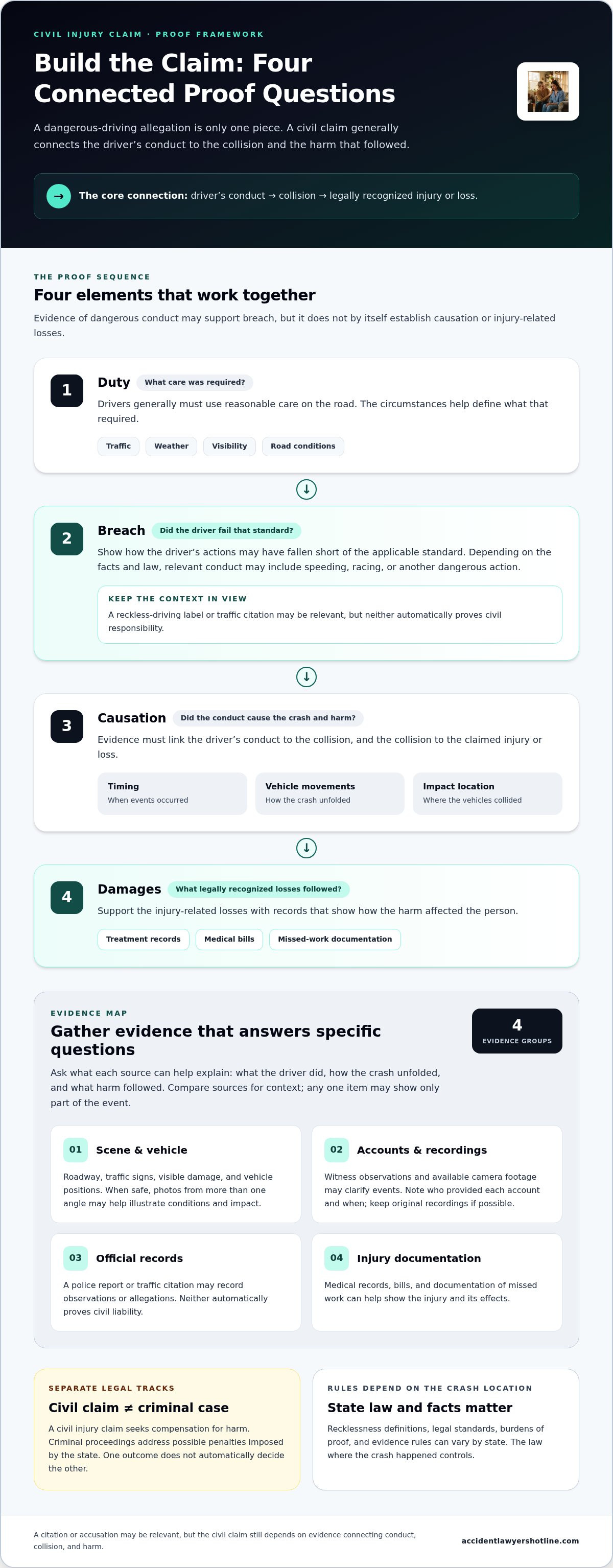
Showing that a driver behaved dangerously is only part of a civil claim. A claimant generally must connect the driver’s conduct to the collision and to a legally recognized injury or loss. Look beyond a reckless-driving label and ask what the evidence establishes at each step. A reckless driving accident lawsuit may involve familiar negligence principles, but legal standards, the burden of proof, and rules for using evidence can vary by state.
How do the four elements fit a reckless-driving claim?
Courts generally assess four elements: duty, breach, causation, and damages. They work together. Evidence of dangerous conduct may help show a breach, for instance, but it does not alone establish that the conduct caused the crash or a particular injury.
- Duty: Drivers generally must use reasonable care on the road. Traffic, weather, visibility, and road conditions can help define what reasonable care required in the circumstances.
- Breach: A claimant must show that the driver failed to meet the applicable standard. Evidence of speeding, racing, or another dangerous action may be relevant. The National Highway Traffic Safety Administration discusses speeding risks in its Dangers of Speeding and Reckless Driving resource.
- Causation: Evidence must link the conduct to the collision and the collision to the claimed harm. Timing, vehicle movements, impact location, and medical records may help establish those connections.
- Damages: The claimant must support legally recognized losses. Treatment records, bills, and documentation of missed work can help show how the injury affected them.
What evidence can help establish what happened?
Evidence is most useful when it answers specific questions: What did the driver do? How did the crash unfold? What harm followed? Preserve available records without assuming any single item proves liability. Compare sources for context, since each may capture only part of the event.
- Scene and vehicle evidence: Photos of the roadway, traffic signs, visible damage, and vehicle positions may help illustrate conditions and impact. Take pictures from more than one angle when it is safe to do so.
- Accounts and recordings: Witness observations and available camera footage can help clarify events. Note who provided each account and when, and keep original recordings if possible.
- Official records: A police report or traffic citation may provide useful observations or allegations. Neither automatically proves civil liability.
- Injury documentation: Medical records can describe treatment and symptoms. Keep appointment details, bills, and records of how symptoms affect daily activities.
- Electronic or vehicle data: Some data may shed light on speed or vehicle activity. It can require proper preservation and qualified interpretation, so avoid altering or discarding potentially relevant materials.
Keep copies of records and note where each item came from. Accident Lawyers Hotline evaluates motor vehicle accident inquiries and connects people with independent attorneys for potential legal assistance. You can share available details through a motor vehicle accident case evaluation.
How Does a Civil Lawsuit Differ From Criminal Charges or an Insurance Claim?
The same crash can lead to different processes, each with a different purpose. Criminal proceedings address alleged lawbreaking. A civil claim seeks recovery for an injured person’s losses. An insurance claim asks an insurer to assess whether coverage applies and payment is owed under the policy. These paths may overlap, but none should be treated as a substitute for the others.
| Process | Who is involved | Purpose and possible outcome |
|---|---|---|
| Criminal case | Government authorities bring the case against the accused driver. | Seeks penalties for an alleged offense, such as a fine, jail time, or a driving-related consequence. The criminal burden of proof is generally beyond a reasonable doubt. |
| Civil lawsuit | An injured person brings a claim against the person or parties alleged to be responsible. | Seeks compensation for legally recognized harm. The claimant generally must prove the case by a preponderance of the evidence, a lower standard than in a criminal case. |
| Insurance claim | A claimant seeks payment from an insurer under applicable coverage. | The insurer reviews the claim under policy terms and applicable law. It may resolve the claim through payment, dispute it, or deny coverage. |
This comparison is general. Procedures, proof rules, and the relationship between proceedings can vary by state. A civil case does not result in criminal penalties, and an insurance decision is not the same as a court judgment.
Does a criminal charge decide the civil lawsuit?
No charge or verdict should be assumed to decide a civil claim automatically. Prosecutors handle criminal cases on behalf of the government, while an injured person brings a civil claim and must establish the required elements under civil law. A criminal charge is an allegation, not proof that the driver caused a specific injury. A conviction may be relevant, but its effect in a civil case depends on applicable law and the circumstances.
An injured person may explore a civil claim without assuming that the driver will be charged or convicted. The civil case still needs evidence connecting the conduct to the collision and resulting harm. If both cases proceed, their timing and how information from one may be used in the other depend on state-specific rules.
Where does an insurance claim fit?
An insurance claim may offer a way to seek payment without first resolving a lawsuit in court. The insurer reviews the reported facts, available evidence, policy language, and applicable coverage. A disputed claim may lead to further negotiation or a lawsuit, but filing an insurance claim does not guarantee payment or determine fault for every legal purpose.
Available coverage, policy terms, and state rules can affect potential recovery. A court, by contrast, resolves disputes presented in a lawsuit under applicable legal standards. A case evaluation can help you discuss a reckless driving accident lawsuit and possible insurance options. Accident Lawyers Hotline evaluates motor vehicle accident inquiries and connects people with independent attorneys for potential legal assistance.
What Damages and Case Factors Matter After a Reckless-Driving Crash?
A claim evaluation looks at more than the driver’s alleged conduct. It considers what harm the crash caused, how well that harm is documented, and whether the evidence connects it to the collision. No checklist can determine a case’s value on its own. The losses a person may seek to recover, and the rules that apply, depend on the facts and state law.
Which losses may be considered in a civil claim?
Commonly discussed losses include medical expenses, income loss, and the ways an injury affects everyday life. These categories help organize what changed after the crash, but they do not establish a particular recovery amount. Keep records showing each loss and how it relates to the injury.
- Medical expenses and care needs: Bills, treatment records, prescriptions, and follow-up recommendations can document care received and ongoing needs. Keep copies and note appointments or treatment plans, including care that may continue.
- Income and work effects: Pay records or employer documentation may help show missed work and income loss. If an injury affects a person’s ability to perform their usual job or earn income in the future, that issue may require additional evidence and analysis.
- Pain and daily-life limits: Some claims include non-economic harm, such as pain, difficulty with routine activities, or disruption to family and social life. A brief, consistent record of symptoms and limitations can explain the impact beyond medical bills.
What can affect the value or viability of a claim?
Evidence must connect the crash to the injury and the injury to the losses claimed. Medical records can document treatment, while work records may help show missed time. Gaps or conflicting accounts can raise questions that require further review. Injury severity and recovery progress also matter, but neither guarantees a particular outcome.
Responsibility may be disputed. State rules can affect how shared fault is considered, and insurance policies differ in their terms and available coverage. Those details can shape the practical options for seeking recovery. Punitive damages are governed by state-specific law and should not be assumed to apply. Whether they can be considered requires a review of the jurisdiction and facts.
If an independent attorney handles a claim on a contingency basis, the attorney-client agreement controls the arrangement. Learn more about contingency-fee arrangements before discussing how fees may work.
A case evaluation can help organize your losses, available records, and questions about coverage. Request a motor vehicle accident case evaluation to discuss the crash facts and potential legal options. Accident Lawyers Hotline connects people with independent attorneys for potential legal assistance.
How Can a Case Evaluation Help You Consider a Reckless Driving Lawsuit?
After a crash, it can be hard to know which facts matter or what to do next. A case evaluation gives you a chance to discuss what happened, your injuries, the records you have, and questions about possible legal options.
What information can help an initial case evaluation?
You do not need to have every detail sorted out before discussing the crash. A clear summary can make the conversation more useful. If you are able, gather or note:
- Basic crash details: The date, the state where the collision happened, and your best account of how events unfolded.
- Available records: Police or incident reports, photographs, video, witness names or contact details, and insurance information.
- Injury information: The injuries you have experienced, treatment received, and any records or bills you already have.
- Questions you want answered: Note concerns about fault, insurance coverage, evidence, and possible filing deadlines. Deadlines vary by state, so identify the state where the crash occurred.
If you are missing a report or do not know exactly what happened, say so. Be direct about what you remember and what remains uncertain. Avoid guessing. A careful account separates known facts from unanswered questions.
What happens after an evaluation?
The evaluation gives you a way to discuss the inquiry and potential next steps. Accident Lawyers Hotline may connect you with an independent attorney for potential legal assistance. The attorney reviews the matter and decides whether to offer representation. A referral does not guarantee that an attorney will accept the case or that a claim will succeed.
If an attorney offers representation, ask about the proposed arrangement and review the written attorney-client agreement. Attorneys connected through the platform operate on a contingency basis, meaning there are no fees unless the case is won. The specific terms in the agreement control.
Taking this step can help you move from uncertainty toward a clearer understanding of your options. You can request a car accident case evaluation to discuss the crash circumstances and potential legal questions related to a reckless driving accident lawsuit.
Take a Clear Next Step Toward Your Options
You do not need to have every answer before exploring whether a reckless driving accident lawsuit may be right for you. Start with the questions that matter most: What do you need to clarify about your injuries, the crash, insurance, or possible deadlines? Knowing what remains uncertain can make the next conversation more focused and help you decide what to do at your own pace.
Accident Lawyers Hotline is a national case-evaluation and attorney-referral platform. It connects accident victims with independent attorneys for potential legal assistance. Attorneys connected through the platform operate on a contingency basis, meaning there are no fees unless the case is won. The attorney-client agreement sets the specific terms, and a case evaluation or referral does not guarantee that an attorney will accept a matter or that it will succeed.
If you are ready to discuss your circumstances and possible next steps, request a car accident case evaluation.
Frequently Asked Questions
Can I file a reckless driving accident lawsuit if the driver was not convicted?
Yes, you may be able to explore a civil claim even if the driver was not convicted. A criminal case and an injury claim follow separate processes, and a conviction is not automatically required to pursue a civil claim. You still need evidence supporting the elements of your claim, including how the driver’s actions relate to your injuries. State rules and the specific facts matter. A case evaluation can help you discuss the evidence and potential legal options with an independent attorney.
Does a reckless driving ticket prove the other driver caused my injuries?
No. A ticket may be relevant, but it does not automatically establish civil liability or prove that the cited conduct caused your injury. The circumstances around the citation may differ from what caused the collision. A claim also requires evidence about fault, the connection between the crash and your injury, and the harm you experienced. How a ticket may be considered depends on applicable law and the full facts.
Can I bring a claim if I was partly at fault for the crash?
Possibly. Some states allow an injured person to seek recovery even when they share fault, while others apply different rules or restrictions. There is no single nationwide threshold that determines every case. Fault allocation may affect whether a claim can proceed and what recovery may be available. Each driver’s actions and the evidence about the collision matter, so a state-specific review can help clarify your options.
Can a passenger sue a reckless driver after a car accident?
An injured passenger may have a potential claim against a driver responsible for the collision, depending on the facts, applicable law, and available coverage. More than one driver may have contributed to a crash, so responsibility is not always limited to the vehicle the passenger rode in. A passenger’s relationship to a driver does not settle liability by itself. A case evaluation can help identify relevant questions about the collision and injuries.
Can a family bring a lawsuit after a fatal reckless-driving accident?
Certain surviving family members or representatives may be able to bring a wrongful-death or related claim after a fatal crash. State law determines who may file, what losses may be considered, and which deadlines apply. No single relative is eligible in every situation. A case evaluation can help the family organize relevant information, such as crash records and relationship details, and identify questions to discuss with an independent attorney.
How long do I have to file a reckless driving accident lawsuit?
Filing deadlines vary by state and may depend on the type of claim and the parties involved. There is no one deadline that applies nationwide. Missing the applicable deadline may affect your ability to bring a claim, so do not assume you have a particular amount of time. Identify the state where the crash occurred and seek prompt, state-specific legal guidance to understand which deadline may apply to your circumstances.
Can I sue if the reckless driver has no insurance?
The other driver’s lack of insurance does not by itself determine whether a civil claim is possible or whether compensation can be recovered. Potential options may depend on insurance policies that apply to the crash, state law, and the driver’s resources. Coverage terms can be complex, and payment is not guaranteed. An independent attorney can review the available policies and crash facts to explain what routes, if any, may be available.
Were You Injured in an Accident?
Get a free, confidential case evaluation. No upfront fees.
Get Free Case Evaluation