Should I Accept the First Settlement Offer After a Car Accident?
Should I accept the first settlement offer after an accident? Discover why initial insurer payouts are low and how to protect your right to full recovery now.
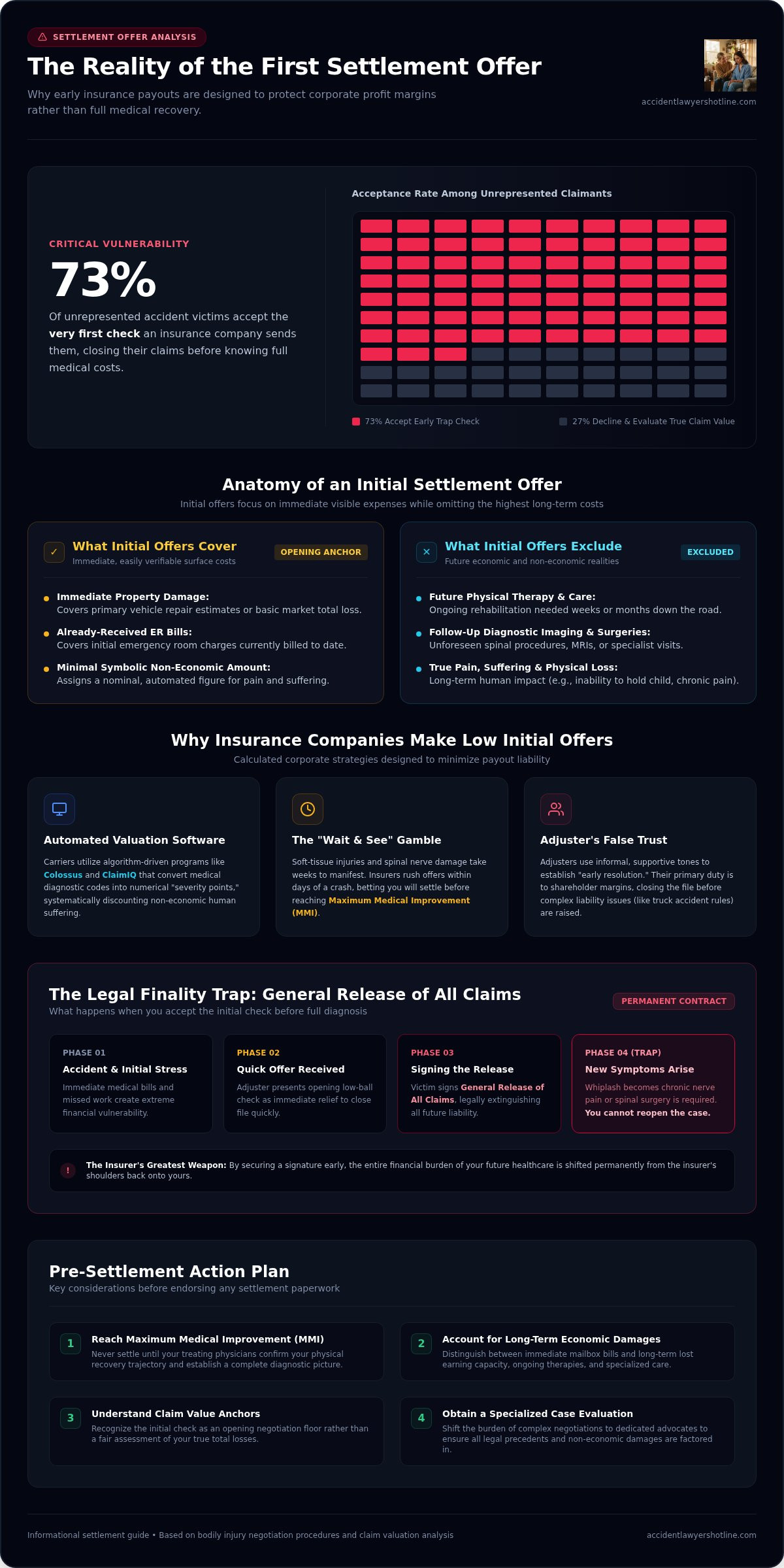
Did you know that 73% of unrepresented accident victims accept the very first check an insurance company sends them? When you're facing mounting medical bills and lost income, you might wonder, should I accept the first settlement offer just to find some relief? It's a common question, especially when aggressive adjusters are pressuring you to sign away your rights immediately. While you want the stress to end, this quick payout is often a calculated trap designed to protect the insurer's bottom line rather than your recovery.
This guide reveals why that initial number is almost always a floor rather than a ceiling. You'll discover how to protect your right to maximum compensation and ensure every future medical bill is covered. We will walk you through common insurance tactics and show you how a specialized case evaluation helps you avoid leaving money on the table. You deserve a fair resolution that accounts for your pain and suffering, not just the immediate costs. By understanding the true value of your claim, you can shift the burden from your shoulders to a capable expert who will fight for the restoration of fairness.
Key Takeaways
- Identify why insurance companies use automated software to generate low-ball offers that often ignore your specific physical and emotional suffering.
- Learn why you should never sign a release until you reach maximum medical improvement and have a complete diagnostic picture of your injuries.
- Discover how to distinguish between immediate bills and long-term economic damages to ensure you don't leave money on the table.
- Understand when it's time to ask, "should I accept the first settlement offer," and why a professional case evaluation provides the clarity you need.
- Find out how specialized advocates handle the heavy lifting of insurance negotiations so you can focus entirely on your physical recovery.
The Reality of the First Settlement Offer: Why It Is Tempting but Risky
The first settlement offer is an opening move in a high-stakes negotiation. It is the insurance company's initial attempt to resolve your claim as quickly and cheaply as possible. When you're facing mounting medical bills and a loss of income, the question of should I accept the first settlement offer carries immense weight. You need financial relief immediately to keep your household running. However, this "quick cash" is often a calculated trap. Insurers know that victims in financial distress are more likely to accept a lower amount just to find a sense of security.
Financial vulnerability creates a leverage point that adjusters are trained to exploit. They understand that a check for a few thousand dollars looks like a lifeline when you're missing work. But this initial figure is almost always lower than the actual value of your claim because it represents an opening anchor, not a fair assessment of your total losses. It is designed to save the insurance company money before you fully understand the scope of your recovery needs.
Once you sign the settlement paperwork, you're usually signing a "General Release of All Claims." This is a legally binding contract that permanently ends your right to seek further compensation. If you discover a week later that you need a spinal procedure or that your whiplash has turned into chronic nerve pain, you cannot go back for more. This finality is the insurer's greatest weapon. By securing your signature early, they shift the entire financial burden of your future care from their shoulders back onto yours. The case is closed forever, regardless of how your health changes.
What an Initial Settlement Offer Actually Covers
Early offers typically focus on the most obvious, immediate costs. They might cover your vehicle's property damage and the emergency room bills you've already received. They intentionally exclude costs that haven't hit your mailbox yet, such as future physical therapy, follow-up diagnostic imaging, or specialized care. Furthermore, insurers often use automated software to minimize "pain and suffering" damages. They treat your unique trauma as a mere data point, assigning a symbolic, low value to your emotional and physical distress.
The Insurance Adjuster's True Objective
An insurance adjuster's primary loyalty is to their employer's bottom line, not your recovery. Their goal of "early resolution" is a strategy to prevent you from seeking a professional case evaluation. They may use a friendly, supportive tone to build false trust, making you feel like they're on your side. In reality, they're working to settle before you realize the complexities of truck accident liability or other legal factors that could significantly increase your compensation. By keeping the conversation informal and fast-moving, they hope to close the file before you understand what you've truly lost.
Why Insurance Companies Make Low Initial Offers
Insurance companies are profit-driven corporations. Their primary responsibility is to their shareholders, not to the victims of accidents. Every dollar they save during a settlement negotiation is a dollar that stays in their profit margins. This financial incentive is the driving force behind the low initial checks they send. When you ask yourself, should I accept the first settlement offer, you must recognize that the number you're seeing is likely the result of a calculated business decision to minimize loss.
Most major carriers use sophisticated, algorithm-driven software like Colossus or ClaimIQ to value bodily injury claims. These programs convert medical diagnostic codes into numerical "severity points." They often ignore the human element of your recovery, such as how a back injury prevents you from picking up your child. By relying on actuarial data and historical averages, these systems systematically discount non-economic damages. They're betting that you don't know the true market value of your claim or the standard legal precedents that could increase your payout.
Insurers also employ a "wait and see" tactic. They know that many soft-tissue injuries or spinal complications don't fully manifest for weeks or even months. By offering a quick settlement within days of the crash, they're gambling that you'll sign before the true extent of your physical damage becomes clear. It's a test of your legal knowledge. If you accept the first offer, you've essentially told the insurer that you're willing to settle for the bare minimum without a fight.
The Problem of Maximum Medical Improvement (MMI)
Reaching Maximum Medical Improvement, or MMI, is the most important milestone in your recovery. This is the point where your doctors determine that your condition has stabilized and no further significant improvement is expected. Settling before you reach MMI is a massive financial risk. If you sign a release early, you're responsible for any future surgeries, chronic pain management, or complications that arise later. A professional car accident case evaluation can help you determine if you're settling too soon.
Common Tactics Used to Devalue Your Claim
Adjusters use several reliable methods to lower the value of your case during the initial stages:
- Pre-existing Conditions: They'll search your medical history to claim your current pain is actually a "flare-up" of an old injury.
- Comparative Fault: They may try to shift a percentage of the blame onto you to legally justify a reduced payout.
- Recorded Statements: Adjusters often ask "friendly" questions early on. They'll use your casual answers to contradict your medical records later.
Calculating the True Value of Your Claim Beyond Immediate Bills
Valuation is the foundation of any successful personal injury claim. When you're asking yourself, should I accept the first settlement offer, you're essentially asking if that number reflects the total impact the crash has had on your life. Most initial offers from insurance companies only account for "special damages." These are the objective, easily calculable costs like the emergency room bill or the repair estimate for your car. While these are important, they represent only a fraction of what you've actually lost.
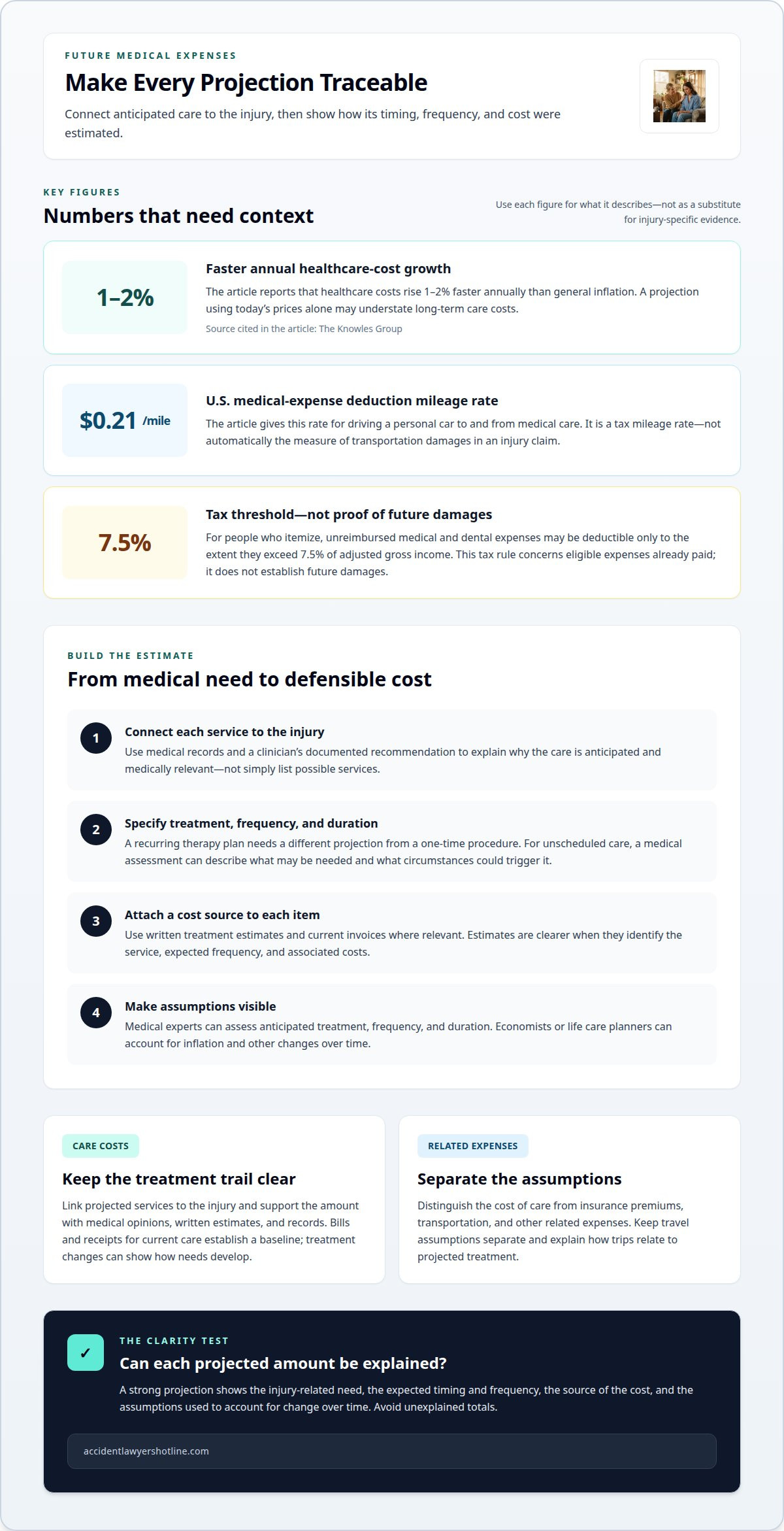
To reach a fair figure, you must look at both economic and non-economic damages. Economic damages include your past and future medical expenses, lost wages, and out-of-pocket costs for things like transportation to appointments. Non-economic damages are more complex. These cover pain and suffering, emotional distress, and the loss of enjoyment of life. Because these don't come with a receipt, insurance adjusters often try to ignore them entirely in the first round of negotiations.
Attorneys typically use one of two methods to value your suffering. The "multiplier method" takes your total economic damages and multiplies them by a number between 1.5 and 5, depending on the severity of your injuries. The "per diem" method assigns a specific daily dollar amount for every day you live with pain until you reach maximum medical improvement. Proving these figures often requires expert testimony. Medical professionals can explain the long-term nature of your disability, while vocational experts can testify about how your injuries will limit your ability to earn a living in the future.
Hidden Costs You Might Be Overlooking
Many victims settle too early because they don't realize how expensive a permanent injury can be. If you can't return to your previous career, you've lost more than just a few weeks of pay; you've lost your future earning capacity. You may also need home modifications, such as ramps or widened doorways, to maintain your independence. Don't ignore the psychological impact either. PTSD, anxiety, and sleep disturbances are real injuries that require professional treatment and deserve compensation.
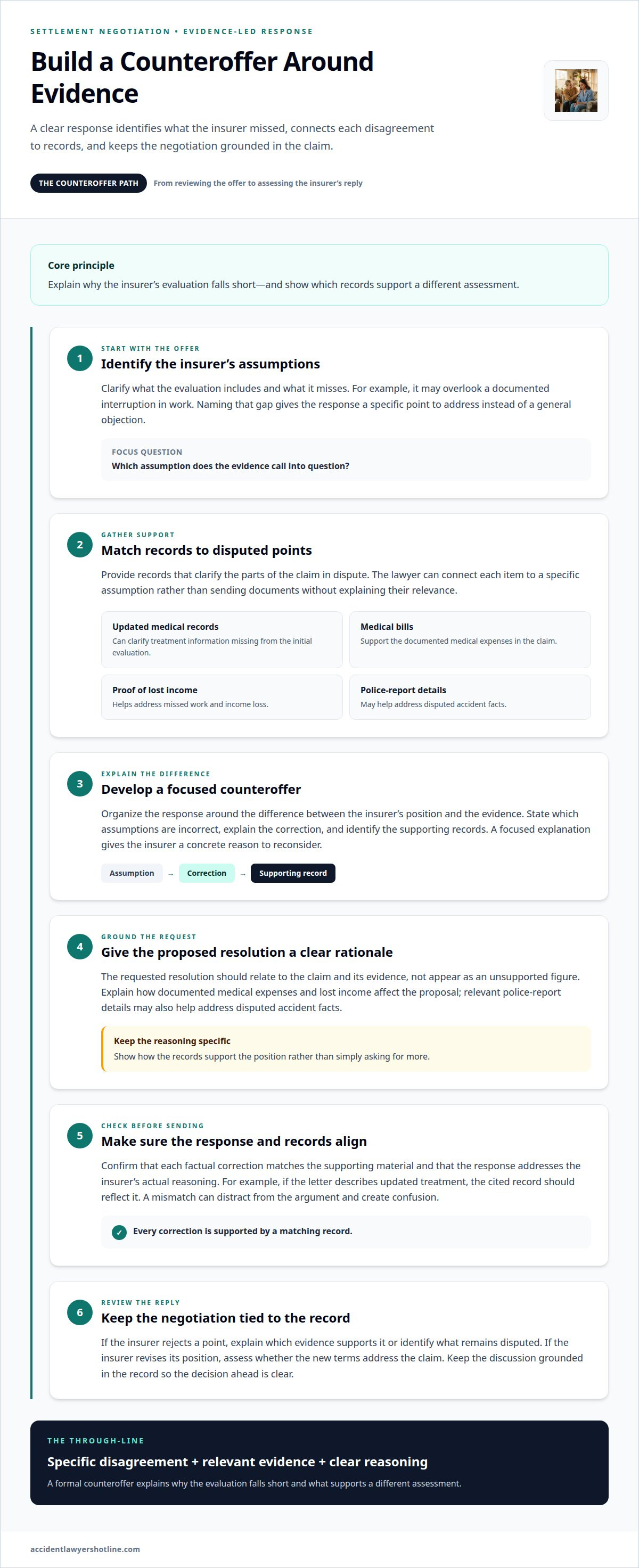
The Role of Evidence in Increasing Offer Value
Evidence is the only tool that forces an insurer to increase their offer. Comprehensive medical records and high-resolution diagnostic imaging, like MRIs or CT scans, provide undeniable proof of your physical trauma. Witness statements and detailed police reports are equally vital because they counteract the insurer's attempts to shift fault onto you. This is why a car accident case evaluation is so critical. It allows experts to identify the specific evidence needed to prove the full scope of your damages before you sign away your rights.
What to Do Before You Sign Any Settlement Agreement
Before you pick up a pen, take a breath. The insurance company wants you to move quickly. They know that speed favors their profit margins. If you are asking yourself, should I accept the first settlement offer, you need to complete a specific checklist first. This process protects you from signing away your future for a fraction of what you deserve. Taking these steps ensures you are operating from a position of strength rather than financial desperation.
- Complete all medical diagnostics. Never sign until your doctors have performed every necessary MRI, CT scan, or specialist referral. You cannot value an injury that hasn't been fully diagnosed yet. Settling while you are still in the dark about your long-term health is a recipe for financial disaster.
- Request a written breakdown. Ask the adjuster exactly how they calculated the offer. Demand to see the specific amounts allocated for medical bills, property damage, and non-economic losses. If they cannot explain how they valued your pain and suffering, they are likely using an automated low-ball figure.
- Keep a daily pain journal. Record your physical limitations and emotional distress every day. Note the activities you can no longer perform, like driving or playing with your children. This creates a powerful, personal timeline of your recovery that is hard for insurers to dispute.
- Get a professional second opinion. Before you agree to anything, get a free car accident case evaluation to ensure no damages were missed.
The Danger of the Recorded Statement
Adjusters often call within hours of a crash to ask for a recorded statement. They may sound empathetic, but their goal is to lock you into a version of events before you have legal advice. You are not legally required to provide this statement immediately. In fact, doing so is dangerous. A simple, polite phrase like "I'm doing okay today" can be used to deny your claim later if your pain worsens. It's best to direct all adjuster communication to a legal representative who knows how to handle these high-stakes conversations and protect your right to fair compensation.
Understanding the 'Finality' of the Release
The "Release of Liability" is a final, binding contract. Once you sign it, your legal right to sue or seek more money ends instantly. It is a permanent door that locks behind you. If you discover a herniated disc three months later that requires surgery, the insurance company will not reopen your claim. You will be responsible for the cost of surgery and rehabilitation yourself. Under almost no circumstances can a closed claim be reopened once that release is executed. This is why thoroughness is your best defense against financial ruin. You must be certain that the offer covers every possible future complication before you finalize the agreement.
How a Professional Case Evaluation Protects Your Future
Deciding whether to sign a settlement release is one of the most significant financial decisions you'll ever make. If you're still weighing the question, should I accept the first settlement offer, you don't have to make that choice alone. A professional case evaluation serves as an essential second opinion. It provides a clear, objective look at the true value of your claim before you sign away your rights. When dealing with high-stakes injuries, a single mistake in calculation can lead to a lifetime of financial struggle. You deserve to know if the insurer's offer is fair or if they're simply trying to minimize their own liability.
A national referral service bridges the gap between your moment of crisis and a professional resolution. They connect you with specialized advocates who understand the nuances of your specific crash. For instance, determining truck accident liability involves complex federal regulations that differ significantly from a standard car crash. Whether you were involved in a motorcycle, bus, or pedestrian accident, you need an expert who speaks the specific language of that industry. These specialists know how to uncover hidden insurance policies and identify multiple at-fault parties that an individual might overlook.
Many victims hesitate to seek help because they fear the cost of legal expertise. However, the attorneys in our network operate on a no fee unless we win arrangement. This contingency fee structure removes all financial barriers to entry. It ensures that professional legal advocacy is accessible to everyone, regardless of their current bank balance. You don't pay anything upfront. The attorney only receives a percentage if they successfully secure a settlement or verdict for you. This aligns your interests perfectly; your advocate is motivated to secure the maximum possible compensation.
The Peace of Mind of Professional Advocacy
Professional representation shifts the heavy burden of negotiation from your shoulders to an expert facilitator. While you focus on your physical recovery, your advocate handles the aggressive insurance adjusters and the mountain of paperwork. They ensure that all critical deadlines, including the statute of limitations, are met with precision. This protective shield allows you to heal without the constant pressure of legal threats or confusing deadlines. You can rest easy knowing a seasoned professional is fighting for the restoration of fairness in your life.
Next Steps: Starting Your Free Evaluation
Starting the process is streamlined and risk-free. When you request an evaluation, you'll be matched with a qualified attorney who fits your specific needs. To make the most of this consultation, have your police report, medical records, and insurance communication ready. This information allows the expert to provide an accurate assessment of your claim's potential. Don't let an insurer dictate the terms of your recovery. Get your free car accident case evaluation today.
Secure the Full Compensation You Deserve
The path to recovery is often paved with difficult questions, and the most urgent one is often, should I accept the first settlement offer? You now understand that this initial figure is rarely the full value of your claim. It's a strategic starting point for the insurance company, not a fair reflection of your future needs. By waiting for a complete medical diagnosis and calculating both economic and non-economic damages, you protect yourself from the finality of a low-ball release.
You don't have to carry this burden alone. Our national network of experienced attorneys provides specialized evaluations for all motor vehicle accident types, including truck, motorcycle, and bus collisions. With no upfront costs and a commitment to fairness, we act as the bridge between your current crisis and a professional resolution. Don't leave your future to chance or an insurer's algorithm.
Start Your Free Case Evaluation Now and take the first step toward the compensation you truly need. You've been through enough; let a professional advocate fight for the restoration of balance in your life.
Frequently Asked Questions
Is the first settlement offer usually the best?
The first settlement offer is rarely the best. It acts as an opening bid designed to minimize the insurer's liability. If you're asking should I accept the first settlement offer, remember that these initial figures often ignore long-term medical needs. Accepting it quickly means you might leave significant compensation on the table. Treat this offer as a floor rather than a ceiling. A professional case evaluation helps you understand the true market value of your claim.
Can I negotiate a settlement offer myself without a lawyer?
You can legally negotiate with an insurance company on your own, but doing so often puts you at a disadvantage. Insurance adjusters are professional negotiators who use complex software to devalue claims. Without specialized legal knowledge, you may struggle to prove non-economic damages or future care costs. Statistics show that represented victims typically secure significantly higher settlements. A referral service can connect you with an expert who handles these high-stakes conversations for you.
What happens if I reject the first offer from the insurance company?
Rejecting the first offer does not end your claim; it simply moves the process into a negotiation phase. When you decline, you typically provide a counter-offer backed by evidence like medical records and diagnostic imaging. The insurance company will then review your documentation and either accept your number or provide a revised offer. This back-and-forth continues until a fair agreement is reached or you decide to take further legal action to protect your rights.
How long do I have to decide whether to accept a settlement?
You generally have until the statute of limitations expires to settle your claim. This deadline varies by state but is often two to four years. Don't feel pressured to decide within days of the crash. It's vital to wait until you reach maximum medical improvement. Rushing into an agreement before your injuries are fully diagnosed is a major risk. A professional advocate can help you track these critical deadlines while you focus on healing.
Does accepting a settlement mean I can't go to court later?
Yes, accepting a settlement almost always requires you to sign a release of liability that permanently ends your right to seek further compensation. Once you execute this contract, the case is legally closed forever. You cannot go to court later if your condition worsens or if you discover hidden medical complications. This is why it's so important to ask, should I accept the first settlement offer, before you sign. Finality is the insurer's primary goal in early negotiations.
Why is the insurance company offering me money so quickly after my accident?
Insurance companies offer quick payouts to close files before the full extent of your injuries becomes apparent. They know that many victims face immediate financial pressure from lost wages and medical bills. By providing a check within days, they hope to secure a signed release before you consult with a professional. This tactic protects their profit margins by preventing you from discovering the true, long-term value of your personal injury claim.
What should I say to an insurance adjuster who keeps calling me?
You should remain polite but avoid discussing the details of your injuries or the accident itself. Tell the adjuster that you aren't ready to settle until your medical treatment is complete. You aren't required to provide a recorded statement or sign medical authorizations immediately. The most effective way to stop the pressure is to state that you're seeking a professional case evaluation. Once you have representation, all calls will be directed to your attorney instead.
How much does it cost to have a lawyer evaluate my settlement offer?
It costs nothing upfront to have your case evaluated through our national referral network. The attorneys we connect you with work on a contingency basis, meaning there are no fees unless they win your case. This no fee unless we win structure ensures you can get a professional second opinion without any financial risk. You'll receive specialized guidance on whether the insurer's offer is fair, shifting the burden of the process to an expert facilitator.
Were You Injured in an Accident?
Get a free, confidential case evaluation. No upfront fees.
Get Free Case Evaluation