Soft Tissue Injury Settlement Amounts: What Your Claim Is Worth in 2026
Discover typical soft tissue injury settlement amounts in 2026. Learn how insurers value claims, avoid lowball offers, and maximize your injury compensation.
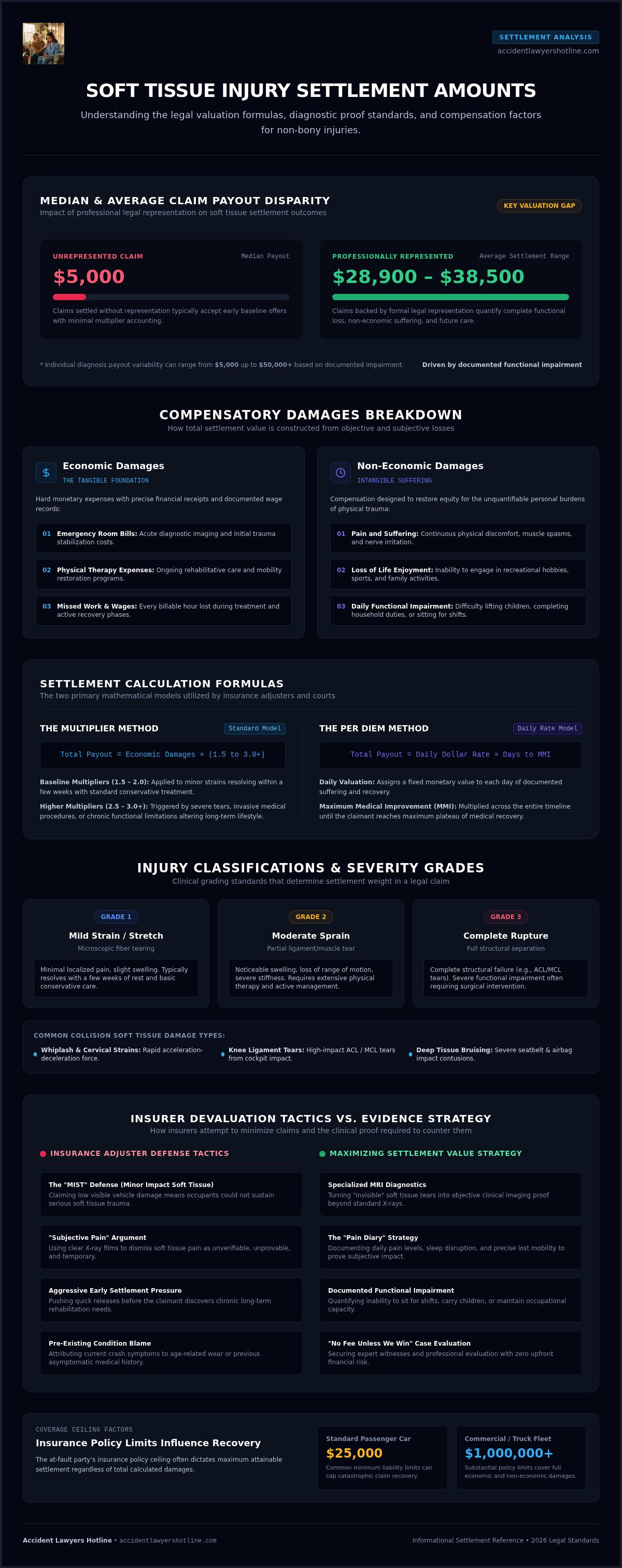
Did you know that the median payout for an unrepresented soft tissue claim is roughly $5,000, while claims backed by professional representation often average between $28,900 and $38,500? It's a staggering difference that highlights how easily insurance companies can devalue your pain. Understanding soft tissue injury settlement amounts is the first step toward reclaiming what you've lost. You aren't just dealing with a minor strain. You're dealing with a disruption to your daily life and your ability to work.
It's frustrating when an insurance adjuster calls your injury temporary while you struggle to finish a shift or pick up your child. You know the pain is real even if the X-ray is clear. We'll show you exactly how to turn invisible pain into objective evidence and what your claim is truly worth in 2026. This guide breaks down the multipliers insurers use, the specific evidence needed to maximize your payout, and how to get a professional evaluation without paying a cent upfront. We'll help you understand the path from a lowball offer to a fair resolution that restores balance to your life.
Key Takeaways
- Learn why "invisible" injuries like whiplash are harder to value and how to prevent insurance adjusters from dismissing your pain as minor.
- Understand how economic and non-economic damages combine to determine soft tissue injury settlement amounts in 2026.
- Discover realistic settlement ranges for minor versus moderate injuries and the treatment milestones that trigger higher payouts.
- Master the "Pain Diary" strategy and specialized diagnostic tools like MRIs to provide objective proof for subjective suffering.
- Find out why a professional case evaluation is the most effective way to identify a lowball insurance offer without any upfront costs.
Understanding Soft Tissue Injuries and Settlement Variability
Soft tissue injuries involve damage to the muscles, tendons, ligaments, and nerves. These are often called "invisible" injuries because they don't appear on a standard X-ray. Unlike a broken arm or a fractured leg, you can't point to a clear break on a film to prove your pain. Legally, soft tissue injuries represent significant compensable damage even in the absence of a broken bone. This lack of visible evidence is exactly why these claims are so difficult to value. You know your body isn't the same, but you're forced to prove it to an insurance company that would rather ignore your struggle.
Why do soft tissue injury settlement amounts vary so wildly? You might hear about one person receiving $5,000 for whiplash while another receives $50,000 for a similar diagnosis. This isn't a matter of luck. The "average" settlement is a myth because every body reacts differently to trauma. One person might recover with a few weeks of rest, while another develops chronic pain that prevents them from working or sleeping. Settlement value is driven by documented functional impairment, not just the clinical name of the injury. If you can't lift your child or sit at a desk for eight hours, that loss of function must be quantified.
Common Types of Soft Tissue Damage in 2026
In motor vehicle accidents, the most frequent injuries include whiplash and cervical strains. These often result from the rapid back-and-forth motion of a rear-end collision. High-impact crashes can lead to more severe sprains or complete ligament tears, such as ACL or MCL damage in the knee. Even seatbelts and airbags, while life-saving, can cause deep tissue bruising and contusions that take months to heal. Medical professionals categorize these based on soft tissue injuries and severity classifications, ranging from Grade 1 strains to Grade 3 complete ruptures. Each grade carries a different weight in a legal claim.
Why Insurance Companies Undervalue These Claims
Insurance adjusters often use the "MIST" defense, which stands for Minor Impact Soft Tissue. They argue that if the car didn't sustain heavy damage, the passenger couldn't have been hurt. This is a common tactic used to lower soft tissue injury settlement amounts. Since these injuries don't show up on X-rays, adjusters claim the pain is purely "subjective." They also push for early settlements. They want you to sign a release before you realize that "minor" neck pain is actually a chronic issue requiring months of physical therapy. Don't let their timeline dictate your recovery.
Key Factors That Influence Your Settlement Calculation
Calculating soft tissue injury settlement amounts requires a precise look at two distinct categories of loss. Economic damages provide the foundation. These are the hard numbers, such as your emergency room bills, physical therapy costs, and every hour of work you missed while recovering. Non-economic damages address the intangible. They quantify your pain, suffering, and the loss of enjoyment in activities you once loved. Courts and insurers typically use a compensatory damages calculation to arrive at a total that aims to restore fairness.
Most adjusters rely on the multiplier method to value pain. They multiply your economic damages by a number, usually between 1.5 and 3, to account for your suffering. Higher multipliers are reserved for injuries that cause permanent lifestyle changes or require invasive treatments. Alternatively, the per diem method assigns a specific dollar value to every day you suffer until you reach maximum medical improvement. A "No Fee Unless We Win" model is vital during this phase. It ensures you can afford expert witnesses who can testify about your functional limitations without any upfront financial burden.
The Role of Insurance Policy Limits
Your recovery is often capped by the at-fault driver's insurance policy limits. If a driver carries only $25,000 in bodily injury liability, that might be the maximum you can recover from their insurer regardless of your actual damages. This is why the type of vehicle involved in your crash matters significantly. Passenger cars often have low limits. Commercial vehicles, however, are usually backed by policies worth $1 million or more. If you were hit by a large vehicle, you should review a Truck Accident Lawyer Selection Guide to understand how these higher limits change your legal strategy.
Pre-Existing Conditions and Comparative Negligence
Insurance adjusters frequently use your medical history to devalue your claim. They may argue that your neck pain is "age-related wear and tear" rather than trauma from the accident. Legal advocacy is necessary to prove that the crash aggravated an asymptomatic condition, a concept known as the eggshell plaintiff rule. Your own actions also play a role in the final payout. Under modified comparative negligence rules, being found more than 50% at fault can completely bar you from recovery. Professional guidance helps ensure the blame stays where it belongs. To see how these factors impact your specific situation, you can request a car accident case evaluation today.
Settlement Ranges by Injury Severity and Treatment
Understanding the potential value of your claim requires a clear look at how medical evidence categorizes your injury. Insurers don't just look at the diagnosis; they look at the intensity and duration of your medical care. Treatment duration is a primary driver of settlement value. When evaluating soft tissue injury settlement amounts, adjusters divide cases into three broad categories based on recovery time and long-term impact. This classification determines whether your case falls into a nuisance value bracket or warrants a high-value recovery for compensatory damages in personal injury claims.
Minor Soft Tissue Claims ($2,500 - $15,000)
Minor claims typically involve grade 1 or grade 2 sprains, strains, or whiplash that resolve within two to six weeks. Treatment usually consists of conservative care, such as a short course of physical therapy or chiropractic adjustments. In these cases, insurance companies often focus on medical reimbursement plus a small multiplier for pain. Because these injuries don't involve lost wages or permanent limitations, insurers frequently make "nuisance value" offers. These are lowball settlements intended to make the claim go away quickly. It's vital to ensure you've reached maximum medical improvement before accepting any offer in this range.
Moderate to Severe Claims ($15,000 - $100,000+)
Moderate injuries involve more than just soreness; they include partial tears or facet joint injuries that require six or more weeks of therapy. These claims often reach between $15,000 and $35,000, and can climb to $50,000 if you require spinal injections for pain management. Severe cases involve complete ligament ruptures, like an ACL or rotator cuff tear, or nerve impingement documented by an MRI. These injuries often require surgery and lead to permanent loss of range of motion. If your injury prevents you from performing specific job duties, the valuation must account for future lost earning capacity. For high-impact incidents, such as those involving bikers, specialized advocacy found in a Motorcycle Accident Lawyer Guide can be the difference in securing a six-figure settlement. Documenting the shift from "soreness" to "functional limitation" is the key to moving your claim into these higher brackets.
How to Prove the Value of an 'Invisible' Injury
Proving an injury that doesn't show up on a standard X-ray requires a shift in strategy. You must transform your subjective experience into objective data. One of the most effective tools for this is a "Pain Diary." This isn't just a list of complaints. It is a daily log of functional limitations. Instead of writing "my back hurts," you should record "I couldn't lift my groceries today" or "I woke up three times due to shooting pain." These specific details help adjusters visualize the real-world impact of your injury.
Advanced diagnostics are equally critical. While an X-ray might look normal, an MRI or an Electromyography (EMG) can reveal the tears or nerve damage that explain your symptoms. These tests provide the hard evidence needed to justify higher soft tissue injury settlement amounts. You also need witness statements. Friends, family, or coworkers can describe the physical state they observed before versus after the crash. Their testimony adds a human element to your medical files. Finally, be cautious with medical releases. Never sign a blanket release that gives the insurer access to your entire medical history. They'll use it to hunt for pre-existing conditions to devalue your current trauma.
Essential Medical Documentation Checklist
- Immediate, Gap-Free Treatment: Seek medical attention on the day of the accident. Gaps in care suggest your injury wasn't serious.
- Specialist Referrals: See an orthopedist or neurologist. Their specialized notes carry more weight than a general practitioner's report.
- Work Restriction Notes: Ensure your doctor provides clear notes regarding any limitations on your job duties to support lost wage claims.
Overcoming Common Adjuster Tactics
Insurers often argue that low vehicle damage means you couldn't have been hurt. This is a myth. Human bodies are far more fragile than steel bumpers. Don't give a recorded statement about your pain levels early on. Soft tissue pain often peaks days or weeks after the initial impact. If you say you're "fine" today, they'll use it against you later. Wait until you have a final Maximum Medical Improvement (MMI) report. This document proves the full extent of your recovery and any permanent limitations. If you're feeling overwhelmed by these tactics, you can get a free car accident case evaluation to start building your evidence today.
Securing a Professional Case Evaluation for Your Claim
Determining the true value of your claim is not a DIY project. While online calculators can provide a rough idea, they cannot account for the specific nuances of your medical history or the strength of your evidence. A professional evaluation is the only way to establish a realistic expectation for soft tissue injury settlement amounts. By connecting with a national referral network, you gain access to specialists who have handled thousands of similar cases. This broad perspective ensures your claim is compared against successful outcomes nationwide. It provides a level of expertise that a single local firm may lack.
Many victims hesitate to seek help because they fear high legal costs. This is where Understanding Contingency Fees becomes vital. You don't pay anything upfront. This risk-free approach shifts the financial burden from you to the experts. It levels the playing field against billion-dollar insurance companies that have unlimited resources to fight your claim. You shouldn't have to choose between paying your rent and pursuing justice.
What Happens During a Case Evaluation?
The process begins with a thorough review of your accident report. We look at liability factors to ensure the at-fault party is held accountable. Next, we assess both your current and future medical needs. Soft tissue injuries often require long-term care that adjusters try to ignore during early negotiations. Finally, we develop a specific strategy for dealing with the at-fault party's insurance carrier. This involves identifying the best diagnostic tools to prove your pain is real and measurable. It's about building a case that is too strong for an adjuster to dismiss.
The 'No Fee Unless We Win' Advantage
This model provides you with high-level legal resources without the stress of hourly billing. It ensures that the insurance company takes your injury seriously from day one. When you have professional backing, adjusters are less likely to use devaluing tactics like the "MIST" defense. They know you have the resources to take the case as far as necessary to reach a fair resolution. You deserve a partner who is results-oriented and protective of your future. Get Your Free Car Accident Case Evaluation Now to take the first step toward the recovery you deserve.
Secure Your Future Recovery Today
Your recovery shouldn't be a guessing game. While insurance adjusters might try to minimize your pain as temporary, the reality is that your functional limitations are the true measure of your claim's value. By using tools like a pain diary and specialized imaging, you transform subjective suffering into objective evidence. Understanding the factors that drive soft tissue injury settlement amounts ensures you aren't forced to accept a lowball offer that fails to cover your long-term needs.
You don't have to navigate this complex legal path by yourself. Our national network of experienced attorneys is ready to provide the professional advocacy you need to restore fairness to your life. We offer free, confidential evaluations to help you understand your options without any financial risk. With our "No Fee Unless We Win Your Case" model, the burden of seeking justice shifts from your shoulders to our capable experts. You deserve to focus on healing while we focus on the results.
Get Your Free Soft Tissue Injury Case Evaluation
Take the first step toward a resolution that reflects the true impact of your injury and provides the security you need to move forward with confidence. We're here to help you bridge the gap between a moment of crisis and a professional resolution.
Frequently Asked Questions
Is $10,000 a good settlement for whiplash and soft tissue damage?
Whether $10,000 is a fair amount depends entirely on your medical expenses and how the injury impacts your daily life. For a minor case with two weeks of physical therapy and no lost wages, it might be reasonable. However, if you have persistent pain or missed several weeks of work, it could be a lowball offer. Insurers often use this round number as a "nuisance value" to close claims quickly. You should reach maximum medical improvement before deciding if any amount is sufficient.
How long does it take to get a settlement for a soft tissue injury?
Most soft tissue settlements take between six months and a year to resolve. You shouldn't settle until you reach maximum medical improvement, which often takes several months of therapy. Settling too early means you cannot ask for more money if the pain returns or worsens later. Once you finish treatment and your attorney sends a demand letter, negotiations usually take another 30 to 90 days to conclude. Your specific recovery timeline is the biggest factor in the duration.
Can I still get a settlement if I didn't go to the hospital immediately?
Yes, you can still recover compensation, but you must act quickly to link the pain to the accident. Many soft tissue injuries involve delayed symptoms that don't appear for 24 to 48 hours. However, insurance companies use "gaps in care" to argue that you weren't actually hurt or that something else caused the pain. If you didn't go to the ER, see a doctor or a specialist immediately to document the injury and protect your legal rights.
What is the 'multiplier' for pain and suffering in soft tissue cases?
Soft tissue injury settlement amounts are often calculated using a multiplier between 1.5 and 3 times your total medical bills and lost wages. A 1.5 multiplier is common for minor strains that heal quickly. A 3 or higher multiplier is reserved for injuries involving documented tears, nerve damage, or chronic pain that interferes with your daily routine. The specific multiplier depends on the strength of your medical evidence and the testimony regarding your functional limitations.
Do I need an MRI to prove a soft tissue injury in court?
While not strictly required, an MRI is one of the most powerful tools for proving an "invisible" injury. Standard X-rays only show bone fractures, which means they often come back "normal" even when you're in significant pain. An MRI provides objective proof of ligament tears, bulging discs, or inflammation. This objective data makes it much harder for an insurance adjuster to claim your pain is merely subjective or temporary. It transforms your complaints into measurable medical facts.
Can I sue for soft tissue injury if the car damage was minor?
You can absolutely pursue a claim even if the vehicle damage was minor. Insurance companies often use the "MIST" defense to devalue claims, but cars are designed to absorb impact while humans are not. A low-speed collision can still cause significant whiplash or spinal trauma due to the rapid transfer of energy. Success depends on your medical records and your doctor's testimony rather than the repair estimate for your bumper or fender. Your health is the priority.
Will my settlement be higher if I have a permanent soft tissue injury?
Permanent injuries significantly increase the value of a claim because they involve future damages. If a doctor certifies that you've reached a permanent baseline of impairment, your settlement should account for future medical care and lifelong pain. It also covers "loss of enjoyment of life" if you can no longer participate in hobbies or sports you once loved. Documenting this permanence requires specialized diagnostic testing and expert medical opinions to ensure you're compensated for the long term.
What happens if the insurance company denies my soft tissue claim?
A denial is often a starting point for negotiation rather than a final decision. If your claim is denied, you should seek a professional case evaluation to identify why the insurer rejected it. Common reasons include a "lack of objective evidence" or "pre-existing conditions." An experienced attorney can file a lawsuit or present new evidence, such as specialist reports or witness statements, to force the insurance company to reconsider their position. We help connect you with experts who challenge these denials.
Were You Injured in an Accident?
Get a free, confidential case evaluation. No upfront fees.
Get Free Case Evaluation