Steps to Take After a Motorcycle Accident: A Comprehensive 2026 Checklist
Learn the essential steps to take after a motorcycle accident. Follow our 2026 checklist to protect your rights, beat biker bias, and claim compensation.
In the seconds after a crash, the road isn't just a scene of physical trauma; it is a legal battlefield where the deck is often stacked against the rider. While you're dealing with the shock of impact, insurance adjusters are already looking for ways to use "biker bias" to minimize your claim. Knowing the specific steps to take after a motorcycle accident is the only way to shift the momentum back in your favor. It's natural to feel overwhelmed by rising medical bills and the confusing fine print of insurance policies. You deserve a recovery process that focuses on your healing rather than your paperwork.
We understand that the path to justice feels steep when you're recovering from a serious injury. This comprehensive 2026 checklist serves as your "calm in the storm" to protect your future. By following this methodical guide, you'll learn how to preserve critical evidence and access professional advocacy without any upfront financial risk. We'll preview the essential medical actions you must take, how to document the scene to fight unfair blame, and how a specialized motorcycle accident case evaluation can help you secure fair compensation for your bike and lost wages.
Key Takeaways
- Prioritize immediate safety by moving away from traffic and checking for injuries before documenting the scene.
- Learn the essential steps to take after a motorcycle accident to gather high-resolution evidence that counters unfair biker bias.
- Seek medical attention immediately to identify internal injuries and establish a clear link between the crash and your health.
- Protect your rights by declining recorded statements to insurance companies until you have professional support.
- Access expert help through a motorcycle accident case evaluation that connects you with attorneys who work on a "no fee unless we win your case" basis.
Immediate Steps at the Accident Scene: Prioritizing Safety and Law
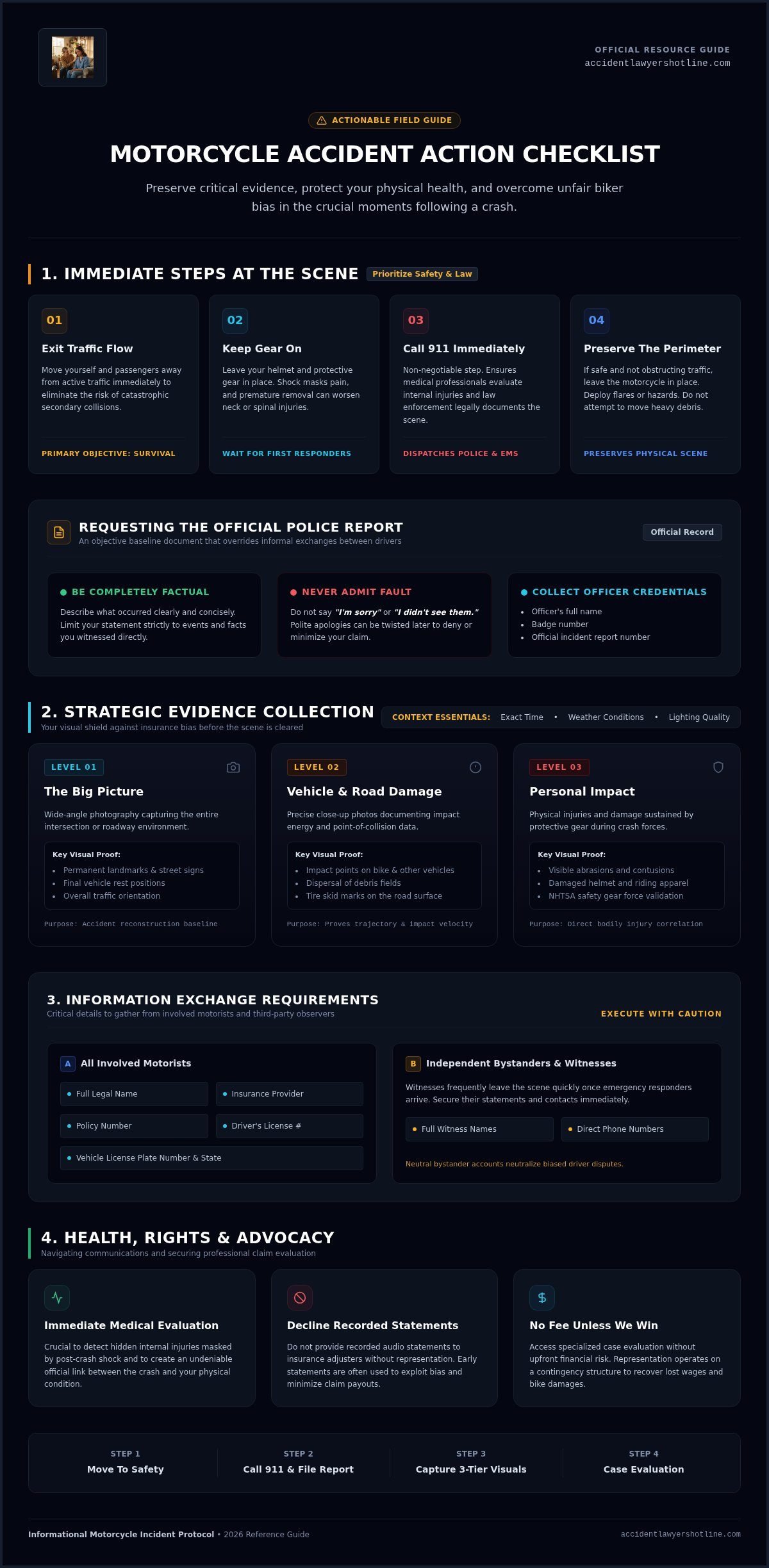
The seconds following a collision are often a blur of adrenaline and confusion. Your actions in this window determine both your physical recovery and your legal future. The first of the critical steps to take after a motorcycle accident is to secure your physical safety. If you are able to move, get yourself and any passengers away from the flow of traffic immediately. Staying in the roadway puts you at risk of a secondary collision, which can be more devastating than the first.
Check yourself for injuries, but be aware that shock often masks pain. Keep your helmet and protective gear on until emergency responders arrive. Removing a helmet prematurely can exacerbate an undiagnosed neck or spinal injury. Call 911 immediately. This ensures that medical professionals can evaluate you and that law enforcement can document the scene. A police presence is non-negotiable for your protection and the integrity of your future claim.
Securing the Area and Preventing Further Harm
Once you are in a safe position, focus on alerting other drivers to the hazard. If your motorcycle is not obstructing traffic, leave it where it is to preserve the scene for investigators. If you have hazard lights or emergency flares, use them to create a visible perimeter. This protects you and prevents other motorists from becoming part of the accident. Remember, your priority is survival and stabilization, not the condition of the bike. Do not attempt to move heavy debris if you feel any physical strain.
Requesting an Official Police Report
A formal police report is the most reliable piece of evidence in any insurance dispute. When the officer arrives, insist that they file a full report rather than just exchanging information between drivers. This document serves as an objective record of the event. When speaking with the officer, follow these guidelines:
- Be factual: Describe what happened clearly and concisely. Stick to the events you witnessed directly.
- Avoid admitting fault: Don't say "I'm sorry" or "I didn't see them." Even polite apologies can be twisted later to deny your claim.
- Collect details: Ask for the officer’s name, badge number, and the incident report number before they leave the scene.
Following these initial steps to take after a motorcycle accident creates a strong foundation for your recovery. Once the scene is secure and you have received initial medical clearance, getting a professional motorcycle accident case evaluation is the next logical move to protect your rights. This allows experts to begin the work of shifting the burden of the claim away from you while you focus on healing.
Strategic Evidence Collection: Building Your Claim Foundation
Evidence is the only objective shield you have against insurance companies that might try to shift blame onto you. While the police report provides a high-level overview, your personal documentation captures the raw reality of the crash before the scene is cleared. These specific steps to take after a motorcycle accident ensure that your side of the story is backed by undeniable proof. Start by recording the exact time of the incident, the current weather conditions, and the quality of the lighting. These environmental factors often play a significant role in accident reconstruction and liability determinations.
Visual Documentation of the Scene
Your smartphone is your most powerful tool in the minutes following a collision. High-resolution imagery prevents insurance adjusters from downplaying the severity of the impact. Focus on three distinct levels of photography:
- The Big Picture: Take wide-angle shots of the entire intersection or stretch of road. Include landmarks to show exactly where the vehicles came to rest.
- Vehicle Damage: Capture close-ups of the impact points on your bike and any other vehicles involved. Don't forget to photograph debris fields and skid marks.
- Personal Impact: Document your injuries and any damage to your safety gear. According to NHTSA motorcycle safety data, protective gear is critical for survival, and showing the damage it sustained helps prove the force of the collision.
Exchanging Information Responsibly
Gathering data from other parties is a legal requirement, but it must be done with caution. You need the full name, insurance provider, policy number, driver’s license number, and license plate for every driver involved. If there are bystanders who saw what happened, secure their names and phone numbers immediately. Witnesses often leave once the initial shock wears off, and their testimony can be the deciding factor in a disputed claim. These steps to take after a motorcycle accident are vital for securing your financial future.
When you interact with other drivers, keep the conversation strictly professional. Avoid discussing the mechanics of the crash or who might be at fault. Even a casual remark can be interpreted as an admission of liability. Once you have documented the scene and gathered contact details, the next move is to seek a professional motorcycle accident case evaluation. This ensures that your evidence is organized and used effectively to build a solid foundation for your recovery.
Seeking Medical Attention: Protecting Your Health and Your Rights
One of the most overlooked steps to take after a motorcycle accident is seeking an immediate medical evaluation. Even if you feel "fine," your body is likely flooded with adrenaline. This natural survival hormone can easily mask internal bleeding, organ damage, or traumatic brain injuries that aren't immediately visible. Visit an emergency room or urgent care facility within hours of the crash. Professional diagnostics are the only way to confirm your physical status and ensure your safety. These steps to take after a motorcycle accident are vital for both your health and your legal standing.
The Link Between Medical Care and Legal Evidence
Your medical records are the backbone of any future legal claim. They provide an objective, third-party timeline that connects your injuries directly to the accident. Insurance companies often look for "gaps in treatment" to argue that your injuries were pre-existing or not as severe as claimed. If you delay care by even a few days, you give them a reason to devalue your case. Always request copies of all diagnostic tests, such as X-rays, CT scans, and MRIs, to keep in your personal files. Following every physician-recommended treatment plan and attending all follow-up appointments shows that you are committed to your recovery.
Documenting Long-Term Impact
Physical healing is only part of the process. You must also document how the crash has altered your daily life. Start a "pain journal" to record your physical symptoms and emotional state every day. This log serves as powerful evidence of the non-economic damages you've suffered. When building your record, focus on these specific areas:
- Daily Limitations: Record how injuries prevent you from working, sleeping, or performing household tasks.
- Mental Health: Track struggles with anxiety, insomnia, or PTSD, which are common after high-impact crashes.
- Financial Tracking: Keep every receipt for out-of-pocket costs, from prescriptions to parking fees at the hospital.
These records help a personal injury lawyer build a comprehensive case for fair compensation. When you are ready to move forward, getting a motorcycle accident case evaluation can clarify how your medical documentation impacts your potential recovery. We focus on removing barriers to justice, which is why our network operates on a "no fee unless we win your case" basis.
Navigating Post-Accident Communications: Avoiding Costly Mistakes
The way you communicate in the days following a crash can be just as impactful as the evidence collected at the scene. Motorcyclists face a unique challenge: systemic bias. Many insurance adjusters default to a "reckless rider" narrative to shift liability and minimize payouts. One of the most defensive steps to take after a motorcycle accident is to recognize that the adjuster is not your ally. Their goal is to protect the company's bottom line, not your recovery. Keep every conversation with the other party’s insurance company strictly limited to the basic facts of the incident.
Handling Insurance Adjusters with Caution
Insurance adjusters are highly trained to find inconsistencies in your story. They may reach out shortly after the crash, offering a quick settlement while you are still in shock. These offers rarely cover the full scope of long-term medical care or lost wages. Decline to give a recorded statement. These recordings are often parsed for any phrasing that suggests you were even partially at fault. Instead, follow these professional communication protocols:
- Refuse recorded interviews: You are not legally obligated to provide a recorded statement immediately.
- Avoid signing releases: Never sign a medical or liability release without a professional evaluation of your case.
- Redirect inquiries: Once you have a legal representative, provide their contact information and end the call.
Digital Discretion and Privacy
Your online presence is now a target for investigation. Assume that insurance companies will monitor your social media activity for any evidence that contradicts your injury claims. Even an "innocent" photo of you at a family gathering can be used to argue that your physical limitations are exaggerated. Taking proactive steps to take after a motorcycle accident includes securing your digital footprint. Pause all posting on platforms like Facebook, Instagram, and TikTok until your claim is resolved. Advise your friends and family not to post updates about your health or tag you in photos. Digital privacy is a critical shield that protects your right to a fair resolution.
Protecting your future means knowing when to stop talking and when to let a specialist speak for you. If you are feeling pressured by an adjuster or confused by the "fine print" in a policy, getting a motorcycle accident case evaluation is a risk-free way to regain control. This allows you to shift the burden of communication to an advocate who understands the high stakes of your situation.
Securing Professional Advocacy: The Case Evaluation Process
The final and most decisive of the steps to take after a motorcycle accident is to move the legal burden from your shoulders to an expert. While you focus on physical therapy and emotional healing, a dedicated professional should be handling the complex insurance filings and liability disputes. The path to a fair resolution begins with a comprehensive motorcycle accident lawyer case evaluation. This initial step provides a clear roadmap for your recovery and ensures that no critical deadlines, such as statutes of limitations, are missed.
Leveraging a national referral network allows you to find a specialized attorney who understands the specific challenges of your case. You don't have to settle for a local generalist who lacks experience with high-impact collisions. Instead, you can connect with advocates who have a proven track record in motor vehicle law. This specialized approach ensures that your claim is handled with the precision and authority it deserves.
Why a Specialized Evaluation Matters
General practice lawyers may not fully grasp the mechanics of a motorcycle crash or the specific road hazards that affect riders. A specialized evaluation looks beyond the surface to identify every potential liable party. This could include negligent manufacturers if a part failed, or even government entities if poor road maintenance caused the slide. A professional evaluation identifies the true potential value of your claim by accounting for future medical needs and long-term loss of earning capacity. It provides the "calm in the storm" you need to make informed decisions about your future.
Connecting with a No-Fee-Unless-We-Win Attorney
Financial stress should never be a barrier to justice. High-quality legal support is accessible through a contingency fee structure. You can learn more about how a no fee unless we win your case attorney operates to protect your interests. This model means you face no upfront costs and no out-of-pocket expenses while your case is pending. The attorney’s interests are directly aligned with yours; they only get paid if they secure a successful outcome for you.
This risk-free approach allows you to pursue the full compensation you deserve for bike repairs, medical bills, and lost wages. By following these steps to take after a motorcycle accident, you transform a moment of crisis into a structured plan for recovery. Expert advocacy ensures that the restoration of fairness is not just a goal, but a reality. You have already faced the trauma of the accident; you don't have to face the legal aftermath alone.
Take Control of Your Recovery and Your Future
The aftermath of a crash doesn't have to be a period of confusion and unfair blame. By prioritizing your safety, securing medical evidence, and maintaining digital privacy, you've already built a strong foundation for your claim. Knowing the methodical steps to take after a motorcycle accident is the difference between an insurance denial and the compensation you need to move forward. You've protected your health; now it's time to protect your legal rights with expert support.
Our national referral platform provides you with immediate access to specialized motor vehicle advocates who understand the unique biases riders face. You don't have to worry about upfront costs. We connect you with experienced personal injury attorneys who work on a contingency basis, meaning there is no fee unless we win your case. Shifting the burden of a legal battle to a professional allows you to focus entirely on your physical healing and peace of mind.
Get Your Free Motorcycle Accident Case Evaluation Now. You deserve a partner who fights as hard for your recovery as you do. Rest assured that a fair resolution is within reach.
Frequently Asked Questions
How long do I have to file a claim after a motorcycle accident?
The time you have to file depends on the statute of limitations in your specific area. Most states set deadlines ranging from one to four years from the date of the crash. Missing this critical window permanently bars you from seeking any financial recovery. This is one of the most time-sensitive steps to take after a motorcycle accident. A professional case evaluation helps you identify your specific deadline immediately so you don't lose your right to justice.
What happens if I was partially at fault for the motorcycle crash?
You may still be eligible for compensation depending on comparative negligence rules. Many states allow you to recover damages as long as you were 50% or less at fault for the incident. Your total payout is usually reduced by your specific percentage of responsibility. Don't assume you have no case simply because you shared some blame. Let a specialized attorney review the facts of your crash to determine your legal rights and potential recovery.
Should I talk to the other driver’s insurance company?
You should avoid discussing the details of the crash beyond providing basic contact information. Insurance adjusters often use biker bias to trick you into admitting fault or downplaying your injuries. Recorded statements are frequently used against you later in the process to devalue your claim. Refer the adjuster to your legal representative. This ensures your words aren't twisted and shifts the burden of communication to a professional who understands insurance tactics.
How is the value of a motorcycle accident case determined?
The value of your case is calculated by combining your economic and non-economic damages. This includes tangible costs like medical bills, lost wages, and bike repair receipts. It also accounts for intangible impacts such as pain and suffering or long-term disability. Every case is unique; therefore, a professional evaluation is necessary to estimate the true potential value of your claim. Experts look at the severity of your injuries and the impact on your future quality of life.
What if the police report is incorrect about my accident?
You can challenge an inaccurate police report by providing additional evidence. Officers sometimes make mistakes or overlook critical factors like road hazards or obscured signs. You can submit supplemental evidence such as witness statements, scene photos, or dashcam footage. An experienced attorney can help you file an addendum to the report or use accident reconstruction experts to clarify the facts. Correcting the record is vital for proving liability and securing a fair settlement.
Do I need a lawyer if my injuries seem minor?
You should still seek a professional evaluation because minor symptoms often mask serious internal issues. Soft-tissue injuries or traumatic brain damage may not appear for several days after the initial impact. Even if your injuries seem small, the steps to take after a motorcycle accident remain the same to protect your future health. A lawyer ensures you aren't pressured into a low settlement before the full extent of your medical needs is known.
How does a contingency fee work for a motorcycle accident case?
A contingency fee means you pay nothing for legal services unless your attorney wins your case. This "no fee unless we win" model removes the financial barriers to high-quality advocacy. The attorney’s fee is a set percentage of the final settlement or court award. If there is no recovery, you don't owe any legal fees. This makes the process risk-free for you while aligning the attorney’s interests directly with yours to get the best result.
What should I do if the other driver was uninsured?
You can often recover through your own uninsured motorist (UM) coverage. Many motorcycle insurance policies include UM or underinsured motorist (UIM) protection specifically for these situations. Your insurance company steps into the shoes of the at-fault driver to cover your losses. You might also have grounds for a personal lawsuit, though this is often more complex. A case evaluation can help you identify all available insurance pools to cover your medical bills and bike repairs.
Were You Injured in an Accident?
Get a free, confidential case evaluation. No upfront fees.
Get Free Case Evaluation