Underinsured Motorist Coverage: What It Covers & What to Do
Need underinsured motorist coverage explained? Discover how UIM protects you when at-fault limits fall short, what losses are covered, and your next steps.
If the driver who caused your crash has insurance but not enough to cover your losses, could your own policy help? Getting underinsured motorist coverage explained in plain language can help you understand what to review, although the answer depends on your policy and state rules.
It’s understandable to expect the other driver’s insurer to cover the damage. But that driver’s policy limits may fall short of your medical expenses, lost income, or other eligible losses. Your own underinsured motorist coverage may provide another layer of protection, subject to its limits and terms.
This article explains when UIM coverage may apply, how it differs from uninsured motorist and collision coverage, and what losses it may address. You’ll also learn which policy details and crash-related documents to organize before pursuing a claim. If fault, losses, policy language, or settlement terms are disputed, a case evaluation can help clarify possible legal paths. Accident Lawyers Hotline evaluates crash situations and connects people with independent attorneys.
Key Takeaways
- Understand when your own policy’s underinsured motorist coverage may help if the at-fault driver’s liability limits fall short.
- Learn how the other driver’s insurance and your UIM policy interact, and why each policy’s terms matter.
- Compare UIM with collision coverage, health insurance, PIP, and MedPay to see how their roles differ.
- Organize crash, medical, and insurance records, and review policy notice requirements and applicable deadlines promptly.
- See how a case evaluation may help clarify options when fault, losses, policy language, or settlement terms are disputed.
Underinsured Motorist Coverage Explained: When Can It Help After a Crash?
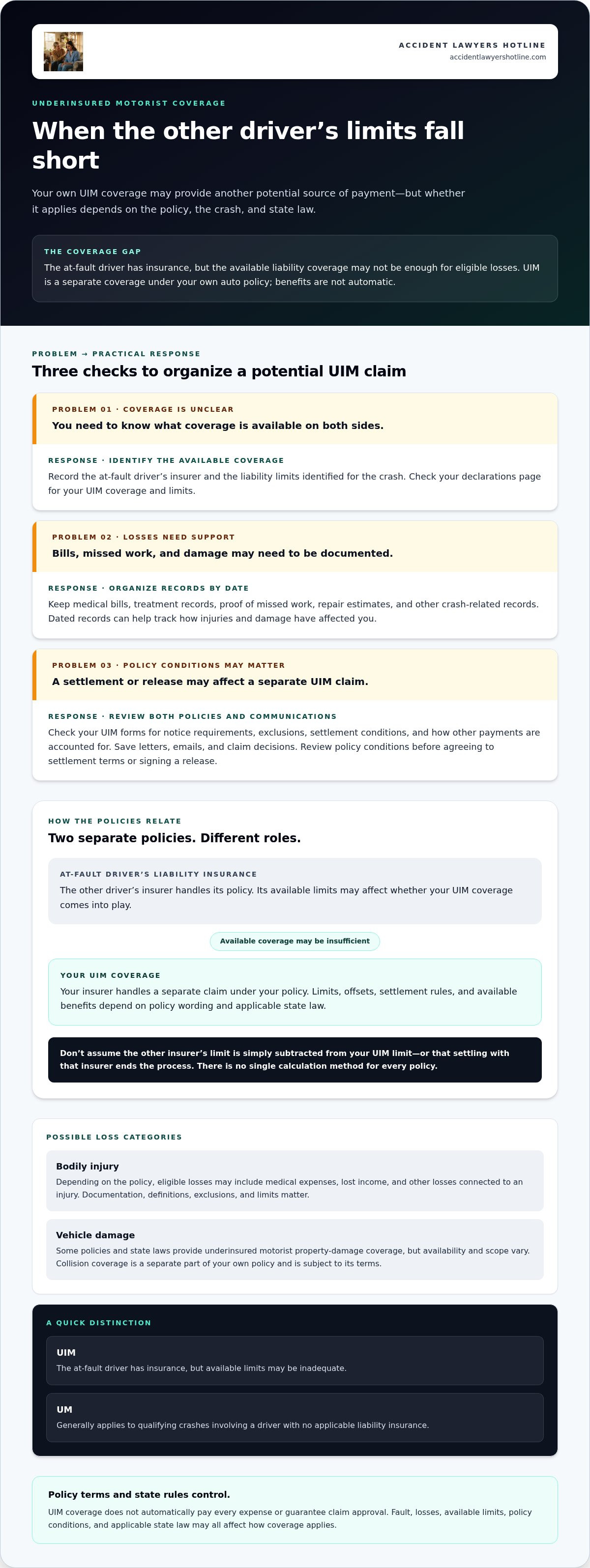
If an at-fault driver has insurance but their policy limits may not cover all your losses, your own underinsured motorist (UIM) coverage may help. It’s coverage on your auto policy, and whether it applies depends on the policy language and state law. It doesn’t automatically pay every expense or guarantee that a claim will be approved.
In plain language: Underinsured motorist coverage may help pay eligible losses after a crash with an at-fault driver whose insurance is insufficient, subject to your policy’s terms and applicable state law. The key distinction is that the other driver has insurance, but the available coverage may not be enough.
What makes another driver underinsured?
A driver may be underinsured when the coverage available under their liability policy falls short of the losses connected to the crash. There’s no single dollar threshold that defines underinsurance nationwide. State rules and policy provisions can affect whether UIM applies and how available coverage is calculated.
For example, an injured person may have substantial medical expenses and lost income while the at-fault driver’s policy has a much lower limit available for the claim. The driver is insured, but the coverage may not be enough to address the losses. The injured person’s UIM policy could offer another potential source of payment, up to its applicable limit and subject to its terms. This example is hypothetical. Actual coverage depends on the policies and law that apply.
UIM may concern bodily injury, vehicle damage, or both, depending on the coverage purchased and the policy. A shortfall doesn’t automatically qualify. The insurer may assess fault, losses, available liability limits, and policy conditions before deciding how coverage applies.
How is UIM different from uninsured motorist coverage?
Uninsured motorist (UM) coverage generally applies to qualifying crashes involving a driver who has no applicable liability insurance. UIM is different: the at-fault driver has insurance, but the available limits may be inadequate. The coverages address distinct situations, even though an auto policy may offer them together or use a combined UM/UIM label.
Coverage names don’t tell the whole story. The Underinsured motorist coverage overview describes the general purpose of UIM and notes that coverage arrangements can vary. Your policy and state law govern your situation, including coverage availability and qualifying conditions.
Hit-and-run crashes can raise separate questions. Depending on the policy and state rules, a hit-and-run may be treated under uninsured motorist provisions, but requirements differ. Don’t assume it qualifies the same way under every policy or in every state. Review the exact UM/UIM language and any conditions that apply to your claim.
How Underinsured Motorist Claims Interact With the Other Driver’s Insurance
A UIM claim involves two separate policies: the at-fault driver’s liability insurance and your own UIM coverage. The other driver’s insurer handles its policy; your insurer handles your UIM claim under a separate contract. The first policy’s limits may affect whether your UIM coverage comes into play, but the calculation and claim process depend on your policy wording and applicable state law.
A practical starting sequence is:
- Identify the available coverage. Record the at-fault driver’s insurer and the liability limits identified for the crash. Review your declarations page for UIM coverage and limits.
- Document your losses. Keep medical bills, treatment records, proof of missed work, repair estimates, and other records related to the crash. Organize them by date so you can track how your injuries and damage have affected you.
- Review both policies and claim communications. Check your UIM forms for notice requirements, exclusions, settlement conditions, and how the policy accounts for other payments. Save copies of letters, emails, and claim decisions.
UIM benefits are not automatic; they depend on your policy terms, the facts of the crash, and applicable state law. Limits, offsets, settlement rules, and available benefits can differ by contract and jurisdiction. An insurer may consider the at-fault driver’s available coverage and the documented value of the claim, but there isn’t one calculation method for every policy. Don’t assume the other insurer’s limit is simply subtracted from your UIM limit, or that settling with that insurer ends the process. Review your policy’s conditions before agreeing to settlement terms or signing a release that could affect a separate claim.
What losses might UIM bodily injury coverage address?
Depending on the policy, bodily injury UIM may address eligible medical expenses, lost income, and other losses connected to an injury. These are possible categories, not guaranteed payments. Definitions, exclusions, coverage limits, and claim requirements control. A policy may require particular documentation or define which expenses qualify, so keep bills and records that show the care received and time missed from work. The Texas Department of Insurance’s UIM guidance offers a practical overview, but it reflects Texas coverage rules and shouldn’t be treated as a statement of law everywhere.
Can UIM cover vehicle damage too?
Some policies and state laws provide underinsured motorist property-damage coverage, but its availability and scope vary. Collision coverage is a separate part of your own policy and generally addresses damage from a collision, subject to its terms. Neither option works exactly the same way under every contract. Review your declarations, coverage forms, deductibles, and exclusions to understand which coverage may address your vehicle loss.
If liability limits, settlement terms, or policy language leave you unsure about your options, a motor vehicle accident case evaluation can help clarify possible legal paths. Accident Lawyers Hotline evaluates crash situations and connects people with independent attorneys.
UIM, Collision, Health Insurance, and PIP: What Is the Difference?
Several types of insurance may relate to one crash, but they don’t all cover the same loss. Some address injuries, others vehicle damage, and each follows its own policy terms. To understand underinsured motorist coverage in practical terms, identify what each coverage is designed to address, then review which protections your policies include.
| Coverage | General purpose | Whose policy may apply? | Key limitations |
|---|---|---|---|
| UIM | May address eligible losses when an at-fault driver’s coverage is insufficient | Your own auto policy | Availability, limits, covered losses, and claim conditions vary |
| Collision | May cover damage to your vehicle from a collision | Your own auto policy | Deductible, exclusions, and policy terms apply |
| Health insurance | Helps pay for eligible medical care | Your health plan | Plan rules, cost-sharing, and coordination terms apply |
| PIP or MedPay | May provide first-party benefits for certain crash-related expenses | Your auto policy, where available | Coverage, limits, and eligible expenses depend on policy and state |
These coverages aren’t necessarily alternatives. More than one may be relevant, but having one doesn’t establish that another applies or determine which insurer pays first. The California Department of Insurance’s UIM overview discusses bodily injury and property damage coverage in California. Its rules shouldn’t be assumed to apply in other states.
In general, injury coverage addresses eligible losses tied to a person’s injuries, while vehicle-damage coverage addresses eligible repair or vehicle losses. The actual distinction depends on the policy and state law.
UIM versus collision coverage for vehicle damage
Collision coverage may apply to damage to your insured vehicle after a collision, subject to its terms. UIM property-damage coverage, where available, may address damage involving an at-fault underinsured driver. The coverages have different triggers and conditions. Deductibles, fault rules, coverage limits, exclusions, and coordination between policies can affect a claim. Don’t assume one coverage is always available or pays before the other.
UIM versus health insurance, PIP, and MedPay
Health insurance primarily addresses eligible medical care under the health plan. PIP and MedPay, where included and applicable, are first-party auto coverages that may pay certain crash-related medical expenses. Their scope differs by policy and state. They may interact with UIM or health benefits, so review coordination terms and any reimbursement or subrogation provisions before assuming one payment won’t affect another.
What to Do If the At-Fault Driver’s Coverage Is Too Low
A low liability limit can leave important questions unanswered, especially while medical care and vehicle repairs are ongoing. Take an organized approach: preserve evidence, identify the coverage involved, and keep a clear record of every claim conversation. These steps can help you assess possible options without assuming that a particular policy will pay.
Documents and details to organize
Create one secure folder for crash and insurance records. Keep originals where possible, and store copies of anything you send. A simple timeline can help you track what happened, what you submitted, and what each insurer said.
- Policy and claim information: Save your declarations page, full policy documents, claim numbers, and correspondence from both insurers.
- Injury records: Keep medical bills, treatment records, prescription receipts, and documentation of missed work or reduced income.
- Vehicle and crash evidence: Save repair estimates, photographs, crash reports, witness details, and other evidence related to the collision.
- Communication log: Record dates, contact names, phone calls, requests, and responses. Note which documents you provided and keep copies.
Review your policy promptly for UIM notice requirements and applicable deadlines. Requirements vary by policy and state, so don’t rely on a general timeline or assume that an open claim pauses a deadline. If you’re unsure how a term applies, write down the question and seek guidance specific to your circumstances.
Questions to resolve before accepting a settlement
Before signing or accepting, identify exactly what the offer covers. Is it a proposed payment under the at-fault driver’s liability policy, a resolution of your own UIM claim, or an agreement involving both? Don’t assume one payment resolves every claim connected to the crash.
Read the release and related documents carefully. Check who is being released from further claims, which losses are included, and whether the language addresses future claims. Review your UIM policy for any notice or consent provisions that could apply before settling with the other driver’s insurer. The effect of a release or settlement depends on its wording, the policy, and applicable law. A general rule can’t replace reviewing the documents in your case.
Keep signed agreements, payment records, and insurer communications together. If a document is unclear, pause before signing and get help understanding its possible effect. This article offers general educational information, not individualized insurance or legal advice. How underinsured motorist coverage explained applies to your claim depends on the facts, policy language, and state rules.
If you’re facing an insurance dispute and want help understanding possible legal paths, request a motor vehicle accident case evaluation.
When a UIM Dispute Calls for a Legal Case Evaluation
Insurance questions can become difficult when the facts or policy terms are disputed. Legal guidance may be useful if insurers disagree about fault, the value of your losses, how a UIM provision applies, or what a settlement would resolve. A denial or serious injury may also raise questions worth discussing. None of these circumstances alone guarantees that a claim is valid or that a particular outcome will follow.
Situations where outside legal guidance may be useful
Consider an individual review if the insurer disputes who caused the crash, challenges the extent of your injuries, denies coverage, or relies on policy wording you don’t understand. Settlement discussions can also raise concerns if you’re unsure what claims a release would affect. An attorney can assess the specific facts and applicable law rather than relying on general explanations that may not fit your situation.
Before an evaluation, gather the records you have, such as the policy, insurer letters, medical documentation, and any settlement offer. You don’t need to resolve every question first. A clear summary of what happened, what each insurer has said, and what remains uncertain can help focus the discussion.
What a case evaluation can help clarify
A case evaluation can consider the crash circumstances, reported injuries, available insurance information, and the questions raised by a UIM dispute. It may help identify legal issues to explore, including how fault, damages, policy terms, or settlement documents could affect possible next steps. Having underinsured motorist coverage explained is a useful starting point, but it doesn’t determine how a particular claim will be handled.
Accident Lawyers Hotline evaluates motor vehicle crash situations and connects people with independent personal injury attorneys. The platform is not a law firm and doesn’t directly represent users. An attorney who receives a referral can assess the individual matter and explain potential options. Referred attorneys may offer contingency-based representation, with fee arrangements governed by the agreement between the attorney and client. An evaluation doesn’t guarantee representation, claim approval, or a recovery.
If you’re unsure how an insurance dispute affects your options, you can request a car accident case evaluation. An individual review can help you understand possible legal paths without assuming in advance what the outcome will be.
Take the Next Step With Greater Clarity
Insurance uncertainty can make it hard to decide what deserves attention first. Identify what remains unresolved, gather the relevant documents, and consider which questions need individual guidance. Having underinsured motorist coverage explained is a starting point, not a substitute for advice based on your policy, evidence, and applicable law.
Accident Lawyers Hotline is a national case-evaluation and attorney-referral platform that connects people injured in crashes with independent personal injury attorneys. Referred attorneys may offer contingency-based representation, subject to the terms of their agreement with you. A case evaluation can help you explore possible next steps, but it doesn’t promise a particular result.
If you’re ready to discuss your situation, request a car accident case evaluation. Accident Lawyers Hotline can evaluate your crash situation and connect you with an independent attorney to discuss possible legal options.
Frequently Asked Questions
What does underinsured motorist coverage mean?
Underinsured motorist coverage is protection under your own auto policy that may apply when an at-fault driver’s available insurance can’t cover all eligible losses. In plain terms, the other driver has insurance, but your policy may provide another source of coverage if its conditions are met. Check your declarations page and policy forms for your limits, covered losses, and requirements.
Does underinsured motorist coverage pay for medical bills?
It may help address eligible injury-related expenses, including medical bills, if your policy includes bodily injury UIM coverage and the claim meets its conditions. Treatment charges from follow-up care, for example, may be part of the losses reviewed. Keep itemized bills and records showing the care you received. Coverage limits, exclusions, fault findings, and how other payments are treated can affect whether and how much the policy pays.
Can I use underinsured motorist coverage if the other driver has insurance?
Yes, potentially. UIM is intended for situations where an at-fault driver has liability insurance but the available limits may not cover all eligible losses. The existence of the other driver’s policy doesn’t automatically rule out a UIM claim. Your own policy may define when the driver qualifies as underinsured and what steps you must take, so review its wording before assuming coverage applies.
How is an underinsured motorist claim calculated?
There isn’t one calculation used for every UIM claim. The insurer may examine documented losses, the other driver’s available limits, your UIM limits, and policy provisions addressing offsets or other payments. For instance, it may review medical records, income documentation, and evidence about the crash before evaluating the claim. State law and contract language can change how those figures interact, so don’t rely on a simple subtraction formula.
Is underinsured motorist coverage required in every state?
No single UIM requirement applies nationwide. State laws differ: some require UIM or combined uninsured and underinsured motorist coverage, while requirements and availability can differ elsewhere. Even where coverage is required, rules may set minimum limits or affect how policies are issued. Review the current requirements where your policy is issued and read your declarations page to see the coverage and limits that apply to you.
Can underinsured motorist coverage pay for car damage?
It may, if your policy and applicable state law provide underinsured motorist property-damage coverage. Don’t assume bodily injury UIM automatically covers your vehicle. Check the declarations page for property-damage coverage and review exclusions, limits, and any deductible. Collision coverage is a separate option under an auto policy, and its terms may address vehicle damage differently. The available route depends on your coverage and the circumstances of the crash.
Should I accept the at-fault driver’s insurance settlement before making a UIM claim?
Don’t accept or sign a release until you understand how the settlement could affect your UIM claim. Review your policy for notice or consent provisions, and check whether the release applies only to the other driver’s insurer or addresses additional claims. The effect depends on the documents, policy, and applicable law. If the language is unclear, consider getting individualized guidance before agreeing to settlement terms.
What should I do if my underinsured motorist claim is denied?
Request and keep the written denial, then identify the policy language and facts the insurer relied on. Compare the explanation with your policy, claim records, and submitted evidence. Gather any missing documentation and review the policy’s procedures and deadlines for challenging the decision. If you can’t resolve the issue or don’t understand the stated reason, a case evaluation may help clarify possible legal options. A denial doesn’t by itself establish whether further action is available.
Were You Injured in an Accident?
Get a free, confidential case evaluation. No upfront fees.
Get Free Case Evaluation