What Not to Say to an Insurance Adjuster
Learn what not to say to an insurance adjuster to protect your claim. Avoid costly mistakes, dodge tricky traps, and secure the full settlement you deserve.
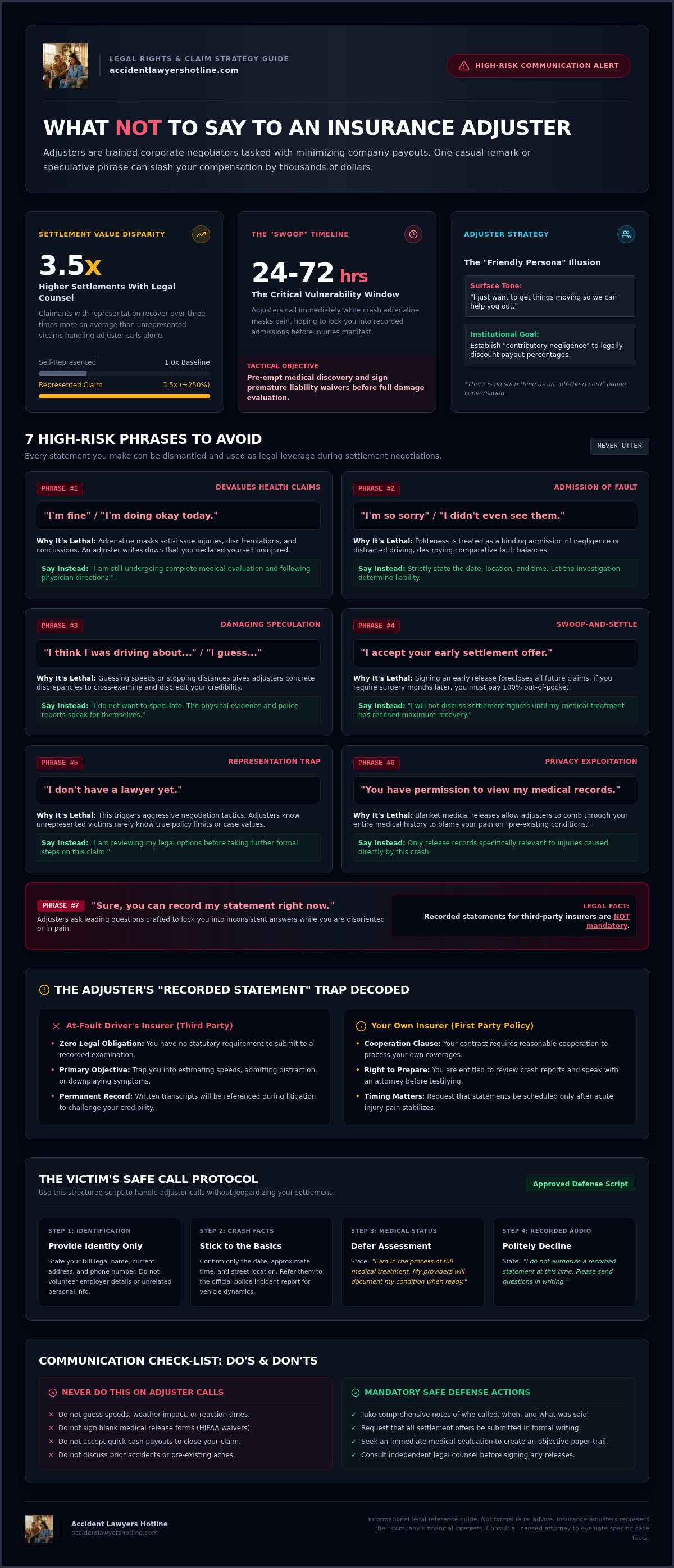
Did you know that insurance claimants who retain legal counsel receive settlements that are 3.5 times higher on average than those who represent themselves? This massive gap often begins with the very first phone call you receive after an accident. While the person on the line may sound empathetic, they are a professional working to protect their company's bottom line. Knowing exactly what not to say to an insurance adjuster is your first line of defense in protecting the true value of your claim.
You likely feel the weight of persistent phone calls and the fear of accidentally admitting fault while you are still in pain. It is exhausting to manage complex insurance requirements when you should be focusing on your recovery. We are here to help you regain control. This guide identifies the specific phrases that can devalue your settlement and provides the tools you need to handle insurance calls with authority. We will walk through common traps and show you how to secure a professional case evaluation without any upfront risk.
Key Takeaways
- Recognize that an adjuster’s friendly tone is a professional tactic used to gather information that can eventually devalue your claim.
- Identify the high-risk phrases in our guide on what not to say to an insurance adjuster to avoid accidentally admitting fault or speculating about the crash.
- Understand your legal rights regarding recorded statements, which are often not mandatory and can be used to lock you into a damaging narrative.
- Learn how to use a safe script that limits your communication to basic contact information while deferring medical and fault-based questions.
- Find out how a professional case evaluation can shield you from insurance tactics and ensure your settlement covers the full scope of your injuries.
The Role of the Insurance Adjuster: Why They Are Not on Your Side
You just survived a traumatic event. Your phone rings, and it's the insurance adjuster. They sound kind. They ask how you're feeling and offer to "get things moving" for you. It feels like help has finally arrived. However, you must understand the insurance claim adjustment process from the very beginning. The adjuster is a professional negotiator. Their primary loyalty lies with the insurance corporation's shareholders, not your health or financial recovery. They aren't your friend. They are there to protect the company's assets. Knowing what not to say to an insurance adjuster is the only way to ensure your words aren't turned against you during negotiations.
Their Goal: Minimizing the Payout
Adjusters have a clear metric for success. They are often evaluated on how effectively they minimize settlement payouts. This is why many adjusters contact victims within the first 24 to 72 hours of an incident. This is your "vulnerability window." You are likely still in shock. You might not even know the full extent of your injuries because adrenaline often masks pain. They want to lock you into a low-value statement before you have a chance to seek a professional case evaluation. A single misstatement about your vehicle's speed or your physical condition can slash your compensation by thousands of dollars. They aren't looking for the truth. They are looking for evidence of "contributory negligence" to reduce their liability.
The 'Good Neighbor' Trap
Professional training teaches adjusters to use a "friendly" persona as a tactical tool. It's a data-collection method designed to lower your guard. When they ask, "How are you doing today?" and you reflexively answer, "I'm doing okay," they note it. They use that casual politeness later to argue you weren't actually injured. There is no such thing as an "off-the-record" comment. Every word you speak can end up in a formal report used to deny your claim. You should maintain a guarded, professional distance during every interaction.
It's also vital to distinguish between different types of adjusters. Your own insurance company has a "cooperation clause" in your policy that requires you to speak with them. However, the at-fault driver's adjuster has zero legal obligation to help you. They are actively looking for reasons to pay you nothing. This is why learning what not to say to an insurance adjuster is the most critical step for every motor vehicle accident victim. Staying silent on specific details isn't being difficult; it's being smart.
7 Phrases Never to Say to an Insurance Adjuster
The initial conversation with an insurance company is a legal minefield. Every word you utter is recorded or noted to build a case against your settlement. Understanding what not to say to an insurance adjuster is not just about being cautious; it is about protecting your financial future. According to the legal definition and role of an insurance adjuster, these professionals are tasked with investigating claims to determine the insurer's liability. Their institutional goal is to minimize that liability whenever possible.
Avoid these specific phrases to keep your claim intact:
- "I think" or "I guess": Speculation is dangerous. If you estimate your speed or distance and you are wrong, the adjuster will use the discrepancy to discredit your entire testimony.
- "I accept your offer": Early offers are almost always "swoop-and-settle" tactics. Accepting too soon prevents you from claiming damages for injuries that appear weeks later.
- "I don't have a lawyer": This signals to the adjuster that you may not know the full value of your claim or the legal limits of their policy.
- "You have permission to review my medical records": Blanket releases allow adjusters to dig through years of unrelated history to find "pre-existing conditions" to blame for your current pain.
The Danger of Apologizing
In everyday life, saying "I'm sorry" is a sign of good manners. In an insurance claim, it is a legal admission of liability. Even a phrase like "I didn't see them" can be used to prove you were distracted or negligent. Stick strictly to the objective facts: the date, time, and location. Fault is a complex legal determination made by experts and authorities, not a conversational one made on a phone call. Do not do the adjuster's work for them by taking the blame.
Premature Health Assessments
The most dangerous phrase you can say after a crash is "I'm fine." Adrenaline is a powerful chemical that masks serious pain for hours or even days. If you tell an adjuster you aren't hurt, and a week later you discover a herniated disc, they will use your initial statement to deny the link between the crash and your injury. Instead, use the safe response: "I am still seeking medical evaluation." This leaves the door open for a professional diagnosis. Knowing what not to say to an insurance adjuster regarding your health ensures you don't lock yourself into a "zero-injury" status before you see a doctor.
If you are feeling pressured to provide a statement, getting a free car accident case evaluation can help you understand your rights before you speak with the insurance company again.
Common Adjuster Tactics: Decoding the 'Recorded Statement' Trap
One of the most common pressure tactics you will face is the request for a recorded statement. The adjuster may tell you it's a routine step to "speed up your claim" or "get your side of the story." In reality, the official duties of claims adjusters involve obtaining audio recordings to scrutinize every detail for inconsistencies that can justify a claim denial. Unless you are dealing with your own insurance company, you are generally not legally required to provide a recorded statement. Once you agree to be recorded, your words become permanent evidence that can be used against you in court. This record limits your future legal options if your injuries turn out to be more severe than you initially realized. Understanding what not to say to an insurance adjuster during these high-stakes moments is your best defense.
The Leading Question Technique
Adjusters are trained in the "leading question" technique. This involves framing a question so it suggests the answer they want you to give. For example, they might ask, "You didn't see the other car until the moment of impact, correct?" This sounds like a simple confirmation. However, it's designed to make you admit you weren't keeping a proper lookout. If you encounter a question that assumes facts you haven't stated, you should identify and deflect it. A safe response is, "I'm not going to speculate on that right now." It's especially vital for riders to consult a motorcycle accident lawyer before speaking on the record. Adjusters often use unfair biases about bikers to shift blame, and professional guidance can help you avoid these narrative traps.
The 'Quick Settlement' Lure
You may receive a settlement offer within days of the accident. It's tempting to take the fast cash to cover immediate bills or car repairs. This is the "swoop-and-settle" lure. These early offers usually come with a "Release of Liability" form. Once you sign this, you lose your right to ask for more money forever. If you discover a week later that you need surgery or long-term physical therapy, the insurance company will not pay another dime. A professional case evaluation is the only way to determine the true value of your claim before you sign your rights away. Knowing what not to say to an insurance adjuster includes knowing when to say nothing at all until you have evaluated your legal options with an expert.
How to Speak with an Adjuster: A Safe Script for Victims
When the insurance company calls, you might feel like you are being interrogated. You don't have to be. The most effective way to protect your claim is to keep the conversation short, polite, and strictly limited to basic facts. Knowing what not to say to an insurance adjuster requires a disciplined approach. You should never discuss your injuries, the mechanics of the crash, or who you think was at fault. Instead, use a safe script that keeps you in control of the narrative.
Step 1: Verify Identity and Intent
Before you provide any information, you must know exactly who you are speaking with. Ask for the caller's full name, the insurance company they represent, and the specific claim number assigned to your case. You must record this information in a dedicated file for your own records. This establishes a professional tone and ensures you know which party is seeking data. Limit your identification of the incident to the vehicles involved, such as the make and model. Do not go beyond these basics. If they ask how the crash happened, simply state that the police report contains the necessary details.
Step 2: Set Boundaries Early
Adjusters often push for details about your physical health or the speed of the vehicles. You are not a medical professional or a crash reconstruction expert. The most powerful tool in your script is the phrase: "I am not prepared to discuss that at this time." This response is polite but firm. It prevents you from making the speculative errors we discussed in earlier sections. If the pressure continues, tell the adjuster you are "still evaluating your options" and end the call.
For those involved in complex collisions with commercial vehicles, it is often best to direct the adjuster to your truck accident lawyer for further details. Professional advocates understand the high stakes of these cases and can manage all communications on your behalf. This allows you to focus on healing while ensuring your words are not used to devalue your recovery. If you are unsure of your next steps, you can get a free motor vehicle accident case evaluation to see where you stand before speaking to the insurance company again.
Why a Professional Case Evaluation Is Your Best Defense
You now understand the high stakes of what not to say to an insurance adjuster, but knowing the rules is only half the battle. Carrying the weight of these high-stakes negotiations while you are trying to heal is an unnecessary risk. A professional case evaluation shifts that burden from your shoulders to a seasoned expert. It provides a comprehensive look at the true value of your claim, which often extends far beyond your current medical bills. A specialist identifies costs you might overlook, such as future physical therapy, long-term diagnostic needs, and the full impact of lost earning capacity. This ensures you don't settle for a "quick fix" that leaves you financially stranded later.
Leveling the Playing Field
Insurance companies employ entire departments of professionals dedicated to minimizing their financial exposure. Attempting to negotiate against these resources alone puts you at a severe disadvantage. Data from the Insurance Research Council shows that claimants who retain legal representation receive settlements that are 3.5 times higher on average than those who represent themselves. Furthermore, represented claimants achieve a successful recovery 91% of the time, compared to just 51% for those without counsel. You can gain this advantage without any upfront cost. By working with a no fee unless we win your case attorney, you ensure that your advocate's interests are perfectly aligned with yours. You don't pay a dime unless they successfully recover compensation for you.
Starting Your National Case Evaluation
The process of protecting your rights should be streamlined and stress-free. Our national referral service acts as a protective shield, matching you with a legal professional who specializes in your specific accident type, whether it involved a car, truck, or motorcycle. This specialist takes over all correspondence with the insurance company, meaning you never have to worry about what not to say to an insurance adjuster again. Every call and email is handled by a professional who knows how to deflect trap questions and demand fair value.
Time is a critical factor in any motor vehicle accident claim. Evidence like witness memories and digital data from commercial vehicles can vanish quickly. Waiting too long to seek a professional evaluation can weaken your position and make it harder to prove the full extent of your damages. Take the first step toward a fair resolution today and regain the peace of mind you deserve. Get your free accident case evaluation now and let a professional fight for the settlement you actually need.
Take Control of Your Accident Recovery Today
You now have the tools to navigate the high-stakes world of insurance claims with confidence. By understanding the adjuster's financial incentives and mastering the script of what not to say to an insurance adjuster, you have already strengthened your claim's value. Your words are powerful. Keeping them brief and factual ensures that the insurance company cannot use your own statements to deny you the compensation you deserve.
You don't have to carry this burden by yourself. Our national network of legal advocates is ready to act as your protective shield. We provide 24/7 case evaluation availability to ensure you get the support you need at any hour. Because our partners work on a no fee unless we win your case basis, you can seek a professional evaluation with zero financial risk. Get Your Free Case Evaluation Today and start the journey toward a fair resolution. You have already survived the storm; now it's time to secure your future.
Frequently Asked Questions
Do I have to talk to the other driver's insurance adjuster?
No, you are not legally required to speak with the other driver's insurance adjuster. You must cooperate with your own insurance company due to your policy's terms, but you owe the other party nothing. Their adjuster is trained to gather evidence that reduces their financial responsibility. Directing their questions to a professional advocate prevents you from accidentally devaluing your settlement by knowing what not to say to an insurance adjuster.
What happens if I already gave a recorded statement?
If you have already given a statement, you should request a written transcript or a copy of the audio file immediately. While you cannot erase what was said, a professional can review the document for potential errors or traps. Understanding exactly how the adjuster might use your words allows you to build a stronger strategy for future negotiations and ensures you are better prepared for the next steps.
Can an insurance adjuster deny my claim if I don't give a statement?
An adjuster for the at-fault party cannot legally deny your claim solely because you refuse a recorded statement. They may suggest that your claim is stalled or cannot proceed without one, but this is a common pressure tactic. You have no legal obligation to provide a recording to the other side. Providing a statement often gives them the chance to find reasons to deny your claim later.
Is it okay to tell the adjuster I'm hiring a lawyer?
Yes, informing the adjuster that you are seeking legal counsel is a smart protective move. Once you have representation, the insurance company must stop calling you directly. This strategy effectively ends the risk of saying something damaging. It allows you to stop worrying about what not to say to an insurance adjuster and shifts the complex task of negotiation to a seasoned expert who understands how to protect your interests.
How much is my car accident claim worth?
Claim value is determined by medical expenses, lost income, and the severity of your injuries. Adjusters often use automated software to generate low-ball offers that don't account for your future needs. A professional evaluation identifies the true value of your claim by looking at long-term impacts. This ensures you aren't pressured into a settlement that fails to cover the full extent of your physical and financial recovery.
What if the adjuster offers me a settlement check right away?
You should decline any immediate checks until you know the full extent of your injuries. Accepting a "quick settlement" usually requires signing a release form that ends your claim forever. If you discover a hidden injury like a herniated disc a week later, you will be unable to seek additional compensation. Always wait for a professional medical and legal evaluation before you agree to any final payout.
Should I sign a medical records release for the insurance company?
You should not sign a blanket medical release. These forms often grant the insurance company access to your entire health history. Adjusters use this access to find unrelated past injuries and claim they are the source of your current pain. You are only required to provide medical documentation that is specifically related to the accident. A professional can help you provide only the necessary records to protect your privacy.
Does it cost anything to get a professional case evaluation?
It costs nothing to start the process. Accident Lawyers Hotline offers free evaluations for victims of motor vehicle accidents. We connect you with a national network of advocates who operate on a contingency basis. This means you pay no fee unless they win your case. This risk-free approach ensures you can evaluate your legal options and protect your claim without any upfront financial burden or obligation.
Were You Injured in an Accident?
Get a free, confidential case evaluation. No upfront fees.
Get Free Case Evaluation