What to Do After a Hit and Run: 2026 Legal Guide
Learn what to do after a hit and run with our 2026 legal guide. Get a step-by-step checklist for the scene, insurance tips, and your recovery options.
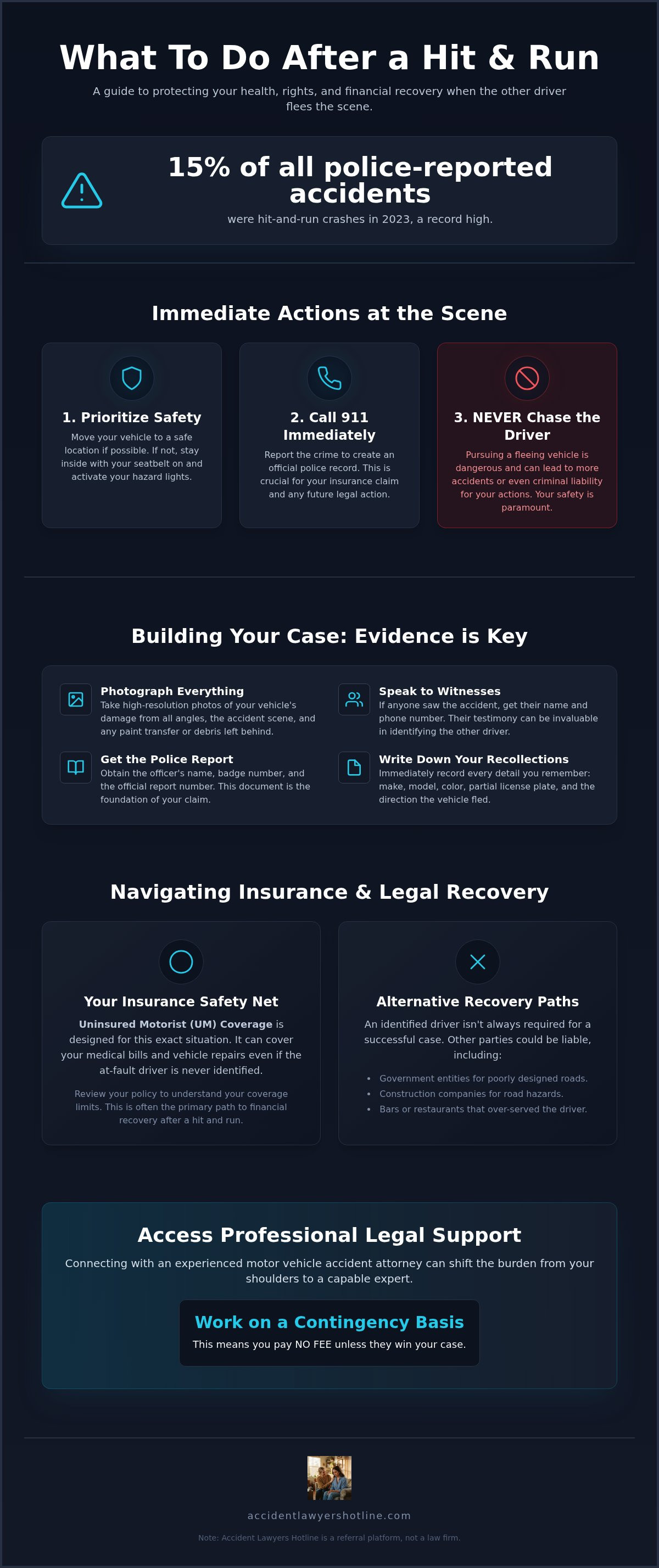
In 2023, hit-and-run crashes reached a record high, accounting for 15% of all police-reported accidents in the United States. If you are standing on the side of the road watching a pair of taillights disappear, you are likely feeling a mix of shock and overwhelming anxiety. It is natural to worry about how you will pay for repairs or medical bills when the responsible party is nowhere to be found. You might feel like the situation is out of your control, but your path to recovery does not depend on the other driver's cooperation.
Knowing exactly what to do after a hit and run can mean the difference between financial ruin and a successful recovery. This 2026 legal guide provides the specific steps you need to take to protect your health and your legal rights immediately. We will walk you through the essential checklist for the scene, explain how your own insurance coverage provides a safety net, and show you how to access professional legal support. While Accident Lawyers Hotline is a referral platform rather than a law firm, we connect you with experienced motor vehicle accident attorneys who work on a contingency basis. This means there is no fee unless they win your case. This guide helps you shift the burden from your shoulders to a capable expert.
Key Takeaways
- Prioritize your immediate safety and report the crime to 911 to establish an official record for your insurance and legal claims.
- Learn exactly what to do after a hit and run to gather critical evidence, such as photos of paint transfer and collecting debris from the scene.
- Demystify insurance options like Uninsured Motorist coverage to ensure your medical and repair bills are covered even if the driver is never found.
- Identify alternative legal paths for financial recovery, including third-party liability for poorly designed intersections or road hazards.
- Understand how a professional case evaluation connects you with a motor vehicle accident attorney who works on a contingency basis, meaning no fee unless you win.
Immediate Actions: What to Do at a Hit and Run Scene
The moments following a collision are often a blur of adrenaline and confusion. Your heart is likely racing, and the sight of a vehicle speeding away can leave you feeling powerless. However, your first priority must be safety. If your car is still drivable, move it to the shoulder or a nearby well-lit public area immediately. If the vehicle is disabled, stay inside with your seatbelt fastened and turn on your hazard lights. Staying calm in this high-stakes moment is the most effective way to protect yourself and your future legal interests. It's natural to feel a sense of urgency, but your physical well-being comes before any investigation.
Call 911 as soon as you are in a secure position. Reporting the incident is a foundational step in what to do after a hit and run because it alerts law enforcement to a crime and ensures medical professionals are dispatched to your location. Never attempt to chase the fleeing driver. Pursuing another vehicle at high speeds is dangerous and can lead to secondary accidents or even criminal liability for your own actions. Instead, use these initial minutes to document the exact time of the impact, the specific intersection or mile marker, and the current weather conditions while the details are fresh.
The Importance of the Official Police Report
An official police report serves as the primary evidence for your insurance company and any future legal action. Most insurance carriers require this document to process claims involving unidentified drivers. When the officer arrives, provide a clear, factual account of what happened. Avoid speculating or apologizing for the crash. Apologies are often misconstrued as admissions of fault, which can negatively impact your ability to recover damages later.
Ensure you get the responding officer's name, their badge number, and the incident report number. This documentation is essential because it verifies that the incident meets the legal definition of a hit and run in a formal investigation. Without this official record, it becomes significantly harder to prove to an insurer that a second vehicle was actually involved. This report shifts the burden of proof away from you and onto a verified legal document.
Recording Your Immediate Recollections
Human memory is fragile, especially after a traumatic event. As soon as you are safe, write down every detail you can remember about the other vehicle. Focus on the make, model, and color. If you caught even a partial license plate number, it could be the key to identifying the responsible party. Note any identifying features of the driver or specific damage to their vehicle, such as a broken taillight or a distinct bumper sticker.
Note the direction the vehicle was traveling when it fled the scene. These details are vital for investigators who may be able to track the vehicle using traffic cameras or local business security systems. Taking these structured steps is a vital part of what to do after a hit and run to ensure your case has the strongest possible start. By acting as a diligent observer, you provide the specialized knowledge your future advocate will need to restore fairness to your situation.
Evidence Collection: Building Your Case When the Driver Is Gone
When a driver flees the scene, you become the primary investigator for your own recovery. Understanding what to do after a hit and run starts with the physical evidence left behind. Physical evidence is the only voice your case has when the other party is silent. Start by taking high-resolution photos of your vehicle from every possible angle. Look closely for paint transfer or scuffs that don't match your car's color. These marks often reveal the color and type of vehicle that struck you. Don't overlook debris on the ground. Broken headlight glass or plastic trim pieces can help investigators identify the specific year and model of the fleeing car. While these tasks feel heavy in a moment of shock, they are essential steps to take after an accident to ensure your story is backed by hard facts.
Collecting evidence is a vital part of what to do after a hit and run because it builds a bridge between an unidentified driver and a successful insurance claim. If there were bystanders, speak to them immediately. Ask for their names and phone numbers. They might have seen a partial plate or the driver's face. Research shows that less than half of all hit-and-run drivers are ever identified. These witness statements are often the only way to prove to an insurance company that you weren't at fault for the impact.
Canvassing for Digital Evidence
Ask local businesses for their CCTV footage as soon as possible. Many security systems overwrite their data within 24 to 48 hours, so speed is critical. If you have a dashcam, preserve that footage immediately. If you don't, look for other vehicles nearby that might have captured the impact. You can also use community apps or social media to see if anyone in the area caught the fleeing vehicle on a doorbell camera. Digital proof is difficult to dispute and provides the clarity needed to move your case forward.
Medical Documentation as Evidence
Seeking medical attention is a legal necessity, not just a health precaution. Even if you feel only minor pain, go to an emergency room or urgent care. Medical records link your injuries directly to the accident date and time. If you delay treatment, insurance companies will argue that your injuries happened later or were unrelated to the crash. This documentation protects the value of your claim. If you're unsure how to organize this information, a car accident case evaluation can help clarify your next steps and identify the strength of your evidence.
Navigating Insurance: How Hit and Run Claims Work
Insurance claims are often the source of the most intense financial anxiety after a collision. You've secured the scene and called the police, but the question remains: how do the bills get paid? Most drivers carry Uninsured Motorist (UM) coverage. This is your primary defense. In most legal contexts, a driver who flees is treated exactly like an uninsured driver. This coverage steps in to pay for medical expenses and vehicle repairs when the responsible party is missing. It is a vital safety net designed for this exact moment of crisis.
Understand how your different policy types interact to protect you. Collision coverage pays for your car's repairs regardless of who caused the crash, though you'll likely have to pay a deductible first. Property Damage liability, however, often requires the other driver to be identified to trigger a payout from their insurer. If you are in a "No-Fault" jurisdiction, your own Personal Injury Protection (PIP) typically covers your medical costs immediately. In "At-Fault" areas, your financial recovery depends more heavily on your UM policy. Be extremely cautious when speaking with insurance adjusters. Do not agree to a recorded statement without professional guidance. Adjusters are trained to find inconsistencies that can lead to a claim denial. Their goal is to protect the company's bottom line, not your restoration of fairness.
Filing a Claim Without a License Plate
You can still file a successful claim even with zero information about the other car. This is often processed as a "John Doe" claim in various jurisdictions. Your insurance company will conduct a thorough investigation to confirm the accident happened as you described. They will look for the physical evidence mentioned earlier, such as paint transfer or scuffs, to verify the impact and rule out fraud. If your insurance company denies your hit and run claim by suggesting no other vehicle was involved, you have the right to appeal that decision with the evidence you've preserved.
Protecting Your Premium Rates
Many victims worry that reporting the incident will cause their rates to skyrocket. However, many jurisdictions have laws that protect drivers from premium increases following an accident where they were not at fault. Paying out of pocket might seem like a way to save money, but it leaves you unprotected if long-term injuries or hidden mechanical issues appear later. A car accident attorney can negotiate with your insurer to ensure they act in good faith. They understand the national standards for what to do after a hit and run and will fight to prevent unfair rate hikes while you focus on your recovery.
Legal Recovery Options: Why an Identified Driver Isn’t Always Required
Many victims assume that if the driver isn't caught, the case is closed. This is a common misconception. Recovery often involves looking beyond the fleeing vehicle. For example, a poorly designed intersection or a malfunctioning traffic light might have contributed to the crash. In these instances, a government entity or a private contractor could be held liable for your damages. A legal professional can analyze the scene to determine if third-party negligence played a role. This is a critical part of what to do after a hit and run when the trail for the other driver goes cold.
Even if the driver remains unknown, an attorney can help uncover hidden insurance assets. Some policies have secondary layers of coverage that aren't immediately obvious to the policyholder. If you're worried about the cost of this investigation, remember that you can hire a no fee unless we win your case attorney. This model removes the financial risk from your shoulders. It allows you to pursue justice without paying upfront legal costs. You only pay if your lawyer successfully secures a settlement or verdict for you. This ensures that expert help is accessible to everyone, regardless of their current financial situation.
When the Fleeing Driver Is Found
If the police eventually identify the driver, your situation changes from a simple insurance claim to a potential civil lawsuit. A criminal conviction for fleeing the scene serves as powerful evidence in your civil case. It establishes a clear breach of legal duty. Beyond standard medical and repair costs, you may be eligible for punitive damages. These are specifically designed to punish the driver for their gross negligence and intentional flight. Your attorney will use the criminal record to hold the driver fully accountable for the harm they caused, ensuring the restoration of fairness.
Special Cases: Truck and Motorcycle Hit and Runs
Some collisions involve higher stakes and more complex insurance structures. If a commercial vehicle hit you, the expertise of a truck accident lawyer is essential. Commercial fleets often have multi-million dollar policies and aggressive legal teams. Similarly, riders face unique vulnerabilities. A motorcycle accident lawyer understands how to fight the bias often faced by bikers while navigating corporate insurance layers. No matter the vehicle type, knowing what to do after a hit and run involves seeking specialized advocacy to level the playing field. To start your journey toward financial recovery, request a motor vehicle accident case evaluation today.
Securing a Professional Case Evaluation
The legal system is complex, and attempting to navigate it alone while recovering from an injury is a heavy burden. A professional case evaluation is the most critical step in what to do after a hit and run to ensure you aren't leaving money on the table. This process allows an expert to review the facts you've preserved and identify the most efficient path toward financial stability. Whether the driver is ever found or remains anonymous, an evaluation provides a clear roadmap for your recovery. It shifts the pressure from your shoulders to a dedicated advocate who understands the high stakes of your situation.
Accident Lawyers Hotline acts as your "calm in the storm" during this transition. We are a referral platform, not a law firm, but we specialize in bridging the gap between a moment of crisis and a professional legal resolution. We connect you with experienced motor vehicle accident attorneys who have the specialized knowledge required for hit-and-run investigations. During your initial consultation, you can expect a transparent review of your evidence and a straightforward assessment of your claim's strength. This ensures you move forward with a realistic plan and a powerful advocate by your side.
Removing the Burden of Legal Research
You shouldn't have to spend your recovery time researching statutes or insurance subrogation. Our referral service saves you time and energy by matching you with a No Fee Unless We Win Your Case Attorney. This contingency model is essential for the restoration of fairness. It means you face zero financial risk. You only pay if your lawyer successfully secures a settlement or verdict for you. This risk-free approach removes the barriers to high-quality legal help and allows you to focus entirely on your physical and emotional healing.
Next Steps for Your Recovery
Time is a critical factor in hit-and-run cases. While you have already learned the essential steps for the scene and evidence collection, the window for legal action is not infinite. Every jurisdiction has a statute of limitations that restricts how long you have to file a claim. Waiting too long can permanently forfeit your right to compensation. Your 24-hour action plan should conclude with a professional review of your case. Taking this step is a vital part of what to do after a hit and run to prevent further loss. Don't let an unidentified driver dictate your future. Request a car accident case evaluation today to secure the advocacy you deserve.
Taking Control of Your Financial Future
A hit and run is a traumatic event, but it doesn't have to define your financial future. You now have the roadmap for what to do after a hit and run, from securing an official police report to documenting physical evidence like paint transfer and digital footage. Remember that your own insurance coverage and third-party liability options provide paths to recovery even when the other driver remains unidentified. You don't have to navigate these complex legal waters alone.
Accident Lawyers Hotline is here to bridge the gap between your moment of crisis and a professional resolution. As a dedicated referral platform, we provide fast and empathetic case matching to connect you with a national network of specialized personal injury attorneys. We prioritize your peace of mind with a No Fee Unless We Win Your Case model, ensuring your path to justice is risk-free. Get Your Free Hit and Run Case Evaluation Now and let a seasoned expert take the lead in your recovery. You've been through enough; now it's time to focus on healing while we help restore fairness to your life.
Frequently Asked Questions
Is a hit and run a felony or a misdemeanor?
A hit and run can be either a felony or a misdemeanor depending on the severity of the incident. If the collision only causes property damage, it is typically charged as a misdemeanor. However, if the accident results in injury or death, it becomes a felony. In 2026, states maintain strict penalties for fleeing. For instance, a fatal hit and run in Michigan can result in up to 15 years in prison and a $10,000 fine.
Can I still get compensation if the police never find the driver?
Yes, you can still receive financial recovery even if the driver is never identified. This is typically handled through your Uninsured Motorist (UM) coverage. Since less than half of all hit-and-run drivers are ever caught, insurance policies are designed to act as a safety net. Knowing what to do after a hit and run involves checking your policy for this specific coverage to ensure your medical bills and repairs are covered.
Will my insurance pay for a hit and run if I only have liability coverage?
Standard liability insurance typically does not cover your own losses in a hit and run. Liability coverage only pays for damages you cause to other people or their property. To receive compensation for your vehicle or medical bills, you generally need Uninsured Motorist (UM) coverage or Collision coverage. If you are unsure about your policy limits, a professional case evaluation can help you understand your specific options for financial recovery.
How long do I have to report a hit and run to my insurance company?
Reporting deadlines vary significantly by state and insurance provider. In Michigan, many policies require notification within 30 days to maintain your coverage. Additionally, states like California require filing Form SR-1 within 10 days if property damage exceeds $1,000 or if injuries occurred. It is best to report the incident immediately after filing a police report. This ensures you meet all legal requirements and prevents the insurer from denying your claim due to delays.
What happens if I was a pedestrian in a hit and run accident?
Pedestrians have strong legal rights following a hit and run. Statistics from 2023 show that pedestrians and cyclists account for over 70% of hit-and-run fatalities. If you are struck, your own auto insurance policy or a household member's policy may provide coverage through Personal Injury Protection (PIP) or Uninsured Motorist benefits. Even if you weren't in a car, these policies often follow you. An attorney can help you navigate these complex recovery options.
Do I need a lawyer if the insurance company offers me a settlement?
You should consult a lawyer before accepting any settlement offer. Insurance adjusters often offer quick, low settlements that don't cover long-term medical needs or hidden vehicle damage. A motor vehicle accident attorney evaluates the true value of your claim and ensures the insurer isn't acting in bad faith. Having an advocate shifts the burden of negotiation away from you, allowing you to focus on your physical and emotional recovery while they handle the legal details.
What if I am partially at fault for the hit and run accident?
You may still be eligible for compensation even if you share some responsibility for the crash. Most states follow comparative negligence rules. This means your final settlement is reduced by your percentage of fault. For example, if you were 20% at fault, you could still recover 80% of your total damages. A lawyer helps prove the fleeing driver's primary liability, which is essential for maximizing your recovery under these complex 2026 legal standards.
How does a contingency fee lawyer get paid in a hit and run case?
A contingency fee lawyer is only paid if they successfully win your case. This is often referred to as a "No Fee Unless We Win" model. The attorney's payment is a pre-agreed percentage of the final settlement or court award. This arrangement removes financial barriers for victims who need expert legal help but cannot afford upfront hourly rates. It ensures that your advocate is fully motivated to secure the highest possible compensation for your recovery.
Were You Injured in an Accident?
Get a free, confidential case evaluation. No upfront fees.
Get Free Case Evaluation