Who is at Fault in a Rear-End Accident in NJ? (2026 Guide)
Learn who is at fault in a rear-end accident in NJ. Our 2026 guide covers comparative negligence, no-fault rules, and how to get fair compensation.
What if the driver who slammed into your bumper isn't the only one the law holds responsible? You're likely dealing with the shock of a collision while staring at a growing stack of medical bills. It's natural to wonder who is at fault rear end accident and assume the rear driver always pays. However, complex insurance regulations and varying liability laws can make a seemingly straightforward claim feel like an uphill battle. You're right to feel anxious about insurance companies protecting their profits instead of your recovery.
This guide provides the clarity you need to navigate this high-stakes situation. We'll explain how liability is determined under common legal principles and why factors like the "rebuttable presumption" are often considered in these cases. You'll learn about key legal concepts, including how comparative negligence might affect your compensation. Most importantly, we'll show you a risk-free way to connect with a motor vehicle accident attorney through Accident Lawyers Hotline for a professional case evaluation. You don't have to carry this burden alone; let's find the path to restoring fairness for you.
Key Takeaways
- Understand the "rebuttable presumption" and why NJ law typically holds the trailing driver responsible for a collision.
- Learn how New Jersey’s no-fault insurance rules ensure your medical bills are paid regardless of who is at fault rear end accident nj.
- Identify the specific types of evidence, from dashcam footage to police reports, required to overcome insurance company denials.
- Discover how the modified comparative negligence rule allows you to seek compensation even if you are partially responsible for the crash.
- Find out how a professional case evaluation can simplify the legal process and protect your right to a fair settlement.
The Rebuttable Presumption: Is the Rear Driver Always at Fault?
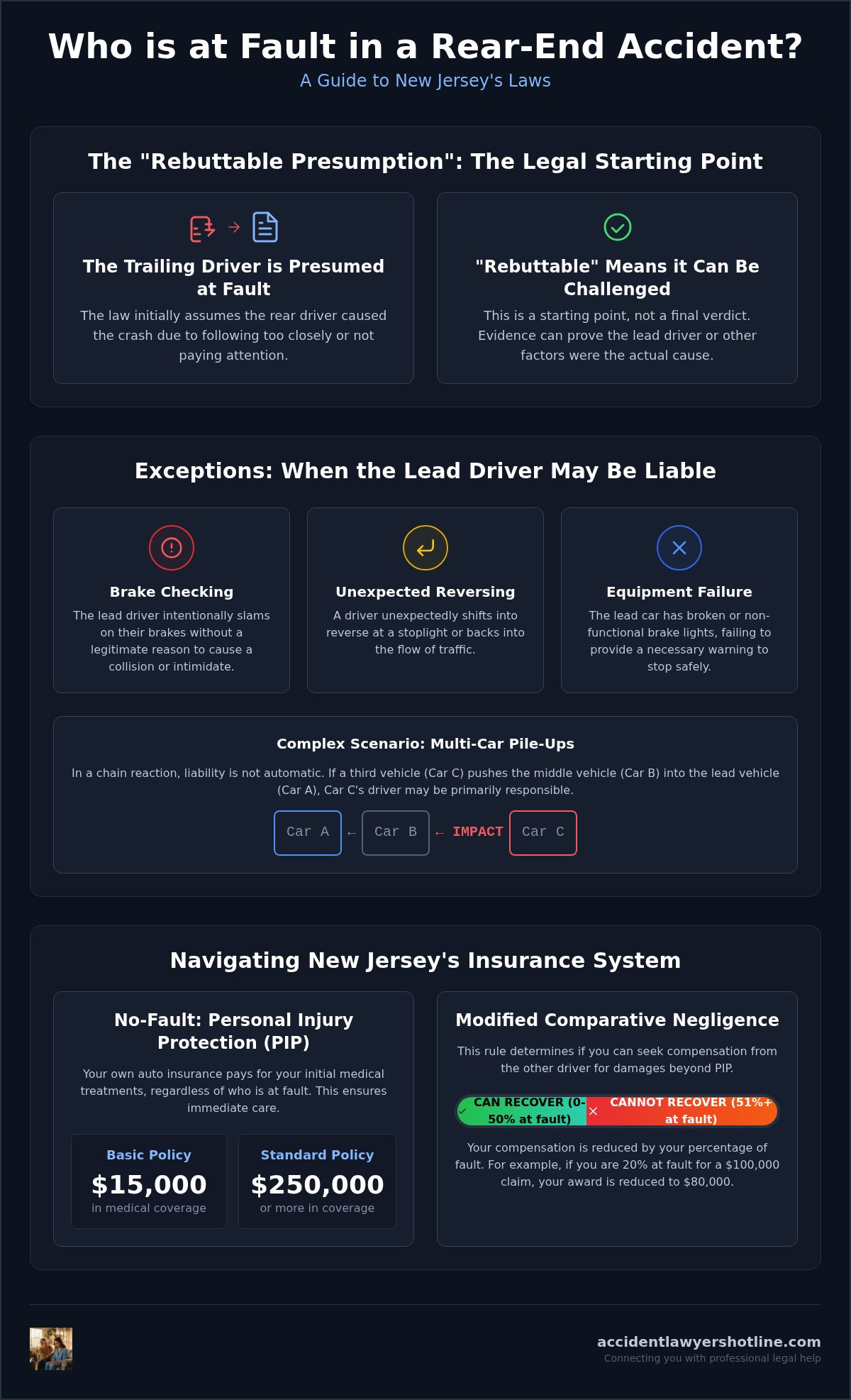
A Rear-end collision often seems like an open-and-shut case. In New Jersey, the legal system applies a "rebuttable presumption" of negligence against the trailing driver. This means the law starts with the assumption that the person in the back caused the crash. The logic is simple: every driver is expected to maintain a safe following distance. If you hit the car in front of you, the state's initial position is that you were following too closely or weren't paying enough attention to stop in time.
Why does this presumption exist? It's rooted in the expectation that you should always have enough space to react to the car ahead, even during sudden stops. However, determining who is at fault rear end accident nj isn't always that simple. "Presumed" fault is a legal starting point for investigations, but it isn't an absolute or automatic verdict. The word "rebuttable" is key. It means you have the right to present evidence that proves the lead driver, or even a third party, was actually the one at fault.
The law expects you to account for the unexpected. This "safe distance" isn't a fixed number of feet; it's a dynamic gap that changes based on your speed and the flow of traffic. If the lead driver's actions were so erratic that no reasonable person could have avoided the impact, the presumption of fault can be overturned. This is why a professional case evaluation is vital. It helps identify the specific evidence needed to prove you weren't the negligent party in a complex situation.
Situations Where the Lead Driver May Be Liable
Sometimes, the person in front is the one who broke the rules of the road. You can challenge the presumption of fault by proving the lead driver's negligence in several specific scenarios:
- Brake Checking: This occurs when a driver slams on their brakes intentionally to harass or "test" the person behind them without a legitimate reason.
- Unexpected Reversing: A driver might accidentally shift into reverse at a stoplight or backup into your vehicle while trying to navigate traffic.
- Equipment Failure: If the lead car has broken brake lights or fails to use hazard lights while disabled on the shoulder, they haven't given you the necessary warning to stop safely.
The Role of External Factors in Liability
Road conditions often complicate the question of who is at fault rear end accident nj. While ice or heavy rain doesn't excuse a driver from the requirement to maintain a safe distance, these factors play a major role in multi-vehicle pile-ups. In a three-car chain reaction, the middle driver might be pushed into the lead car by a third vehicle. In these cases, the initial presumption against the middle driver can often be defeated by showing they were stopped safely before being struck from behind.
Every driver in New Jersey has a legal duty of care to operate their vehicle with reasonable caution to prevent foreseeable harm to others. When a multi-car crash occurs, investigators must look at the "duty of care" of every participant. If a third party's negligence triggered the entire chain, they might bear the ultimate financial responsibility for the damages to every car involved.
New Jersey No-Fault Insurance and Comparative Negligence
Many people hear the term "No-Fault state" and believe it means liability doesn't matter. This is a common misunderstanding. In New Jersey, "No-Fault" refers specifically to Personal Injury Protection (PIP). Your own insurance company pays for your medical treatments regardless of who is at fault rear end accident nj. This system ensures you get immediate medical care without waiting for a legal battle to conclude. However, it does not mean the other driver is off the hook for your pain, suffering, or vehicle damage.
Understanding PIP and Medical Recovery
PIP coverage is a mandatory part of every NJ auto policy. If you have a "Basic" policy, your medical coverage might be limited to $15,000 per accident. In contrast, a "Standard" policy typically offers much higher limits, often up to $250,000. Most drivers also select a "limitation on lawsuit" or "verbal threshold" option. This choice restricts your ability to sue for non-economic damages unless your injury is considered permanent or catastrophic under state law. Navigating these limits is complex. If you are overwhelmed by medical costs, a car accident case evaluation can help you determine if your injuries allow you to bypass these restrictions and seek a full recovery.
How Partial Fault Affects Your Compensation
New Jersey follows a "modified comparative negligence" rule. This means the blame for a crash can be split between both drivers. For example, if you were rear-ended but one of your brake lights was out, you might be found 10% responsible while the other driver is 90% responsible. If your total damages are $100,000, your final settlement would be reduced by your 10% share, leaving you with $90,000. It's a system designed to be fair, but it also gives insurance companies an incentive to blame you.
The "51% Rule" is the most critical hurdle in this process. If a court or adjuster finds you are 51% or more at fault, you cannot recover any compensation from the other driver. Insurance adjusters are trained to shift even a small percentage of blame onto you to save their company money. They might argue you stopped too suddenly or failed to use a turn signal. Protecting your future means gathering evidence to prove the other driver carries the majority of the weight. Determining who is at fault rear end accident nj requires a careful look at the facts before the insurance company twists them to their advantage.
Critical Evidence Needed to Prove Rear-End Liability
The police report is often the most influential document in your initial claim. Officers at the scene assess the situation and record their findings, which insurance companies use to make an initial determination on who is at fault rear end accident nj. While the report isn't always the final word in court, a citation issued to the other driver provides powerful leverage during settlement negotiations. Beyond the official report, you must gather objective evidence to protect your side of the story. Physical evidence at the scene acts as a silent witness to the truth of the impact.
- Skid Marks: These marks indicate if and when a driver attempted to stop. A lack of skid marks often proves the rear driver never hit their brakes.
- Vehicle Damage Patterns: The location and depth of the dents can prove if a car was cut off or struck squarely from behind.
- Debris: The spread of glass and plastic helps investigators determine the exact point of impact on the roadway.
- Witness Statements: Neutral third parties who saw the crash provide a level of credibility that drivers involved in the accident simply cannot match.
Digital and Technical Evidence
Modern cars are equipped with Event Data Recorders, often called "black boxes." These devices capture speed, throttle position, and braking data in the seconds before a crash. If the rear driver claims they weren't speeding, this data provides the objective truth. Cell phone records are also vital. They can prove the other driver was texting or distracted at the exact moment of impact. Digital data from a vehicle's onboard computer serves as the foundation for proving proximate cause by establishing the exact sequence of events leading to the collision.
Documenting the Scene and Injuries
Take photos of everything immediately if it's safe to do so. You need wide shots to show the road layout and close-ups to capture the severity of the damage. This visual proof prevents insurance adjusters from downplaying the force of the collision. Dashcam footage is particularly valuable for refuting claims of "brake checking" or sudden lane changes. If you don't have a dashcam, nearby business security cameras might have captured the incident.
Medical records are equally important for your case. They don't just track your recovery; they serve as scientific evidence of the physical toll the impact took on your body. In complex cases where who is at fault rear end accident nj is still disputed, accident reconstruction experts can use this data to create a 3D model of the crash. This technical analysis leaves no room for insurance companies to hide behind vague arguments or denials. Gathering this evidence is the first step toward shifting the burden from your shoulders to the responsible party.
4 Essential Steps to Take After a Rear-End Crash
The moments following a collision are often a blur of adrenaline and confusion. Your first instinct might be to check your car, but your physical safety must come first. Move to the shoulder if you can and call 911 right away. A formal police report is a cornerstone of any legal claim. It provides an objective snapshot of the scene, which is essential when investigators determine who is at fault rear end accident nj.
Once you've secured the scene, follow these tactical steps to protect your interests:
- Exchange Information: Collect names, phone numbers, and insurance details from all drivers involved.
- Document the Scene: Use your phone to record video of the vehicle positions and take high-resolution photos of the damage.
- Identify Witnesses: Ask bystanders for their contact information before they leave the area.
- Prioritize Medical Care: Visit an emergency room or urgent care even if you feel uninjured.
Adrenaline is a powerful mask. You might feel "fine" at the scene only to wake up with debilitating neck or back pain the next morning. Whiplash and soft tissue injuries often take 24 to 48 hours to manifest. Seeing a doctor immediately creates a medical paper trail that links your injuries directly to the crash. This documentation is vital for your recovery and your claim.
The Danger of Admitting Fault
In the heat of the moment, you might feel the urge to apologize to the other driver. Don't do it. A simple "I'm sorry" can be interpreted as a legal admission of guilt. Insurance companies look for any reason to deny a claim. They will analyze every word you say to decide who is at fault rear end accident nj. When the police arrive, stick to the facts. Describe what happened clearly without speculating about your speed or the other driver's intentions. If an insurance adjuster calls you later, remember that you aren't required to give a recorded statement until you've spoken with a professional.
Securing Professional Legal Insight
New Jersey law gives you exactly two years from the date of the crash to file a personal injury lawsuit. This is known as the Statute of Limitations. While two years seems like a long time, evidence can disappear in a matter of days. Surveillance footage is often overwritten, and witnesses' memories begin to fade. Acting quickly ensures your rights are protected from the start. You can learn more about this process by reading Car Accident Case Evaluation: Knowing Your Legal Rights.
Don't let the insurance company decide your future. They often try to settle quickly for the lowest amount possible. A professional review of your situation helps you understand the true value of your claim. If you're ready to move forward, you can secure a car accident case evaluation today to start the process of restoring fairness.
How a Professional Case Evaluation Protects Your Future
Insurance companies have vast resources. They use them to minimize your settlement. Fighting them alone is a high-risk gamble that often leads to undervalued claims. You need a clear strategy to prove who is at fault rear end accident nj and ensure your medical bills are covered. A professional case evaluation acts as your first line of defense. It transforms a confusing mess of paperwork into a structured legal path. During this process, a specialist reviews your police report, medical records, and evidence to identify the strongest arguments for your recovery.
This evaluation isn't just a consultation. It's a strategic matching service. We analyze the specific details of your crash to connect you with a motor vehicle accident attorney who has a proven track record. This removes the guesswork from finding a lawyer. You get the peace of mind that comes from knowing an expert is reviewing your claim. The burden of proof rests on your shoulders, but you don't have to carry it alone.
Removing the Financial Barrier to Justice
Many victims hesitate to seek legal help because they fear high hourly rates. We eliminate that concern. Our referral network operates on a contingency fee basis. This means you don't pay any upfront costs for professional advocacy. You can learn more about this protective model by reading No Fee Unless We Win Your Case Attorney: Understanding Contingency Fees in 2026.
Under this arrangement, your attorney only receives a fee if they successfully secure a settlement or verdict for you. The fee is a pre-agreed percentage of the final recovery. This aligns your interest with your legal team's goals. They are motivated to maximize your compensation because their payment depends on it. It's a risk-free way to ensure you have a formidable advocate in your corner without risking your personal savings.
Connecting with the Right Advocate
A general lawyer might handle everything from contracts to divorces. However, a specialized car accident lawyer understands the specific nuances of New Jersey's 2026 insurance reforms. They know how to challenge an adjuster's claim about who is at fault rear end accident nj when the facts are in your favor. This specialization is the difference between a denied claim and a successful resolution. We handle the complexity of the search so you can focus on your physical recovery.
You deserve a "calm in the storm" during this difficult time. Our process is designed to be fast, direct, and highly efficient. Don't let the clock run out on your right to compensation. Take the first step toward restoring fairness today. Get Your Free Car Accident Case Evaluation Now and shift the burden of your claim to a capable professional.
Take Control of Your Recovery Today
You've learned that determining who is at fault rear end accident nj involves more than just a simple assumption about the driver in the back. While New Jersey law begins with a presumption of negligence, your success depends on proving the specific facts of your case through objective evidence and expert analysis. Navigating the 2026 insurance minimums and modified comparative negligence rules is a heavy burden to carry while you are trying to heal. You deserve a clear path forward that focuses on your physical and financial restoration.
You don't have to face the insurance companies alone. Our experienced attorney network is ready to handle the legal complexities on your behalf. We offer free comprehensive evaluations to help you understand the true value of your claim without any initial cost. Best of all, there is no fee unless your case is won. This risk-free approach ensures that financial barriers never stand in the way of the justice you deserve. We take charge of the difficult situations so you can focus on getting back to your life.
Restoring fairness starts with a single, decisive step. Start Your Free Car Accident Case Evaluation Today and move forward with the confidence of a professional advocate in your corner. You have the right to be heard; let's secure your future together.
Frequently Asked Questions
Is the driver who hits you from behind always at fault in New Jersey?
No. While New Jersey law applies a rebuttable presumption of fault against the trailing driver, it is not an absolute rule. The rear driver is expected to maintain a safe following distance, but the lead driver can be held liable in specific scenarios. Evidence of "brake checking," reversing unexpectedly, or operating a vehicle with broken brake lights can shift the legal responsibility. Every case requires a detailed investigation to determine the truth.
Can I sue for a rear-end accident if New Jersey is a no-fault state?
Yes, you can sue, but certain conditions must be met first. New Jersey's no-fault system means your own Personal Injury Protection (PIP) insurance covers your initial medical bills regardless of who is at fault rear end accident nj. To sue the other driver for pain and suffering, your injuries must typically meet the "verbal threshold" defined in your policy. Permanent injuries or those involving significant scarring often allow victims to bypass these legal restrictions.
What if the lead driver slammed on their brakes for no reason?
If the lead driver "brake checked" you or stopped maliciously without cause, they may be found partially or fully at fault. While you have a duty to maintain a safe distance, the law does not protect drivers who create intentional hazards. Proving this usually requires objective evidence like dashcam footage or neutral witness statements. If the lead driver's negligence was the primary cause of the impact, the standard presumption of fault can be overturned.
How much is a typical rear-end accident settlement in NJ?
Settlement amounts vary based on the severity of your injuries and the insurance policies involved. As of January 1, 2026, New Jersey's minimum bodily injury liability limits increased to $35,000 per person and $70,000 per accident. Your recovery depends on factors like total medical costs, lost wages, and the impact on your quality of life. A professional case evaluation is the most effective way to understand the potential value of your specific claim.
How long do I have to file a lawsuit after a rear-end collision?
You generally have exactly two years from the date of the crash to file a personal injury lawsuit in New Jersey. This deadline is known as the Statute of Limitations. If you fail to file within this window, the court will likely dismiss your case regardless of its merits. Acting quickly is essential. Early legal intervention prevents critical evidence from disappearing and ensures that witness memories remain fresh for your claim.
What happens if I was partially at fault for the accident?
You can still recover damages as long as you are not more than 50% responsible for the crash. New Jersey follows a modified comparative negligence rule. This means your final compensation is reduced by your percentage of fault. For example, if you are found 20% responsible, you would receive 80% of the total damages. Determining who is at fault rear end accident nj is a complex process that adjusters often use to minimize payouts.
Do I need a lawyer if the insurance company offered me a settlement?
You should always have a settlement offer reviewed by a professional before signing anything. Insurance companies often offer quick, low settlements to avoid paying the full cost of long-term medical care or future lost wages. Once you accept an offer, you waive your right to seek additional funds later. A car accident attorney ensures the settlement reflects the true extent of your damages. This protection is vital for your financial security.
What should I do if the other driver doesn't have insurance?
You would file an Uninsured Motorist (UM) claim through your own insurance policy. New Jersey law requires your UM coverage to match the state's 2026 liability minimums of at least $35,000 per person. Your insurance company takes the place of the at-fault driver's missing policy to pay your damages. These claims can be technically difficult and adversarial. A professional case evaluation helps you navigate your own policy's requirements to ensure you receive the benefits you paid for.
Were You Injured in an Accident?
Get a free, confidential case evaluation. No upfront fees.
Get Free Case Evaluation