Why Avoid TV Lawyers? What to Check Before Choosing in 2026
Learn why not to use a TV lawyer without research. Discover what ads hide, key questions about fees, and how to find the right accident attorney for your case.
What if the lawyer who feels familiar from TV isn’t the person who handles your accident case? It’s reasonable to notice a polished ad, but an ad can’t tell you whether an attorney has experience with cases like yours or whether you’ll feel heard. If you’re wondering why not to use a TV lawyer, the answer isn’t that every lawyer who advertises on television is a poor choice. It’s that an advertisement is a lead, not proof of fit.
After an accident, you may already be managing pain, appointments, and uncertainty. You shouldn’t have to guess who will take your calls or what a fee agreement means. Look beyond slogans, awards, and dramatic claims so you can make an informed choice without feeling rushed.
This article explains what an ad can and can’t tell you, what to ask about relevant experience and case responsibility, and how to clarify communication and fees before you decide. A case evaluation can help you explore possible next steps, but it doesn’t guarantee representation or a particular outcome. The goal is to make a choice based on clear answers, not pressure.
Key Takeaways
- A TV lawyer is simply an attorney who advertises on television. It is not a special credential or a measure of case fit.
- When weighing why not to use a TV lawyer, focus on unanswered questions, not screen time. Check relevant experience, who would handle your case, and how the firm communicates.
- Verify an attorney’s professional standing through the appropriate state authority. Requirements and available records vary by state.
- Compare attorneys by their answers and written fee terms, not by firm size, advertising style, awards, or dramatic claims.
- Prepare a brief case summary, gather available records when practical, and take time to understand an agreement before deciding.
Why not to use a TV lawyer? Start with what the ad cannot tell you
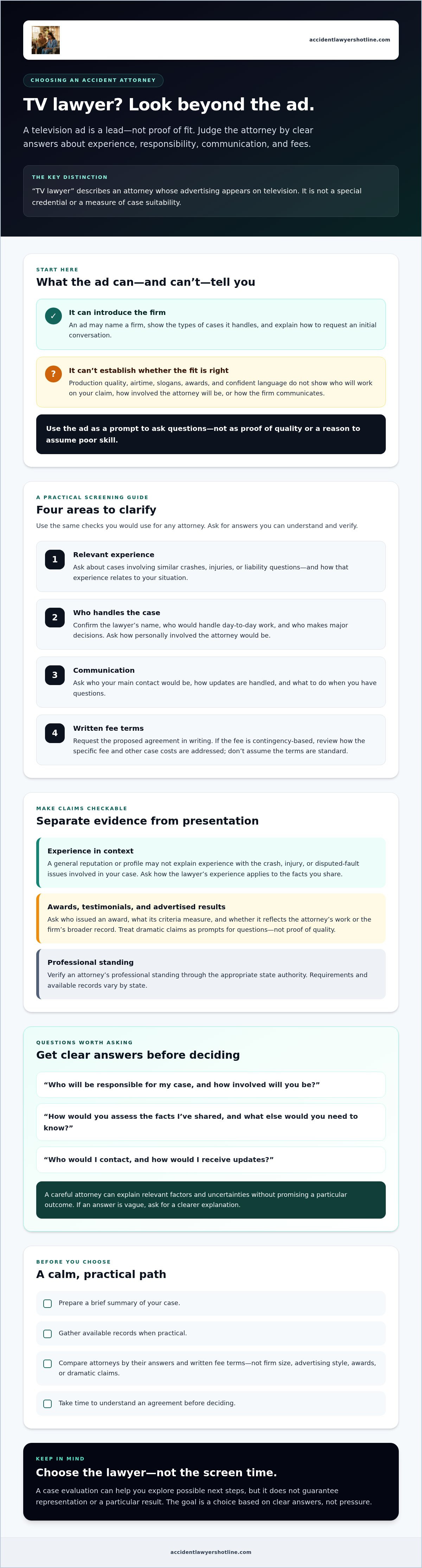
Seeing a lawyer on television isn’t, by itself, a reason to hire or reject them. “TV lawyer” describes an attorney whose advertising appears on television. It isn’t a formal credential or a measure of ability. If you’re asking why not to use a TV lawyer, start with what the ad leaves unanswered, not with the fact that it aired.
Television visibility is marketing, not an independent measure of case suitability. A polished commercial may make a firm easy to recognize, but it can’t establish whether its attorneys have handled claims like yours, who would be responsible for your case, or how clearly the firm will communicate with you.
An ad may name a firm, show the types of cases it handles, and explain how to request an initial conversation. For broader background, Wikipedia’s overview of the history and regulation of legal advertising describes how legal advertising has used different media, including television. The commercial itself, though, isn’t a substitute for asking direct questions about the attorney and the proposed arrangement.
What a television advertisement can and cannot show
Production quality, airtime, slogans, and confident language tell you how a message was presented, not who will work on your claim. An ad also can’t establish an attorney’s current caseload, personal involvement, or communication style. Ask who would be your main contact, which attorney would make decisions about the case, and how you can expect updates. Clear answers give you more useful information than a memorable tagline.
Why a blanket warning about TV lawyers is misleading
Some attorneys who advertise on television may have relevant experience. Others may not be the right fit for your situation. Neither conclusion follows from advertising alone. Treat broad claims, awards, and dramatic language as prompts to ask what they mean and how you can verify them. They are not proof of quality or a reason to assume poor ethics or skill.
Judge the actual attorney and firm using information you can check and answers you can understand. A case evaluation can help you explore possible next steps, but it doesn’t guarantee representation or a particular result. You’re entitled to gather information and decide whether the attorney’s experience, involvement, and approach fit your needs.
How to evaluate a TV lawyer beyond slogans, awards, and case results
Once you’ve looked past the commercial, use the same practical checks you’d use for any attorney. The question isn’t simply why not to use a TV lawyer. It’s whether the attorney and firm can explain their experience, responsibilities, communication practices, and fee terms clearly enough for you to make an informed choice.
Relevant, verifiable experience explained in context is more useful than a general reputation. A lawyer’s profile may not tell you whether they’ve handled cases involving the kind of crash, injury, or disputed fault issues in yours. The Federal Trade Commission’s FTC guide on hiring a lawyer also encourages consumers to ask direct questions about experience, fees, and case handling.
- Relevant experience: Ask about cases involving similar crashes, injuries, or liability questions. Then ask how that experience relates to your situation.
- Attorney identity: Confirm the name of the lawyer you’re speaking with and who would handle day-to-day work. Ask who makes major decisions about the case.
- Communication: Ask who your contact would be, how updates are handled, and what to do if you have questions.
- Written fee terms: Request the proposed agreement in writing. If the attorney works on a contingency basis, review how the specific fee and other case costs are addressed instead of assuming the terms are standard.
Questions to ask about experience and case responsibility
Try asking, “Who will be responsible for my case, and how involved will you be?” Then ask how the attorney would assess the facts you’ve shared and what additional information they’d need. A careful lawyer can discuss relevant factors and uncertainties without promising a particular outcome. If an answer is vague, ask for a clearer explanation before deciding.
How to interpret awards, testimonials, and advertised results
An award may provide useful context, but ask who issued it, what its criteria measure, and whether it reflects the attorney’s work or the firm’s broader record. Testimonials and reported results also need context. Another case may have involved different injuries, evidence, insurance, or legal issues. A past result doesn’t predict what will happen in yours.
Separate a firm’s promotional claims from information you can verify independently. You can check an attorney’s license and any publicly available disciplinary information through the appropriate state authority. Procedures and available records vary, so consult the relevant authority for the state where the lawyer is licensed. A case evaluation may help you explore possible next steps. Accident case evaluation options connect people with independent attorneys for potential legal assistance. Accident Lawyers Hotline is a referral platform, not a law firm, and doesn’t provide legal advice or direct representation.
TV lawyer or another attorney? Compare the service, not the screen time
To decide whether a TV-advertising firm or another attorney may fit, compare what each offers in practice. A large firm isn’t automatically less personal, and a smaller firm isn’t automatically more attentive. Screen time and production style don’t establish service quality. The concern behind “why not to use a TV lawyer” is better answered by finding out who will actually be responsible for your case.
A familiar spokesperson may appear in commercials without managing every client’s day-to-day legal work. Ask the same questions of each attorney or firm you consider:
| What to compare | Questions to ask |
|---|---|
| Attorney identity | Who would represent me if we proceed? Who would handle routine work and make major case decisions? |
| Relevant experience | What experience do you have with crashes, injuries, or liability issues like mine? |
| Communication | Who would answer my questions, and how would I receive updates? |
| Case handling | What investigation or next steps might be appropriate? What could affect the timing? |
| Fee terms | Can I review the proposed fee agreement in writing, including how fees and case costs are handled? |
What to compare during an initial conversation
Pay attention to more than who takes the first call. Does the attorney explain who manages the file, how updates work, and what steps may make sense based on the information available? You don’t need a guaranteed timeline. You do need clear answers, room to ask follow-up questions, and an explanation of what remains uncertain.
If your accident involved a commercial truck, the investigation and liability questions may differ from those in other crashes. Review this truck accident lawyer selection guide for questions to consider.
How representation and referral services differ
A law firm may directly represent you after you and the firm agree to the terms and sign a representation agreement. Accident Lawyers Hotline is different: it evaluates accident cases and connects people with independent attorneys for potential legal assistance. The platform is not a law firm and doesn’t provide legal advice or direct representation. A case evaluation can help you consider possible next steps, but it doesn’t guarantee a match, representation, or a particular outcome.
Before hiring a TV lawyer, use these practical screening steps
A short plan can make conversations easier to manage, especially if you’re recovering from an accident. These steps can help you compare attorneys and understand what you’d be agreeing to before you decide. Don’t delay urgent medical care to collect paperwork.
- Prepare a brief case summary. Note when and where the crash happened, who was involved, and any injuries you know about. Gather available crash, medical, and insurance information if you can. You don’t need a complete file to ask initial questions.
- Speak with the attorney. Ask who would handle your case, what experience they have with similar accidents or issues, how you’d receive updates, and what next steps may be appropriate. Write down questions beforehand so you don’t have to remember everything during the conversation.
- Compare the answers. If you speak with more than one attorney, compare how clearly each explains the process, who would be responsible for the work, and whether you feel comfortable asking follow-up questions. Don’t treat a confident prediction as a guarantee.
- Review the agreement before signing. Read the representation agreement carefully. Ask about fees, case expenses, when expenses may be owed, and what happens if there’s no recovery. Clarify how you or the attorney can end the representation and what that could mean for fees or expenses.
Prepare for a consultation without overcomplicating it
A few notes are enough to get started. Keep your immediate questions focused on attorney identity, communication, relevant experience, and possible next steps. Don’t post sensitive details publicly. Before sharing private information through a website, phone call, or other channel, ask how it will be handled and who may receive it.
Understand the fee agreement before deciding
Ask whether the attorney works on a contingency basis and how the fee would be calculated under the specific agreement. Confirm how case expenses are treated, including what may happen if there’s no recovery. Terms can vary by attorney, so get answers in writing and take time to understand them. For more detail, read this contingency-fee agreement guide.
These steps can help replace “why not to use a TV lawyer” with a more useful question: does this attorney’s experience, communication, and written agreement fit what I need? If you’re exploring options after a car crash, a car accident case evaluation can help you learn about potential next steps. An evaluation doesn’t guarantee representation or a particular outcome.
Choose your next step based on the lawyer, not the TV ad
The useful question isn’t simply why not to use a TV lawyer. It’s whether a particular attorney is right for your needs. Consider whether the attorney explains things clearly, has experience relevant to your situation, identifies who will handle the work, and provides written terms you understand. A familiar face or persuasive commercial can’t answer those questions for you.
You can ask for clarification and take time to review an agreement before deciding. If you’re unsure about a fee, expense, or other term, ask the attorney to explain it in plain language. Don’t sign because you feel rushed. At the same time, don’t let the search for a lawyer delay urgent medical care or prevent you from asking about time-sensitive legal issues.
When a case evaluation may help clarify options
A case evaluation gives you an opportunity to discuss the circumstances of an accident and explore potential legal next steps. Accident Lawyers Hotline offers evaluations for car, truck, motorcycle, pedestrian, and bus accidents, and connects people with independent attorneys for potential legal assistance. It’s a referral platform, not a law firm. It doesn’t provide legal advice or direct representation, and an evaluation doesn’t promise that a claim will succeed or that an attorney will accept it.
What to confirm before moving forward with an attorney
If an independent attorney contacts you or discusses your matter, confirm who they are, what role they would have, and whether they’re willing to handle your specific case. Before agreeing to representation, review the written agreement. Ask about any unclear fee or expense terms, and make sure you know who would be responsible for your case.
Rules and deadlines can vary by state and depend on the circumstances. Ask an attorney for advice about your specific situation, especially if you’re concerned about a deadline. An evaluation can be a starting point for exploring options, not a substitute for legal advice or a guarantee of a particular attorney or outcome.
If you’d like to explore possible next steps after a motor vehicle accident, you can request a case evaluation through Accident Lawyers Hotline. Focus on clear answers, relevant experience, responsibility for the case, and terms you understand rather than deciding based on an advertisement alone.
Make your next step with confidence
The best choice isn’t determined by how often you’ve seen a lawyer on television. If you’re still asking why not to use a TV lawyer, remember that the ad alone can’t establish whether an attorney is right for your case. Focus on what you can confirm: relevant experience, who will handle the matter, clear communication, and written terms you understand.
You can ask questions and take time to review an agreement before deciding. If you’d like to explore possible next steps after a car accident, Accident Lawyers Hotline is a national case-evaluation and referral platform that connects accident victims with independent attorneys. Some participating attorneys may work on a contingency basis, but fee terms vary and should be confirmed directly with the attorney. An evaluation doesn’t guarantee representation or a particular result.
Request a car accident case evaluation to discuss your circumstances and consider potential next steps. You deserve clear information and the space to make a decision that feels right for you.
Frequently Asked Questions
Is a TV lawyer less qualified than a lawyer who does not advertise?
No. Television advertising is a marketing choice, not proof that an attorney is more or less skilled. Ask which lawyer would handle your matter and what experience they have with similar accidents or legal issues. You can also check licensing and available disciplinary information through the relevant state authority. Weigh what you verify alongside the attorney’s communication and written agreement, rather than treating an advertisement as a credential.
Can a TV lawyer personally handle my car accident case?
Possibly, but an advertisement can’t tell you who would manage your case. Ask whether the lawyer featured in the commercial would be responsible for your matter, who would handle routine work, and how you could contact the responsible attorney. Before signing, confirm that the representation agreement identifies the attorney or firm representing you. If the answers are unclear, ask for clarification before deciding whether to proceed.
How do I know whether a TV lawyer has experience with my type of accident?
Ask about cases involving crash circumstances, injuries, and liability questions similar to yours. Find out what role the attorney played and how that experience relates to your situation. Past outcomes can offer context, but they don’t predict what will happen in your case. You can also check licensing and available disciplinary information with the relevant state authority. Procedures and public records vary by state.
What should I ask a TV lawyer during a consultation?
Ask who will handle your case, how you’ll receive updates, and what experience applies to your accident. Find out what next steps may be appropriate without expecting a guaranteed timeline or result. Discuss how the attorney’s fee is calculated, how case expenses are handled, and what happens if there’s no recovery. Read the proposed representation agreement and ask for plain-language explanations of anything you don’t understand.
Do TV lawyers charge more than other personal injury attorneys?
Not necessarily. Advertising alone doesn’t establish what an attorney will charge. Fee arrangements depend on the attorney and the written agreement. Ask whether the lawyer works on a contingency basis, how the specific fee is calculated, and who may be responsible for case expenses. Review those terms in writing and compare agreements directly. Don’t assume that a firm’s size, advertising style, or television presence determines the cost of representation.
Should I avoid a lawyer who advertises a large settlement or verdict?
Not automatically, but a headline result doesn’t show whether the attorney is right for your case or predict your outcome. Ask what role the lawyer played and whether the matter involved facts similar to yours. Treat awards, testimonials, and advertised results as information to examine, not guarantees. Also consider the attorney’s relevant experience, communication, responsibility for your case, and the terms in the proposed agreement.
Can Accident Lawyers Hotline represent me in court?
No. Accident Lawyers Hotline is a case-evaluation and referral platform, not a law firm, and it doesn’t provide legal advice or direct representation in court. It evaluates motor vehicle accident cases and connects people with independent attorneys for potential legal assistance. Any decision to accept representation and the terms of an attorney-client relationship are between you and the attorney. A referral or evaluation doesn’t guarantee that an attorney will accept your case.
Were You Injured in an Accident?
Get a free, confidential case evaluation. No upfront fees.
Get Free Case Evaluation