Accident Caused by Poor Road Conditions in Michigan: When Can You File a Claim
An accident caused by poor road conditions in Michigan may support a claim. Learn who may be liable, what evidence helps, and the 120-day notice deadline.
A road-defect claim can have a short deadline. If an accident caused by poor road conditions injures you, local or state laws often require you to notify the responsible government agency of the injury and road defect within a strict timeframe, such as 120 days from the accident. A claim may be possible when an unsafe public road caused bodily injury or property damage, but the responsible agency and the facts matter.
It’s understandable to wonder whether a pothole, damaged pavement, or another hazard can make someone legally responsible for a crash. Key questions include who maintained that stretch of road, whether the agency knew or should have known about the danger, and whether it had a reasonable opportunity to address it.
This article explains which government agencies may maintain roads, what evidence can show how a hazard contributed to a crash, and how potholes and other defects can damage vehicles or cause collisions. It also covers notice deadlines and circumstances that may support a claim, helping you understand what to consider after an accident caused by poor road conditions. If you need immediate guidance, the team at Accident Lawyers Hotline is here to help you navigate your legal options.
Key Takeaways
- A claim may be possible when an unsafe public road causes injury or property damage, but identifying the agency responsible for that road section is essential.
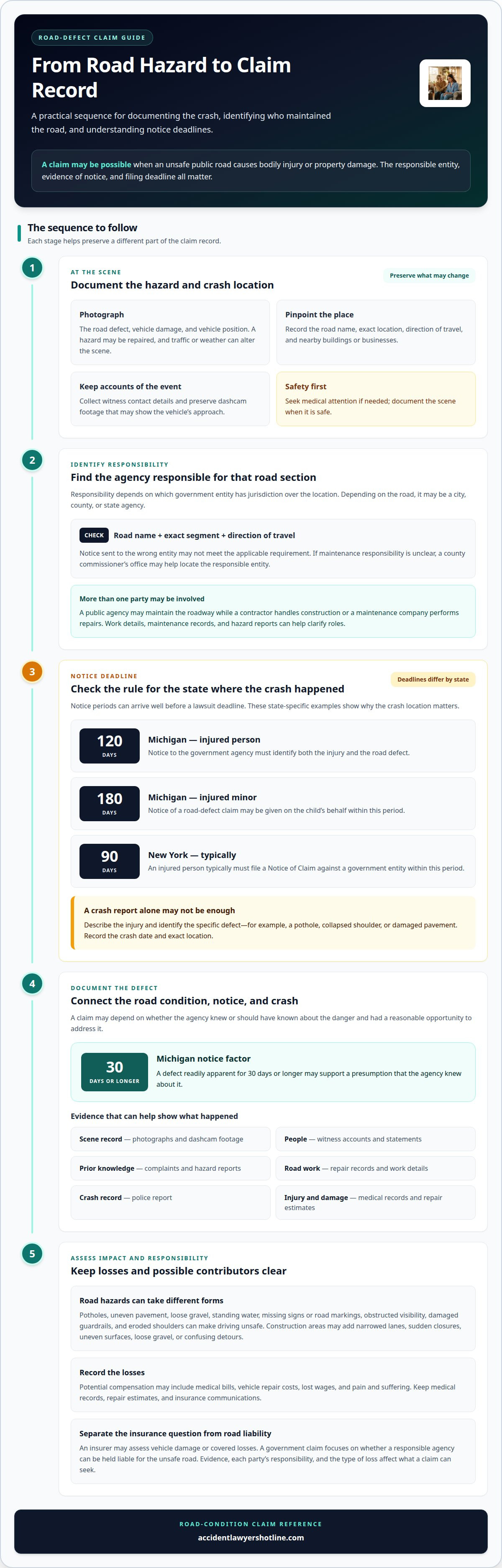
- Michigan requires notice to the government agency within 120 days of the accident. A defect readily apparent for 30 days or longer may support a presumption that the agency knew about it.
- Photographs, dashcam footage, witness accounts, repair records, and prior complaints can help show what the hazard was and whether it had been reported.
- Potholes, uneven pavement, standing water, and missing road markings can contribute to crashes, vehicle damage, or loss of control.
- Learn how road-condition accident data puts Michigan’s road-safety concerns in context and what factors can affect a claim.
Can You File a Claim Against the Government?
Yes, a claim may be possible when a dangerous public-road condition causes bodily injury or property damage. The responsible entity, evidence of notice, and filing deadline all matter.
Identifying the Responsible Government Entity
The responsible government entity is the agency with jurisdiction over the road section where the crash occurred. Depending on the road, that may be a city, county, or state agency.
Identifying the right agency matters because notice sent to the wrong entity may not meet the applicable requirement. Pinpoint the location, road name, and direction of travel, then identify which government maintains that segment. A county commissioner’s office may help locate the responsible entity if ownership or maintenance responsibility is unclear.
Notice Requirements for Government Claims
Notice deadlines can arrive well before a lawsuit deadline, so identify the applicable rule promptly. In Michigan, an accident victim must notify the government agency of the injury and road defect within 120 days of the accident, according to the Michigan Legislature. The notice needs to identify both the injury and the defect, not merely report that a crash occurred.
For an injured minor, notice of a Michigan road-defect claim may be given on the child’s behalf within 180 days of the accident, according to the Michigan Legislature. New York has a different deadline: an injured person typically must file a Notice of Claim against a government entity within 90 days of an accident, according to the New York State Legislature. These state-specific examples show why the location of the crash matters.
When preparing notice, record the crash date, exact location, injuries, and dangerous road condition. Describe a pothole, collapsed shoulder, or damaged pavement clearly enough to identify the hazard. Missing a required notice period can complicate a claim before repair or compensation questions are even considered.
Shared Liability for Road Conditions
Shared liability means more than one party may have contributed to a dangerous condition or failed to address it. A city or county may maintain the road, while a contractor handles construction or a maintenance company carries out repairs.
For example, a public agency may be responsible for a roadway while a contractor’s work leaves uneven surfaces or loose material. Maintenance records, road-work details, and hazard reports can help clarify who controlled the area and what each party knew. A claim may involve more than one entity.
Insurance and Compensation Effects
Insurance claims and claims against a government entity are separate considerations after a road-condition crash. An insurer may assess vehicle damage or covered losses, while a government claim focuses on whether a responsible agency can be held liable for the unsafe road.
Potential compensation may include medical bills, vehicle repair costs, lost wages, and pain and suffering. The available evidence, each party’s responsibility, and the type of loss affect what a claim can seek. Keep repair estimates, medical records, and insurance communications to document the damage and its connection to the crash.
What Constitutes Hazardous Road Conditions?
Hazardous conditions include defects or obstacles that make driving unsafe, such as potholes, uneven pavement, loose gravel, standing water, and missing signs. Faded lane markings, obstructed visibility, damaged guardrails, and eroded shoulders can also confuse drivers or leave them less room to recover. Whether a condition contributed to a crash depends on the road surface, visibility, traffic, and the vehicle’s response.
Construction areas can create several hazards at once. A narrowed lane, sudden closure, uneven surface, loose gravel, or confusing detour may force a driver to brake or change direction unexpectedly. Work zones should be clearly marked and reasonably safe for passing drivers. For example, a faded temporary lane line beside a fresh detour marking can make the route unclear. Construction companies and government entities may have different roles in maintaining the roadway, so details about the work area can matter.
Water can also change how a road behaves. Standing water may reduce tire traction and make steering, braking, or accelerating more difficult. Flooding can hide potholes, debris, or downed power lines beneath the surface. A driver encountering pooled water may lose control or hydroplane, while a shoulder drop-off can jolt a vehicle and contribute to a tire blowout or rollover. These examples show why both the road condition and the vehicle’s path deserve attention.
After a crash involving a pothole or another road hazard, seek medical attention if needed and document the scene when it’s safe. Photograph the defect, vehicle damage, and vehicle position, then record the road name, direction of travel, and exact location. Note nearby buildings or businesses and collect witnesses’ contact details. This can preserve information before the hazard is repaired or the scene changes.
Evidence can be difficult to preserve because crews may repair dangerous surfaces after a crash, while traffic or weather can alter the scene. Clear photographs can show the hazard’s location and appearance, and dashcam footage may capture the vehicle’s approach. Keep police reports, witness statements, medical records, and vehicle-damage documentation together. If the defect is no longer visible, records of prior complaints or road repairs may help show its history.
Defensive driving can reduce the chance of losing control on uneven or wet roads. Slow down when visibility or traction worsens, leave more distance between vehicles, and avoid sudden steering or braking near a pothole or loose gravel. In winter conditions, prepare the vehicle for winter driving and adjust speed on icy roads. These steps can help drivers respond to hazards, but they don’t establish who caused a crash.
Road hazards can cause drivers to swerve into nearby traffic, lose control, or blow a tire. A pothole or large crack encountered at speed may destabilize a vehicle, and loose debris can strike a windshield. Documenting the road defect alongside the resulting damage helps connect the condition to the crash and any injuries.
Potholes and vehicle damage
An accident caused by poor road conditions can damage a vehicle, cause a driver to lose control, or force a sudden move into traffic. Depending on the crash and its effects, potential damages may include medical bills, vehicle repairs, lost wages, and pain and suffering.
Pothole Causes and Roadway Deterioration
Potholes develop as roadway surfaces weaken, often because of extreme weather, heavy use without maintenance, or improper construction. Cracks can let water reach lower pavement layers, while repeated traffic wears down weakened areas. As the surface breaks apart, an unrepaired pothole can grow and spread beyond its original location.
The defect’s size and surrounding damage can help explain how the impact happened. A broken edge or network of cracks may show that deterioration extended beyond the hole itself. Photographs of the pothole and nearby pavement can capture its condition before repair work changes the roadway.
Damage may develop in stages. A small crack can deepen, then break into loose pavement under passing traffic. Photographing the surrounding surface gives a fuller picture than a close-up of the hole alone.
Cracked Pavement and Pothole Damage
Cracked pavement can indicate a weakened surface, while a pothole creates a sudden drop that can strike tires, wheels, and suspension parts. Hitting one at speed may cause a tire blowout or damage the suspension or axle. The impact can also jolt the driver and make steering difficult.
Other damage can follow. Loose debris may hit the windshield, and uneven pavement can reduce traction, particularly in rain. An inspection and repair records can help identify which parts were damaged and whether the damage followed the road impact.
Keep photographs of the vehicle and records of repairs or replaced parts. Pairing them with images of the pothole can help connect a particular impact to the resulting damage, rather than relying only on a general account of the crash.
Pothole-Related Crashes
A pothole-related crash may happen when a driver loses control, swerves to avoid a hole, or blows a tire after impact. A sudden move can send a vehicle into nearby traffic. Motorcycles may become unstable when a tire strikes a deep or uneven surface.
Speed, visibility, traffic, and the vehicle’s path shape how an incident unfolds. For example, water may conceal a pothole until the driver is close. An accident caused by poor road conditions can involve a collision after a swerve, even if the vehicle never strikes the defect.
Preserve records that show both the sequence of events and the harm. Photographs, witness accounts, police reports, medical records, and vehicle inspections can help document how the pothole contributed to the crash and resulting injuries or repairs.
Who is Responsible for Maintaining Safe Highways, Roads, and Streets in Michigan?
In Michigan, responsibility generally rests with the government agency that has jurisdiction over the public road. A claim can depend on which agency controlled the location and what it knew about the hazard.
Maintenance Records and Prior Complaints
Maintenance records and prior complaints can document when an agency learned about a road defect and what action followed. They may help show whether the hazard was reported and addressed in a timely manner.
For example, a complaint describing a broken pavement edge may help show that the agency received notice before a crash. Repair logs, inspection records, work orders, and complaint details can add context. Along with photos or witness accounts, these records may help establish how long the hazard existed and whether repairs were made.
Inadequate Road Maintenance
Inadequate maintenance means a road condition was not kept in reasonable repair or left reasonably safe and convenient for public travel. Michigan law places that responsibility on government agencies with jurisdiction over public roads.
A missing guardrail, unrepaired pothole, or eroded shoulder may raise questions about maintenance. The condition alone does not establish liability. The timing, the agency’s knowledge, and its opportunity to respond also matter when assessing whether a lawsuit may be supported.
Michigan’s public roads may fall under state, county, or city jurisdiction. The responsible agency depends on the specific road segment, not simply the city or town where the crash occurred. Record the road name, direction of travel, and precise location to help identify the correct entity. A county commissioner’s office may help locate the agency responsible for a particular section.
Knowledge of a defect is important. According to the Michigan Legislature, an agency’s knowledge of a road defect can be presumed if the defect was readily apparent for 30 days or longer before the accident. That presumption can make evidence about the defect’s visibility and duration especially relevant. Photos, dated reports, and repair records may help establish those details.
Government agencies may use public reporting systems to receive hazard complaints, while contractors or maintenance companies may perform repairs. A report should identify the location and describe the hazard clearly, such as a sunken roadway surface near an intersection. Keep a copy or record of the report, including its date, because it may help show when the responsible parties learned about the condition.
Responsibility can involve more than one party. A government entity may control the road, while a contractor performs construction or a maintenance company handles repairs. Records showing who managed the work, received complaints, or completed repairs can help clarify each party’s role. A contractor or maintenance company may also be liable in some cases, depending on its connection to the hazard.
Road maintenance budgets and inspection practices can affect how quickly hazards are found and repaired, but an unsafe surface alone does not establish a valid claim. Evidence must connect the road condition, the responsible parties, and the resulting crash. Maintenance histories and prior complaints can help clarify that connection.
Road-condition accident statistics
Michigan’s road-condition figures show why maintenance deserves attention, but they don’t explain every crash. TRIP reported that nearly a quarter of Michigan’s roads were in poor condition. TRIP also projected that roughly half could be rated poor by 2031. These figures describe road conditions, not the cause of a particular collision.
That distinction matters when assessing a serious crash. A statewide estimate cannot establish that a specific pothole, missing sign, or failed shoulder caused injuries. In an individual case, the important question is how the road condition affected the vehicle and whether available evidence connects it to the crash.
TRIP’s projection gives a broad view of possible deterioration, not a forecast for every street. A state highway, county road, and city street can have different conditions and maintenance histories. For example, a poor rating somewhere in Michigan doesn’t show whether a road at a particular intersection had a defect on the crash date.
Statistics can help frame the issue. When a large share of roads receives a poor rating, road maintenance and repair become important public concerns. But a claim requires details about the actual location, such as the surface defect, visibility, traffic flow, and vehicle damage. A general statewide figure cannot replace that evidence.
For an individual crash, the useful record is specific: the road name, direction of travel, defect location, and date. Photographs, dashcam footage, witness accounts, and repair records can help describe the scene. These details show what drivers encountered, rather than relying on a statewide estimate to explain a collision.
Road-condition numbers also don’t identify who was responsible for a particular stretch. Michigan roads can fall under state, county, or local jurisdiction. Pinpointing the location helps identify the responsible entity and the maintenance history relevant to that road. A poor-road statistic alone doesn’t establish that an agency failed to act.
For a lawyer reviewing a roadway case, the central task is connecting the condition to the harm. The review can consider the crash sequence, reported injuries, vehicle damage, photographs, and road records. A statewide figure can provide context, while location-specific evidence helps explain whether a road hazard contributed to the collision.
The practical takeaway is to treat statistics as context, not proof. TRIP’s Michigan figures highlight broad concerns, while the facts at the crash scene show what happened to individual drivers. If road conditions contributed to a motor vehicle collision, request a motor vehicle accident case evaluation to discuss the evidence and potential next steps.
Accident Lawyers Hotline
Accident Lawyers Hotline provides case evaluations for people whose crashes may involve unsafe road conditions. An evaluation can help clarify how the road hazard, crash evidence, injuries, and maintenance records relate to potential claims. The service connects people with experienced personal injury and motor vehicle accident attorneys for legal assistance.
Consider an evaluation if a pothole, uneven pavement, or construction hazard may have contributed to your crash, or if you’re unsure which agency maintained the road. Case evaluations are available for car, truck, motorcycle, and pedestrian accidents.
To discuss your situation, contact Accident Lawyers Hotline.
Take the Next Step With a Clear Plan
After an accident caused by poor road conditions, conflicting accounts, vehicle damage, and ongoing recovery needs can make it hard to know what to do next. Start by putting the events in order: what you encountered, how the crash unfolded, and what changed afterward. This gives you a clearer basis for discussing your concerns and deciding which questions need answers.
The right path depends on the circumstances, including the nature of the crash and the losses involved. A case evaluation can help you understand how those details may relate to potential claims and which considerations deserve attention. It can’t promise a particular result, but it can help you make a more informed next decision.
If you’re ready to discuss what happened, contact Accident Lawyers Hotline. You don’t have to sort through the questions alone, and taking one considered step can help you move forward.
Frequently Asked Questions
Can You Sue the City for Bad Roads?
Yes, a city may face a claim if it maintains the road and a dangerous defect contributed to injury or property damage. The public-highway maintenance exception can allow liability, but the evidence must connect the road condition to the loss. For example, a crash near a city-maintained intersection may raise questions about the pavement, warning signs, and the city’s response to reports about that location.
Can You Sue the Government in Michigan for Damages?
Yes, Michigan law allows claims involving certain unsafe public highways, including claims for bodily injury and property damage. The claim must address which agency had jurisdiction and whether the road defect contributed to the harm. Keep records of the crash location, damage, and injuries. Government immunity and required claim procedures can affect whether a lawsuit proceeds, so address these issues early.
What Are the Effects of Poor Road Maintenance?
Poor maintenance can leave potholes, cracked pavement, loose material, or eroded shoulders that damage vehicles and create crash risks. A tire may blow out, a vehicle may swerve, or a driver may lose control. For example, a shoulder that drops sharply below the driving surface can jolt and destabilize a vehicle. The consequences may include repairs, injuries, missed work, and other losses.
Who Is Responsible?
The government agency with jurisdiction over a specific road section is generally responsible for maintaining that public road. Depending on its location and classification, the road may fall under state, county, or city control. A private contractor or maintenance company may also share responsibility if its work contributed to the hazard. Road ownership, maintenance duties, work records, and complaint history help distinguish each party’s role.
What Counts as Poor Road Conditions in a Car Accident?
Poor road conditions include defects or hazards that make a roadway unsafe for ordinary travel. Examples include deep potholes, broken pavement, standing water, faded markings, missing signs, loose gravel, and damaged guardrails. A construction area with confusing detours or uneven surfaces may also create danger. The key question is whether the condition affected driving and contributed to the collision, not simply whether the road looked worn.
How Do You Prove Poor Road Conditions Caused a Crash?
Show what the hazard looked like, where it was, and how it affected the vehicle’s path. Scene photographs, dashcam footage, witness accounts, police reports, medical records, and repair documents can each support part of that account. Keep the original files and note when and where each image was taken. Maintenance records, prior complaints, or an accident reconstruction assessment may help explain the hazard’s history and role in the crash.
Who Is Liable for an Accident Caused by a Pothole or Unsafe Road?
Potentially responsible parties include the government agency that maintains the road and private contractors or maintenance companies whose work relates to the defect. Liability depends on each party’s control, knowledge, actions, and connection to the crash. For example, records may show whether a public agency received a pothole report or a contractor left a damaged surface after road work. More than one party may share responsibility.
Can You Sue a City or State for a Road-Condition Accident?
A claim against a city or state may be possible when an unsafe public road caused injury or property damage and a legal exception to government immunity applies. Identify whether the road was under city, county, or state jurisdiction, because the responsible entity affects where notice must go. Government claims have strict procedural requirements, so preserve crash records and address the applicable notice process promptly.
Were You Injured in an Accident?
Get a free, confidential case evaluation. No upfront fees.
Get Free Case Evaluation