Bus Accident Passenger Rights and Who May Be Liable
Learn about bus accident passenger rights, who may be liable, steps to protect your claim, filing deadlines, and compensation for injuries and other losses.
A bus driver may not be the only party responsible for a passenger’s injuries. Bus accident passenger rights can include claims against a negligent driver, bus company, another motorist, or a party responsible for a vehicle defect or dangerous road condition. Laws and deadlines vary by state, and claims involving government-operated buses may have shorter notice requirements.
It’s understandable to feel unsure about what to do after a crash, especially when injuries and responsibility aren’t immediately clear. Focus first on your health and preserving evidence that may help identify who is liable.
This article explains how liability may be shared, what steps can help protect a claim, and what compensation may cover, including medical care, lost income, pain, emotional distress, and lasting disability. Acting promptly matters, particularly if a public transit agency may be involved.
Key Takeaways
- Liability may involve the bus driver or company, another motorist, a vehicle manufacturer, or an entity responsible for a dangerous road condition.
- Bus companies may owe passengers a heightened duty of care, and standing when the crash happens doesn’t automatically prevent a valid claim.
- Present a written claim against a public transportation authority promptly within statutory notice periods, as applicable to your local jurisdiction.
- Prompt medical care and records of the crash, injuries, expenses, and missed work can help preserve important evidence.
- Compensation may cover medical care, lost income, pain and suffering, emotional distress, and other losses tied to the injury.
Do I Still Have a Claim if Another Passenger Caused My Injury?
Yes. In Michigan, another passenger’s actions may contribute to an injury, but that doesn’t automatically end your options. No-fault benefits may help with certain losses, while responsibility and deadlines affect a personal injury claim.
Passenger Rights and No-Fault Coverage
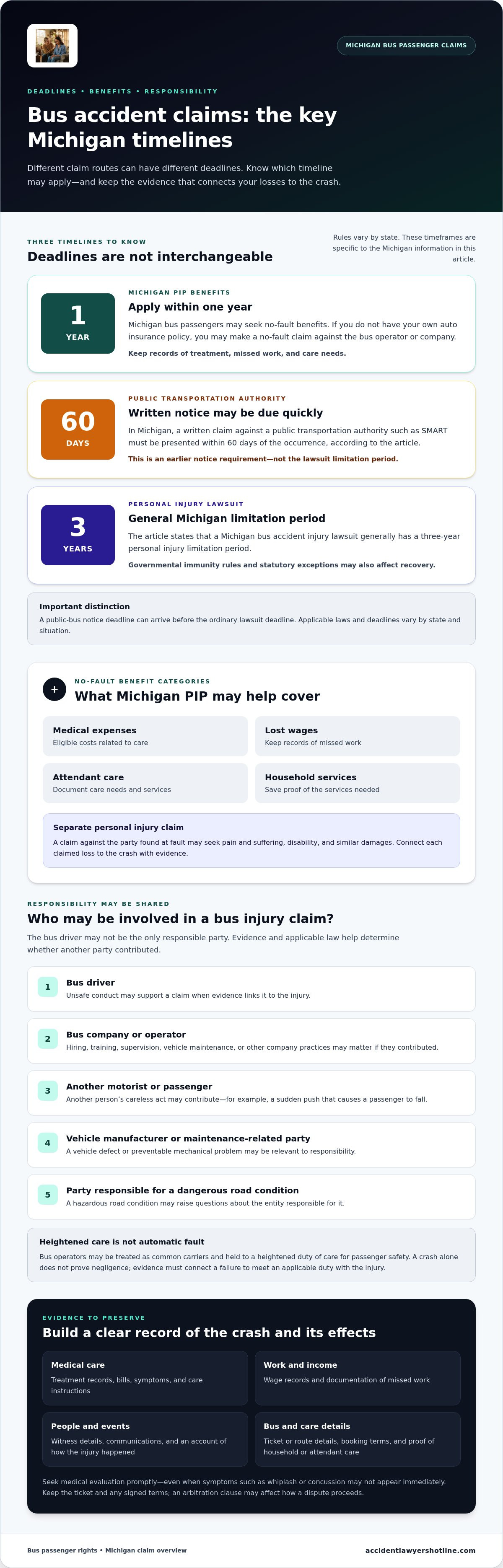
Michigan bus passengers may seek no-fault benefits for medical expenses, lost wages, attendant care, and household services. If you don’t have your own auto insurance policy, you may make a no-fault claim against the bus operator or company. Apply for Michigan PIP benefits within one year. Keep records of treatment, missed work, and care needs.
Recoverable Passenger Compensation
No-fault benefits may cover eligible medical costs, wage loss, attendant care, and household services. A separate personal injury claim may seek pain and suffering, disability, and similar damages from the party found at fault. Connect each claimed loss to the crash with evidence. Save medical bills, treatment notes, wage records, and proof of household or attendant care.
Ticket, Waiver, and Arbitration Terms
A ticket or waiver doesn’t automatically determine whether an injured passenger can pursue a claim. An arbitration clause may affect how a dispute proceeds, but its wording and the applicable law matter. Keep the ticket, booking confirmation, and any signed terms. These documents may clarify what the bus operator disclosed and which terms it may rely on.
Another passenger may be responsible if their careless act caused the injury. For example, a sudden push could make someone fall and strike a seat. The bus company may also face a claim if its own negligence contributed. Identify witnesses, preserve relevant communications, and note how the injury occurred while memories are fresh.
Bus crashes can cause bruises, fractures, whiplash, or concussions. Whiplash or concussion symptoms may not appear immediately, so seek medical evaluation promptly. A pedestrian struck by a bus may also qualify for Michigan no-fault benefits, even without owning a vehicle or having an auto policy. Record symptoms and follow medical instructions.
Government-operated bus claims have strict notice rules. In Michigan, a written claim against a public transportation authority such as SMART must be presented within 60 days of the occurrence, according to Michigan Legislature. A Michigan bus accident injury lawsuit generally has a three-year personal injury limitation period, according to Michigan Legislature. Governmental immunity rules and statutory exceptions can also affect recovery. Do not confuse the lawsuit deadline with the earlier notice requirement.
Contact a personal injury attorney promptly if injuries are serious, fault is disputed, or a public authority operated the bus. An early review can help identify responsible parties and preserve evidence before deadlines pass. Attorneys may work on a contingency fee, meaning they’re paid only if the case is won or compensation is recovered. Read the fee agreement and understand how expenses are handled.
Passenger rights and common-carrier duty of care
Bus operators are often treated as common carriers, which may require heightened care for passenger safety. That duty doesn’t make every crash automatic proof of negligence. Understanding bus accident passenger rights starts with knowing that operators must take reasonable steps to protect passengers from foreseeable harm.
The standard focuses on reasonable steps to protect passengers from foreseeable harm. A bus company should maintain safe vehicles, train drivers adequately, and follow applicable safety rules. For example, a maintenance failure that leaves a door unsecured may create a passenger hazard. A driver’s unsafe maneuver may also support a claim if evidence links it to an injury.
The bus driver and company may be separate parties to a claim. The driver’s conduct matters, while company practices may also matter if hiring, training, supervision, or vehicle maintenance contributed to the crash. A passenger’s account, witness statements, maintenance records, and medical documentation can help show what happened and how it caused harm. These bus accident passenger rights depend on applicable law and evidence.
The common-carrier standard requires heightened care, not strict liability. An injured passenger still needs evidence that a responsible party failed to meet an applicable duty and that the failure caused an injury. A sudden stop alone, for instance, may not establish fault. Evidence of speeding, distraction, or a preventable mechanical problem may help show why the driver or company should be held responsible.
Do different rules apply to public transit, school buses, charter buses, and interstate carriers? Yes. State law and the operator’s status can affect duties, immunity, and claim procedures; commercial interstate carriers also face federal safety rules. The Federal Motor Carrier Safety Regulations address commercial bus drivers’ hours on the road and vehicle equipment standards. Long-distance carriers such as Greyhound are subject to those regulations.
Public transit claims can involve a government agency, so special notice rules may apply in addition to ordinary injury procedures. School buses, charter coaches, and local transit buses may have different operators, insurance arrangements, and applicable regulations. Identify who owned and operated the vehicle, its route, and whether a government body was involved. Those details help determine which rules and parties matter.
After a crash, preserve the bus ticket or route details, identify witnesses, and describe the driver’s actions while memories remain fresh. Keep medical records that connect treatment to the incident. A lawyer can assess how the common-carrier duty applies to the operator and evidence. If you need help evaluating a bus injury claim, consider speaking with a personal injury lawyer.
Who Can Be Held Liable in a Bus Accident?
More than one party may be involved in a bus crash. Liability depends on whose actions or failure to act contributed to the collision and injury. The bus driver, bus company, another motorist, vehicle manufacturer, or government entity may be liable. Each potential claim needs evidence connecting that party’s conduct or responsibility to the harm.
A bus driver may be responsible when speeding, distracted driving, or a traffic violation causes a crash. The bus company or transit authority may also be vicariously liable for an employee’s negligent actions while working. Separate company negligence may involve hiring an unqualified driver, inadequate training, or poor vehicle maintenance. Driver logs and employment records can help investigate these issues.
Federal law requires bus companies to maintain driver qualification files. Those records can be reviewed when investigating negligent hiring or training. For a Michigan public transit claim, the Governmental Tort Liability Act, cited as MCL § 691.1401 et seq., governs claims involving most public transit systems. Michigan’s motor vehicle exception, MCL 691.1405, addresses claims involving negligent bus operation.
Michigan law also affects claims against individual government employees. Under MCL 691.1407, a bus driver may be personally liable if grossly negligent. Governmental immunity may otherwise limit claims against public bodies. The agency’s role, the driver’s conduct, and the facts surrounding the crash all matter when identifying responsible parties.
Another motorist may be liable if their negligent driving caused or contributed to the bus accident. For example, a car cutting into a bus’s path may cause a sudden collision. A manufacturer may also face a product-liability claim if a defect in the bus or a component contributed. A strict-liability theory may require proof that the defect caused injury, without proof that the manufacturer was careless.
A government entity responsible for a dangerous road condition may also be involved. A poorly maintained road or malfunctioning traffic signal could contribute to a crash. Evidence should identify the specific hazard and connect it to the collision. Road inspection records, maintenance documents, photographs, and witness accounts may help establish that link.
To assess possible recovery for medical expenses and other losses, make a simple list of parties and evidence. Record the driver and bus operator, any other vehicles involved, and known road hazards. Preserve photographs, witness names, crash reports, and treatment records. These details can help clarify whether one or several parties may be responsible and what evidence supports each claim.
Evidence preservation and post-accident steps
Take practical steps after a bus crash to document injuries, identify witnesses, and preserve records. Call 911 to report the accident and request emergency help when needed.
Passenger-Collected Evidence
From a safe location, photograph the bus, its route number, visible damage, the crash scene, and any injuries. Write down the date, location, direction of travel, and what happened while details are fresh. Collect witness names and contact information. Keep medical records, receipts, wage documents, and messages about the crash together in a secure file.
Preserve original photos and videos instead of editing or deleting them. If a witness describes what they saw, note their words and when you spoke. For example, a passenger who saw the bus stop suddenly may help clarify how an injury occurred. Keep the bus ticket or trip confirmation, since it may identify the operator and route.
Bus Camera Footage and Accident Reports
Ask the bus company or transit agency to preserve onboard or exterior camera footage from the crash. Include the incident date, approximate time, route, bus number, and location to help staff identify relevant recordings. Request the accident report from the responding police department. Keep copies of each request and response with your evidence file.
Different parties may hold footage and records. A transit agency may control bus video, while police hold their report and a government entity may keep road maintenance records. Identify the bus operator and responding agency, then direct each request to the organization holding the record. An attorney can help pursue evidence relevant to a lawsuit.
Police Reports and Evidence Preservation
Tell the responding officer what you remember, including the bus’s movement and where you were seated or standing. Ask how to obtain the report, then review it for basic details such as the date, location, vehicles involved, and witness names. If a detail appears incorrect, note the specific point and any supporting evidence for follow-up.
Preserve medical records documenting symptoms, treatment, and diagnoses after the crash. Keep damaged clothing or personal items, and photograph them before cleaning or repair. The bus company may hold maintenance records and driver logs, while a government agency may hold road inspection documents. An attorney can send preservation requests to responsible parties before relevant material is lost.
Deadlines make prompt action especially important in Michigan. A written claim against a public transportation authority such as SMART must be presented within 60 days of the occurrence, according to Michigan Legislature. Michigan bus accident injury claims are subject to a three-year personal injury statute of limitations, according to Michigan Legislature. Preserve evidence and identify the correct public entity early, because a lawsuit deadline does not replace a separate notice requirement.
Bus accident compensation for financial and non-financial losses
Compensation may address both documented expenses and the personal effects of a bus injury. Available recovery depends on the losses, evidence connecting them to the crash, and the parties whose negligence caused or contributed to the harm. A transit passenger’s claim may involve insurance benefits, a personal injury claim, or both.
Financial losses may include emergency care, follow-up treatment, rehabilitation, and medication. Keep bills, receipts, medical records, and appointment details together. If an injury prevents you from working, preserve pay records and employer documentation showing missed time and income. A lasting injury may also affect future earning capacity, especially when medical records describe ongoing work restrictions.
Non-financial losses may include pain and suffering, emotional distress, and long-term disability. These effects may not appear on a bill, so document them consistently. Note changes in sleep, mobility, daily routines, or activities you stopped after the collision. Treatment notes and observations from people who see those changes can help show how the injury affected everyday life.
Michigan illustrates how compensation may involve different claim types. No-fault benefits may cover eligible medical expenses, lost wages, attendant care, and household services. A separate personal injury claim may seek pain and suffering, disability, and similar damages from the driver found at fault. Evidence should support each loss and connect it to the bus accident.
Liability can shape which party may owe compensation. A distracted bus driver, negligent bus company, another motorist, or a manufacturer whose defective component caused the crash may be involved. More than one party may contribute. For example, evidence might show that another vehicle triggered the collision while poor bus maintenance worsened the passenger’s injuries. Establishing each connection helps assess potential recovery.
Some states also treat claims against government-operated transit differently from claims against private companies. Washington, for example, describes a $1 million damages cap for negligence claims against government entities. That limit does not apply to every bus claim or state, so identify the operator and location before assessing applicable rules. Public-entity procedures can affect the claim as well as available damages.
A passenger settlement of $185,000 has been reported after collision injuries. That single result does not establish a standard value for other claims. Injury severity, treatment needs, lost income, lasting effects, evidence, and liability all influence a claim’s assessment. Compare documented losses with the injuries’ likely long-term impact, not another passenger’s outcome.
Organize medical bills, wage records, treatment notes, and proof of daily limitations before evaluating a settlement. A careful review can show which losses are documented and where evidence needs strengthening. If a bus crash caused financial or personal losses, request a bus accident case evaluation.
Accident Lawyers Hotline: Car Accident Case Evaluation
Accident Lawyers Hotline offers a Bus Accident Case Evaluation for passengers weighing their next steps after an injury. The evaluation can help organize key details, such as the bus operator, crash circumstances, injuries, and available records, so you can discuss the claim with an experienced personal injury or motor vehicle accident attorney.
Consider an evaluation if fault is disputed, a government transit agency was involved, or medical expenses and lost income are adding up. Attorneys connected through the service work on a contingency basis, meaning they’re paid only if they win the case.
If you’re ready to discuss a bus injury claim, contact Accident Lawyers Hotline.
Take the Next Step Toward Clarity
After a bus crash, uncertainty about responsibility can make it hard to decide what to do next. A focused review of your situation can help organize the key questions: how the injury happened, which records may support your account, and what losses continue to affect daily life. Understanding your bus accident passenger rights can help you make those decisions with greater confidence.
Accident Lawyers Hotline offers Car Accident Case Evaluation, Truck Accident Case Evaluation, and Motorcycle Accident Case Evaluation. These options help people injured in different types of motor vehicle crashes consider a path forward. Start with the evaluation that reflects the accident and the questions you need answered.
You don’t have to sort through every detail alone. Contact Accident Lawyers Hotline to discuss your situation and take a practical next step toward clarity.
Frequently Asked Questions
What Compensation Is Available for Bus Accident Victims?
Compensation may include medical expenses, lost income, reduced earning capacity, pain and suffering, emotional distress, and property damage. Available losses depend on the injury and its effects. For example, a passenger who needs follow-up rehabilitation may document treatment costs, while someone unable to return to their former work may show reduced earning capacity. Keep records connecting each claimed loss to the crash and its consequences.
What Should I Do If I Am a Passenger in a Bus Accident?
Prioritize safety and medical care, then report the crash to law enforcement by calling 911. Give officers a clear account of what you observed, and note the bus route, location, and time. Ask witnesses for their contact details if you can do so safely. Save your ticket or trip confirmation. You aren’t required to give the bus company’s insurer a recorded statement.
Can I Sue for Pain and Suffering From a Bus Accident in Michigan?
Yes, an injured Michigan passenger may bring a personal injury claim for pain and suffering, disability, and similar damages against the driver found at fault. Evidence should show how the driver’s conduct caused the injury and how the injury affected your life. Keep treatment records and notes about changes to daily activities. Michigan no-fault benefits address certain expenses but are distinct from this personal injury claim.
Can I Still Make a Claim Even if the Bus Accident Seemed Minor?
Yes. A minor-looking collision can still cause an injury, and symptoms such as whiplash or concussion may not appear immediately. Arrange a medical evaluation promptly, even if you feel well at first. Tell the clinician about the bus crash and any symptoms that develop. A dated record of your condition helps connect later treatment to the incident and provides a clearer timeline.
Could a Manufacturer or Government Body Be at Fault?
Yes. A manufacturer may be responsible if a defect in the bus or one of its components contributed to the crash. A government entity may also face liability if a hazardous road condition, such as a malfunctioning traffic signal, caused or contributed to the collision. Photographs, maintenance records, inspection documents, and witness accounts can help identify the hazard or defect and link it to the injury.
What Rights Do Bus Passengers Have After an Accident in the United States?
In the United States, bus accident passenger rights may include pursuing an injury claim when another party’s negligence caused harm. Bus operators are often treated as common carriers and may owe passengers heightened care, though the exact standard depends on applicable law. A passenger’s partial fault doesn’t automatically bar recovery in many states, but compensation may be reduced according to that share. State rules, insurance systems, and the operator’s status shape available rights.
Who May Be Liable for a Bus Accident: The Bus Company, Driver, Manufacturer, or Another Driver?
Any of those parties may be liable if evidence connects their conduct or responsibility to the crash. A driver’s traffic violation, a company’s negligent hiring or maintenance, a vehicle defect, or another motorist’s unsafe driving could contribute. More than one party may share responsibility. To assess bus accident passenger rights in a particular claim, investigators examine crash reports, vehicle records, driver information, and witness accounts to determine which actions caused or worsened the injuries.
What Deadlines Apply to Filing a Bus Accident Injury Claim or Lawsuit in Each State?
Deadlines differ by state and claim type, so there isn’t one nationwide filing period. Michigan generally allows three years for a bus injury lawsuit, but a written claim against a public transportation authority must be presented within 60 days, according to Michigan Legislature. Examples elsewhere include three years for personal injury in Washington and Wisconsin, and two years against a private bus company in New Jersey. Government claims can require earlier notice.
Were You Injured in an Accident?
Get a free, confidential case evaluation. No upfront fees.
Get Free Case Evaluation