Cement Truck Accident Lawsuit Help for Injured People
A cement truck accident lawsuit may cover medical bills, lost income, pain, and property damage. Learn who may be liable and how to protect your claim.
A cement truck accident lawsuit may seek compensation for medical bills, future treatment, lost income, reduced earning capacity, pain and suffering, emotional distress, loss of enjoyment of life, and property damage. Available damages depend on the injuries and losses involved. Responsibility may extend beyond the driver to a trucking company or another party whose actions contributed to the crash.
When you’re dealing with injuries, expenses, and uncertainty about what comes next, it’s understandable to want clear answers. This guide explains the compensation an injured person may pursue, who could be liable, and how fault can affect a claim.
You’ll also learn how legal help can support an investigation, preserve important evidence, and address filing deadlines. Understanding the process can help you focus on recovery while considering your next steps.
Key Takeaways
- Learn which losses may support a compensation claim, from treatment costs and lost income to personal impacts and property damage.
- See how delivery pressure, driver fatigue, distraction, loading issues, or vehicle problems may contribute to a crash.
- Understand why preserving records and investigating the truck, driver, and crash circumstances can help clarify what happened.
- Find out how a construction company, trucking company, maintenance provider, or manufacturer may share responsibility in some cases.
- Explore how a Truck Accident Case Evaluation can help you understand potential next steps after a cement truck crash.
What Damages Can I Recover for Cement Truck Accident Injuries?
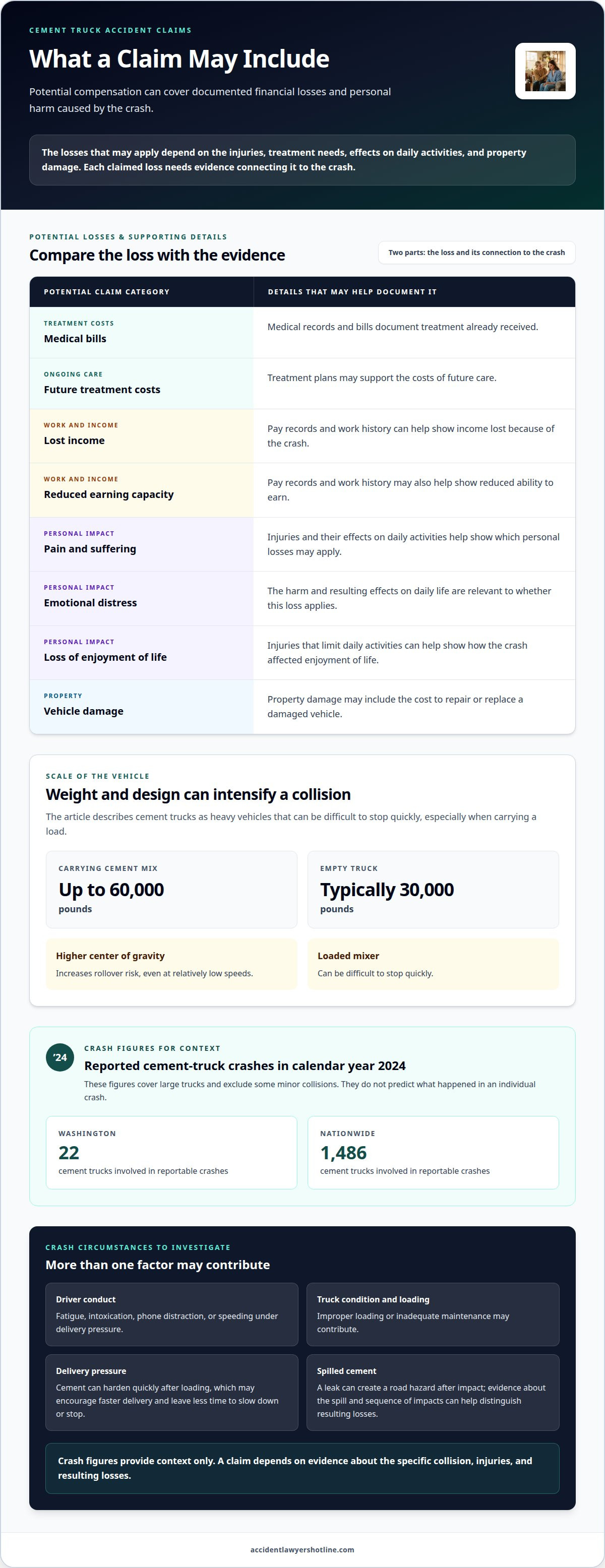
A cement truck accident lawsuit may seek compensation for documented financial losses and personal harm caused by the crash. Potential damages include medical bills, future treatment costs, lost income, reduced earning capacity, pain and suffering, emotional distress, loss of enjoyment of life, and property damage. Injuries, treatment needs, and effects on daily activities help show which losses apply.
Crash figures offer context, but they don’t predict what happened in an individual collision. During calendar year 2024, 22 cement trucks were involved in reportable crashes in Washington, while 1,486 were involved nationwide. These figures cover large trucks and exclude some minor collisions. A personal injury claim still depends on evidence about the specific crash, injuries, and resulting losses.
Several factors can contribute to a cement truck crash. A driver may be fatigued, intoxicated, distracted by a phone, or speeding under delivery pressure. Cement can harden quickly after loading, which may encourage faster delivery and leave less time to slow down or stop. Improper loading or inadequate maintenance may also contribute. Traffic or construction delays can add pressure, but the driver’s conduct and other circumstances need investigation.
Weight and design can make a collision especially dangerous. Cement trucks can weigh up to 60,000 pounds when carrying cement mix, and an empty truck typically weighs 30,000 pounds. Their high centers of gravity increase rollover risk, even at relatively low speeds. A fully loaded mixer can also be difficult to stop quickly. The size and weight difference between a mixer and a passenger vehicle can cause severe injuries, including brain injuries, spinal cord injuries, burns, permanent disability, or death.
A mixer leak can create danger after the initial impact. Spilled cement may harden quickly and become a road hazard, contributing to secondary crashes involving other vehicles. Evidence about the spill, the sequence of impacts, and resulting injuries can help distinguish losses from each collision. For example, a driver hit after braking for spilled material can describe how the hazard affected the crash.
Damages should be tied to specific effects of the collision. Medical records and bills document treatment already received, while treatment plans may support future care costs. Pay records and work history can help show lost income or reduced earning capacity. Pain, emotional distress, and loss of enjoyment of life may also matter, particularly when injuries limit daily activities. Property damage may include repairs or replacement of a damaged vehicle. Each claimed loss needs evidence connecting it to the crash.
Legal help with investigating and filing a claim
A lawyer can organize the investigation, identify potentially responsible parties, and prepare a claim using evidence about the crash. Filing deadlines and claim procedures depend on where the collision occurred and who operated the truck.
An investigation may begin with the crash report, witness accounts, photographs, and available vehicle records. A lawyer can compare those details with the truck driver’s account and the reported injuries. This can help clarify how the collision happened, which losses may be recoverable, and whose conduct needs further review.
Deadlines matter. In Tennessee, a cement truck accident lawsuit must be filed within one year of the accident. In Georgia and Alabama, a claim must be brought within two years of the accident. For wrongful-death claims, Tennessee allows one year from the victim’s death, while Georgia and Alabama allow two years. The applicable period depends on the state and claim type.
Wrongful-Death and Survival Claims
A wrongful-death claim addresses losses connected to a person’s death, while a survival claim concerns claims the victim could have pursued. Washington law allows a personal representative to maintain a wrongful-death action when death results from another person’s wrongful act, neglect, or default, according to the Washington State Legislature under RCW 4.20.010. Identifying the proper representative and claim helps protect the family’s ability to seek recovery.
Claims involving government-owned trucks may require a different review. In South Carolina, claims involving trucks operated by or on behalf of government entities are subject to the South Carolina Tort Claims Act. The truck’s ownership and operation therefore matter from the outset. A lawyer can determine whether a public entity was involved and assess the applicable filing requirements, rather than treating the case like an ordinary claim against a private company.
Insurance Claims and Settlements
Insurance discussions may involve the truck’s insurer, a trucking company, or other potentially responsible parties. Consider a settlement offer alongside the evidence, documented losses, and expected treatment needs. Accepting an offer before understanding ongoing care needs, for example, may leave future costs unresolved. A lawyer can assess the offer in relation to the claim.
Before filing or negotiating, legal help can organize the documents, connect evidence to specific losses, and track the applicable deadline. If a fatal crash occurred, the representative and claim type also need attention. A claim filing evaluation can help clarify which questions to address next.
Investigating and preserving truck accident evidence
Evidence can help explain how the collision happened, identify potentially responsible parties, and connect the crash to injuries. A truck accident lawyer may organize records before they disappear or become harder to obtain.
Preserving Evidence and Handling Insurance Statements
After a crash, preserve photographs, witness names, medical records, and repair estimates. If it’s safe, photograph vehicle positions, road conditions, visible damage, and any cement spill. Keep the original files and note when each image was taken. A written account made soon after the collision can also help preserve details about traffic, weather, and the truck driver’s actions.
Insurance representatives may ask for a recorded statement or documents. Give accurate basic information, but avoid guessing about speed, distance, or the cause of the crash. For example, don’t describe a spinal injury as minor before a medical assessment. An accident attorney can help organize the evidence and explain a request before you respond.
Investigating Liability and Evidence
A thorough investigation considers the vehicles, roadway, and people involved. An accident lawyer may review the crash report, witness accounts, photographs, and available truck maintenance or employment records. Those records can help assess whether the driver’s conduct, inadequate maintenance, or another factor contributed. Compare each piece of evidence with the physical damage and the timeline witnesses describe.
Truck weight and mixer design can matter when reconstructing a collision. Investigators may examine damage locations, skid marks, road debris, and rollover evidence to assess how the vehicles moved. If cement spilled, they can also document where the material landed and whether another collision followed. Medical records help connect injuries to the crash and show how treatment developed over time.
Immediate Steps After a Cement Truck Accident
What should you do immediately after a cement truck accident? Move to safety if possible, seek medical care, and cooperate with emergency medical technicians, even if you feel no pain. Some injuries may become apparent later. If conditions allow, record the truck’s identifying details, witness contact information, and the location of damaged vehicles without entering traffic or approaching a spill.
Next, keep records together. Save the incident report, medical paperwork, receipts, and insurer messages in one secure place. Document damaged property before repairing or discarding it. If an insurer requests a statement, note the request and get legal guidance before giving a detailed account. A truck accident lawyer can assess what evidence exists, which records may need preservation, and how the facts support a claim.
Can a construction company be responsible for a cement truck crash?
Yes, a construction company may be an additional defendant if it controlled the worksite and its actions contributed to the crash. Compensation may include economic damages, such as treatment costs and lost income, and non-economic damages, such as pain and emotional distress. Liability and the losses supported by evidence shape what an injured person may seek.
Site control matters because construction activity can affect where trucks travel, stop, and maneuver. Investigators may examine site instructions, traffic arrangements, access routes, and communications about delivery timing. If a company directed a truck through a congested work area, for example, those details may help determine whether its decisions contributed. The company’s involvement alone does not establish liability; evidence must connect its conduct to the collision.
Economic damages reflect measurable financial losses. They may include medical bills, future treatment costs, lost income, reduced earning capacity, and property damage. Records help establish each category: invoices document care already received, while work and wage records can show missed income. If an injury affects someone’s ability to return to the same job, employment history and treatment information may help explain the resulting loss.
Non-economic damages address personal effects that do not appear on a bill. Pain and suffering, emotional distress, and loss of enjoyment of life may be relevant. Someone who can no longer take part in ordinary activities, for example, may describe those changes alongside treatment records and statements from people familiar with their routine. The nature and duration of the impact help explain the claimed damages.
Weigh a settlement offer against all documented losses, not just current bills. Consider whether future treatment is likely, whether missed work has affected earning ability, and whether the offer accounts for non-economic harm. A truck accident attorney can review how the evidence supports each category and whether disputed responsibility affects negotiations. Signing a settlement generally resolves the claim covered by its terms, so read the wording carefully.
Case value depends on the severity and duration of injuries, financial losses, available evidence, and the parties’ share of responsibility. No single invoice or injury label captures those factors. In Georgia, compensation is reduced by the same percentage as the injured person’s share of fault. A Georgia crash victim who is 40% at fault will receive 40% less compensation than otherwise.
Responsibility may involve more than the construction company. A trucking company may be liable for a driver’s actions on the job, while a maintenance company may be an additional defendant if inadequate repairs contributed. Reviewing site control, repair records, and the truck’s assignment can help clarify which parties may be liable. This analysis connects each defendant’s conduct to the damages being claimed.
Potentially liable parties
A serious cement truck collision may involve more than the driver behind the wheel. Liability depends on which actions or failures contributed to the crash, and evidence may point to several responsible parties. The driver, trucking company, maintenance provider, manufacturer, or construction company may need investigation. Naming a party alone does not establish responsibility; the connection between conduct and harm matters.
The cement truck driver may be liable when their conduct caused the collision. Investigators can compare witness accounts, crash records, and available vehicle information to understand what happened. A trucking company may also face vicarious liability when its driver caused a crash while working. The driver’s work status and the circumstances of the trip are therefore relevant to the liability analysis.
A trucking company may be directly responsible for its own decisions. Evidence that it hired an unqualified driver or failed to arrange appropriate truck maintenance, for example, may raise separate questions about its conduct. These issues differ from whether the driver made an error during the collision. Reviewing company records and maintenance history can help clarify whether a failure contributed to the crash.
A maintenance company may be an additional defendant if inadequate repairs contributed to the accident. Investigators can examine the repair work and the truck’s condition to assess whether a mechanical problem played a role. The key question is whether a maintenance failure contributed to the collision, not simply whether the company serviced the vehicle beforehand.
A truck or component manufacturer may be sued if a defect contributed to the crash. An investigation may examine whether a defective component affected how the truck operated. Evidence must connect the alleged defect to the collision and resulting injuries. If the available facts point to multiple causes, both a product problem and the driver’s actions may warrant review.
A construction company may also be an additional defendant if it controlled the site and its conduct contributed. Site instructions, delivery arrangements, and worksite conditions can help explain the company’s role. Investigators may also examine applicable regulations and records related to the truck or site. Assess each potential party separately, because one company’s involvement does not establish another’s liability.
A truck accident attorney can help organize the investigation around each potential defendant, including the driver, trucking company, and maintenance provider. The review should connect records and witness accounts to specific actions, rather than assume responsibility from a company’s name or role. To understand which parties may be responsible in your situation, request a Truck Accident Case Evaluation.
Accident Lawyers Hotline: Truck Accident Case Evaluation
Accident Lawyers Hotline provides a Truck Accident Case Evaluation to help you understand potential next steps after a cement truck crash. The evaluation considers the collision circumstances, injuries, available evidence, and potentially responsible parties, then helps connect you with a personal injury attorney for legal assistance.
Consider an evaluation if you’re unsure how to assess an insurance offer, identify who may be liable, or organize the facts for a claim. Accident Lawyers Hotline also provides case evaluations for car, motorcycle, and pedestrian accidents.
Contact Accident Lawyers Hotline to discuss a Truck Accident Case Evaluation.
Take the Next Step Toward Clarity
After a serious crash, deciding what to do next can feel difficult. You don’t need to resolve every question at once. A cement truck accident lawsuit starts with understanding how the collision affected you and what information can support your decisions.
A case evaluation can help you discuss the crash and consider a path forward. Accident Lawyers Hotline provides Truck Accident Case Evaluation, along with Car Accident Case Evaluation and Motorcycle Accident Case Evaluation. These services can help connect people with legal assistance suited to their accident circumstances.
Whether you’re still gathering information or considering a claim, you can take the next step at your own pace. Contact Accident Lawyers Hotline to discuss your situation and explore a case evaluation. Clear guidance can help you move forward with greater confidence.
Frequently Asked Questions
What Is the Deadline for Filing a Cement Truck Accident Lawsuit?
The filing deadline depends on the state and type of claim. In Tennessee, a personal injury claim must be filed within one year of the accident; Georgia and Alabama allow two years. Wrongful-death deadlines also differ: one year from death in Tennessee and two years in Georgia and Alabama. Claims involving government-operated trucks may have additional procedures, so identify the truck’s owner promptly.
What if the cement truck driver was an independent contractor?
An independent-contractor label doesn’t automatically determine who may be responsible. An investigation should examine the driver’s work arrangement, who assigned the delivery, and which company maintained or dispatched the truck. A trucking company may face liability for a driver’s actions while on the job and may also be directly liable for its own hiring or maintenance failures. Contracts and trip records can help clarify those relationships.
Why Work with a Lawyer Who Focuses on Trucking Accidents?
A lawyer familiar with truck cases can assess evidence specific to commercial vehicles, such as maintenance records, driver work information, and company documents. This can help distinguish the driver’s conduct from the trucking company’s separate decisions. A collision involving a mechanical problem, for example, may require examining repair history as well as the driver’s actions. Choose legal help that can explain how the evidence relates to each potentially responsible party.
Can I still recover compensation if I was partially at fault for the crash?
In some states, partial fault reduces compensation; in others, it may prevent recovery at a particular fault level. Under Washington’s RCW 4.22.005, assigned fault generally reduces compensatory damages proportionately but doesn’t automatically bar recovery. In Georgia, compensation is reduced by the injured person’s share of fault, and a victim who is 50% or more at fault can receive nothing. The state where the crash occurred matters.
Can the cement company be liable for a driver's accident?
A company associated with the cement isn’t automatically liable just because its product was in the truck. Responsibility depends on the company’s role and whether its actions contributed to the crash. A trucking company may face liability for an employee driver’s conduct on the job, for example, while a manufacturer may be sued if a truck or component defect contributed. Delivery records and company relationships can help identify relevant parties.
Do cement truck accidents near active construction zones create any special legal issues?
Construction companies can raise questions about site control, truck access, and delivery instructions. A construction company may be an additional defendant if it controlled the site and its conduct contributed to the crash. Investigators may examine delivery directions, site traffic arrangements, and communications about truck movement. A work zone alone does not establish liability; evidence must connect a party’s actions to the collision.
Is it worth hiring a lawyer if the cement company’s insurer has already offered a settlement?
Consider legal advice before accepting, especially if the offer requires you to sign a release. Assess the settlement amount against documented losses, ongoing treatment, and the effects of injuries on work and daily activities. An offer made before a treatment plan is clear, for example, may not account for later care. A lawyer can review the terms and explain what rights you may give up by accepting.
What if the insurance company says I was partly responsible?
An insurer’s position is an allegation to assess, not a final determination of fault. Ask what evidence supports its claim and compare that account with the crash report, photographs, witness statements, and vehicle damage. A diagram may omit a truck’s movement or a road hazard, for example. Keep insurer communications and avoid guessing in your responses. State law governs how an assigned share of fault may affect compensation.
Were You Injured in an Accident?
Get a free, confidential case evaluation. No upfront fees.
Get Free Case Evaluation