Drowsy Driving Accident Claims in Michigan
Learn how to prove a drowsy driving accident claim in Michigan, preserve key evidence, and understand no-fault benefits and when legal help may matter.
A driver who falls asleep may not brake before a crash. In Michigan, no specific statute prohibits drowsy driving, but driving while fatigued may be negligent under common law. A drowsy driving accident claim can rely on evidence of fatigue and its role in the collision.
It can be difficult to prove what was happening inside another driver’s car, especially because there’s no direct test for fatigue like there is for intoxication. That uncertainty can make the aftermath feel overwhelming, but witness accounts, driver statements, vehicle data, and crash evidence may help build a clearer picture.
This article explains signs of drowsy driving, ways to preserve useful evidence, and how to assess whether another driver’s fatigue contributed to your injuries. It also covers how Michigan’s no-fault system affects accident claims and when legal help may be useful.
Key Takeaways
- Preserve witness details, driver statements, and available vehicle or travel records that may help show fatigue before the crash.
- Record what you remember about the collision and share factual observations with law enforcement.
- Learn how Michigan’s no-fault benefits and serious-impairment threshold can affect the compensation available after an accident.
- Understand why fatigue-related crash figures may not capture every collision, and what the reported data can still show.
- Consider legal help when evidence needs to be gathered or the rules for pursuing a claim feel difficult to manage.
How do I prove the other driver was drowsy in Michigan?
Look for several kinds of evidence, such as witness accounts, driver statements, police reports, and vehicle data. When handling a drowsy driving accident claim, the challenge is linking those clues to the crash and your damages, since there’s no direct fatigue test like an intoxication test.
Evidence of Driver Fatigue
Look for evidence of the driver’s condition and conduct before impact. A witness may report that the vehicle drifted between lanes, swerved, or moved erratically. Another driver or passenger may have seen the driver nod off or appear exhausted. Statements from the driver about being tired or falling asleep can also support a fatigue claim.
Police reports may record driver statements or witness observations. Vehicle event data recorders may capture speed, braking, and steering inputs before a crash. An absence of skid marks may suggest that the driver didn’t brake, though it doesn’t establish why. Accident reconstruction specialists can analyze crash dynamics, while medical experts can explain how sleep deprivation affects performance.
Claim Evidence and Documentation
Organize evidence to show how the collision happened and what injuries followed. A police report can preserve observations from the scene and recorded statements. Witness names and descriptions can help connect unusual driving to the moments before impact. Photos of the vehicles, roadway, and visible damage can document the scene while details are fresh.
Medical records describe diagnoses and treatment. Repair bills document vehicle damage, while wage records can show income lost during recovery. Keep these materials together with a dated account of pain, symptoms, and changes to daily activities. A drowsy driving accident claim needs evidence linking the driver’s conduct, the crash, and your damages, not just evidence that fatigue was possible.
Evidence Preservation and Insurance Contacts
Write down what you remember promptly, including the driver’s words, unusual movements, and the sequence of events. Give law enforcement factual observations, not guesses about fault. Keep a copy of what you reported and share it during a legal consultation. Store photos, witness contact details, medical records, and repair documents in one organized file.
Vehicle data, phone records, and other digital information may help explain the driver’s activity, but can be difficult to recover later. Don’t alter or delete relevant messages or records. Avoid discussing fault or making assumptions about the crash. Get legal advice before giving the other driver’s insurer a statement, since insurance conversations can affect how the claim is evaluated.
Key risks include missing evidence, conflicting witness accounts, and uncertainty about what caused the collision. Fatigue can be difficult to establish without direct testing, so independent details matter. The other driver’s insurer may dispute whether fatigue caused the crash or whether it caused your injuries. Preserve records early, document treatment and losses, and keep your account consistent. Contact Accident Lawyers Hotline to help assess which insurance benefits or injury claims may apply. A focused review can identify gaps and determine what additional records, witnesses, or expert analysis could strengthen the case.
Preserving driver logs, phone records, and work schedules
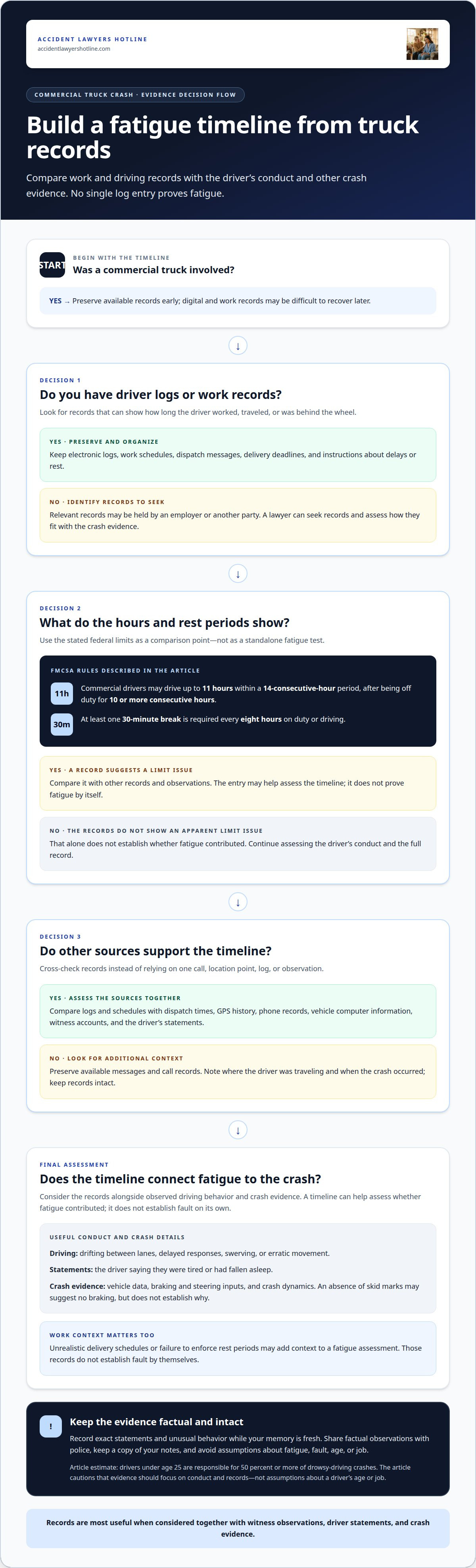
In a commercial truck crash, records may show how long a driver had been working, traveling, or behind the wheel. Preserve details early: electronic logs, work schedules, dispatch messages, GPS data, phone records, and vehicle computer information may help establish a timeline. These records may also show whether fatigue contributed to unsafe driving, rather than merely documenting that a collision occurred.
Federal Motor Carrier Safety Administration rules allow commercial drivers to drive for up to 11 hours within a 14-consecutive-hour period after being off duty for 10 or more consecutive hours. The Federal Motor Carrier Safety Administration also requires at least one 30-minute break every eight hours on duty or driving. Records that show driving periods and breaks can help assess whether a driver followed these limits. A log entry alone doesn’t prove fatigue, but it can be compared with dispatch times, GPS history, and witness observations.
Work schedules can add context. An employer may share liability when a commercial driver is fatigued, and evidence of unrealistic delivery schedules or failure to enforce rest periods may support a claim. Preserve schedules, delivery deadlines, dispatch instructions, and communications about delays or rest. For example, a timeline showing a late dispatch, extended travel, and a crash may help investigators assess whether work demands contributed to the driver’s condition. It doesn’t establish fault by itself; the records need to be considered together.
Phone records and GPS data can help establish activity and travel, while vehicle computer systems may record trip information. Keep available messages and call records intact, and note where the driver was traveling and when the crash occurred. A lawyer can seek relevant records from employers or other parties and assess how they fit with the crash evidence. Don’t rely on a single call, location point, or log entry to prove negligence.
At the scene, record unusual behavior and exact statements while your memory is fresh. Note examples such as drifting between lanes, delayed responses, or the driver saying they were tired or fell asleep. Share those observations with police, and keep a copy of your notes. Drivers under age 25 are responsible for an estimated 50 percent or more of drowsy-driving crashes, a reminder that fatigue evidence should focus on conduct and records, not assumptions about a driver’s age or job.
In a truck collision, a truck accident case evaluation can help identify which driver, work, and vehicle records may matter to proving fatigue and negligence.
What is Drowsy Driving?
Drowsy driving means operating a vehicle while fatigue or sleepiness affects alertness, judgment, or reaction time. In Michigan, driving while fatigued may be negligent under common law, and a collision can cause injuries and financial losses.
Compensation depends on the kind of loss and the claim involved. Michigan’s no-fault system provides personal injury protection (PIP) benefits for medical expenses and wage loss under MCL § 500.3107. A third-party pain-and-suffering claim requires meeting the serious-impairment threshold under MCL § 500.3135.
When the serious-impairment threshold is met, an injured person may pursue excess damages and loss-of-consortium damages under MCL 500.3135. The facts connecting the other driver’s conduct to the crash matter, as do medical records and evidence documenting the injury’s effects. A claim may involve more than one category of loss, but each must be supported by relevant documentation.
Sleepiness can impair attention even before a driver falls asleep. A microsleep may last a few seconds, leaving a driver unable to respond to traffic during that brief period. The Centers for Disease Control and Prevention states that 35 percent of American adults don’t get enough sleep. Drowsiness can also affect judgment and focus, increasing the risk of a collision.
To document injuries and financial losses, keep records of medical visits, treatment recommendations, prescriptions, and symptoms. Add wage records showing missed work and notes describing how an injury affects daily activities. For example, a medical record documenting a diagnosed injury and follow-up care can help connect treatment to the collision. Police records may preserve crash details, while bills and wage documents help substantiate claimed losses.
Deadlines depend on the state and the type of claim. In Michigan, the general deadline for a drowsy-driving injury claim is three years from the accident date under MCL 600.5805(2). An application for Michigan PIP benefits must be made within one year under MCL 500.3145. Washington generally sets a three-year deadline for most personal injury claims, but that Washington rule does not govern a Michigan accident.
For a Michigan claim, distinguish state-specific deadlines from information that applies elsewhere. An attorney assessing liability and compensation will consider the injury evidence, documented losses, and whether the serious-impairment threshold applies. These factors help clarify which benefits or claims may be available after a drowsy-driving collision.
Drowsy driving crash statistics
The National Highway Traffic Safety Administration estimated that in 2017, 91,000 police-reported crashes involved drowsy drivers. That figure counts reported crashes, not every collision involving fatigue. Drowsiness can reduce a driver’s ability to react, maintain a lane, or avoid another vehicle. Statistics show the scale of the danger, but evidence from the specific crash determines how fatigue and liability are assessed.
After a collision, look for observable signs rather than assuming fatigue from the crash alone. A witness might describe a vehicle drifting, swerving, or responding slowly to traffic. Red eyes, sluggish responses, or an admission that the driver was tired can also provide context. Police may record statements and witness accounts. Each observation is most useful when it aligns with other evidence about what happened before impact.
Commercial crashes can raise questions about an employer’s role. A company may share liability when it pressures a driver to exceed legal driving limits or falsify logbooks. Unrealistic delivery schedules or failure to enforce rest periods may also support a claim. For example, dispatch records showing pressure to meet a deadline can help explain a driver’s work demands. Consider those records alongside the driver’s logs, crash details, and other evidence.
After a drowsy-driving collision, take practical steps to protect your health and preserve information:
- Call police, remain at the scene, and provide officers with facts you personally observed.
- Get medical care and keep records of diagnoses, treatment, and changes in your condition.
- Write down driver statements, witness details, and unusual vehicle movements while you remember them.
- Keep repair documents and wage records that show losses connected to the collision.
Compensation in Michigan may include PIP benefits for medical expenses and wage loss under MCL § 500.3107. A third-party pain-and-suffering claim requires meeting the serious-impairment threshold under MCL § 500.3135. The amount of a settlement turns on documented injuries, treatment, lost income, evidence of fault, and the available claim. A lawyer can assess how those factors fit together; no statewide “typical” figure explains what an individual claim is worth.
An experienced lawyer can examine collision evidence, identify missing records, and evaluate how Michigan’s insurance rules apply. The review can distinguish a dangerous driving pattern from a crash caused by another factor. Clear documentation helps connect the driver’s conduct to your injuries and losses. A careful evaluation can show which compensation paths the evidence supports and what may strengthen them.
Hiring a drowsy driving accident attorney
Contact a car accident lawyer after urgent medical and police needs are handled. Early legal guidance may help when fatigue is disputed, an insurer requests a statement, or a witness’s account needs follow-up. You don’t need to wait until every record is collected before seeking advice.
An attorney can assess whether the available facts connect the driver’s fatigue to the collision and your injuries. That review may consider the driver’s conduct, witness accounts, police documentation, and other causes raised by the insurer. For example, a lawyer may compare a witness’s description of drifting with the timing and direction of the impact. One sign of tiredness alone doesn’t prove negligence.
Legal help can be especially useful when a crash involves a commercial vehicle, disputed responsibility, serious injuries, or several potentially responsible parties. In a commercial case, a lawyer can assess whether employer scheduling or delivery demands contributed to fatigue. In a passenger-car collision, the focus may instead be on the driver’s actions before impact and how they caused harm.
During an initial consultation, be ready to explain the crash in your own words. Useful topics include:
- Where and when the collision happened, and what you personally observed.
- What the driver or witnesses said about fatigue, sleep, or falling asleep.
- How your injuries affected treatment, work, and daily activities.
A lawyer can identify unanswered questions, explain how Michigan’s no-fault rules relate to your situation, and outline possible next steps. Ask how the attorney will communicate updates, who will handle questions, and what documents would help evaluate the case. Clear answers can help you understand the working relationship before deciding whether to proceed.
Cost terms matter, too. The legal professionals connected through this service work on a contingency basis, meaning there are no legal fees unless they secure a settlement or court award. Ask the attorney to explain the fee arrangement and any case expenses in the written agreement before signing. The agreement should clarify what happens if the case doesn’t succeed.
Hiring an attorney may be less necessary when injuries are minor, responsibility is clear, and the insurer handles the claim fairly. But disputed fatigue, ongoing treatment, lost income, or pressure to accept a settlement can make a legal review valuable. A focused consultation can help you weigh the evidence, the claim’s practical demands, and whether representation fits your needs.
If you want help assessing the collision and possible next steps, request a car accident case evaluation.
Accident Lawyers Hotline
Accident Lawyers Hotline helps people injured in drowsy-driving crashes consider possible next steps through an accident case evaluation. When fatigue is disputed, injuries affect work, or important records need review, an evaluation can clarify the issues and connect you with legal professionals who handle motor vehicle accident matters.
Bring the information you have, such as the police report, medical records, witness details, and insurer communications. You don’t need every document before requesting an evaluation. The discussion can help identify which facts may matter and whether further legal assistance could be useful. Accident Lawyers Hotline offers case evaluations for car, truck, motorcycle, and pedestrian accidents.
If you’d like to discuss your situation, contact Accident Lawyers Hotline.
Take the Next Step Toward Clarity
A drowsy driving accident claim can feel difficult to pursue when you’re still recovering and unsure what comes next. You don’t need to resolve every question before seeking an evaluation. A focused conversation can help you understand what information may matter and whether further legal assistance fits your situation.
Accident Lawyers Hotline offers Car Accident Case Evaluation, Truck Accident Case Evaluation, and Motorcycle Accident Case Evaluation. These evaluations can help injured people consider their options after different kinds of roadway crashes. The next step is deciding whether you want to discuss your circumstances and current concerns.
Bring the questions you want answered and any documents you already have. A conversation can help you identify a practical path forward without requiring you to organize everything first. You deserve space to make an informed decision at your own pace.
Contact Accident Lawyers Hotline to discuss your situation and consider what comes next.
Frequently Asked Questions
Can I still recover money if I was partly at fault?
Possibly, but the effect of shared fault depends on the claim and the facts. In Michigan, PIP benefits may be available for medical expenses and wage loss regardless of who caused the crash. A separate claim against another driver has different requirements, including the serious-impairment threshold for pain and suffering. A review should consider your actions, the other driver’s conduct, and which losses are documented.
How do I prove the driver was sleep-deprived?
Use records and observations that help establish the driver’s recent activity and condition. Work schedules, dispatch communications, travel records, and relevant medical information may reveal factors connected to inadequate rest. A witness who saw the driver struggling to stay alert can add context. No single record necessarily proves sleep deprivation, so the timeline and surrounding evidence matter when assessing whether fatigue contributed to the crash.
How do you prove someone fell asleep while driving?
Evidence may include the driver’s statement, a witness account, or crash data showing no braking or steering response before impact. For example, a passenger who saw the driver’s eyes close can describe what happened directly. A lack of skid marks may be consistent with no braking, but doesn’t establish by itself that the driver was asleep. Compare each clue with the circumstances of the crash.
How much will your legal services cost?
Legal professionals connected through Accident Lawyers Hotline work on a contingency basis, so they charge no legal fees unless they secure a settlement or court award. That describes legal fees, not necessarily every case-related expense. Before agreeing to representation, review the written fee agreement and ask how expenses are handled, what counts as a recovery, and what you may owe if the case doesn’t succeed.
What Are the Warning Signs of a Drowsy Driver?
Warning signs include frequent yawning or blinking, a bobbing head, drifting between lanes, tailgating, or hitting the shoulder. Red eyes and sluggish responses may also suggest fatigue. For example, a vehicle that repeatedly crosses lane markings and then corrects suddenly may indicate reduced alertness. These signs can help describe a driver’s behavior, but they don’t prove the cause of a crash without other evidence.
What expenses can I seek damages for after the accident?
Michigan PIP benefits may cover accident-related medical expenses and wage loss. If an injury meets the serious-impairment threshold, a third-party claim may include pain and suffering or excess damages. Keep bills, treatment records, and wage documentation so each claimed loss has supporting evidence. Which categories may apply depends on the injury, available coverage, and legal requirements for the claim.
What evidence should you collect after a drowsy driving accident?
Preserve materials that show the crash, the driver’s conduct, and your resulting losses. Useful items may include photographs, witness contact details, the police report, medical records, repair documents, and relevant messages. Write down your observations and the driver’s exact words as soon as practical. Keep originals and note when and where each item came from to maintain a clear timeline.
Who can be held liable for a drowsy driving accident?
The driver may be liable if fatigue-related conduct caused the collision and resulting harm. In a commercial crash, an employer may also share liability if evidence shows pressure to exceed driving limits or falsify logs. Responsibility depends on the facts, including the driver’s actions, work demands, and crash evidence. A legal review can examine whether another party’s conduct contributed to the crash.
Were You Injured in an Accident?
Get a free, confidential case evaluation. No upfront fees.
Get Free Case Evaluation