Head-On Collision Lawsuit: Fault, Evidence, and Your Legal Options in 2026
Wondering if you have a head-on collision lawsuit? Learn how fault is proven, key evidence to collect, and legal options to protect your rights after a crash.
What if the other driver says you crossed the center line, but you remember their vehicle entering your lane? Conflicting accounts can make it difficult to know whether you have a head-on collision lawsuit. After a serious crash, you may also be concerned about medical bills, missed work, lasting effects, and pressure from an insurer to decide quickly.
The type of crash alone doesn’t determine responsibility. Fault may depend on the available evidence, the law in the state where the collision happened, and records documenting your losses. You don’t have to assume the outcome before learning what information may matter.
This guide explains how fault may be evaluated, what evidence could help clarify what happened, and why filing deadlines vary by state. It also explains how a case evaluation can help you explore legal options. Accident Lawyers Hotline evaluates motor vehicle accident cases and connects people with independent personal injury attorneys for legal assistance. Those attorneys handle representation, and any contingency-fee arrangement is set out in the attorney-client agreement. A case evaluation can give you a clearer starting point for deciding what to do next.
Key Takeaways
- A head-on collision lawsuit depends on evidence and applicable state law; the crash type alone doesn’t establish fault.
- Accounts, scene evidence, official records, and injury documentation may help clarify what happened.
- Documented medical expenses, income disruption, property damage, and other effects may be relevant to a claim.
- Gather the crash date, general location, involved-party details, and available report information for a case evaluation, without delaying medical care.
- Accident Lawyers Hotline evaluates motor vehicle accident cases and connects people with independent attorneys. Contingency-fee terms are set out in the attorney-client agreement.
What a Head-On Collision Lawsuit Can Address, and What It Cannot Guarantee
A lawsuit is a civil legal action asking a court for a remedy for alleged harm. After a crash, that might mean seeking compensation for injuries or other losses, but filing a case does not establish that another party is legally responsible. A head-on collision describes the direction of impact, not all the circumstances that led to it.
Crash direction alone does not determine liability; responsibility depends on the evidence and the law that applies. The vehicles’ positions, the sequence of events, and the parties’ conduct may all matter. A statement that one driver crossed the center line, for example, may be relevant, but it isn’t by itself a final legal finding.
It helps to distinguish three steps that people sometimes treat as the same thing. An insurance claim asks an insurer to consider coverage and responsibility. Settlement discussions are efforts to resolve a claim by agreement. A court lawsuit begins when a legal action is filed. Insurance communications or negotiations can take place without a lawsuit. A lawsuit may address issues the parties haven’t resolved through those discussions.
What claims may be available, and what result may follow, depends on the facts, supporting evidence, and applicable state law. Rules differ by state, so a general explanation can’t determine how a particular crash will be assessed. A head-on collision lawsuit is one possible legal route, not an automatic next step or a guaranteed recovery.
When a head-on collision may raise a legal claim
A claim may arise when someone alleges that another party’s conduct caused an injury or other loss. For example, a person might report that an oncoming driver left their lane or attempted an unsafe pass. Those are possible allegations, not conclusions about what occurred. Accounts, physical evidence, official records, and documentation of harm may help clarify the circumstances. Each incident calls for an individual review under the law that applies.
Even when the accounts initially seem clear, questions may remain. Drivers may describe the same movement differently, or available records may not capture every detail. That uncertainty doesn’t settle the question either way. It means the full record needs to be assessed rather than treating the impact pattern as proof of fault.
A claim is not a guaranteed lawsuit or recovery
An investigation and insurance discussions may take place before a lawsuit is filed. Depending on the circumstances, people may explore a resolution through the claims process or consider court action if disputes remain. An attorney can assess the available information and explain possible legal options, but cannot promise that a claim will qualify, that another party will be found liable, or that compensation will result.
Injuries deserve attention, but an injury alone doesn’t automatically establish a right to recover from another party. Evidence must support the relevant allegations, and state law shapes how a claim is evaluated. A careful review can separate what is known from what remains uncertain, giving you a clearer basis for deciding what to do next without assuming an outcome.
How Fault and Evidence Are Evaluated After a Head-On Crash
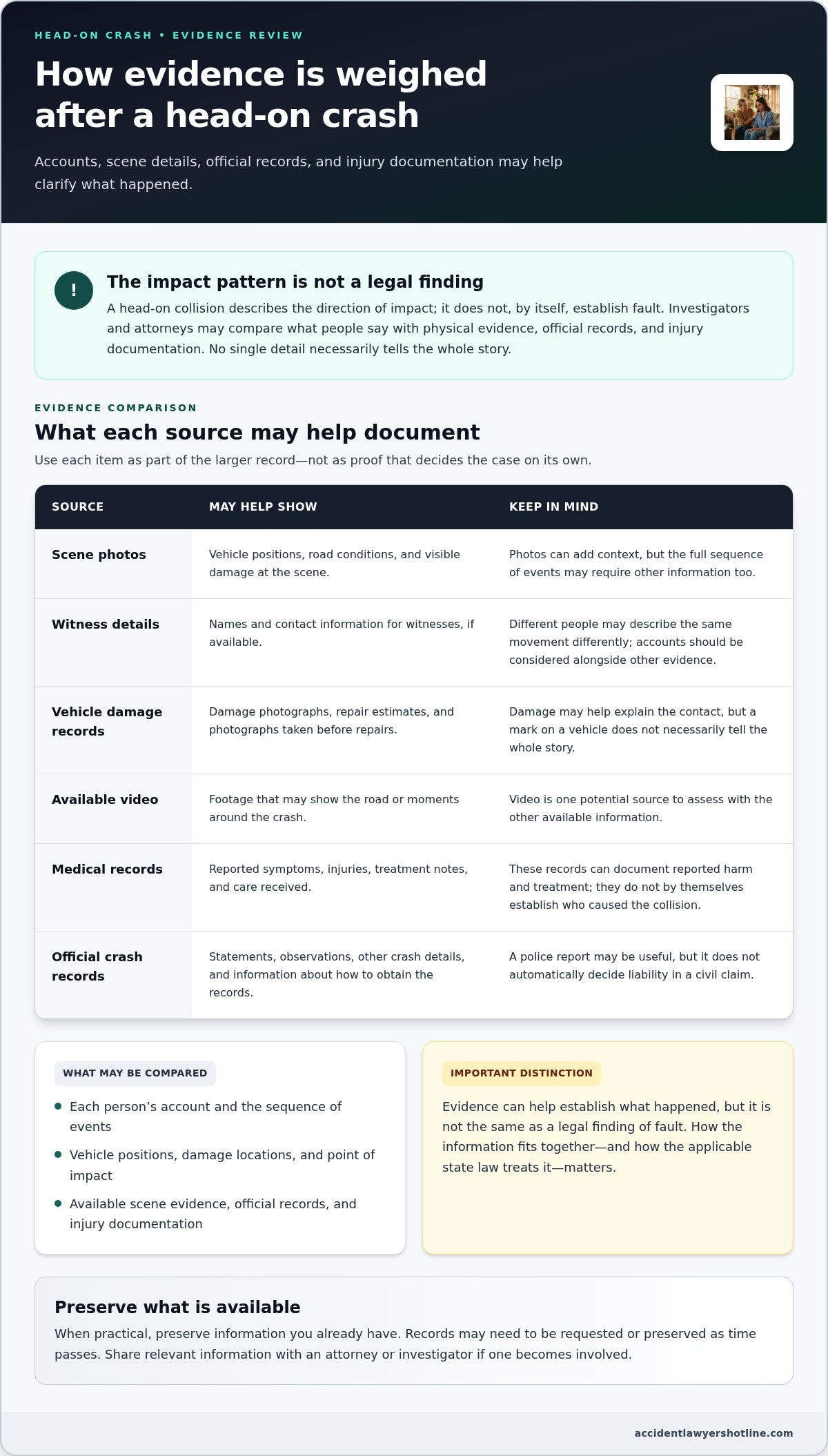
When accounts conflict, investigators and attorneys may compare what each person says with physical evidence, official records, and injury documentation. They may examine the vehicles’ positions on the road, where damage appears, the point of impact, and other available scene evidence. No single detail necessarily tells the whole story. A mark on a vehicle, for example, may help explain the contact but needs to be considered alongside other information.
Evidence can help establish what happened, but it is not the same as a legal finding of fault. A police report may record statements, observations, or other crash details. It can be useful, but it doesn’t automatically decide liability in a civil claim. The overall evidence evaluation in lawsuits turns on how relevant information fits together and how applicable law treats it.
Evidence in a head-on collision lawsuit may come from several sources. Preserve what you already have when practical, and share relevant information with an attorney or investigator if one becomes involved. When available, records may need to be requested or preserved as time passes.
Evidence that may help clarify what happened
Information that may help establish a timeline or document reported harm includes:
- Photographs of the scene, vehicle positions, road conditions, and visible damage.
- Names and contact information for witnesses, if available.
- Vehicle damage records, repair estimates, and photographs taken before repairs.
- Available video, such as footage that may show the road or moments around the crash.
- Medical records and treatment notes documenting reported injuries and care received.
- Official crash records and information about how to obtain them.
These materials can support an account or raise questions about it. Medical notes, for instance, can document symptoms reported and treatment provided, but they don’t by themselves establish who caused the collision.
Why disputed or shared fault needs careful review
Different accounts don’t automatically mean that no claim exists. They do mean the evidence deserves close attention. Comparative or contributory fault rules vary by state, and those rules may affect whether a claim can proceed or how responsibility is assessed. Don’t assume a general online explanation settles your situation. The relevant state law and the specific facts need to be considered together.
Reviewing the full record can help distinguish confirmed details from disputed ones. An attorney can assess how the available evidence and state rules may apply, without guaranteeing a liability finding or result. If you’re unsure how to organize the information or what it may mean, a motor vehicle accident case evaluation can help you explore possible legal options and connect with an independent attorney.
What Losses and Legal Issues Could a Head-On Collision Claim Involve?
A claim after a serious crash may involve more than the initial repair bill or emergency visit. It can include different types of alleged losses, but listing a loss does not mean it will automatically be recoverable. The evidence, applicable state law, and circumstances of the individual case all matter. A head-on collision lawsuit may also raise questions about how well each claimed loss is documented and whether it is connected to the crash.
The categories below are common examples, not a promise that every item applies or will be compensated.
| Loss category | Examples | Records that may help document it |
|---|---|---|
| Economic losses | Medical expenses, income disruption, and vehicle or other property damage | Medical bills, wage and employment records, repair documents, and receipts |
| Non-economic losses | Pain, physical limitations, and emotional effects associated with an injury | Treatment notes and consistent records describing how symptoms affect daily activities |
Documented financial losses and property damage
Keep bills, receipts, wage records, and repair documents together. Medical statements can show amounts charged for care, while employment records may help describe missed work or a change in income. Repair estimates, invoices, and photographs can help record vehicle damage. These documents support an account of claimed losses; they don’t, on their own, determine responsibility or the amount that may be legally recoverable.
Some costs have already occurred. Other claimed losses may relate to future needs, such as ongoing care or continued work disruption. Future effects generally call for supporting information rather than an unsupported estimate. An attorney can review what records exist and how the applicable law treats the claimed losses.
Injury effects and the role of medical documentation
Symptoms and treatment can change over time. Medical records and treatment notes may help show what you reported, the care you received, and how an injury affected you. Keep your descriptions accurate and consistent. Don’t exaggerate symptoms or try to diagnose yourself. If pain, limited movement, sleep difficulties, or emotional effects interfere with daily activities, describe those changes honestly to your healthcare provider.
Non-economic losses can be harder to document than bills or missed pay. A clear record of the effects you experience may help explain their impact, but it doesn’t establish a particular legal value. There is no single formula that applies to every claim. Valuation depends on the evidence, jurisdiction, and individual circumstances. State-specific rules may also affect available damages, so an attorney’s review can help clarify which documented losses may be relevant without promising a recovery.
What to Gather Before a Head-On Collision Case Evaluation
You don’t need a complete file to ask about your options. First, get needed medical attention and follow your healthcare provider’s guidance. Records can be collected afterward. For broader post-crash actions, see this car accident steps guide.
Use this checklist to organize what you have for a head-on collision lawsuit evaluation. Don’t delay care or feel you must locate every document before requesting a review.
- Write down the basic crash details. Note the date, general location, people involved, and any available report number or agency information. Keep the location general when sharing details online.
- Gather crash-related records. Set aside report information, photographs, video, vehicle damage records, and witness names or contact details you already have.
- Collect medical information. Include bills, visit summaries, treatment notes, and other available records related to care after the collision. Keep appointment dates handy.
- Organize insurance communications. Save letters, emails, claim references, and notes of calls. Record who contacted you and when, without editing the original messages.
- Document financial and property effects. Gather wage or employment records, repair estimates or invoices, receipts, and other documents that may help explain the losses you’re reporting.
Records that can make an initial review clearer
Sort materials into crash records, medical information, insurance communications, and loss documentation. Keep originals intact, including digital files and message dates. Don’t add details to a report or alter photographs. Missing paperwork doesn’t necessarily prevent you from requesting an evaluation. Make a note of what you don’t have and any steps you’ve taken to obtain it. A brief timeline can help connect events and identify unanswered questions.
How to prepare for a focused legal conversation
Describe what you personally saw, heard, or did separately from what you infer or learned later. If you’re unsure about a detail, say so rather than guessing. List questions about responsibility, potential claims, deadlines, and possible next steps. Deadlines can depend on state law and case details, so ask how they may apply to your situation. Don’t sign documents or accept proposed terms until you understand their effect.
An organized folder can make it easier to explain what happened, but it doesn’t need to be perfect. Accident Lawyers Hotline evaluates motor vehicle accident cases and connects people with independent personal injury attorneys for legal assistance. The platform is a referral service, not a law firm, and does not directly represent clients. Request a motor vehicle accident case evaluation to explore possible legal options and connect with an independent attorney.
How Accident Lawyers Hotline Can Connect You With Legal Help
Sorting through a potential head-on collision lawsuit can feel like another burden after a serious crash. Accident Lawyers Hotline offers a practical starting point: it evaluates motor vehicle accident cases and connects people with independent personal injury attorneys for legal assistance. The platform is a referral service, not a law firm, and it doesn’t directly represent clients. If an attorney agrees to represent you, that attorney, not the platform, provides legal advice and representation.
What happens during a case evaluation
You can share basic information about the crash, your injuries, and the records you have. The circumstances can then be reviewed to help identify possible legal options. If connected with an attorney, you can discuss questions that need further review, such as the available evidence, potential claims, and deadlines that may apply under the law in the relevant state.
An evaluation is an initial review, not a guarantee that an attorney will take the case or that a lawsuit will succeed. No one can promise a liability finding or a particular recovery based only on a brief account. Share what you know accurately, and mention where facts remain uncertain. That gives the evaluation a more useful starting point.
Connected attorneys operate on a contingency basis, meaning there are no attorney fees unless the case is won. Fee arrangements, case costs, and other representation terms depend on the specific agreement. Review that agreement with the attorney before deciding whether to proceed. This contingency fee information explains the general arrangement and why the written terms matter.
Choosing a next step while protecting your options
Before entering an attorney-client relationship, make sure you understand who would represent you and what the agreement covers. Ask how the attorney’s fee is calculated, how case costs are handled, and what your responsibilities would be. Don’t sign until you understand the terms. If an insurer has sent documents or proposed a resolution, take time to understand the effect of any acceptance or release before agreeing.
If you were riding on a motorcycle during the crash, the details of your role and injuries may shape which questions deserve attention. The motorcycle accident rights guide offers related information for motorcycle crash situations.
You can request a case evaluation through Accident Lawyers Hotline to explore possible legal options and a connection with an independent attorney. It’s a way to begin asking informed questions without assuming what the review will find or what decision you’ll make next.
Take a Clear Next Step Toward Understanding Your Options
You don’t have to decide today whether to file a head-on collision lawsuit. A focused conversation can help you understand what questions remain, what information may matter, and what options could be available under the law that applies to your situation.
Accident Lawyers Hotline connects people with experienced, independent personal injury attorneys. The connected attorneys operate on a contingency basis, with no attorney fees unless the case is won. The specific fee arrangement and any other terms are set out in the attorney-client agreement, so review it with the attorney before deciding how to proceed.
When you’re ready to explore legal help, take the next step at your own pace. Request a head-on collision case evaluation to get a clearer starting point for deciding what comes next.
Frequently Asked Questions
Can I file a lawsuit if I was partly at fault in a head-on collision?
Possibly. Whether shared responsibility affects your claim depends on the law that applies and how the facts are assessed. Some states may allow recovery with reduced damages when an injured person shares fault, while other states apply different rules. Don’t assume that an insurer’s statement about your share of fault settles the legal question. An attorney can review the evidence, identify the relevant state rule, and explain how it may affect your options.
How long do I have to file a head-on collision lawsuit?
The filing deadline depends on the state and circumstances, including who may be involved in the claim. Special rules may apply when a government entity is involved, and some situations require notice before a lawsuit. Don’t rely on a general online estimate or wait for negotiations to finish before asking about timing. Share the crash date and relevant parties with a qualified attorney so they can identify the deadline that may apply.
What evidence is important in a head-on collision case?
Useful evidence may include scene and vehicle photographs, witness contact details, available video, repair records, medical documentation, and insurance communications. Preserve original files and messages when possible, and keep a note of when you received or created them. A police report can provide useful details, but it doesn’t automatically decide legal responsibility. An attorney can help prioritize records based on disputed facts, such as where each vehicle was positioned before impact.
Can a passenger bring a claim after a head-on collision?
A passenger may have legal options if another party’s conduct caused an injury, but the facts and state law control. For example, the review may consider the actions of one or more drivers, available insurance, and what evidence connects the crash to the passenger’s injury. Being a passenger doesn’t by itself determine who is responsible. Keep your own treatment and insurance records, and ask an attorney to assess the circumstances and possible next steps.
Do I have to go to court to resolve a head-on collision claim?
No, a claim doesn’t necessarily require a trial. Some disputes may be resolved through insurance discussions or settlement negotiations; others may proceed to a lawsuit if key issues remain unresolved. Even after a lawsuit is filed, a trial isn’t guaranteed. Before accepting a proposed resolution, understand what claims or rights the documents address and whether accepting would end further pursuit of the claim. An attorney can explain the options and trade-offs.
How do attorneys get paid for a head-on collision case?
Attorneys connected through Accident Lawyers Hotline work on a contingency basis, meaning there are no attorney fees unless the case is won. The written attorney-client agreement explains the specific fee arrangement and how any case-related costs are handled. Read the agreement before signing, including provisions about expenses and what happens at different stages of the case. Ask the attorney to explain any term you don’t understand so you can make an informed decision.
Were You Injured in an Accident?
Get a free, confidential case evaluation. No upfront fees.
Get Free Case Evaluation