How to Calculate Lost Wages From a Car Accident
Learn how to calculate lost wages from car accident injuries with this step-by-step guide. Gather records, calculate missed income, and maximize your claim.
Your paycheck stopped after the crash, but the bills didn’t. If you’re trying to figure out how to calculate lost wages from car accident injuries, start with the income you can document that you would have earned while your injuries kept you from working. This gives you a practical starting point, whether you earn a salary, work hourly, or are self-employed.
It can be unclear which losses to include. Your estimate may involve more than regular wages, and an insurer may ask for records to support each amount. A careful calculation helps you explain what you missed and identify gaps before submitting a claim.
This guide explains how to estimate past lost income, account for overtime, bonuses, commissions, tips, and self-employment earnings, and organize records such as pay stubs, tax returns, and employer statements. It also explains why future loss of earning capacity is a separate, more complex issue that may need expert analysis. If the numbers or evidence are disputed, a case evaluation can help you understand what may need closer legal review.
Key Takeaways
- To calculate lost wages from car accident injuries, start with your pay rate and documented work time missed because of your injuries.
- For hourly or salaried work, use your usual earnings and injury-related absences to build a preliminary estimate.
- Variable pay and self-employment income may require an earnings history and records showing missed income or work opportunities.
- Group medical restrictions, attendance records, and income documents so you can trace each part of your estimate.
- Update the estimate as information changes. Treat future earning losses separately, since they may need closer review.
What Counts as Lost Wages After a Car Accident?
Lost wages are income you missed because car accident injuries prevented you from working. The key is connecting the injury to the missed work. A scheduled shift you couldn’t work under medical restrictions may belong in an initial estimate. Time off for an unrelated reason does not.
Past lost wages are income you would have earned during a period when accident-related injuries kept you from working, subject to the evidence and claim rules that apply. This is an estimate of a past loss, not a promise that every amount claimed will be accepted or recovered. State laws, insurance terms, and the facts of a case can affect what may be considered and how it must be supported.
Think of the estimate as one part of Economic Damages, a category that can include measurable financial losses. For a first pass, record the dates and hours you missed, then separate regular pay from additional earnings that need their own support. This gives you a clearer basis for calculating lost wages from car accident injuries.
Which missed work and pay belong in an initial estimate?
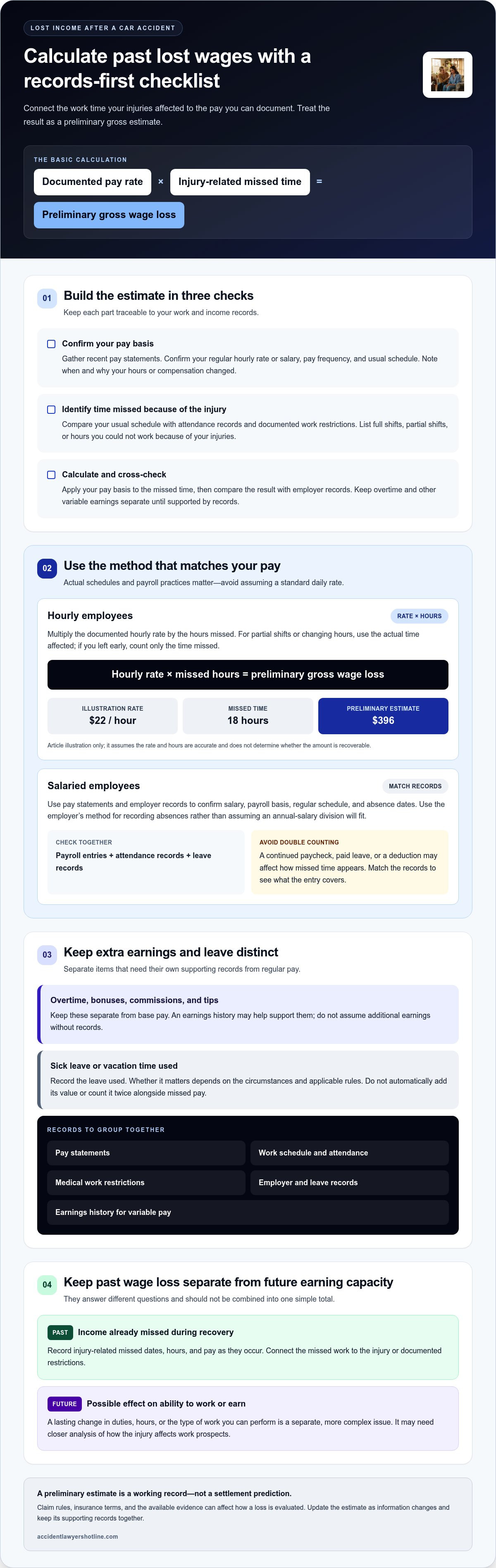
Start with the workdays, shifts, or hours you missed because of your injuries or documented work restrictions. Compare that time with your normal schedule. For example, if you missed a scheduled shift or worked fewer hours after returning under restrictions, record the date and time affected. Keep base pay separate from overtime, commissions, tips, or bonuses. These additional earnings may be relevant, but support them with an earnings history rather than assuming you would have received them.
Used sick leave or vacation time may also matter to a claim, depending on the circumstances and applicable rules. Record the leave used, but don’t automatically add its value or count it twice alongside missed pay. Treat your initial total as a working estimate that organizes the loss and highlights questions. It is not a settlement prediction, and an insurer or legal review may assess the evidence differently.
Are lost wages different from future earning capacity?
Yes. Past wage loss concerns income already missed during recovery. Future loss of earning capacity asks whether an injury may affect your ability to work or earn income going forward. The impact might involve a lasting change in your duties, hours, or the type of work you can perform. This is separate from adding up missed shifts and may require closer analysis of how the injury affects your work prospects.
Keep the two categories distinct in your notes. Record past missed time and pay as it occurs. If you’re concerned that your injuries could limit future work, note what has changed and raise the issue for state-specific legal review. Future earning impact isn’t simply an extension of past wages, so don’t treat a preliminary estimate as a complete measure of that potential loss.
How to Calculate Lost Wages for Hourly and Salaried Employees
Start with records, not a guessed daily rate. To calculate lost wages from car accident injuries, establish how you’re paid, identify the work time your injuries affected, and calculate a preliminary gross amount. This is a snapshot of missed earnings before claim review, not a prediction of what an insurer or other party will pay.
- Establish your pay basis. Gather recent pay statements and confirm your regular hourly rate or salary, pay frequency, and usual schedule. If your hours or compensation changed during the relevant period, record when and why.
- Identify injury-related missed time. Compare your work schedule with attendance records and any work restrictions. List full shifts, partial shifts, or hours you missed because you couldn’t perform your job.
- Calculate a preliminary gross loss. Apply your pay basis to the missed time, then compare the result with your employer’s records. Keep overtime and other variable earnings separate for review instead of adding them to regular pay without supporting records.
How do hourly workers estimate missed pay?
For an hourly employee, multiply the documented hourly rate by the hours missed: hourly rate × missed hours = preliminary gross wage loss. For example, at an assumed rate of $22 per hour, 18 missed hours produce a preliminary estimate of $396 before considering other earnings or claim-specific questions. This illustration assumes the rate and hours are accurate and does not establish whether the amount is recoverable.
Use your actual schedule to account for partial shifts and changing hours. If you left work early for an injury-related reason, count only the time missed, not the full shift. Keep overtime separate. A representative earnings history may help assess it later.
How do salaried workers estimate missed pay?
Start with pay statements and employer records showing your salary, payroll basis, regular schedule, and absence dates. Don’t assume that dividing annual salary by a standard number of days or hours will fit your situation. Schedules and payroll practices differ, so use the actual work time affected and your employer’s method for recording absences.
A paycheck may not show the full picture. Your employer may continue your regular salary while recording an absence through paid leave, or a pay statement may show a deduction without explaining which missed hours it covers. Match payroll entries with attendance and leave records. This can help you avoid overlooking missed time or counting the same loss twice.
Label the calculation as a gross estimate. It doesn’t account for every issue that may affect a claim, and the final evaluation can depend on the evidence and applicable state rules. If you’re unsure how your records support the estimate, a car accident case evaluation through Accident Lawyers Hotline can help assess potential losses and connect you with independent personal injury attorneys.
How to Estimate Variable Income, Self-Employment, and Future Losses
A regular hourly rate or salary may not capture the full effect of missed work. If your income changes from one pay period to another, estimate each income type separately and show how you arrived at each amount. This makes your assumptions easier to understand and helps distinguish a typical earnings pattern from an unusually strong or weak period.
Use this comparison as an organizing guide, not a ruling on what a claim will include:
| Income category | What to examine | Keep in mind |
|---|---|---|
| Variable employee pay | Commission, tips, bonuses, and overtime records across relevant pay periods | Use a representative history and explain unusual changes. |
| Self-employment income | Tax returns, profit and loss statements, invoices, contracts, and canceled work | Business revenue is not automatically personal income lost. |
| Benefits and leave | Records of sick leave or vacation used, and documents showing affected benefits | Assess each item separately. Don’t assign a value or count it twice without support. |
| Future earning impact | Evidence of lasting work restrictions and changes to earning ability | This is a separate analysis from pay already missed. |
How can workers with commissions, tips, or overtime estimate lost income?
Compare earnings across multiple relevant pay periods, using a consistent timeframe where your records allow it. A single unusually high commission check or overtime-heavy week may not reflect a typical pattern. Separate regular wages from each variable component, then identify the earnings history you used to estimate what you might have earned while unable to work.
Payroll summaries, commission statements, employer letters, schedules, and tip records can help show both the amounts and when you earned them. Note changes in hours, sales, or seasonal demand that could affect the comparison. This doesn’t guarantee every variable amount will be accepted, but it makes the basis of your estimate easier to follow.
How are self-employment and future income losses assessed?
Self-employed workers can organize tax returns, 1099 forms, profit and loss statements, invoices, and evidence of canceled contracts or missed opportunities. Records from several years may help show normal fluctuations and business trends. A drop in gross revenue alone, however, doesn’t establish an individual’s lost income. Business expenses, timing, and the worker’s role in generating revenue may all matter to the analysis.
Future earning-capacity claims require a different analysis than calculating pay already missed during recovery. If injuries may limit your ability to work later, records about medical restrictions and job duties can help frame the issue. A detailed assessment may also require vocational or economic expertise. Keep this potential future impact separate from past wage calculations and flag it for state-specific legal review.
For anyone working out how to calculate lost wages from car accident injuries, the clearest estimate separates each income stream and shows the evidence behind it. Don’t treat a projection as certain income or combine categories without explaining your method. A case evaluation can help identify questions about your records and potential losses.
What Records Help Prove Lost Wages After a Crash?
A clear wage-loss estimate connects three things: medical information showing why work was affected, records showing when you missed work, and documents showing what you would have earned. Keep these records organized so you can trace each amount to its source and spot gaps before an insurer or attorney reviews the claim.
Which documents support a wage-loss estimate?
Gather records that show both the work restriction and its financial effect. Useful documents may include:
- Medical work restrictions: doctor’s notes, work-status forms, or treatment records identifying limits or time away from work.
- Employer attendance: schedules, time sheets, attendance records, and leave balances showing the dates and hours missed.
- Income documentation: pay statements, W-2s, and an employer letter. Self-employed workers may also use tax returns, 1099 forms, profit and loss statements, invoices, or contract records.
An employer statement can bring key details together. It may verify missed dates, your usual schedule and pay rate, and whether you used sick leave or vacation time. Compare it with payroll and attendance records. If dates don’t match, ask for the records to be clarified or corrected rather than leaving an unexplained gap.
Keep original documents and organize copies chronologically. Pair each absence with the related medical restriction or treatment record, then connect it to the relevant schedule and pay information. This creates a clear calculation trail. State rules and claim circumstances can affect what proof is needed, so thorough records support review but don’t guarantee an insurer’s decision.
How can you prepare a clear calculation for review?
Create a date-by-date log showing scheduled hours, time actually missed, pay basis, and the source document for each entry. Show the formula used for each subtotal. If you estimated variable earnings from past pay periods, identify those periods and explain why you chose them. Label the total as gross or net, and don’t combine the two. Mixing gross wages with take-home pay can make an estimate difficult to follow.
Insurers may question absence dates that don’t match, averages without supporting records, or calculations with unexplained assumptions. Before sharing your estimate, check that the log agrees with employer statements, payroll records, and medical documentation. If an item is uncertain, mark it as an estimate rather than presenting it as a confirmed amount. Clear labeling makes questions easier to address during review.
Attorney payment arrangements are separate from documenting wage loss. The contingency fee explanation describes one possible arrangement. It doesn’t mean every case-related cost is waived. If you need help assessing your records and potential losses, request a car accident case evaluation. Accident Lawyers Hotline connects injured people with independent personal injury attorneys. An organized record trail can make that review more focused, including when you’re calculating lost wages from car accident injuries.
What to Do After Estimating Lost Wages From a Car Accident
Your estimate gives you an organized starting point. It doesn’t guarantee that an insurer or court will accept the amount, and it can’t replace legal advice tailored to your state and circumstances. Keep it as a working document and update it when missed work, medical restrictions, or income records change.
Take these practical next steps:
- Preserve your records. Keep copies of medical work restrictions, employer records, pay documents, and your calculations.
- Update the estimate. Add new missed time or corrected payroll information, and keep earlier versions so changes are traceable.
- Note open questions. Flag uncertain dates, variable earnings, disputed restrictions, and any potential future effect on your work.
Keep your calculation separate from other losses and label your assumptions clearly. An organized file can make it easier to explain how you reached the estimate, but it won’t resolve every question about eligibility, proof, or the rules that apply. Those issues depend on the claim and state law.
When might a wage-loss estimate need legal review?
Consider individualized legal guidance if your work schedule is complex, your income changes from period to period, an insurer disputes whether restrictions kept you from working, or your injuries may affect your future earning ability. These issues can require more than arithmetic. An attorney can assess the evidence and applicable state rules for your circumstances. An online estimate can’t determine claim value, outcome, or entitlement.
Before a review, write down what you’re unsure about. For example, note a mismatch between an absence date and a payroll record, or explain how you estimated commission income. Clear questions help focus the discussion on the evidence and points that may need further analysis.
How can an accident case evaluation help clarify next steps?
Accident Lawyers Hotline provides case evaluations and connects injured people with independent personal injury attorneys. It is a referral platform, not a law firm, and does not directly represent clients. The evaluation and any attorney-client relationship are separate. An attorney-client relationship would be with an independent attorney, not the platform. Neither an estimate nor an evaluation guarantees compensation.
If you want an attorney to assess your circumstances and potential wage-loss evidence, request a car accident case evaluation. This can be a useful next step when your records raise questions or you want guidance specific to your claim. Bring your estimate and note the assumptions behind it, so you can explain what you counted and what still needs review. The goal is a clearer understanding of possible next steps, not a promise about the result.
Take the Next Step With a Clearer Picture
Your wage-loss estimate can help explain what changed after the crash, but questions may remain about how the records, state rules, or future work impact fit together. Use those questions to identify what needs clarification rather than settling on a number before the evidence has been reviewed. Understanding how to calculate lost wages from car accident injuries is a useful start. Applying the estimate to your circumstances may call for individualized legal guidance.
Accident Lawyers Hotline offers case evaluations and connects people with independent motor vehicle accident attorneys. Those attorneys may work on a contingency basis, subject to the terms of any agreement. The platform is a referral service, not a law firm, and an evaluation cannot promise a particular result.
To have an attorney review your circumstances and help clarify possible next steps, request a car accident case evaluation. You’ve already taken a practical step by organizing your information. Keep your records together and bring your estimate, including the assumptions behind it, to the evaluation.
Frequently Asked Questions
How do you calculate lost wages after a car accident?
Estimate missed income by matching injury-related time away from work with your usual pay records. For hourly work, use the documented rate and missed hours. For salary, use payroll details and the work period affected. For example, compare a scheduled shift with attendance records and the relevant pay statement. This gives you a preliminary gross estimate, not a guaranteed recovery. How to calculate lost wages from car accident injuries depends on the evidence and rules that apply to the claim.
Can I claim lost wages if I used sick days or paid time off?
You may be able to include sick leave or paid time off used because of accident-related injuries in a wage-loss claim, but how it is treated depends on the facts and applicable state rules. Track the dates and hours of leave used, and keep the employer’s leave balance or payroll record. Don’t count the same time both as unpaid wages and as leave value. An attorney can assess how the specific claim treats that loss.
Can self-employed people claim lost income after a car accident?
Self-employed people may be able to claim income losses tied to injury-related work disruption, but gross business revenue alone doesn’t show the individual’s loss. Consider how canceled jobs, delayed projects, or reduced capacity affected your income, accounting for business expenses and other relevant factors. Tax returns, invoices, contracts, and profit and loss records can help show the business pattern. The strength and treatment of a claim depend on its evidence and applicable law.
How do you calculate lost wages if your income changes each month?
Use records from a representative period to understand your usual earnings rather than relying on one unusually high or low month. Compare pay statements and schedules, and note seasonal shifts, changes in hours, or other reasons earnings varied. Keep regular wages separate from commissions, tips, or overtime so the calculation is easy to follow. No single averaging period fits every worker or claim, so explain the records and assumptions behind your estimate.
Can I include overtime, tips, bonuses, or commissions in lost wages?
These earnings may be considered, but they aren’t automatically included just because you sometimes receive them. Support each type with records such as payroll history, tip logs, commission statements, or bonus information. A consistent pattern across pay periods can help show that an amount reflects expected earnings, while a one-time payment may need more explanation. Keep variable pay separate from base wages, and don’t treat a projection as income you were certain to receive.
What documents prove lost wages after a car accident?
No single document proves every part of a wage-loss claim. Medical notes can show work restrictions, while schedules and attendance records can identify missed time. Pay statements, W-2s, or employer letters may help establish earnings. Self-employed workers can organize tax and business records. Match documents by date so a reviewer can follow how an injury-related absence connects to the income estimate. Required proof can vary with the claim and state rules.
Can I claim future lost earning capacity after a car accident?
You may be able to pursue future lost earning capacity if an injury affects your ability to work or earn income, but it is different from pay already missed. The analysis may consider lasting work restrictions, job duties, and changes to your earning prospects. Medical information may help describe limitations, and vocational or financial analysis may also be needed. This kind of claim is highly fact-specific, so individualized legal review is important before drawing conclusions.
Were You Injured in an Accident?
Get a free, confidential case evaluation. No upfront fees.
Get Free Case Evaluation