How to Master Loss of consortium claim after spouse's accident for Better Results
Learn how a loss of consortium claim after a spouse's accident works in Michigan, what evidence shows relationship changes, and how it fits the injury case.
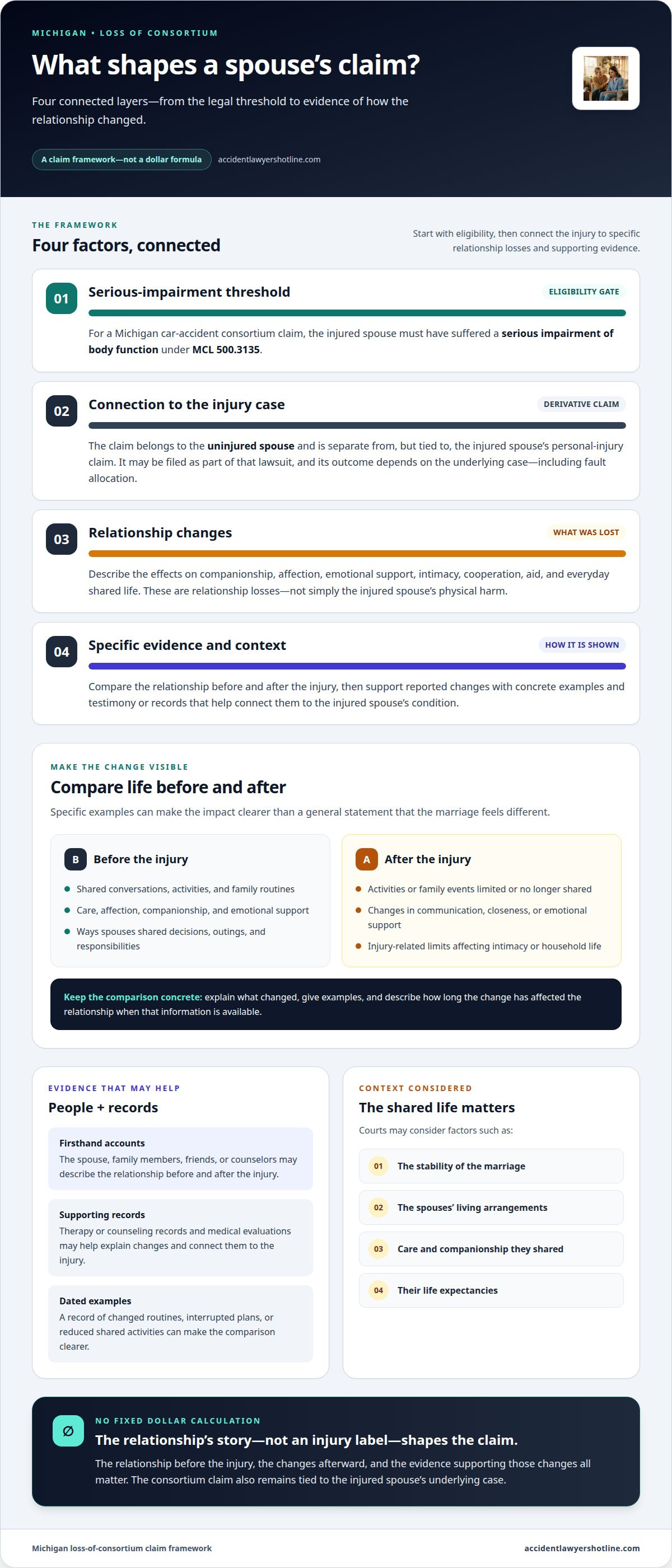
In Michigan, a loss of consortium claim after a spouse’s accident is a separate claim brought by the uninjured spouse, but it is tied to the injured spouse’s case. Under MCL 500.3135, the injured spouse must have suffered a serious impairment of body function for this type of claim to apply.
It’s understandable to focus first on your spouse’s injuries and recovery. But an accident can also change the companionship, affection, intimacy, and everyday support you share. A loss of consortium claim addresses those relationship losses, not just the injured person’s physical harm.
The connection between the claims matters: a spouse’s claim may be filed as part of the injured person’s personal injury lawsuit, and its outcome depends on the underlying case. This guide explains what a Michigan loss of consortium claim involves, which relationship changes may matter, how evidence can show their impact, and how the claim relates to your spouse’s injury case. You’ll get a clearer picture of what to consider as your family adjusts.
Key Takeaways
- In Michigan, the injured spouse must have a serious impairment of body function for a spouse’s loss-of-consortium claim after a car accident to apply.
- The claim belongs to the uninjured spouse and is separate from, but connected to, the injured spouse’s personal injury claim.
- Evidence can show how the relationship changed by comparing companionship, affection, intimacy, and support before and after the injury.
- Compensation may reflect the relationship and household losses caused by the injury, with the nature and extent of those losses shaping the claim.
- Because the spouse’s claim depends on the underlying injury case, understanding how the two claims fit together can help clarify the next steps.
How Much Can a Spouse Be Compensated for Loss of Consortium?
There’s no single figure that captures every spouse’s loss. In Michigan, evidence must show how the accident changed companionship, affection, emotional support, and shared life.
Companionship and Emotional Support
Companionship and emotional support are the care, affection, and everyday connection spouses share. Their loss matters because an injury can change how partners communicate, spend time together, and support each other.
For example, a spouse who once shared daily conversations or family activities may face withdrawal or limited communication after an injury. The effects on children may matter, too, if the injured parent can no longer provide the same attention or guidance. These changes describe the impact on the relationship beyond medical treatment.
Company, cooperation, and aid can change as well. A spouse may no longer be able to share decisions, attend family events, or provide ordinary emotional support. Specific examples in a lawsuit make the loss clearer than a general statement that the marriage feels different.
Intimacy and Companionship Losses
Loss of intimacy describes a change in physical closeness or the ability to share an intimate relationship after an injury. Physical limitations and emotional changes can affect how spouses connect, beyond the household routine.
For example, pain or reduced mobility may prevent a couple from sharing forms of affection they enjoyed before the accident. The spouse’s account can explain what changed and how long the change has affected the relationship. Medical information may help connect the injury to those limitations.
Companionship and intimacy overlap, but describe different parts of a shared life. A couple might still communicate closely while physical intimacy changes, or both forms of connection may be affected. Describing each impact separately helps distinguish the losses instead of treating every change as one general hardship.
There is no reliable dollar calculation based only on the accident or injury label. The relationship before the injury, the changes afterward, and the evidence supporting those changes all shape how a claim is assessed. Courts may consider the marriage’s stability, the spouses’ living arrangements, the care and companionship they shared, and their life expectancies.
A practical way to explain the loss is to compare specific parts of married life before and after the accident. Note whether shared outings stopped, communication changed, or emotional support became harder to give or receive. Testimony from the spouse, family, friends, or counselors may help describe these effects.
Comparative negligence affects the consortium claim through the injured spouse’s underlying personal injury claim. Because the consortium claim is derivative, the outcome and fault allocation in the underlying claim matter to whether and how the spouse may recover.
What is a Michigan loss of consortium claim?
There’s no single nationwide filing period: New York allows three years, while California generally requires filing within two years of injury. After a Michigan accident, preserve evidence of relationship changes and coordinate the spouse’s separate claim with the injured person’s personal injury lawsuit.
Relationship Evidence Before and After Injury
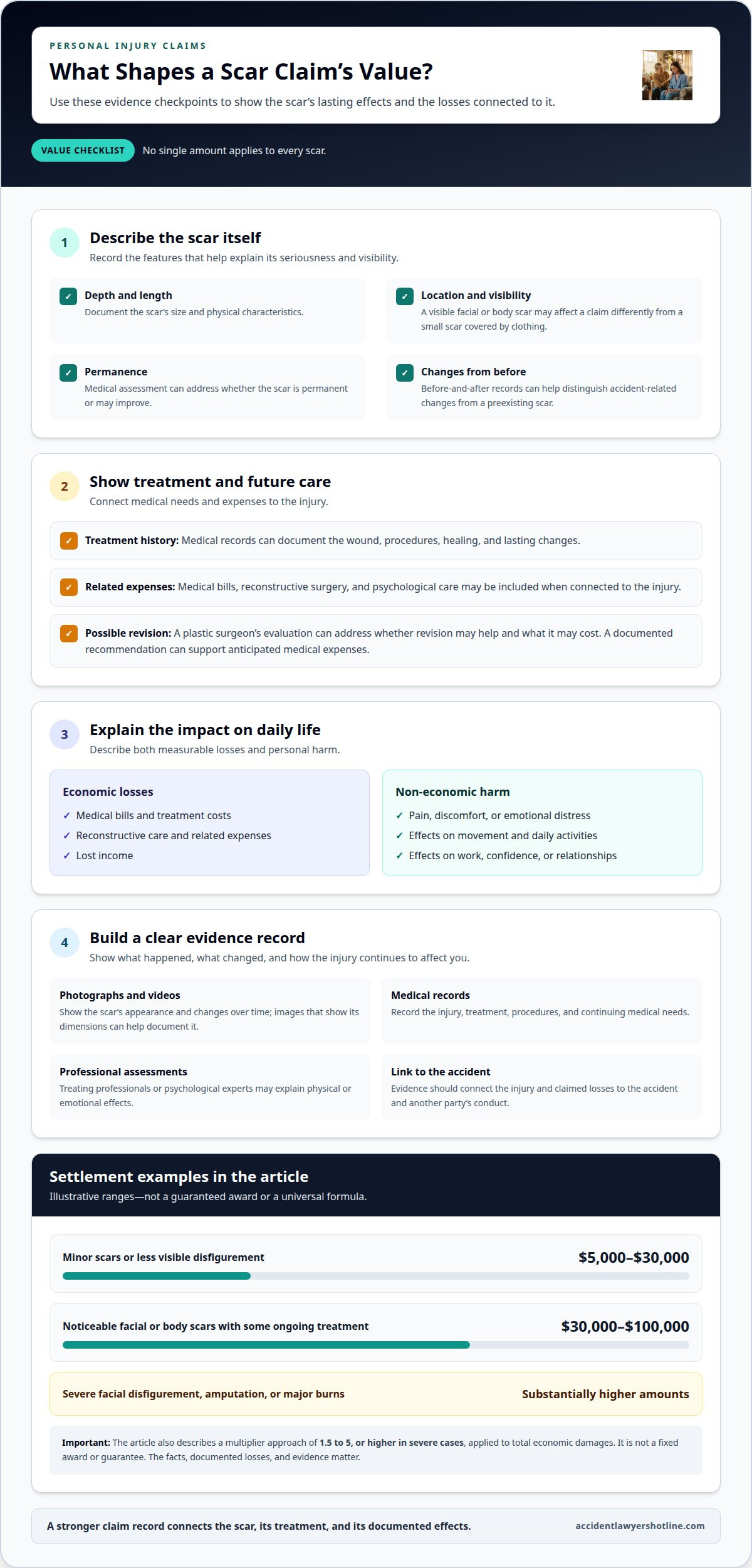
Relationship evidence compares the spouses’ shared life before the accident with their relationship after the injury. It matters because the claim must show a change connected to the injured spouse’s condition, not simply that the couple experienced difficulty.
For example, testimony can describe how often spouses shared activities before the crash and what changed afterward. A spouse may explain that injury-related limitations interrupted family routines or reduced the support they gave each other. A dated record of events can make that comparison clear.
Evidence should present both sides of the comparison. Family members, friends, or counselors may describe the couple’s relationship before and after the injury. Therapy records, counseling sessions, and medical evaluations may also help explain changes, including effects on emotional closeness or sexual relations.
Evidence of Relationship Changes
Evidence of relationship changes shows how an injury affected the couple’s connection and shared responsibilities. Specific examples help distinguish a concrete loss from a general statement that the relationship changed.
For instance, someone who regularly joined a spouse on outings might describe how injury-related limits changed those plans. Testimony from a friend who observed the couple’s shared activities may provide context. Medical evaluations can help connect the reported changes to the injured spouse’s condition.
Michigan law sets a specific threshold for a car-accident consortium claim: the injured spouse must have suffered a serious impairment of body function under MCL 500.3135. The spouse’s claim is separate from the injured person’s injury claim, though it can be filed as part of that person’s personal injury lawsuit.
State rules differ, so evidence requirements and eligibility cannot be assumed to match across the country. California generally limits these claims to spouses and registered domestic partners, while New York recognizes only a marital spouse. These examples show why the state connected to the accident matters when assessing who may bring a claim.
To prepare the claim, preserve testimony and records that describe the relationship before and after the injury, then connect reported changes to the spouse’s condition. Keep examples specific, such as a family activity that stopped or support that became difficult to provide. A focused review of the injury claim can help clarify how the related claim fits into the case.
Compensation and non-economic damages
Compensation depends on the losses a spouse can prove and the law governing the claim. Damages may address relationship harms, while some states also limit certain awards.
Non-Economic Damages
Non-economic damages address personal losses without a direct bill, such as lost affection, companionship, or emotional support. An injured spouse’s changed capacity can affect the marriage even when the uninjured spouse has no specific financial loss.
For example, a couple may lose shared activities or the ability to rely on each other for comfort. A jury may consider the marriage’s stability, living arrangements, care and companionship, and life expectancies. Evidence describing these effects helps explain the claim, but it doesn’t produce a fixed dollar formula.
Florida Consortium Damages
In Florida, loss of consortium damages may address the injured spouse’s company, cooperation, aid, affection, solace, comfort, companionship, fellowship, society, and assistance. This range matters because an injury may affect several parts of married life, not only intimacy.
A spouse may also claim the impact of household work the injured partner would normally perform, including raising children. The claim requires an actual loss caused by the injury, and the defendant’s conduct must have caused that loss. For example, evidence may describe how the injury changed family responsibilities and the support spouses provided each other.
Are loss of consortium damages taxable? They aren’t automatically taxable or tax-free. Treatment depends on the award’s legal character and applicable tax rules, so the label alone doesn’t settle the question.
State caps can change the amount recoverable. In Ohio, non-economic damages are generally limited to the greater of $250,000 or three times economic damages, with a maximum of $350,000, subject to stated exceptions, according to the Ohio General Assembly. This rule is specific to Ohio and shouldn’t be assumed to apply in Michigan or another state.
A jury assesses the relationship evidence and decides whether damages are warranted. Factors may include the spouses’ social, domestic, and sexual life before the accident, as well as how the injury changed their shared life. A personal injury attorney can help explain how the underlying injury claim and relationship evidence fit together.
Economic losses differ from non-economic harms. Depending on state law and the evidence, a claim may account for costs such as therapy or counseling, or hiring someone to perform tasks the injured spouse can no longer do. Keeping these expenses distinct from losses like affection clarifies what each part of the claim represents.
Impact of injuries on marriage and household duties
An injury can change both the emotional rhythm of a marriage and the work each spouse handles at home. A consortium claim may address lost household services and support, along with changes to companionship and intimacy.
Before an accident, spouses may divide cleaning, cooking, childcare, errands, or home maintenance. If the injured spouse can no longer cook dinner or drive children to activities, the other spouse may take on those tasks or arrange help. These specific changes show how the injury reshaped the household beyond the injured person’s own pain and suffering.
Household contributions go beyond chores. A spouse may help care for children, organize family activities, or provide daily support. If an injury prevents those contributions, the loss can affect the family’s routine and the other spouse’s responsibilities. For example, if a parent can no longer help with school routines, the other parent may have to manage them alone.
Economic damages may include lost financial support and household services the injured spouse previously provided. Connecticut recognizes these as potential economic loss-of-consortium damages. The focus is the support or service lost because of the injury, not a general estimate of how difficult family life has become.
To explain the change clearly, compare a specific household routine before the accident with what happens now. Describe who handled the task, whether the injured spouse can still do it, and what replaced that contribution. For example, if the injured spouse used to clean and cook, explain which tasks stopped and whether someone else now performs them. Receipts for paid assistance can show an expense; testimony can describe unpaid work and support.
Caregiving losses can affect children, too. If the injured spouse previously helped with daily care, school activities, or family outings, explain which responsibilities shifted and how that affected the household. Focus on observable changes, such as a spouse taking over transportation or hiring help for tasks the injured person can no longer manage.
An injury may also change shared activities and intimacy. A couple may stop taking walks together, attending family events, or sharing routines that supported their marriage. Describe each change plainly, including whether physical limits, emotional effects, or caregiving demands altered the activity. These details distinguish household-service losses from relationship losses without treating every hardship as the same damage.
A clear account connects each lost contribution to the injury and explains its effect on the household. Separate paid assistance and lost financial support from unpaid chores, caregiving, and changes to shared life. This distinction shows the different ways an injured spouse’s absence from familiar roles can affect a marriage and family.
Derivative relationship to the injured spouse’s claim
A consortium claim belongs to the spouse who experienced relationship losses, but its connection to the injured spouse’s personal injury case can affect the outcome. The underlying injury claim and the separate claim need to be understood together.
Connection to the Injured Spouse’s Claim
A derivative claim is a spouse’s separate claim that depends on the injured person’s underlying case. This connection matters because the injury claim establishes the event and harm from which the consortium claim arises.
The spouse’s claim may be filed as part of the injured person’s personal injury lawsuit. In Florida, its success depends on the underlying claim. If responsibility for the accident is disputed, that issue can affect both claims, even though each spouse’s claimed harm is different.
Who Can Bring a Claim
Who may bring a claim depends on state rules and the relationship recognized by law. In many cases, a spouse can bring one, while some states also recognize claims by registered domestic partners or certain family members.
New York limits eligibility to a marital spouse, while California generally recognizes spouses and registered domestic partners. These differences matter: a life partner who isn’t legally married may not qualify under a state’s rules, even if the relationship was close and longstanding.
In Michigan, the claim after a car accident requires the injured spouse to have suffered a serious impairment of body function under MCL 500.3135. The injured spouse’s ability to recover on the underlying personal injury claim and the uninjured spouse’s loss are related questions, but they describe different harms.
State law can also distinguish claims arising from injury from those connected to death. Connecticut General Statute Section 52-555a treats a spouse’s loss-of-consortium claim related to the other spouse’s death as separate from and independent of claims for damages related to that death. This illustrates why the legal connection between claims should be assessed under the state’s specific rules.
For example, imagine an injured spouse can no longer take part in shared activities because of accident-related limitations. The injured person’s case addresses personal injury, while the spouse’s claim addresses the resulting loss of companionship or support. The evidence and legal issues may overlap, but the spouse’s relationship loss remains distinct.
That distinction helps clarify what each claim must establish. The underlying case concerns the injured person’s harm and the defendant’s responsibility. The consortium claim focuses on the spouse’s loss, while relying on the legal and factual foundation of the injury case. Request an accident case evaluation to discuss how the related claims may fit together.
Accident Lawyers Hotline
Accident Lawyers Hotline provides accident case evaluations to help clarify how an injured spouse’s personal injury case relates to a consortium claim. If the crash involved a car, truck, motorcycle, pedestrian, or bus accident, an evaluation can help you understand the underlying case and the questions surrounding the related claim.
The connection matters because the spouse’s claim depends on the injured person’s case while addressing a separate relationship loss. Accident Lawyers Hotline connects people with experienced personal injury and motor vehicle accident attorneys who provide legal assistance. Consider an evaluation to understand how the accident’s facts and documented relationship changes fit together.
Contact Accident Lawyers Hotline to discuss your accident case.
Take the Next Step With a Clear Plan
A loss of consortium claim after your spouse’s accident can raise personal as well as legal questions. You don’t need to resolve every issue at once. Start by understanding how the injury case and your claim relate, then decide what support would help you move forward.
Circumstances may change as recovery continues. Keep the conversation open with your spouse and make space to describe new effects on your shared life. A calm, organized discussion can help you explain your concerns and identify the questions that matter most to your family.
Accident Lawyers Hotline provides car, truck, and motorcycle accident case evaluations. An evaluation can help you understand the accident case connected to your spouse’s claim and decide what to discuss next. Take the next step when you’re ready to gain a clearer understanding of your options, without pressure to decide before then.
Request a case evaluation with Accident Lawyers Hotline and take the next step at your own pace.
Frequently Asked Questions
How much is a claim worth?
There’s no standard award because the value depends on proven relationship losses and applicable state law. A jury may weigh the marriage’s stability, shared life, care, and companionship. For example, a claim involving a lasting change in daily support may differ from one involving a brief disruption. State damage limits can also affect compensation, so an amount from one state may not apply elsewhere.
What is a loss of consortium claim after a spouse’s accident?
It’s a claim by an uninjured spouse for relationship losses caused by the other spouse’s accident-related injuries. It may address effects on companionship, affection, intimacy, or shared support. For example, if an injury changes how spouses take part in family life, the uninjured spouse may seek damages for that impact. The claim is distinct from the injured person’s claim, even when both are included in one lawsuit.
What must a spouse prove to win a loss of consortium claim?
The spouse must establish that the injury caused a real loss in the relationship and meet the state’s legal requirements. In Michigan, a car-accident claim requires the injured spouse to have suffered a serious impairment of body function under MCL 500.3135. Evidence also needs to connect the injury to the claimed change. For example, medical information may explain why a shared activity became impossible.
How do courts calculate damages for loss of consortium?
Courts assess the evidence rather than apply a universal calculation. Relevant considerations may include the marriage’s stability, the spouses’ living arrangements, care and companionship, and life expectancies. A jury may also consider the couple’s social, domestic, and intimate life before the accident. Specific testimony about a changed routine, such as no longer attending family events together, can help explain the claimed loss.
Does a loss of consortium claim depend on the injured spouse’s personal injury case?
Generally, yes. A consortium claim is derivative, meaning its legal basis is connected to the injured spouse’s underlying personal injury claim. In Florida, the consortium claim’s success depends on the underlying claim’s success. The spouse still seeks damages for their own relationship loss, but issues affecting the injured person’s claim can also affect the related claim.
Can both spouses file separate claims after an accident?
Yes. The injured spouse may pursue a personal injury claim, while the other spouse may bring a separate consortium claim if state law allows it. The claims address different losses. The injured spouse’s case concerns their injuries, while the other spouse’s claim concerns effects on companionship or support. The claims may be brought together in the injured person’s lawsuit.
What evidence supports a loss of consortium claim?
Useful evidence can include testimony from the spouses and people who know their relationship, along with counseling records or medical evaluations. For example, a counselor’s record describing how an injury affected the couple’s communication can be supported by testimony about changes at home. Evidence should show the relationship before the accident and the specific ways it changed afterward.
Can a loss of consortium claim be settled separately from the injured spouse’s claim?
A consortium claim is separate, but it may be filed within the injured spouse’s personal injury lawsuit. The claims can therefore be addressed together, although separate settlement treatment depends on state rules and how the claims are handled. Before agreeing to resolve one claim, consider how the proposed terms affect the other spouse’s claim and whether each person’s losses are addressed.
Were You Injured in an Accident?
Get a free, confidential case evaluation. No upfront fees.
Get Free Case Evaluation