How to Respond When the Other Driver's Insurance Denies Your Claim
What if the other driver's insurance denies your claim? Learn why claims are denied, how to respond with evidence, and when bad-faith concerns may apply.
If you’re asking, “what if the other driver's insurance denies my claim?”, request the insurer’s decision and reasons in writing. A denial doesn’t automatically end your options, but it gives you a specific position to address.
It’s frustrating to face a denial when you believe the other driver caused the collision. Asking “what if the other driver's insurance denies my claim?” is a reason to focus on what the insurer disputes and what evidence may help answer it.
This guide explains common reasons insurers deny claims, practical ways to strengthen your response, and when a denial may raise bad-faith concerns. It also covers how an accident case evaluation can help you consider possible next steps.
Key Takeaways
- Separate a dispute about who caused the crash from a dispute about whether the policy covers it; the distinction shapes your next steps.
- Build a clear record of the crash, your injuries, vehicle damage, and communications related to the claim.
- Review the denial’s reasoning and the policy terms to identify what evidence or explanation may address the insurer’s position.
- Bad-faith remedies vary by state, so learn what standards and options apply where the accident happened.
- A car accident case evaluation can help you understand your evidence and possible next steps after a denial.
What Is a Bad Faith Denial?
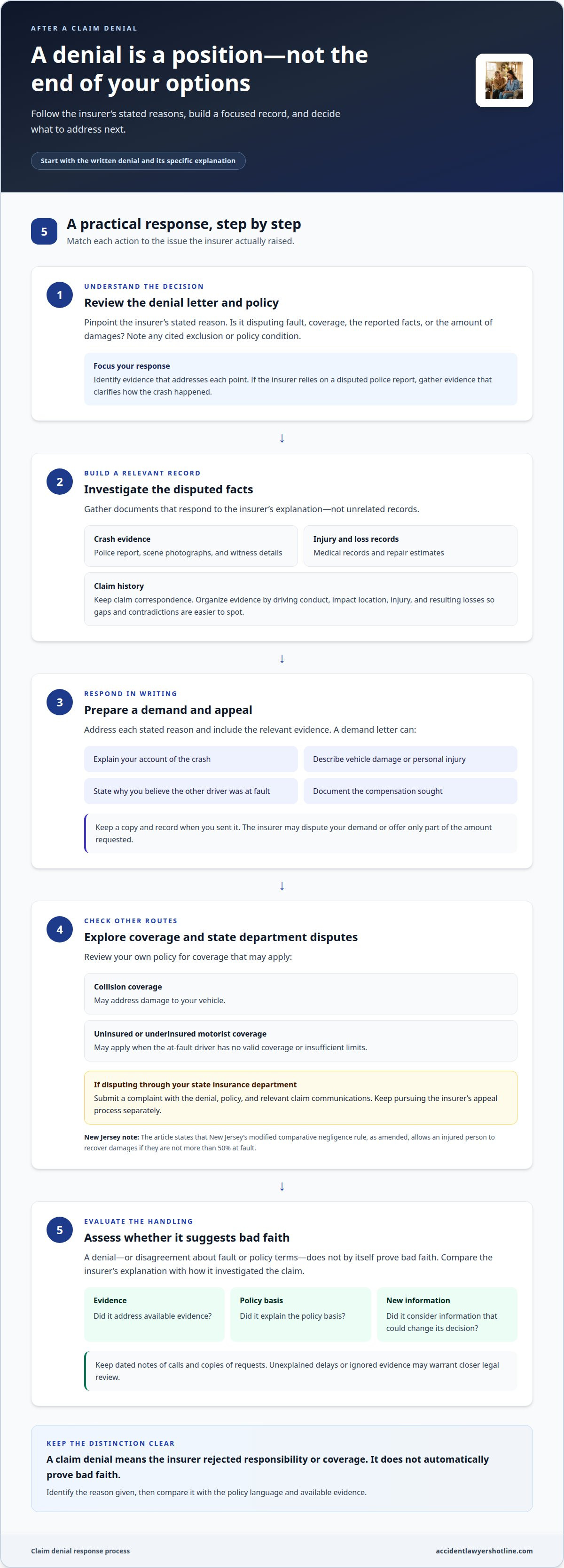
A claim denial means the insurer rejected responsibility or coverage. It does not automatically prove bad faith. Identify the reason given, then compare it with the policy language and available evidence.
-
Review the Denial Letter and Policy
Read the denial letter alongside the policy and pinpoint the insurer’s stated reason. Does it dispute fault, coverage, the reported facts, or the amount of damages? Note any cited exclusion or policy condition, then identify evidence that addresses each point. For example, if the insurer relies on a disputed police report, gather evidence that clarifies how the crash happened.
-
Investigate the Disputed Facts
Build a record that responds to the insurer’s explanation, rather than sending unrelated documents. Gather the police report, scene photographs, witness details, medical records, repair estimates, and claim correspondence. If the insurer says the other driver’s account conflicts with yours, organize evidence by issue: driving conduct, impact location, injury, and resulting losses. This makes gaps and contradictions easier to spot.
-
Prepare a Demand and Appeal
To challenge a third-party auto insurance denial, send the insurer a written response addressing each stated reason and include relevant evidence. A demand letter can explain your account, describe vehicle damage or personal injury, state why you believe the other driver was at fault, and document the compensation sought. Keep a copy and record when you sent it. The insurer may dispute your demand or offer only part of the amount requested.
-
Explore Coverage and State Department Disputes
Review your own policy for collision coverage, which may address damage to your vehicle, and uninsured or underinsured motorist coverage, which may apply when the at-fault driver has no valid coverage or insufficient limits. To dispute a denial through your state insurance department, submit a complaint with the denial, policy, and relevant claim communications. Keep pursuing the insurer’s appeal process separately. New Jersey’s modified comparative negligence rule, as amended, allows an injured person to recover damages if they are not more than 50% at fault, according to New Jersey Legislature.
-
Assess Whether the Handling Suggests Bad Faith
Look beyond the word “denied.” A disagreement about fault or policy terms is not, by itself, proof of bad faith. Compare the insurer’s explanation with its investigation: did it address available evidence, explain the policy basis, and consider information that could change its decision? Keep dated notes of calls and copies of requests. Unexplained delays or ignored evidence may warrant closer legal review.
Reasons an insurer may deny a claim
Insurers may deny claims because of disputed fault, policy terms, reporting issues, or the losses claimed. Match the stated reason to the facts before choosing how to respond.
-
Identify Common Claim Denial Reasons
Read the denial explanation and identify whether it concerns coverage, fault, notice, or damages. The policy may not cover the driver or vehicle involved, or coverage may have lapsed after missed premiums. The insurer may also cite an exclusion, late accident notice, or an injury it considers unrelated to the collision. Each reason calls for a different response.
-
Consider Third-Party Denial Reasons
Compare the insurer’s account with what happened at the scene. The other driver’s insurer may believe its policyholder or an eyewitness, or conclude that fault is unclear. It may dispute your share of responsibility, say the policy limits cannot cover all losses, or assert that the driver or vehicle was not insured. Ask which issue led to the denial.
- Check whether the insurer disputes the cause or extent of your injury. It may argue that a pre-existing condition, rather than the accident, explains your symptoms. Separate earlier treatment records from post-collision records and note when each symptom began. If the insurer alleges distracted driving, identify the conduct and evidence behind that position. A specific explanation helps you focus your response.
- Compare the insurer’s position with the policyholder’s conduct and the policy terms. An insurer may raise an issue if its policyholder was breaking the law during the crash, such as driving under the influence. That allegation alone does not explain every coverage decision. Ask whether the denial concerns liability, an exclusion, or whether a valid policy applied on the accident date.
- Before filing with your own insurer, review your policy’s collision coverage and deductible. A collision claim generally carries the deductible stated in the policy. Any effect on rates depends on the insurer’s rating factors and the circumstances of the claim. Ask how your claim will be handled and record the answer. This can help you weigh that option against challenging the third-party denial.
- Track insurer deadlines separately from court filing limitations. A policy’s accident-reporting deadline and a lawsuit filing deadline are different, so don’t assume an appeal or negotiation pauses the latter. Record the accident date, each notice sent, and the insurer’s response. If you believe the denial overlooks key facts, an attorney can assess whether an appeal or lawsuit may be appropriate.
Organizing the denial reason and your policy details can clarify what to challenge. A car accident case evaluation can help you assess possible next steps after a claim denial.
How Can You Strengthen Your Case After a Claim Denial?
Build your response around evidence that addresses the insurer’s stated concerns. Organize each record by what it shows about the crash, injury, or losses.
- Match evidence to the denial. Read the insurer’s explanation and list each disputed point. If it says fault is unclear, gather records that show how the car accident happened. If it questions an injury, organize medical records by treatment date and symptom. A focused file links each document to a specific issue instead of burying useful evidence among unrelated paperwork.
- Preserve the crash record. Collect the police report, accident-scene photographs, and eyewitness accounts. Save images showing vehicle positions, road conditions, visible damage, and nearby signs. Record each witness’s name and contact details, along with what they observed. Keep original files and note when each photo or account was created. These details can help explain differences between accounts of the collision.
- Organize injury and treatment records. Keep medical records, bills, and receipts connected to care after the crash. Track medical expenses in a dated list, and preserve documents explaining treatment and time away from work. Pay stubs or tax returns can show normal wages; a doctor’s note or medical records can document missed work during recovery. Separate records of prior conditions from accident-related treatment.
- Document vehicle damage and related costs. Photograph the damaged vehicle and keep repair estimates, towing costs, and any valuation report. Match each document to the vehicle and the date it concerns. If the insurer disputes the amount of damage, compare its position with the repair estimate or total-loss valuation. Keep receipts together to create a clear record of the property losses claimed.
- Keep a complete insurance file. Save the denial letter, insurance policy, claim forms, emails, and letters. For phone calls, note the date, the person’s name, and the key points discussed. Keep copies of everything sent to the insurer and record when it was delivered. This communication record can show what evidence the insurer received and how it addressed your response.
- Send a focused written response. Address each denial reason in order and attach records that answer it. For example, respond to a disputed crash account with the police report, photographs, or witness information. Explain how medical documents support the claimed injury and how estimates support vehicle losses. Keep the letter factual and specific. If evidence is missing on a key point, identify the gap before sending your appeal.
The reader said the police report found the other driver at fault. Document medical expenses and share those records with an attorney to help show the financial impact of the accident.
Bad-faith claims and possible remedies
A denial or low offer does not automatically establish insurance bad faith. Appeal deadlines and lawsuit limitations vary by state, so treat the insurer’s review process separately from the deadline to sue.
-
Understand Good Faith and Bad Faith
Compare the insurance company’s handling with the evidence it received and the policy terms. Good-faith handling means evaluating the claim fairly; a disagreement about liability or compensation alone does not prove bad faith. In Illinois, refusing to pay without a reasonable investigation based on all available information is an improper claims practice under 215 ILCS 5/154.6.
-
Check State Laws and Deadlines
Identify the state’s rules and record separate dates for an internal appeal and a lawsuit. New Jersey’s general personal injury lawsuit deadline is two years from the accident date, according to New Jersey Legislature. Many North Carolina negligence-based personal injury and property-damage claims have a three-year limitation period. Negotiations or a reconsideration request do not automatically extend North Carolina’s lawsuit deadline.
-
Address Delays and Low Offers
If the insurer delays or makes a low offer, ask in writing what information it needs and how it calculated the offer. Respond with documents addressing the gap, such as medical records supporting treatment or repair estimates supporting vehicle losses. A partial offer is not the same as full agreement. Review any proposed release carefully before accepting it.
- Preserve evidence of the insurer’s conduct. Keep the denial letter, dated requests and responses, and records showing when you supplied evidence. In Arizona, someone who believes an insurer handled a claim unfairly may complain to the Arizona Department of Insurance and Financial Institutions. A state insurance department can review a complaint, but that process is distinct from pursuing a court claim.
- Check whether state law recognizes a remedy for the conduct involved. New Jersey’s Unfair Claims Settlement Practices Act sets rules for insurers handling claims, and its Insurance Fair Conduct Act may provide a basis to challenge a wrongful uninsured or underinsured motorist claim denial. In Arizona, bad-faith delay or denial without reason may allow a claimant to seek additional compensation.
- Discuss potential damages with an attorney if evidence points to bad faith. A proven wrongful denial may support recovery for financial losses and emotional distress caused by the denial; punitive damages may be available in some cases. Available claims and damages depend on the jurisdiction and facts. Keep documenting losses and preserve medical records connecting treatment to the accident.
Other driver's insurer denying a claim
A third-party denial raises distinct questions: who caused the crash, what coverage applies, and how to pursue damages. Take these steps to identify possible routes and avoid treating a coverage denial as a final decision about fault.
-
Check for Missing or Insufficient Coverage
Ask the adjuster whether the denial concerns fault, policy coverage, or limits, because each issue affects your options. If the at-fault driver has no valid policy, a judgment against that driver personally may not result in payment. If coverage exists but its limits are insufficient, review your own policy for underinsured motorist coverage that could address the shortfall.
-
Consider Filing With Your Own Insurer
Read your insurance policy and ask your insurer which coverage applies to the loss. Collision coverage may address damage to your vehicle, while uninsured motorist coverage may apply when the at-fault driver lacks valid insurance. Underinsured motorist coverage may help when that driver’s limits fall short. Give your adjuster the denial and claim documents, and ask how your policy handles the specific loss.
-
Consider Suing the At-Fault Driver
You can consider suing the driver you believe was at fault after their insurer denies the claim. In Pennsylvania, a driver may be able to file an action against the other driver. A lawsuit requires evidence supporting fault and damages; the insurer’s denial itself does not decide those questions. Before filing, assess repair costs or total-loss value, available injury documentation, and the applicable filing deadline.
- Clarify what the denial means before deciding your next move. An insurer may deny liability while a valid policy remains in force, or deny coverage because no policy applies. In Arizona, if you obtain a judgment against the at-fault driver after a liability denial, the insurer is generally required to pay up to policy limits. A judgment after a no-policy coverage denial may not result in insurance payment.
- Keep the adjuster’s position, policy information, and claim correspondence together. If the insurer disputes fault, compare its account with the police report, witness information, and other crash records. If it disputes damages, organize repair estimates and records of accident-related losses. This helps you discuss the specific issue instead of treating every denial as the same dispute.
- Before choosing a route, map each loss to a possible source of recovery. Vehicle damage, injury-related losses, and unpaid portions of damages can involve different coverage questions. A lawyer can assess the denial, available documentation, and whether pursuing the driver or your own coverage fits the facts. Request a car accident case evaluation to review possible next steps.
Accident Lawyers Hotline: Car Accident Case Evaluation
Accident Lawyers Hotline offers a Car Accident Case Evaluation to help you assess a denial, the available evidence, and possible next steps. If the insurer disputes fault, coverage, or losses connected to your crash, an evaluation can help organize the key questions and connect you with experienced personal injury and motor vehicle accident attorneys who offer legal assistance.
Bring the denial letter, policy information, accident records, and documentation of injuries or vehicle damage to the evaluation. Reviewing these details can help you understand how they relate to your claim and which issues may need further attention.
Contact Accident Lawyers Hotline to discuss a Car Accident Case Evaluation.
Take the Next Step With Confidence
A denial can leave you unsure which path to take. Focus on moving from uncertainty to a clear plan for your claim. If you’re weighing what to do after the other driver’s insurance denies your claim, an evaluation can help you organize the key questions and understand possible next steps. The right approach depends on the facts of your case.
Accident Lawyers Hotline offers Car Accident Case Evaluation, Truck Accident Case Evaluation, and Motorcycle Accident Case Evaluation. These evaluations can help you review the circumstances of the crash and consider what to address next.
Contact Accident Lawyers Hotline to discuss an evaluation. A denial may feel like a dead end, but you can take a practical next step and move forward with greater clarity.
Frequently Asked Questions
Is a claim denial automatic if I was partially at fault?
No. The effect of shared fault depends on the state’s rules. New Jersey uses modified comparative negligence, and an injured person may recover damages if they are not more than 50% at fault, according to New Jersey Legislature. Arizona allows recovery when a person is partly responsible, with compensation reduced by that person’s share of fault. Ask which state’s law applies before accepting a denial based on your share of fault.
What Does a Bad Faith Claim Mean for You?
A bad-faith claim alleges that an insurer handled or denied a claim improperly, rather than simply reaching a disputed decision. If the evidence supports that allegation, state law may allow a separate legal action or additional damages. The focus is the insurer’s conduct, including whether it reasonably investigated available information. Keep records showing what the insurer knew and when it received relevant documents.
Why might the other driver's insurance deny an accident claim?
The insurer may dispute whether its policy covers the driver, whether its policyholder caused the crash, or whether the claimed losses resulted from it. For example, an adjuster may question coverage if the vehicle involved differs from the vehicle described in the policy. A denial may also rest on conflicting accounts or a reporting issue. Identify the specific reason before deciding how to respond.
What evidence can help appeal a denied auto insurance claim?
Use evidence that directly addresses the insurer’s stated concern. If it disputes the crash sequence, a witness account or unedited scene photo may clarify vehicle positions. If it questions when an injury began, preserve appointment records and treatment notes showing when symptoms started. Keep original digital files with their dates and avoid altering images. A dated index can link each item to the point it supports.
When should I hire a car accident lawyer after an insurance denial, and what does it cost?
Consider speaking with a lawyer when a denial involves substantial losses, complex issues, possible bad faith, or a lawsuit deadline that could affect your options. Fees depend on the lawyer’s agreement. Accident Lawyers Hotline connects accident victims with legal professionals who offer contingency arrangements, meaning there are no fees unless the case is won. Review the specific fee terms before agreeing to representation.
Were You Injured in an Accident?
Get a free, confidential case evaluation. No upfront fees.
Get Free Case Evaluation