Multi-vehicle pile-up accident claims and how fault is decided
See how fault is decided in a multi-vehicle pile-up accident claim, which evidence matters, and how Nevada's shared-fault rules may affect compensation.
A pileup doesn't make every driver equally responsible. In a multi-vehicle pile-up accident claim, fault is assessed by examining each driver’s actions, the evidence about how the collisions unfolded, and the rules that apply in the state where the crash happened. More than one driver may share responsibility for different impacts.
It’s understandable to think the first collision determines who caused the entire crash. But a chain reaction can involve separate decisions and impacts, making responsibility more complicated than it first appears.
This article explains how liability is assessed, what evidence can help establish the sequence of events, and how factors such as road conditions and driver behavior may contribute to a pileup. You’ll also learn why insurance claims can involve several parties and when legal representation may help you understand your options and protect your interests.
Key Takeaways
- Responsibility can differ from one impact to another, so the sequence of collisions matters when evaluating a claim.
- Photos, witness accounts, vehicle damage, and official records can help clarify what happened.
- Weather, visibility, road conditions, and driver behavior may all contribute to a chain reaction.
- Nevada’s shared-fault rules can reduce compensation based on a claimant’s percentage of responsibility.
- Legal guidance may help when accounts conflict, several insurers are involved, or fault is disputed.
Multi-Vehicle Accident Lawyer: Who Is Liable in a Pileup?
Liability depends on each driver’s actions and the evidence linking those actions to specific collisions. In a chain reaction, responsibility can differ from one impact to another, and multiple insurers may investigate the same crash.
Insurer Investigations and Conflicting Findings
An insurance adjuster investigates evidence to assess how a policyholder’s actions contributed to a crash. Adjusters may reach different conclusions after reviewing separate statements, vehicle damage, and collision sequences. One insurer might focus on a driver’s speed, while another examines following distance. These findings can affect liability, settlement discussions, and the share of responsibility assigned to each driver.
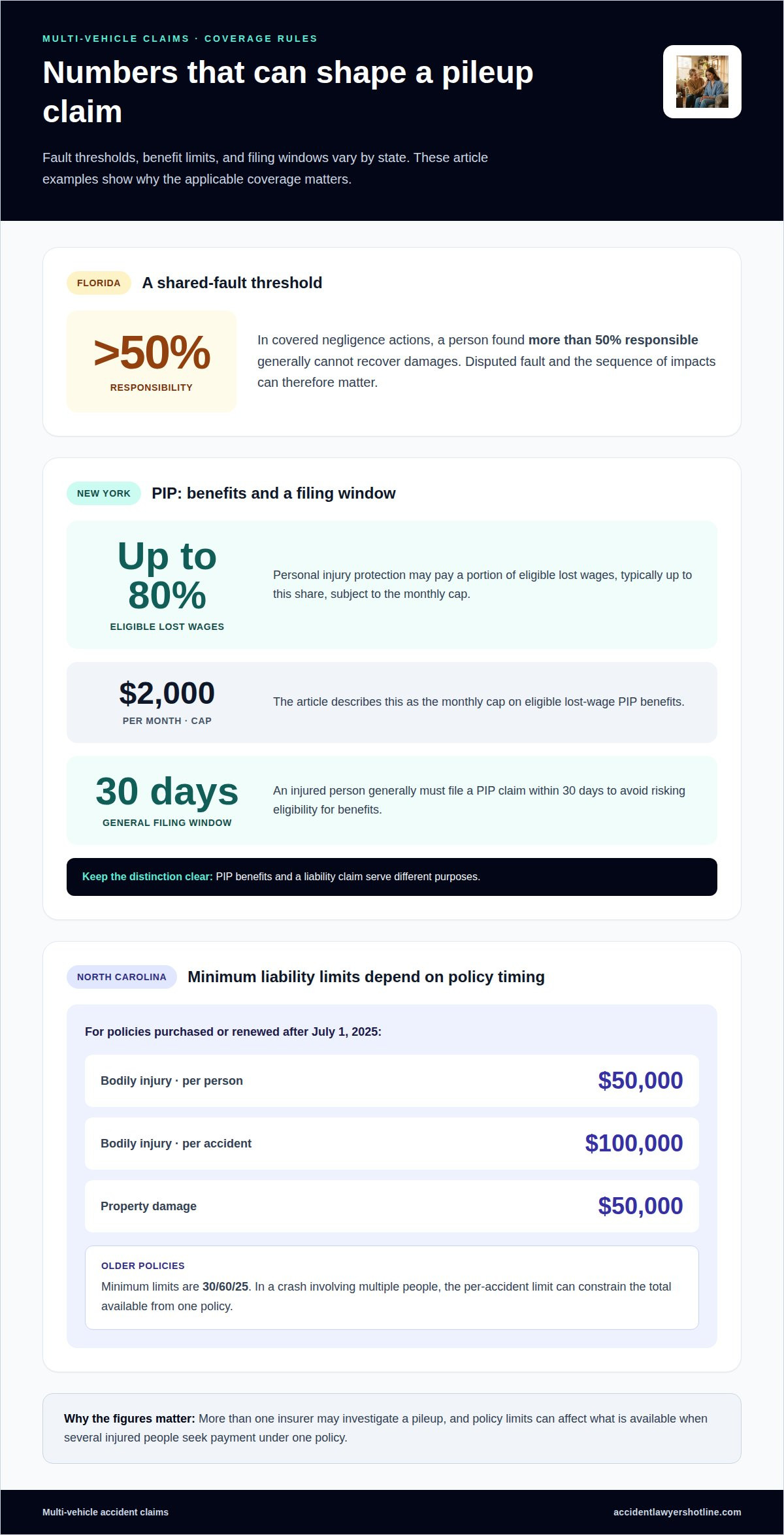
Florida applies a specific limit in covered negligence actions: according to the Florida Legislature, a person found more than 50% responsible generally cannot recover damages. That makes disputed fault consequential. A driver’s account, physical evidence, and the timing of each collision may all influence an insurer’s assessment and any later claim evaluation.
How do insurance policy limits work when multiple people are injured? A policy limit caps what an insurer can pay under the applicable coverage. If several injured people seek payment from one at-fault driver’s policy, they may have to share the available limit, which may not cover everyone’s losses.
New York’s no-fault system provides another route for certain expenses after a crash. Personal injury protection, or PIP, pays a portion of eligible lost wages, typically up to 80%, subject to a cap of $2,000 per month. An injured person generally must file a PIP claim within 30 days to avoid risking eligibility for benefits. PIP benefits and a liability claim serve different purposes, so identifying the available coverage matters.
North Carolina minimum liability limits depend on when the policy was purchased or renewed. For policies purchased or renewed after July 1, 2025, the minimum bodily injury limits are $50,000 per person and $100,000 per accident, with $50,000 for property damage. Older policies have minimum limits of 30/60/25. In a multi-person crash, the per-accident limit can constrain the total available from one policy.
Claims Across Multiple Insurers
Claims involving multiple insurers require separate coverage reviews for drivers, vehicles, and potentially responsible businesses. A commercial truck’s insurer may investigate its driver and vehicle, while other insurers assess their own policyholders. Rideshare coverage can depend on the driver’s work status and the policy terms. Identifying each relevant policy helps clarify who is reviewing which losses and avoids mistaking separate investigations for a shared decision.
Evidence used to determine fault
Fault depends on how clearly evidence links each driver’s actions to a particular impact. After a pile-up, collect photographs, witness details, and available vehicle and insurance information when it’s safe. These records can help establish the crash sequence.
Reconstructing the Collision
Accident reconstruction uses physical evidence and accounts to piece together how a crash unfolded. It matters because a chain reaction may involve distinct impacts, rather than one continuous collision. Investigators can compare vehicle positions, road marks, debris, and damage patterns to assess accounts of where each car was and when it moved.
Preserve relevant records in their original form. Keep scene photographs, repair estimates, and crash-related messages together, with dates and brief notes about what each item shows. For example, a photo of debris beside a lane may help identify the point of impact when compared with vehicle damage. Avoid editing or marking original images; save working copies separately.
Vehicle, Video, and Electronic Evidence
Vehicle damage, video, and electronic records can help establish the direction, timing, and force of separate impacts. A crushed rear bumper, for example, may support an account of a rear collision, while side damage may point to another contact. These details matter when determining which impact caused particular injuries.
Dashcam footage, nearby business cameras, and vehicle data may capture movement or timing that witnesses missed. Preserve available footage promptly because recording systems may overwrite or delete files. A useful record identifies the vehicle, approximate location, and time shown. Investigators can compare it with photographs, repair records, and other accounts rather than relying on one clip alone.
Scene Evidence and Witness Accounts
Police reports, scene photographs, and witness testimony can document different parts of a crash. A report may record responding officers’ observations, while a witness can describe a vehicle’s movement before impact. Neither account necessarily resolves liability on its own, but matching details across sources can strengthen the sequence of events.
After a pile-up, photograph vehicles, road conditions, visible injuries, traffic signs, and debris if it’s safe. Record each driver’s name, contact details, insurance information, and vehicle details. Ask witnesses for their contact information and a brief account of what they saw. Request police assistance and medical evaluation when needed. Injury records can connect reported symptoms with treatment and later settlement discussions.
Organize copies of reports, images, witness details, medical records, and repair bills by date. Add a short note explaining each file, such as “intersection view before towing” or “first repair estimate.” This makes it easier to distinguish firsthand observations from later conclusions. If conflicting accounts or missing footage complicate fault, a review of the crash evidence may help clarify which records matter.
How multi-vehicle pile-ups occur and common causes
A pile-up can start with one collision, then grow as following drivers react to blocked lanes or slowing traffic. Each later impact may have a different cause. For example, one driver may trigger the first crash, while another may have too little room to stop before reaching the wreckage. The chain reaction can involve several drivers and separate points of contact.
Investigating the sequence means establishing what happened before, during, and after each impact. Investigators compare vehicle positions, damage, roadway marks, video, and witness accounts. A rear impact may show that one vehicle struck another, for example, but it doesn’t explain by itself why the second driver stopped. Timing and road conditions help distinguish an initial collision from later impacts.
Nevada road conditions can be relevant when visibility, traction, or traffic flow affects what drivers could see and do. A pile-up near North Las Vegas in January 2022 killed nine people. That fact describes the crash’s toll, not its cause. For any Nevada crash, the investigation must connect specific conditions to particular actions, such as whether a driver could see stopped traffic or had room to respond.
Common contributing factors include speeding for conditions, following too closely, distraction, sudden braking, and reduced visibility. Weather can make it harder to see vehicles ahead or stop in time, while congestion can cause abrupt changes in speed. A driver who reacts late may strike the vehicle ahead, while another driver’s lane change may lead to a separate collision. These factors can combine without making every party equally responsible.
Road conditions also affect how a crash spreads. Rain, snow, ice, dust, smoke, or darkness may affect visibility and control, but investigators still need evidence showing how a condition mattered in that specific crash. A vehicle stopped across a lane can create a different hazard from a collision on a clear, open road. Debris and vehicle damage can help show which lanes were blocked and when.
To understand the chain reaction, investigators build a timeline of distinct events: the first impact, each later collision, and the vehicles’ final positions. They compare driver statements with physical evidence instead of treating one account as the whole story. For example, a driver may say traffic stopped suddenly, while video shows earlier braking. That difference can affect how each party’s actions are assessed.
Documenting road conditions and the crash scene can preserve details that may change after vehicles move or the weather shifts. Photographs of lane markings, visibility, debris, and vehicle positions can add context to later accounts. The central question is not simply who was in the pile-up, but what each driver did and how that conduct contributed to each impact.
How Is Fault Determined in a Nevada Multi-Car Accident?
Nevada assesses each driver’s contribution to a crash rather than automatically assigning fault to one person. Shared fault can reduce compensation, and the collision sequence helps explain each driver’s role.
Shared Fault and Comparative Negligence
Modified comparative negligence assigns responsibility among parties and reduces compensation by the injured person’s percentage of fault. In Nevada, a person may recover damages only if their responsibility is less than 50%.
For example, a person with $100,000 in proven damages and 20% fault may recover $80,000 before other claim issues apply. The reduction reflects the claimant’s share of responsibility, not the other drivers’ total fault.
A driver found 50% responsible does not meet Nevada’s less-than-50% threshold. That makes the specific percentage consequential. Statements, physical evidence, and the actions leading to each impact can influence how insurers evaluate shared negligence and compensation.
Fault in Chain-Reaction Collisions
Assessing fault in a chain-reaction collision means examining each driver’s conduct in relation to each impact. A rear-end collision may start the sequence, but later drivers can have separate responsibility if their actions contributed to additional crashes.
For example, one driver may hit a stopped car and push it forward. A following driver may then collide with the wreckage. The first impact doesn’t establish fault for every later collision by itself. Investigators consider whether each driver could respond to traffic and whether their conduct contributed to the damage or injuries.
Rear-end impacts require careful attention to timing and position. A driver’s statement that they were struck from behind may explain one collision, but it doesn’t establish whether they had already hit the vehicle ahead. Comparing damage locations with nearby drivers’ accounts can help distinguish overlapping impacts.
Impact Sequence and Fault Investigation
An impact-sequence investigation reconstructs the order of collisions to link specific conduct with resulting damage. This matters because a pile-up can involve several impacts, and responsibility may differ from one collision to another.
Investigators compare vehicle damage, final positions, roadway marks, photographs, video, and witness statements. For example, front-end and rear-end damage on the same vehicle may help show that it was struck from behind and then pushed forward. Those details must be considered alongside accounts from the drivers involved.
Insurers may reach conflicting conclusions if they rely on different statements or evidence. A useful comparison asks which impact each account describes, where the vehicles were positioned, and whether physical evidence supports that sequence. A driver’s share of fault should be linked to an identified action, such as following too closely or failing to respond to stopped traffic.
Keep the distinction clear: the number of vehicles involved doesn’t determine any one person’s negligence. In Nevada, the claimant’s own share of responsibility matters because reaching 50% prevents recovery under the stated threshold. A precise collision timeline can help explain whether responsibility should be shared or reduced.
Legal representation in multi-vehicle claims
Legal guidance can help when multiple drivers, injuries, and insurance companies create competing accounts of one crash. An attorney can assess how the evidence supports liability, identify potential sources of coverage, and explain issues that may affect efforts to recover compensation.
A pile-up can lead to separate disputes about the first collision, later impacts, and the injuries each impact caused. One insurer may argue its driver reacted reasonably, while another points to a different vehicle’s actions. An attorney can organize the collision timeline and compare those positions with photographs, vehicle damage, police records, and witness accounts.
That review matters when responsibility is disputed. A driver’s percentage of fault can affect recovery under the state’s rules, and the applicable rule varies by location. In Nevada, for example, an injured person may recover damages only if their responsibility is less than 50%. Evidence connecting a driver’s conduct to a particular impact can therefore shape the claim.
Several insurance companies may request information or offer different views of the same crash. Keep copies of correspondence, medical records, repair bills, and photos. Give your insurer basic facts, but avoid statements that could be interpreted as admitting liability. Before giving a recorded statement to another driver’s insurer, seek legal guidance, especially if the collision sequence is disputed.
A personal injury attorney can also help assess losses tied to the crash. Medical records can document treatment and ongoing symptoms, while repair bills can show vehicle damage. A witness may clarify what happened before an impact, and photos may show the aftermath. Together, these records can connect claimed losses with the collision rather than relying on a general account of the event.
Legal representation can be especially useful when injuries are serious, fault is shared, a commercial vehicle is involved, or insurers disagree about coverage. For example, a truck collision may involve both the driver’s actions and questions about the vehicle’s commercial policy. A legal review can help identify disputed facts and evidence supporting each part of the claim.
Before discussing a settlement, understand what the proposed payment covers and how it relates to documented injuries, vehicle damage, and other losses. A release may affect your ability to seek further payment for the same claim. An attorney can explain the terms, compare them with the evidence, and identify unanswered questions before you decide.
If insurers dispute who was responsible or how the impacts unfolded, request a multi-vehicle accident case evaluation to discuss the evidence and potential next steps.
Accident Lawyers Hotline: Motor Vehicle Accident Attorney
Accident Lawyers Hotline helps people affected by pile-ups understand potential next steps through a case evaluation and connection with a personal injury attorney. When multiple drivers, insurers, or disputed impacts complicate a claim, an evaluation can clarify the issues and whether legal assistance may help.
Depending on the crash, Accident Lawyers Hotline provides Car Accident Case Evaluation, Truck Accident Case Evaluation, Motorcycle Accident Case Evaluation, and Pedestrian Accident Case Evaluation. Sharing the basic circumstances, known insurance information, and available records can help frame the discussion.
If you’re weighing your options after a multi-vehicle crash, contact Accident Lawyers Hotline for a case evaluation.
Take the Next Step With a Clear Plan
After a serious crash, the next decision is how to move forward while preserving your ability to make informed choices. Write down what remains unresolved, such as which impact caused a particular loss or how an insurer’s position affects your options. A focused discussion can turn those concerns into a practical path forward.
A multi-vehicle pile-up accident claim can be difficult to manage while you’re also dealing with recovery and daily responsibilities. You don’t have to resolve every legal issue before asking for help. Bring the questions that matter most to you, and explain what you’re trying to understand. Clear guidance can help you decide what to do next without adding pressure.
Contact Accident Lawyers Hotline to discuss your next steps. Take the process one decision at a time, with support as you move forward.
Frequently Asked Questions
Can a crash report prove the other driver caused the pileup?
A crash report can support your account, but it doesn’t automatically prove that another driver caused every collision. It records an officer’s observations and available information, which can help establish context. If a report misidentifies a vehicle or omits an important detail, note the specific issue and compare it with photos, witness accounts, or other records. The report is one piece of evidence, not a final decision on civil liability.
How Long Do You Have to File a Claim?
The filing deadline depends on the state and the kind of claim. A lawsuit deadline and an insurance notice deadline are separate issues, and a no-fault benefit claim can have its own timing rule. In New York, an injured person generally must file a PIP claim within 30 days to avoid risking eligibility for benefits. Identify the state, claim type, and applicable deadline early so an approaching date doesn’t disrupt your options.
Should I give the other driver’s insurer a recorded statement?
Don’t give another driver’s insurer a recorded statement without understanding how it could affect your claim. An adjuster may ask you to describe the crash before you have complete medical information or know what other witnesses saw. Keep your account accurate, avoid guessing about speed or sequence, and distinguish what you personally observed from what someone later told you. You can ask what the statement is for and seek legal guidance before responding.
What Compensation Can You Recover?
Potential compensation can include documented medical expenses, lost income, and vehicle repair or replacement costs. Injury claims may also involve other losses recognized under the law that applies to the crash. Keep bills, wage records, repair estimates, and treatment documents organized, since each supports a different part of the claim. Available insurance and shared fault can affect payment; no single category or amount applies to every collision.
What Happens When Multiple Drivers Share Liability?
When several drivers share liability, each person’s conduct is assessed under the rules that apply in the state where the crash occurred. An insurer may dispute its policyholder’s share or point to another driver’s actions, creating separate negotiations over responsibility and payment. Keep each insurer’s position and supporting reasons distinct. A disagreement about one impact doesn’t necessarily resolve responsibility for another impact in the same chain.
What Is a Multi-Car Pile-Up or Chain-Reaction Crash?
A multi-car pile-up involves three or more vehicles in a traffic accident. A chain reaction describes how an initial collision can lead to additional impacts, such as when a struck vehicle is pushed into traffic ahead. The sequence can include distinct crashes rather than one simultaneous event. That difference matters when describing which vehicles made contact and when, especially if drivers recall different parts of a fast-moving incident.
What Makes Pileups So Dangerous?
Pile-ups are dangerous because drivers may encounter stopped or slowing vehicles with little room to react. An initial impact can block lanes and expose nearby vehicles to further collisions. Reduced visibility or slick roads can make hazards harder to see and vehicles harder to control. Multiple damaged vehicles can also complicate access to injured people. The immediate priorities are to reach a safer location when possible and request emergency help for injuries.
How is fault determined in a multi-vehicle pile-up accident?
Fault is assessed by linking each driver’s actions to specific collisions, then applying the relevant state’s liability rules. Investigators and insurers consider how the impacts unfolded, whether accounts align with physical evidence, and which injuries or losses followed. For a multi-vehicle pile-up accident claim, separate firsthand observations from assumptions and information learned later. The number of vehicles involved alone doesn’t establish who caused a particular impact.
Were You Injured in an Accident?
Get a free, confidential case evaluation. No upfront fees.
Get Free Case Evaluation