Partially at Fault Car Accident Claim: What You Can Recover
Filing a partially at fault car accident claim? Learn how comparative negligence affects your settlement, what damages you can recover, and your legal rights.
Sharing blame doesn’t automatically erase your right to compensation. A partially at fault car accident claim may still recover damages, reduced by your share of responsibility, under pure comparative negligence; in modified comparative negligence states, recovery is often barred when your fault reaches 50% or 51%. In contributory negligence jurisdictions, even a small share of fault can prevent recovery.
It’s understandable to worry that an insurer assigning you some blame means your claim is over. What matters is how the law in the state where the crash occurred applies and what the evidence shows about each driver’s actions.
This article explains how shared fault can affect compensation, including non-economic damages, how insurers assess responsibility, and what evidence may support your position. It also explains when speaking with a car accident attorney may help, particularly if fault is disputed or a filing deadline could affect your right to recover.
Key Takeaways
- Your state’s negligence rule determines whether shared responsibility reduces your recovery or can prevent it altogether.
- Fault assessments may consider traffic signals, road conditions, vehicle positions, driver actions, and witness accounts.
- Preserve useful evidence, such as crash-scene photos, damage records, and witness information, to support your account.
- If an insurer assigns you fault, ask for its written reasoning and the evidence behind that decision.
- Consider legal guidance when fault is disputed or a filing deadline could affect your ability to seek compensation.
Can I Still Recover Non-Economic Damages if I Share Fault?
Often, yes. Comparative negligence can reduce compensation rather than eliminate it, depending on your state’s rule and your share of fault. A claim may include losses such as medical expenses, lost wages, pain and suffering, and emotional distress.
Recovery Based on Fault Share
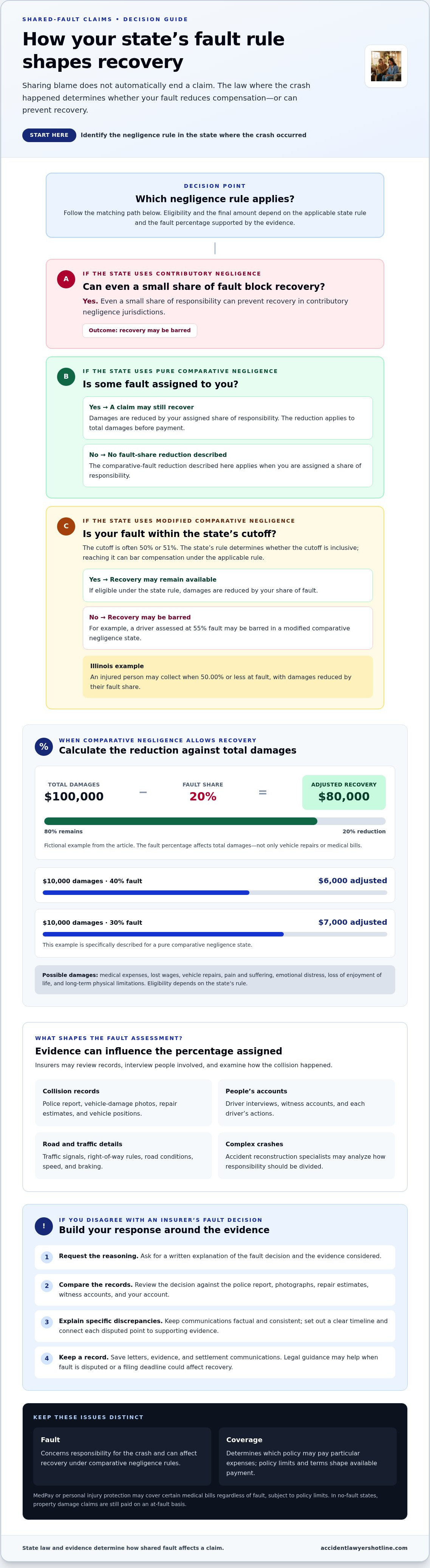
Comparative negligence adjusts a driver’s damages according to that driver’s assigned share of responsibility. If you’re found 20% at fault, the recovery may be reduced to 80% of the damages awarded. That calculation matters because the fault percentage can change the value of a settlement, including compensation for non-economic harm.
For example, a fictional claim totaling $100,000 would produce an $80,000 adjusted recovery at 20% fault. The reduction applies to the total damages before payment, rather than only to vehicle repairs or medical bills.
Compensation Eligibility and Fault Thresholds
Modified comparative negligence allows recovery only while a claimant remains below or within the state’s fault cutoff. The cutoff is often 50% or 51%; reaching it can bar compensation under the applicable rule. Illinois generally allows an injured person to collect when they are 50.00% or less at fault, with damages reduced by their fault share.
That distinction can decide whether a settlement is reduced or unavailable. A driver assessed at 55% fault may be barred in a modified comparative negligence state, while a driver below the cutoff may still recover a reduced amount.
Damages After a Partly At-Fault Crash
Damages may cover financial losses and non-economic effects linked to the crash. Medical expenses, lost wages, and vehicle repair costs are examples of economic damages. Pain and suffering, emotional distress, loss of enjoyment of life, and long-term physical limitations are possible non-economic damages.
For example, a driver with lasting mobility limitations may seek compensation for that impact as well as documented treatment expenses. Where comparative negligence applies, total damages are calculated first and then reduced by the claimant’s assigned share of fault.
Comparative-Fault Settlement Examples
Fictional settlement calculations show how the same damages can lead to different recoveries. In one example, a driver has $10,000 in damages and 40% fault. The adjusted amount is $6,000. The reduction reflects the driver’s share, not a separate penalty.
In another example, a claimant with $100,000 in damages and 20% fault receives an adjusted $80,000. A driver found 30% at fault in a pure comparative negligence state may recover 70% of $10,000, or $7,000. These examples illustrate the arithmetic, while the state’s rule determines eligibility.
How Is Fault Percentage Determined After a Car Crash?
An insurance company reviews evidence to assess responsibility for a collision. Its assessment can affect which party pays expenses, how much coverage applies, and whether premiums change.
Insurer Fault Assessments
An insurer’s fault assessment is its estimate of each driver’s responsibility based on the available evidence. Adjusters may review the police report, interview drivers and witnesses, and examine photos of vehicle damage. They may also consider traffic signals, right-of-way rules, road conditions, speed, braking, vehicle positions, and driver behavior.
Each detail can help explain how the collision happened. Photos showing impact points, for example, may support an account of vehicle positioning, while a witness statement may describe a traffic signal. Accident reconstruction specialists may analyze a complex crash and how responsibility should be divided.
The assigned fault percentage can affect payment under comparative negligence rules. Coverage matters too. MedPay or personal injury protection may cover certain medical bills regardless of fault, subject to policy limits. In Illinois, an at-fault driver’s insurer must reimburse rental vehicle costs in proportion to its insured’s liability.
These are separate issues: fault concerns responsibility, while coverage determines which policy may pay particular expenses. Policy limits and terms shape the payment available. In no-fault states, property damage claims are still paid on an at-fault basis.
Challenging a Fault Assessment
To challenge the insurer’s decision, present evidence that addresses its reasoning. Request a written explanation of the fault decision and the evidence considered. Compare it with the police report, photographs, repair estimates, witness accounts, and your own account of the collision.
Keep communications factual and consistent. Set out a clear timeline, identify evidence supporting each detail, and correct specific errors. If an adjuster’s account overlooks a witness statement or misreads a vehicle’s position, for example, explain the discrepancy and provide the related record.
Negotiation works best when each point connects to evidence. Separate disputed facts from accepted facts, then explain how the disputed detail affects the fault percentage. An accident attorney can help assess a contested determination and its effect on a settlement. A review of your accident claim can help you understand the issues involved.
A fault decision may also affect future insurance costs. Car insurance rates may increase after a partially at-fault accident, typically at the next policy renewal. The insurer’s finding and your policy’s terms can influence the outcome. Keep copies of letters, evidence, and settlement communications to track the decision and its effect on expenses.
What Happens if You’re Partially At Fault in a Car Accident?
The effect depends on the negligence rule in the state where the crash occurred. Under contributory negligence, even a small share of fault can prevent recovery from another party.
Contributory Negligence and Recovery
Contributory negligence can bar an injured driver from recovering damages if their own actions contributed to the crash. That rule makes even a small assigned share of responsibility important: a driver found 1% at fault can be barred from recovering compensation in a contributory negligence state.
For example, a driver found 5% responsible may receive nothing from the other party’s insurance under this rule. The percentage matters because the rule does not reduce recovery in proportion to fault; any responsibility can affect eligibility. Insurance coverage doesn’t change the negligence rule applied to the claim.
Negligence and Causation
Negligence concerns a driver’s conduct; causation connects that conduct to the collision and resulting harm. The distinction matters because a mistake alone does not explain how the crash happened or which injuries resulted from it.
Consider a driver with faulty brake lights who is assigned 10% of the blame in a fictional crash. The key issue is whether that condition contributed to the collision, alongside the other driver’s actions. A lawyer assessing the claim would examine how each action relates to the impact and the losses being claimed.
State Negligence Laws
State negligence laws determine how a claimant’s share of fault affects the ability to recover. Alabama, the District of Columbia, Maryland, North Carolina, South Dakota, and Virginia use contributory negligence. In those jurisdictions, a claimant who bears responsibility may be unable to recover from the other party.
Other states use pure or modified comparative negligence, with different rules for shared fault. Under pure comparative negligence, recovery reflects the other driver’s share of responsibility. Modified systems set a cutoff, and reaching the state’s threshold can bar recovery. The distinction matters if an insurer disputes your percentage: the same facts can lead to different eligibility outcomes depending on where the crash occurred.
Identify which state’s rule applies before evaluating a settlement or coverage position. For example, Virginia follows contributory negligence, while Georgia uses modified comparative negligence. The driver’s conduct, the evidence connecting it to the crash, and the applicable state rule all help determine whether compensation remains available.
Evidence and information for a claim
Evidence helps establish how the crash occurred, which actions contributed, and what injuries or damage followed. Organized records can clarify disputed details, including how traffic conditions affected each vehicle.
Gathering Evidence After a Crash
Gathering evidence means preserving observations and records that may explain the collision. If it is safe to do so, photograph the scene, vehicle damage, traffic signals, road conditions, and visible injuries. Collect witness names and statements, and note what each person directly observed.
Keep the police report and any available 911 recording information. Save driver and witness statements, repair estimates, and relevant video. These records may support your account even if an insurer later assigns you a share of fault.
California drivers should gather scene and vehicle-damage photos and witness statements after a crash. Calling emergency services or law enforcement helps document the accident. If someone is injured, call 911. Evidence may disappear as vehicles move, traffic changes, or memories become less precise, so record details as soon as circumstances allow.
Accident Documentation
Documenting the accident creates a consistent record of the event and its consequences. Write down the date, location, direction of travel, traffic signal status, weather, and a brief sequence of events. Keep the police report, photos, repair estimates, and claim-related communications together.
Keep injury-related information too. Record when symptoms began, how they affect daily activities, and what treatment or expenses followed. A dated note describing pain after the collision, for example, can help connect later concerns with the event. Preserve original photos and statements without altering them.
Clear records can explain details a single image cannot show. A photo of vehicle damage may show an impact point, while a written timeline can describe traffic movement before impact. Preserve both, even if you believe fault is shared.
Evidence for Establishing Fault
Evidence used to assess fault can include police reports, 911 recordings, photos or videos, vehicle damage patterns, repair estimates, event data recorder information, and driver or witness statements. Each item may help explain speed, braking, vehicle position, or traffic signals.
Compare the evidence with the insurer’s specific explanation of fault. If the insurer assigns you partial responsibility, request a written explanation of its decision and the evidence it used. Then identify factual gaps, such as a missing witness account or a damage pattern that conflicts with the proposed sequence.
In modified comparative negligence states, the assigned fault percentage can affect eligibility for recovery or reduce damages. Evidence should address both what happened and how each driver’s actions contributed. A repair estimate may document vehicle loss, while witness testimony may help clarify who had the right of way.
When to consult a car accident attorney
Consider legal guidance when fault is disputed, injuries are serious, or an insurer’s offer does not address your losses. An attorney can help clarify liability, preserve evidence, and assess how your state’s negligence rule may affect compensation.
A disagreement over the percentage of fault deserves attention when it changes whether you can recover. An insurer may say you caused a collision by changing lanes, for example, while a witness says the other driver moved into your space. An attorney can review the accounts, photos, police report, and damage patterns together. In a partially at fault car accident claim, this review can help identify which disputed facts matter most.
Timing matters, too. The time to file a civil action after a car accident depends on where it occurred, and missing the applicable deadline may forfeit your right to seek compensation. In Illinois, a bodily injury claim generally must be settled or filed as a lawsuit within 2 years of the accident. A property damage claim generally has a 5-year deadline. These are different claim types, so identify each loss and the relevant filing period.
Seek legal guidance before signing a release or accepting a settlement that closes your claim. In an Illinois third-party auto claim, signing a release means accepting the settlement as the only amount you’ll ever receive from the other driver and insurer. If treatment continues or the full effect of an injury remains unclear, a review can help you understand what the release covers.
Contributory negligence makes early legal guidance especially important. In jurisdictions using that rule, even some responsibility for the crash can prevent recovery from another party. A lawyer can examine whether the evidence supports the insurer’s liability position and how state rules apply. In comparative negligence states, the assigned fault percentage may instead reduce compensation or affect eligibility at a state cutoff.
Prepare for a legal conversation by organizing the police report, medical records, repair estimates, insurer letters, and witness details. Write down the insurer’s reasons for assigning fault, then mark any disputed facts. For example, identify a traffic signal, braking event, or vehicle position that the adjuster’s account overlooks. This focused record links each disagreement to supporting evidence.
Consider speaking with an attorney if multiple parties share responsibility, the insurer disputes medical losses, or the proposed settlement doesn’t account for documented expenses. These issues can affect both the value and timing of a claim. If your partially at fault car accident claim involves a disputed assessment, discuss the disputed accident claim and the evidence behind it.
Accident Lawyers Hotline: Car Accident Case Evaluation
Accident Lawyers Hotline offers a Car Accident Case Evaluation for people facing disputed fault, an unclear settlement offer, or questions about supporting evidence. The evaluation can help organize accident details, identify issues affecting potential compensation, and connect you with experienced personal injury or motor vehicle accident attorneys who provide legal assistance.
Bring relevant records, such as the police report, insurer correspondence, repair estimates, medical documentation, and witness information. These details can help clarify what happened and which questions need attention. The attorneys you are connected with work on a contingency basis, meaning there are no fees unless the case is won.
If you’re ready to discuss your accident and next steps, contact Accident Lawyers Hotline.
Take the Next Step Toward Clarity
A disputed fault decision can make it hard to know what to do next. You do not have to resolve every question before seeking guidance. Start by identifying your main concern, such as how your actions were assessed, which losses remain unresolved, or what options may still be available. A focused conversation can help clarify those concerns.
If you’re weighing a partially at fault car accident claim, Accident Lawyers Hotline offers Car Accident Case Evaluation, Truck Accident Case Evaluation, and Motorcycle Accident Case Evaluation. These evaluations connect people with experienced personal injury and motor vehicle accident attorneys who provide legal assistance. Bring the records and questions that matter to you, and use the conversation to understand a practical next step.
Contact Accident Lawyers Hotline to discuss your situation and move forward with greater clarity.
Frequently Asked Questions
Do I Have to Conclude My Claim within a Certain Time Frame?
Yes, deadlines apply, and the applicable period depends on the state and claim type. In Illinois, a bodily injury claim generally must be settled or filed as a lawsuit within 2 years of the accident. An Illinois property damage claim generally has a 5-year deadline. These periods address different losses, so identify whether you’re pursuing injury damages, vehicle damage, or both. Missing a filing deadline can forfeit your right to seek compensation.
How Are Medical Bills and Lost Wages Handled When Fault Is Shared?
Medical bills and lost wages may be included in damages, then reduced by your assigned share of fault where comparative negligence applies. MedPay or personal injury protection may cover certain medical bills regardless of fault, subject to policy limits. For example, treatment bills might be addressed through applicable first-party coverage, while lost wages form part of a claim against another driver. Keep bills, wage records, and payment explanations together to track what remains unpaid.
How does comparative negligence affect a car accident claim in the United States?
Comparative negligence affects whether you can recover and how much compensation remains after fault is allocated. The rule depends on the state where the crash occurred. Under pure comparative negligence, an injured driver can recover the other driver’s share of responsibility. Modified comparative negligence uses a cutoff that can bar recovery at or beyond the applicable threshold. Some jurisdictions instead apply contributory negligence, where a claimant’s own responsibility can prevent recovery.
What is the difference between pure comparative negligence and modified comparative negligence?
Pure comparative negligence reduces recovery according to the claimant’s fault share without a fault cutoff. Modified comparative negligence adds a threshold: reaching or exceeding it can bar recovery. The cutoff is often 50% or 51%, depending on the state. For example, California uses pure comparative negligence, while Georgia uses modified comparative negligence. Knowing which system applies helps explain why similar crash facts can produce different recovery outcomes across state lines.
How is fault percentage determined after a car accident?
Fault is assessed by comparing each driver’s actions with the evidence about the collision. Relevant details can include right-of-way, traffic signals, speed, braking, vehicle positions, road conditions, and witness accounts. An insurer’s assessment affects claim handling, but in Illinois, only a judge or jury can ultimately decide who was at fault or how much another person owes for damages. That distinction matters if the insurer’s position is disputed in court.
How are compensation and settlement amounts reduced by my fault percentage?
In comparative negligence states, the fault share is applied to total damages to calculate adjusted recovery. Review a settlement offer alongside both the claimed losses and the insurer’s fault assessment. Check whether the calculation includes documented medical expenses, lost wages, vehicle damage, and non-economic harm. Review any release before signing: in an Illinois third-party claim, a signed release makes the settlement the only amount recoverable from that driver and insurer.
What evidence helps prove fault in a car accident claim?
Evidence can include a police report, 911 recordings, photographs or video, vehicle damage patterns, repair estimates, event data recorder information, and driver or witness statements. Each item can answer a different question: a recording may capture the immediate report, while an event data recorder can preserve vehicle information relevant to the crash. Keep original files and note where and when they were created. That context can help explain what a record shows.
What steps should I take after a car accident if I may share fault?
First, call 911 if anyone is injured. Preserve scene and vehicle photos, witness details, and the police report, then promptly notify your insurer and provide accurate information. California drivers should avoid admitting fault at the scene because statements may be used in insurance claims or legal proceedings. If an insurer assigns you partial fault, request its written explanation and the evidence supporting that decision, then compare it with your records.
Were You Injured in an Accident?
Get a free, confidential case evaluation. No upfront fees.
Get Free Case Evaluation