Sideswipe Collision Fault: How Evidence and Lane-Change Rules Apply
See how sideswipe collision fault determination applies lane-change rules and uses photos, video, witnesses, and reconstruction to clarify responsibility.
Fault in a sideswipe collision depends on which driver moved unsafely and what the evidence shows. In a same-direction crash, a driver who stayed in their lane and followed traffic laws is less likely to be at fault. Sideswipe collision fault determination may also involve shared responsibility if evidence shows that both drivers contributed.
It’s understandable to expect the point of impact to settle the question. But scraped panels alone may not show who crossed the lane line, whether a signal was used, or how the vehicles moved just before contact.
This article explains how lane-change duties and evidence such as photos, witness accounts, and video can help establish what happened. It also covers how accident reconstruction connects physical evidence to the sequence of events, helping you understand how fault is assessed.
Key Takeaways
- Fault often turns on which vehicle changed lanes and whether the other driver was already traveling safely in their lane.
- Photos, video, witness accounts, and police reports can help preserve details that clarify how the collision happened.
- Lane-change duties and comparative negligence rules vary by state, so local law can affect both fault and compensation.
- Accident reconstruction can connect vehicle damage and scene evidence to the vehicles’ movements before impact.
- When the evidence or responsibility is disputed, a case evaluation can help you understand the facts and potential next steps.
How Is Fault Determined In A Los Angeles Side Swipe Car Accident Personal Injury Case?
Across the United States, sideswipe collision fault determination depends on what each driver did before the vehicles made side contact. Investigators examine whether a driver crossed a lane line, merged unsafely, or misjudged the space while passing. A driver who continued straight and obeyed traffic laws is less likely to be at fault in a same-direction collision. But damage alone cannot establish who moved first or whether both drivers contributed.
Common causes include drifting out of a lane, changing lanes without signaling, and misjudging the distance between vehicles. A driver may also lose control on icy pavement and slide into an adjacent lane. Construction zones can complicate the investigation because lane shifts and unclear markings make vehicle positions harder to interpret. Each potential cause raises questions about the drivers’ actions and the conditions surrounding the crash.
- Lane drift: Did a vehicle cross the lane marking while the other stayed in its lane?
- Merging: Did the merging driver signal and move only when the adjacent lane was safe?
- Passing: Did either driver misjudge clearance or move into the other vehicle’s path?
- Road conditions: Did ice or construction-zone markings affect control or lane position?
Photos, video, witness accounts, and vehicle damage can help answer these questions. A scrape along one vehicle’s side may show where contact occurred, while a witness may clarify which car moved. A police report can preserve details about the scene and the drivers’ accounts. Investigators consider the evidence together rather than relying on one detail to determine responsibility.
Side impacts can cause whiplash, shoulder injuries, lacerations, spinal problems, or traumatic brain injuries. Symptoms may appear hours or days after a collision, so seek medical attention promptly if pain or other symptoms arise. Follow medical advice and attend recommended follow-up care. Medical records can document when symptoms began and how injuries affected daily activities.
How long do you have to file a sideswipe accident claim in each state? There is no single deadline for every state. The applicable period depends on the state and the type of claim. Arizona generally allows two years from the crash date to file most personal injury lawsuits, according to the Arizona State Legislature. Nevada’s deadline for a personal injury lawsuit after a sideswipe accident is two years.
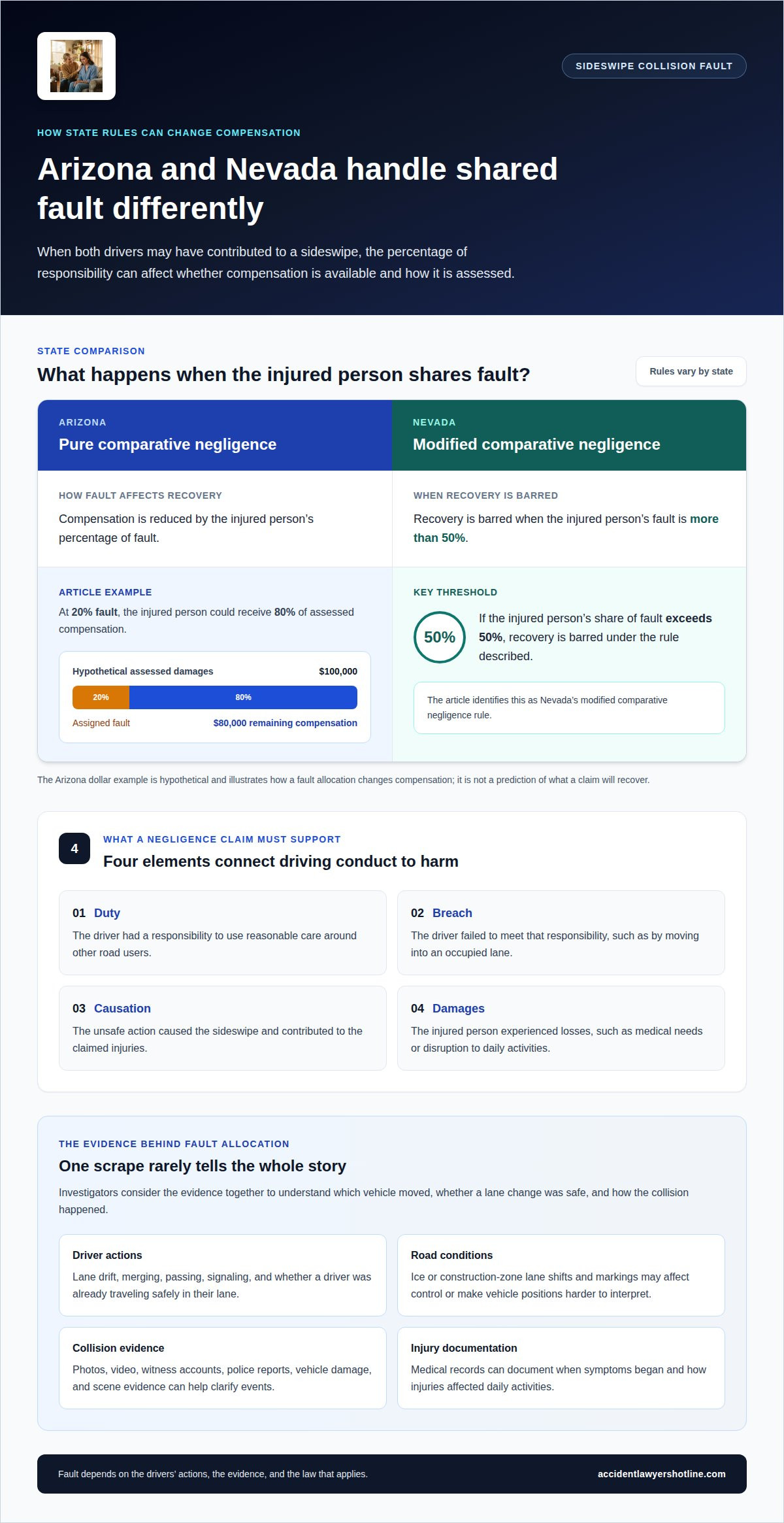
Fault can also affect compensation. Nevada’s modified comparative negligence rule, amended by the Nevada Legislature, bars recovery when an injured person’s fault exceeds 50 percent. This illustrates why evidence of each driver’s conduct matters: responsibility can affect whether compensation is available and how a claim is assessed. If you need assistance navigating these rules, Accident Lawyers Hotline can connect you with experienced professionals. The applicable law may vary depending on where the collision occurred.
What Is a Sideswipe Collision?
A sideswipe collision happens when vehicles traveling in the same or opposite directions make contact along their sides. In a same-direction crash, one vehicle may veer into an occupied lane. In an opposite-direction crash, the vehicles may make contact as they pass. Scraped panels can show where contact happened, but they do not explain why either vehicle moved.
For a personal injury claim, negligence means a failure to use reasonable care that causes harm. The claim generally turns on four elements:
- Duty: The driver had a responsibility to use reasonable care around other road users.
- Breach: The driver failed to meet that responsibility, such as by moving into an occupied lane.
- Causation: The unsafe action caused the sideswipe and contributed to the claimed injuries.
- Damages: The injured person experienced losses, such as medical needs or disruption to daily activities.
Each element needs supporting evidence. A photograph, for example, may show damage, while a witness account may help explain which vehicle crossed the lane line. Medical records can connect reported injuries to treatment after the crash. Together, these details can help distinguish an unsafe lane movement from contact that occurred despite proper driving.
Shared fault can change compensation. Under Arizona’s pure comparative negligence rule, an injured person’s compensation is reduced by their percentage of fault. A person assigned 20% responsibility could receive 80% of assessed compensation. In a hypothetical case with $100,000 in damages, that reduction would leave $80,000. The calculation illustrates the effect of fault allocation, not a prediction of what a claim will recover.
Arizona negligence claims require proof by a preponderance of the evidence. In other words, the evidence must make it more likely than not that the required claim elements are met. The decision-maker considers the full picture, including each driver’s actions, the causes of the collision, and documented harm. An insurer’s initial fault assessment may change if later evidence clarifies the lane positions or sequence of events.
Comparative negligence makes precise evidence important even when a driver believes the other vehicle caused the impact. A sideswipe claim may involve disputed accounts, and a small change in assigned responsibility can alter the compensation calculation. A car accident case evaluation can help organize the collision facts, injury records, and fault questions for a clearer assessment.
Evidence used to determine fault
Fault investigations compare each driver’s account with physical evidence from the vehicles and roadway. Photos, witness statements, reports, and video can help establish the sequence of events.
Evidence of Which Driver Crossed Lanes
Evidence of lane position helps show which driver crossed a lane boundary before impact. Investigators can compare photos of lane markings with vehicle positions and witness accounts. A witness who saw a vehicle drift or merge may help resolve conflicting driver statements. Identifying who crossed lanes can affect how responsibility is assigned, including where comparative negligence applies.
Vehicle Damage and Video Evidence
Damage patterns show where the vehicles contacted each other and can help test each driver’s account. For example, scrape marks along a side panel may support an account of contact between vehicles traveling beside each other. Dashcam footage, traffic-camera recordings, or nearby business security video may show lane positions, turn signals, and which vehicle moved first. Together, these details can support or challenge an account of the collision’s sequence.
Evidence Collection and Collision Investigation
After a sideswipe, useful evidence includes scene photographs, visible vehicle damage, road conditions, witness contact details, and the police report. Photos can capture lane markers and vehicle positions before the scene changes. Investigators can compare those records with statements and physical evidence from both vehicles. Prompt collection matters because video may become unavailable and roadway conditions can change, making the original scene harder to reconstruct.
Keep records organized by source: label scene photos, save available video, and note witness contact information. The police report can provide a formal record of the collision and information gathered at the scene. Organized records help an investigator compare details, such as a driver’s account of staying in their lane with photographs showing the vehicle near a lane marking.
Insurance Fault Investigations
Insurance companies investigate sideswipe collisions by reviewing driver statements, vehicle damage, photographs, witness accounts, available footage, and police reports. They compare this evidence to assess which driver moved, whether a signal was used, and how the impact occurred. To assign fault, insurers weigh each account against the physical and recorded evidence, then determine each driver’s share of responsibility. Conflicting accounts may prompt a closer review of video or damage patterns.
Nevada lane-control and lane-change duties
Lane position and the timing of a lane change can show how a sideswipe began. Nevada and Arizona rules provide useful examples, but the law that applies depends on where the crash occurred.
Lane Movement and Fault
Evidence of lane movement helps establish whether a driver left their lane before contact. Investigators can compare vehicle paths, lane markings, and each driver’s account. For example, a car found angled across a lane line may support one explanation, while video showing it traveling straight may support another. This distinction matters because fault analysis considers each driver’s actions, not just the location of the damage.
Lane Changes, Merging, and Lane Drift
A lane change, merge, or gradual drift can place one vehicle in another driver’s path. A driver merging into an occupied lane may bear different responsibility from a driver who stayed in place. Lane markings, traffic flow, and witness accounts can help distinguish a deliberate merge from unintended drift. In a serious sideswipe, these details can shape how an attorney evaluates liability and settlement discussions.
Unsafe and Simultaneous Lane Changes
An unsafe lane change occurs when a driver moves before confirming that the adjacent lane is clear. If two drivers change lanes at once, their starting positions and the sequence of movement matter. Investigators may compare vehicle damage, roadway marks, and available recordings to establish which movements overlapped. A police report can preserve initial accounts, while later evidence may clarify conflicting descriptions of each vehicle’s direction.
Lane-Control and Signaling Duties
Nevada law, under NRS 484B.223, requires drivers to keep within one lane until determining that moving to another lane is safe. Nevada drivers must signal before changing lanes, check mirrors and blind spots, and yield to vehicles already in the adjacent lane. These duties help explain why a driver’s observation and timing matter in a sideswipe investigation.
Arizona’s lane-use law requires drivers to remain within a single lane as nearly as practicable and to ensure a lane movement can be made safely, according to the Arizona State Legislature. Arizona drivers must signal continuously for at least 100 feet before changing lanes. These Arizona requirements should not be treated as Nevada rules. The location of the collision determines which state’s lane laws apply.
For example, if one vehicle drifts over a marked line while another holds its course, lane position and evidence of signaling may help show how the impact occurred. If both vehicles move, investigators must assess each action and its timing. That analysis can inform fault allocation, an insurance settlement, or questions raised during a legal review.
Accident reconstruction and expert testimony
Accident reconstruction uses physical evidence to explain how vehicles moved before and during a collision. In a sideswipe, an expert may compare vehicle damage, roadway measurements, photographs, and available video. The aim is to build a supported sequence, such as one car drifting across a lane while another continues straight. This analysis can help establish which account fits the physical evidence.
A reconstruction typically begins by organizing records from the scene and vehicles. The investigator identifies the point of contact, compares damage locations, and reviews lane markings and vehicle positions. For example, damage along one car’s side may be compared with marks on the other vehicle. If a dashcam captured the approach, its footage can be examined alongside those physical details.
Next, the expert considers how the vehicles’ paths could have produced the observed contact. A diagram can show their relative positions and direction of travel. If the evidence supports two possible sequences, the expert can explain what each would mean for the collision. This can make a disputed car accident easier to understand than competing descriptions alone.
Expert testimony can translate technical observations into clear explanations for an insurer or court. An expert may describe the materials reviewed, the steps used to reach an opinion, and how the conclusion relates to the damage. The explanation should distinguish observed facts, such as a scrape’s location, from an interpretation, such as which vehicle crossed a lane boundary. That distinction helps readers assess the reasoning.
Reconstruction does not replace the legal assessment of negligence. It addresses how the collision may have occurred, while fault analysis also considers each driver’s actions and the rules that apply. For instance, evidence may support a finding that one vehicle moved into another’s lane, while witness accounts or video add context about signaling and timing. Comparative negligence may also matter if evidence indicates that both drivers contributed.
Reconstruction can be especially useful when drivers give different accounts, vehicles moved before photographs were taken, or damage alone leaves the sequence unclear. An expert’s explanation can help a lawyer assess which evidence supports the claim and how it relates to injuries and losses. A clear reconstruction may also help the parties evaluate whether a settlement position reflects the physical evidence.
If you were involved in a sideswipe and the sequence remains disputed, request a car accident case evaluation to discuss how the available evidence may support your claim and what steps could help you pursue recovery.
Accident Lawyers Hotline
Accident Lawyers Hotline provides case evaluations for people injured in motor vehicle collisions, including sideswipes. If drivers dispute who changed lanes or the available evidence leaves the sequence unclear, an evaluation can help organize the collision details, injuries, and questions about responsibility. This can clarify what information may matter when considering next steps.
Gather the records you already have, such as photographs, witness details, video, or a police report. Accident Lawyers Hotline evaluates car accident cases and connects individuals with legal professionals who provide assistance. A case evaluation can be useful when fault is contested, injuries are involved, or an insurer’s assessment overlooks key evidence.
Contact Accident Lawyers Hotline to discuss your sideswipe collision and questions about fault.
Take the Next Step With a Clearer Plan
You don’t need to resolve every question about responsibility before seeking guidance. A focused review can connect the collision evidence with your injuries and identify which issues deserve attention next. A careful sideswipe collision fault determination depends on how those details fit together under the applicable law.
Accident Lawyers Hotline provides Car Accident Case Evaluation, Truck Accident Case Evaluation, and Motorcycle Accident Case Evaluation. These evaluations can help people involved in a crash understand their case and consider a path forward. The circumstances of each collision shape the available options.
Contact Accident Lawyers Hotline today to discuss your situation. You can take the next step with greater clarity and support.
Frequently Asked Questions
Sideswipe Car Accident Fault | Who Is at Fault for the Crash?
The driver whose unsafe action caused the sideswipe may be found responsible. For example, evidence that one vehicle moved into an occupied lane can support a finding against that driver. But the result may differ if both drivers contributed or if video and witness accounts contradict the initial descriptions. Review the full sequence, including lane positions and movements, rather than relying only on which vehicle has more visible damage.
Who Is Liable for a Sideswipe Accident Claim?
A driver may be liable when their failure to use reasonable care caused the crash and another person’s injuries. The claim must connect the driver’s conduct to both the collision and the harm. For example, a lane movement may explain the contact, while medical records can document resulting injuries. If the evidence indicates shared responsibility, the state’s comparative negligence rules may affect how compensation is assessed.
How Is Fault Determined in a Sideswipe Collision?
A sideswipe collision fault determination weighs each driver’s actions against the available evidence and the law where the crash occurred. Investigators may compare photographs, vehicle damage, witness accounts, video, and driver statements. For example, a recording might show one vehicle crossing a lane marking just before contact. The key question is whether the combined evidence supports a clear account of how the vehicles reached the point of impact.
Which Traffic Laws Apply to Sideswipe Accidents in the United States?
The traffic laws depend on the state where the collision occurred. Arizona’s lane-use law, A.R.S. § 28-729, requires drivers to stay within a single lane as nearly as practicable and make lane movements safely, according to the Arizona State Legislature. Nevada law, NRS 484B.223, addresses staying within a lane until a move is safe. Apply the law for the crash location, not another state’s rules.
Who Is at Fault When Both Vehicles Change Lanes and Sideswipe?
Both drivers may share fault if evidence shows that each made an unsafe lane movement that contributed to the impact. Investigators need to establish where each vehicle began, when each moved, and whether either driver had entered the adjacent lane first. For example, video showing the vehicles’ positions moments before contact may clarify the timing. The applicable comparative negligence rules determine how shared responsibility affects a claim.
How Is Fault Determined When One Car Drifts Out of Its Lane?
Investigators examine whether the drifting vehicle crossed the lane line and whether that movement caused the collision. A witness, dashcam recording, or traffic-camera footage may help establish the vehicle’s path. They may also consider road conditions and lane markings, especially in construction zones with shifted or unclear striping. Evidence that the other vehicle held its course can help distinguish a lane departure from simultaneous movement.
What Evidence Helps Prove Fault in a Sideswipe Accident?
Useful evidence can include photographs of both vehicles, lane markings, road conditions, and visible injuries. Dashcam or traffic-camera footage may capture vehicle positions and movements before contact. Witness contact information, statements, and the police report can add context. Keep original files and note when and where images were taken. These details can help an investigator compare the physical scene with each driver’s account.
How Do Police Reports and Witness Statements Affect Sideswipe Fault Decisions?
A police report can preserve information gathered at the scene, including the drivers’ accounts and observed conditions. A witness may offer an independent description of which vehicle moved or what happened immediately before impact. Neither item replaces a review of all the evidence. For example, investigators can compare a witness’s account with photographs or video to assess whether the descriptions match the vehicles’ positions and damage.
Were You Injured in an Accident?
Get a free, confidential case evaluation. No upfront fees.
Get Free Case Evaluation